Everyday listening
Start with short recordings, then work through longer phrases. Listen once for the situation and again for the words.
Showing 127–144 of 306 lessons
-

Synonyms in English: Choose the Right Word
A synonym is a word or phrase that has the same or nearly the same meaning as another word in the same language. While two words may share a central idea, their usage depends on context, grammar, and tone.
-
Sentence fragments: repair and practice guide
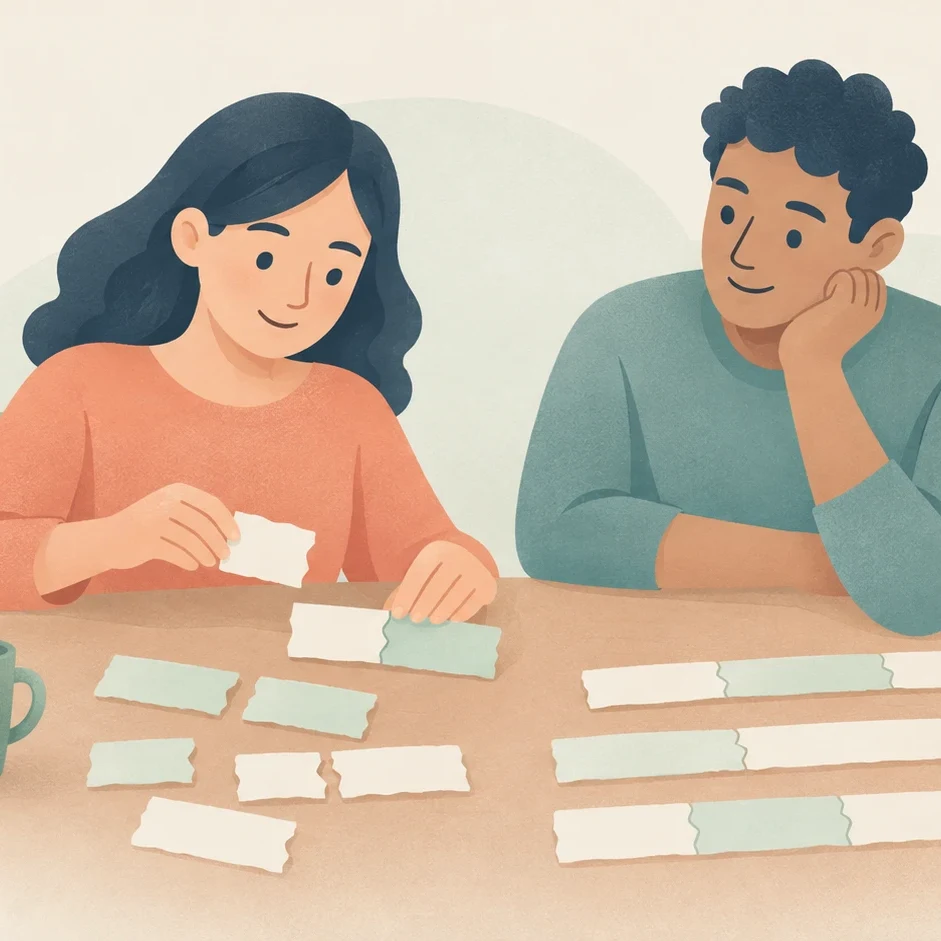
A complete sentence delivers an independent statement. In standard English writing, every sentence requires a subject and a working verb that together express a complete thought. A sentence fragment is a word group that begins with a capital letter and ends with a period, but fails to provide the grammatical elements required to stand by itself.
-

Infinitives: When to Use To
An infinitive names an action directly without changing its shape for time or person. It connects two ideas by showing what action completes a main verb, what action explains a feeling, or why an action happened.
-

Adjectives of Number: Forms and Examples
Number words perform several distinct communicative jobs. Cardinal numbers specify an exact count, such as one, two, or forty. Ordinal numbers pinpoint an exact position in a sequence, such as first, second, or twentieth. Indefinite words such as many, several, and some indicate an approximate quantity without naming a precise figure. Distributive words such as each, every, either, and neither describe how members of a group are considered. Traditional grammar books classify these terms together as adjectives of number, whereas modern grammatical frameworks often describe them as numerals, quantifiers, or determiners.
-

Future perfect or continuous: Choose the right form
Both the future perfect simple and the future perfect progressive look ahead to a future reference point and evaluate earlier activity. The future perfect simple places a completed action, milestone, or quantity before that checkpoint. The future perfect progressive looks back from that same checkpoint to show how long an activity has been underway. One tense focuses on the finished product; the other focuses on the elapsed time of the process.
-

John and I or John and me: Choose the Right Form
I functions as a subject pronoun, representing the speaker performing an action or expressing a state with be. Me functions as an object pronoun, representing the speaker receiving an action from a verb or following a preposition like to, for, with, or between. Adding John creates a compound unit, but the grammatical role of the pronoun remains unchanged.
-
Membership
Open every lesson free for 7 days
- 452 lessons with dictation and listening tests
- Three accents: British, American and Australian
- New lessons every day, and your progress is saved
No card needed. Then from $7.50 a month if you want to keep going.
Start free trial -

Equipment or Equipments: Which Is Correct?
Equipment represents the collective collection of devices, tools, machines, or apparatus required for a particular activity, profession, or job. English conceptualizes equipment as a single collective resource or mass concept, similar to furniture, luggage, or information. Because it is an uncountable noun, English does not place a number directly before equipment or add a plural ending to it. Even when a room is filled with dozens of distinct objects, they are described collectively as equipment.
-

Adjective Order: Rules and Examples
Adjective order is the customary sequence English speakers use to organize multiple details before a noun. Placing broad personal opinions first and moving inward toward physical facts, origin, and material allows listeners to process descriptive layers smoothly without pausing.
-

English Adjectives: Describe People and Things
An adjective is a word that describes a noun or pronoun. It gives specific information about size, appearance, quality, age, or feeling, helping a listener know which person or object you mean.
-

Hit the jackpot: Meaning and use
Literally, hitting the jackpot means winning the highest prize in a lottery or game of chance. In figurative use, it means securing an outstanding result, finding an exceptional item, or stumbling upon a remarkable opportunity. The speaker evaluates the outcome as far better than a normal or expected result.
-

Gerunds: When to Use -ing
A gerund names an activity rather than showing an action in progress. Because it acts like a noun, a gerund can serve as a subject, follow the linking verb be, or act as the object of a verb or preposition. The spelling ends in -ing, but its sentence job decides whether the word is a gerund.
-

Have or Has: Choosing the Right Verb Form
Have and has describe possession, relationships, and everyday activities. The verb form depends on who or what performs the action.
-

Myself and John: How to Choose
A subject names who or what performs the action or who the sentence is about. An object names the person affected by an action or comes after a preposition such as to, for, with, or between. A reflexive pronoun like myself or ourselves turns the action back onto the subject of the exact same clause.
-

Then or Than: Choose the Right Word
Use then to show sequence, a specific point in time, or a consequence following a condition. Use than to introduce the second element in a comparison of size, price, speed, quality, or amount.
-

Whenever or When Ever: One Word or Two?
Whenever functions as a subordinating conjunction that connects a time condition to a main clause. It carries two related meanings: every time that, which describes routines or repeated occurrences, and at any time that, which grants flexible permission for a single action. In contrast, when ever divides the sentence into the interrogative adverb when and the adverbial intensifier ever. In that rare structure, ever does not indicate a condition or flexible schedule; instead, it strengthens the speaker's tone of astonishment, impatience, or curiosity.
-

Discuss or discuss about: Which is correct?
To discuss means to consider, examine, or exchange ideas about a subject with another person. It does not require an argument or total agreement; it simply names the act of talking through a topic. Because the idea of considering a subject is already built into the verb discuss, the subject follows the verb directly.
-

Where, Were, or Wear: Choosing the Right Word by Meaning
Where identifies or asks for a place. Were serves as the past form of be with you, we, and they. Wear describes having clothes, shoes, or accessories on your body.
-

Interjections in Daily English: Choosing, Punctuating, and Hearing Everyday Reactions
An interjection is a sound, single word, or brief phrase that expresses an immediate reaction or emotion. It does not connect grammatically to subject-verb structures, and its spelling remains identical regardless of tense, person, or quantity.
Not ready for a trial? Get a free lesson every day
One short dictation in your inbox each day for 7 days. Practise where you are, no account needed.
Can’t find the phrase or situation you need?
Lesson requests come with membership.
See membership