Micro-listening
Hair or hairs: countable noun choices
Should I say 'hair' or 'hairs'?
Use 'hair' for the whole head of hair or a person's general appearance; use 'a hair' or 'hairs' for separate strands. For example, 'Her hair is curly' describes her appearance, while 'I found two hairs on the sofa' counts individual strands. Match verbs and pronouns to the noun form.
Key points
- Use singular 'hair' for grooming, colour and overall appearance.
- Use 'a hair' for one separate strand.
- Use plural 'hairs' when counting distinct strands.
- Uncountable 'hair' takes singular verbs and 'it'.
This lesson has 5 stages. You can stop at any time and continue later.
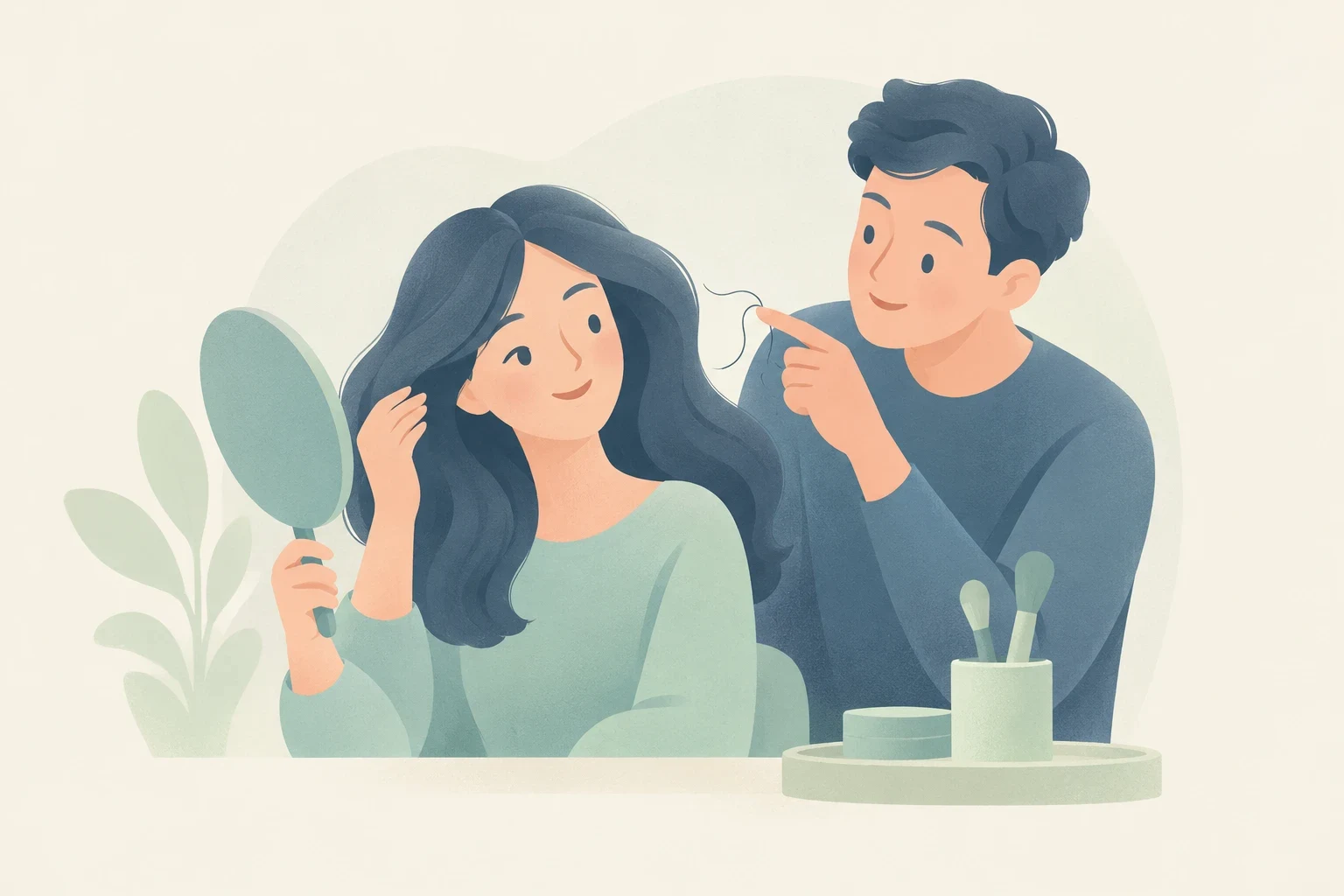

At a glance
| Form | Use it for | Example |
|---|---|---|
| 'hair' | The whole head of hair or general appearance. | Her hair is naturally curly. |
| 'a hair' | One distinct, countable strand. | A hair was stuck to my sleeve. |
| 'hairs' | Two or more separate strands. | I found a few hairs on the cushion. |
Stage 1 of 5
Understand
What it means, when to use it, and mistakes to avoid.
The full explanation
Hair refers to the collective growth of threadlike strands covering a person's head or body, treated grammatically as a single uncountable substance. By contrast, a hair refers to one single strand, and hairs refers to two or more separate, identifiable strands.
David washed his curly brown hair after exercising.
Why it works: Hair refers to all the hair on his head as an uncountable mass.
2 more examples
-
The waiter apologized and replaced the plate because a black hair was resting on the rim.
A hair points to one separate countable strand in a specific location.
-
She used adhesive tape to remove several white cat hairs from her navy trousers.
Hairs is plural because the speaker refers to multiple individual detached strands.
Read the full guide
Decide Between the Whole Amount and Separate Strands
When you speak about hair in English, your primary decision is whether you are describing an overall substance or separate pieces. Most everyday sentences about grooming, personal hygiene, and haircuts treat hair as an uncountable noun without any plural ending. You switch to countable strands only when an individual piece separates from the body or becomes visible by itself.
-
Lucas dried his hair with a warm towel.
Why it works: Hair represents the entire growth on his head as an uncountable entity.
-
I noticed a single brown hair on your shoulder.
Why it works: A hair designates one detached countable strand.
Your turn
Why is 'hair' uncountable in the sentence 'Her hair is very soft'?
Answer: It refers to her entire head of hair as one general substance.
Show the answer
Answer: It refers to her entire head of hair as one general substance.
English views the hair on a person's head as a collective uncountable mass rather than a group of counted strands.
Describe Hairstyles, Colors, and Haircuts
Describing personal appearance always requires the singular uncountable form. When you discuss colors such as blonde, brunette, or black, or textures like wavy, curly, or straight, you must pair hair with singular verbs and pronouns. Saying that someone has nice hairs is an unnatural phrasing that native speakers will immediately notice as an error.
-
Priya dyed her hair dark red before starting her new job.
Why it works: Dark red describes her overall appearance, so hair is singular.
-
His short hair makes him look much younger.
Why it works: Short hair is treated as an uncountable physical attribute.
You can practise this again in Adjective clauses: identify the noun and Emphasizing adjectives: four common choices.
Your turn
Which sentence correctly compliments a friend's new appearance?
Answer: Your hair looks wonderful after that salon visit.
Show the answer
Answer: Your hair looks wonderful after that salon visit.
Appearance descriptions require the uncountable singular noun hair paired with a singular verb.
Identify One Stray Strand with an Article
When one single strand separates from someone's head and lands on a surface, it becomes an individual countable object. In this situation, you must place the indefinite article 'a' before the noun. Common examples include finding a hair in a bowl of soup, on an office desk, or on a freshly washed pillowcase.
-
The customer found a hair in her salad and called the manager.
Why it works: The article a specifies one isolated strand.
-
He gently plucked a white hair from his chin.
Why it works: A white hair highlights one separate follicle.
Your turn
Fill in the blank: The inspector spotted ___ on the sterile hospital tray.
Answer: a hair
Show the answer
Answer: a hair
The sentence highlights one distinct strand contaminating a sterile tray, which takes the indefinite article a.
Count Multiple Loose Strands on Surfaces
Use the plural noun hairs when you can see, collect, or count several individual strands. This form typically appears when someone cleans furniture, inspects clothing, or empties a hairbrush. Specific numbers, words like several, or quantifiers like a few frequently accompany hairs to emphasize that you are talking about separate physical items.
-
I pulled five hairs out of the vacuum cleaner brush.
Why it works: Five indicates that the separate strands are being counted.
-
There are several blonde hairs on your black jacket.
Why it works: Several hairs refers to distinct loose strands visible on dark fabric.
Your turn
Choose the natural sentence for cleaning a brush:
Answer: She pulled three hairs from the wooden comb.
Show the answer
Answer: She pulled three hairs from the wooden comb.
The number three requires the plural countable noun hairs to represent separate strands.
Match Verbs and Pronouns to Your Noun Form
Subject and verb agreement depends entirely on whether you select uncountable hair or countable hairs. Uncountable hair takes the singular verb is, was, or has, and you refer back to it with the pronoun it. Countable hairs takes the plural verb are, were, or have, and you refer back to them with they or them.
-
My hair is wet because it rained while I walked home.
Why it works: Singular is and it match uncountable hair.
-
Those two hairs are long, so throw them into the trash bin.
Why it works: Plural are and them match countable hairs.
Your turn
Complete the sentence: Her hair ___ damp, so she dried ___ before going outside.
Answer: is / it
Show the answer
Answer: is / it
Uncountable hair takes the singular verb is and the singular object pronoun it.
Differentiate Animal Coats from Scientific Samples
When discussing a pet or wild animal, you normally use hair or fur as an uncountable substance to describe its whole body coat. However, when individual strands shed onto furniture or are examined in a scientific laboratory under a microscope, writers use the countable plural hairs to describe specific fibers and physical specimens.
-
The horse has smooth, glossy hair across its neck.
Why it works: The animal's coat as a whole is uncountable hair.
-
The forensic lab compared deer hairs found on the bumper.
Why it works: Individual shed strands used as evidence take the plural hairs.
Your turn
Why does a science report say 'cat hairs were recovered from the rug'?
Answer: The technician is treating the collected fibers as individual countable items.
Show the answer
Answer: The technician is treating the collected fibers as individual countable items.
Individual fibers collected as samples or evidence are countable units, so plural hairs is appropriate.
Choose Much, Many, and Other Quantifiers
Selecting the proper quantifier reinforces the difference between substance and items. With uncountable hair, use much, a lot of, or a little, as in 'He does not have much hair left.' With countable hairs, use many, several, or a few, as in 'There are a few hairs on the counter.' Never combine many with the singular form hair.
-
How much hair did the barber cut off during your appointment?
Why it works: Much hair asks about an uncountable volume or quantity.
-
How many hairs did the technician find on the car seat?
Why it works: Many hairs asks for an exact count of separate strands.
Your turn
Which phrase correctly asks about the amount trimmed at a salon?
Answer: How much hair did the stylist trim?
Show the answer
Answer: How much hair did the stylist trim?
Volume or overall mass of hair trimmed requires the quantifier much followed by singular hair.
Apply a Meaning Test Before You Speak
Before forming a sentence, pause and ask yourself what picture you want your listener to visualize. If you want them to picture a person's hairstyle, grooming habits, or general look, choose the singular noun hair. If you want them to look at loose, detached, or counted strands on a specific surface, choose a hair or hairs.
-
She combed her hair before leaving the house.
Why it works: The speaker focuses on general grooming and styling.
-
She removed three hairs from her dark sweater.
Why it works: The speaker focuses on separate loose strands on fabric.
Your turn
You want to tell a friend that their new haircut suits them. What do you say?
Answer: Your new hair looks really stylish on you.
Show the answer
Answer: Your new hair looks really stylish on you.
A haircut is part of someone's overall personal appearance, so uncountable hair is the correct choice.
Common mistakes
What learners often say, what to say instead, and why.
-
Not this:
My hairs are very long.Say: My hair is very long.
Hair is uncountable when describing the overall length of someone's hair.
-
Not this:
There are three hair on the chair.Say: There are three hairs on the chair.
A specific number of separate strands requires the plural countable form.
-
Not this:
How many hair did the barber cut?Say: How much hair did the barber cut?
Ask about the general amount of hair with 'how much hair'.
Questions about "Hair or hairs: countable noun choices"
Can I say 'my hairs are long' if I have a lot of hair on my head?
No, that is a common error. Even though your head has tens of thousands of individual strands, English treats your head of hair as a single uncountable mass. Always use singular hair and singular verbs when discussing length, color, or hairstyle.
My hair is getting very long.
She brushed her dark hair before dinner.
Should I say 'gray hair' or 'gray hairs' when I see age marks?
Both are possible depending on what you see. If someone has a full head of gray hair, use the uncountable singular form. If you notice two or three isolated silvery strands among darker hair, use the plural countable form hairs.
Grandfather has completely white hair.
I spotted three gray hairs near my ear this morning.
Do animals have hair or fur, and can we count animal hairs?
Animals can have hair or fur to describe their coat as a general substance. When individual strands shed onto clothing, rugs, or car seats, you can refer to them as animal hairs or dog hairs.
Our cat has short, silky hair.
I used a brush to sweep cat hairs off the cushion.
When should I ask 'how much hair' instead of 'how many hairs'?
Ask 'how much hair' when referring to bulk volume, length, or the general amount cut off during a salon visit. Ask 'how many hairs' only when counting separate individual strands, such as strands recovered by investigators or caught on a sweater.
How much hair did the stylist cut off?
How many hairs did you pull from the shower drain?
Before you go
Remember this
Remember the fundamental distinction: hair is an uncountable substance for styling, washing, and personal appearance, whereas hairs names countable individual strands found on surfaces or examined separately.
Stage 2 of 5
Listen
Hear it in real sentences, from short to long, and write what you hear.
0 of 4 done
Listening 1 of 4
Listening 2 of 4
Try a longer clip. Listen once, then replay the part you missed.
Listening 3 of 4
This clip is longer. Follow the instruction above the answer field.
Listening 4 of 4
Listen, then type the missing words. The rest of the text is already there.
0:00
Practice complete
You listened closely.
Your result is saved in this browser.
Keep your progress. Your practice is saved on this device only. Create a free account to keep it everywhere.
Create a free accountThat was today's free lesson. Tomorrow you get another one. Want more today? See membership.
Create a free SubLearn account to keep this progress across devices.
Save my progressStage 3 of 5
Speak
Say it with the speaker, then use it in your own answer.
Shadow
Say it along with the speaker
Play the line slowly, then speak at the same time as the speaker. Copy the rhythm, not just the words.
Your turn
Say it your way
Describe your morning grooming routine, explaining how you style your hair and how you remove stray hairs from your clothes.
Use: hair or hairs: countable noun choices
You could start with “Every morning, I comb my hair and check my jacket for…”
Take ten seconds to think, then answer out loud without looking at the lesson. Speak for the time shown in the task above. Nothing is sent unless you ask for feedback.
0:00
Stage 4 of 5
Write
Use what you've learned to write about your day or week, then write a message.
Write
Put it in your own words
- I used “hair or hairs: countable noun choices”.
- It is about my life, not the lesson’s example.
- I read it once aloud to check it sounds right.
Write your own response
Choose a situation and write 30–50 words of your own. In this activity, you decide what to say rather than copy the words in a recording.
Check your own writing
Read one possible response
Use these checks to revise your message. Grammar and meaning are not automatically graded. Each task keeps its own draft in this browser tab.

You finished the free part of this lesson
- Understand
- Listen
- Speak
- Write
- CheckPart of membership
Worth another look
With a free account, the lessons you finish come back for review to help you remember them.Create a free account
Stage 5 of 5 · Part of membership
Check
New clips without hints.
Listening tests are included with membership. Try the free dictation first, then decide whether to continue.
Listening 1 of 2 Part of membership
Listening 2 of 2 Part of membership
Follow MicroEnglish
New lessons, short videos and quick quizzes every day. Pick the app you already use.
Questions & comments
Ask about this lesson, share an example, or help another learner.
Example
Memory tip
Goes with
Related forms
Not to be confused with
In this lesson
This word isn't in our dictionary. Check the spelling, or try another form of the word.
We couldn't load this word. Try again.
