
Micro-listening
Caught a cold or got a cold: choose the right phrase
Is it more natural to say I caught a cold or I got a cold?
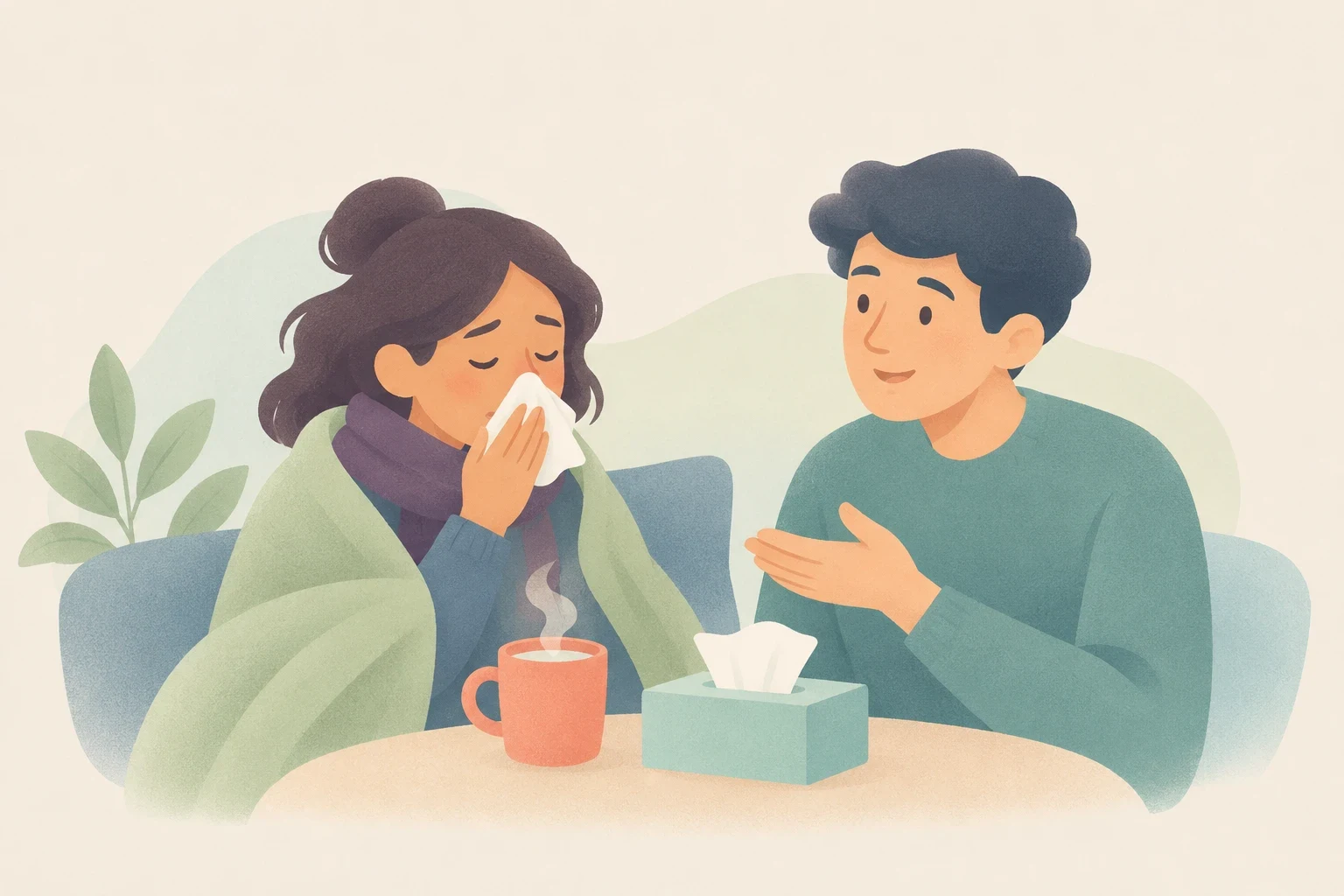
Use catch a cold or get a cold for the action of becoming ill. Both verbs point to the transition from healthy to sick, such as picking up a virus on a bus or at work. Use have a cold or I've got a cold for the ongoing state of being sick right now.
Key points
- When symptoms are just starting and you are not fully ill yet, use come down with a cold.
- Ask yourself one question before you speak or write: am I talking about how the illness started or how I feel now?
- If you are still sick after several days, use I've had a cold for plus the number of days.
This lesson has 5 stages. You can stop at any time and continue later.

At a glance
| Phrase | Core meaning | Typical time clue | Example |
|---|---|---|---|
| catch a cold / caught a cold | Become sick by picking up a virus | yesterday, last week, from someone | She caught a cold from her nephew. |
| get a cold / got a cold | Become sick (general everyday event) | last night, two days ago, in winter | I got a cold two days ago. |
| have a cold / have got a cold | Be sick right now (ongoing state) | today, right now, this morning | He has a cold today. |
| have had a cold | Stay sick from a past point until now | for three days, since Tuesday | I've had a cold for three days. |
| come down with a cold | Begin to feel the first symptoms | right now, this evening, I think | I think I'm coming down with a cold. |
Stage 1 of 5
Understand
What it means, when to use it, and mistakes to avoid.
Examples
I caught a cold from my coworker after we shared a small meeting room.
Why it works: Uses caught a cold in the past simple to show the event of picking up the virus from another person.
3 more examples
-
I got a cold last week, so I stayed home on Thursday and Friday.
Uses got a cold with a finished past time expression to describe becoming sick in the past.
-
I cannot come into the office today because I have a bad cold.
Uses have a bad cold in the present simple to describe the ongoing state of being ill right now.
-
My throat feels scratchy, so I think I'm coming down with a cold.
Uses coming down with a cold for the early stage when the first symptom appears.
Read the full guide
Choose catch a cold for the action and have a cold for the state
Both I caught a cold and I got a cold are natural English, and both mean you became sick. The main decision is between the event of becoming sick and the state of being sick right now. Use catch a cold or get a cold when you talk about when or how the illness began. Use have a cold when you describe your condition today. Catch a cold often emphasizes picking up the virus from a person or place.
-
I caught a cold on the crowded evening bus.
Why it works: Focuses on the event of picking up the virus in a specific place.
-
I got a cold after walking home in the rain.
Why it works: Describes the past event of becoming ill in everyday conversation.
-
I have a cold today, so I am working from home.
Why it works: Describes the ongoing state of being sick right now.
Your turn
You want to tell a colleague where you picked up your virus last week. Which sentence fits best?
Answer: I caught a cold on a crowded flight last week.
Show the answer
Answer: I caught a cold on a crowded flight last week.
Caught a cold describes the past event of picking up the virus in a specific place during a finished time (last week).
How got a cold works as a past event versus I've got a cold today
The word got appears in two different structures that look similar but refer to different times. In I got a cold last week, got is the past simple of get and marks a finished past event (see /idioms/expressions-with-get/ for other uses of get). In I've got a cold today, have got expresses a present state and means the same thing as I have a cold. For duration from the past until now, use present perfect: I've had a cold for three days.
-
I got a cold last Tuesday, but I feel fine now.
Why it works: Past simple got a cold shows when the illness started in a finished past time.
-
I've got a cold today, and my nose is completely blocked.
Why it works: Present structure I've got a cold means I have a cold right now.
-
I've had a cold since Monday, and my cough is still loud.
Why it works: Present perfect I've had a cold connects a past start (since Monday) to the present state.
You can practise this again in Invest in or invest on: Choose the right word and Encase or In Case: Choose the Right Form.
Your turn
Your cold started four days ago and you are still sick today. Which sentence is grammatically accurate?
Answer: I've had a cold for four days.
Show the answer
Answer: I've had a cold for four days.
Use the present perfect (I've had a cold) with for plus a length of time to show a state that started in the past and continues today.
Compare catch a cold, get a cold, and have a cold side by side
When you choose between these phrases, look at the time marker in your sentence. Words like yesterday, last night, or on Friday point to the moment the illness began, so caught a cold or got a cold fits best. Words like right now, today, or at the moment point to an ongoing condition, so have a cold or have got a cold is the clear choice. Compare the forms and time clues in the table below.
-
Omar caught a cold at the gym on Saturday, and he still has a cold today.
Why it works: Combines caught a cold for the Saturday start with has a cold for today's state.
-
Whenever I get a cold, I drink hot tea and try to get eight hours of sleep.
Why it works: Uses present simple get a cold for a repeated event whenever the speaker becomes sick.
Your turn
Which sentence combines the start of the illness and the present state accurately?
Answer: I got a cold on Sunday, and I still have a cold today.
Show the answer
Answer: I got a cold on Sunday, and I still have a cold today.
Got a cold marks the past event on Sunday, and still have a cold describes the continuing state today.
Use I've got a cold and I got a cold in everyday conversation
Both British and American speakers use I have a cold and I've got a cold to describe being sick today. I've got a cold is especially common in British English and informal American speech. In casual American conversation, some speakers also drop the helper verb have and say I got a cold right now to mean a present state. As a learner, use I have a cold or I've got a cold for present illness so your meaning is never ambiguous.
-
I've got a cold today, so I cannot join you for coffee.
Why it works: Natural in both British and American everyday speech for a present state.
-
I have a cold and will join the afternoon meeting by phone.
Why it works: Clear, neutral choice for workplace emails and professional messages.
-
Sorry my voice sounds rough, I got a bad cold right now.
Why it works: Casual spoken American pattern where have is dropped; understand it when listening, but prefer I have a cold or I've got a cold in your own writing.
Your turn
You hear an American coworker say, 'Stay back, I got a bad cold right now.' What does the coworker mean?
Answer: The coworker is sick right now and dropped the weak sound 've in casual speech.
Show the answer
Answer: The coworker is sick right now and dropped the weak sound 've in casual speech.
With the time marker right now, casual American 'I got a bad cold' functions as 'I've got a bad cold' and describes a present illness.
Use come down with a cold when symptoms first start
Sometimes you are not sure whether you have a full cold yet, but you notice early signs like a scratchy throat, a slight headache, or sudden tiredness. English speakers use the phrasal verb come down with a cold for this beginning stage. You will most often hear it in the present continuous with think or feel, as in I think I'm coming down with a cold. In that situation, people often advise you to rest and take it easy (/idioms/take-it-easy/).
-
I feel chilly and my throat hurts, so I think I'm coming down with a cold.
Why it works: Present continuous coming down with a cold describes symptoms that are just beginning.
-
Nina came down with a cold on the last night of her vacation.
Why it works: Past simple came down with a cold marks the exact moment her symptoms started.
-
Go home early and rest if you feel like you are coming down with something.
Why it works: Coming down with something is used when symptoms start before you know the exact minor illness.
Your turn
Your throat started feeling scratchy an hour ago, and you suspect a cold is beginning. What is the most natural way to say this?
Answer: I think I'm coming down with a cold.
Show the answer
Answer: I think I'm coming down with a cold.
Come down with a cold in the present continuous describes the early stage when the first symptoms start to appear.
Keep the article a with cold and contrast it with the flu
In modern everyday English, the noun cold takes the indefinite article a across all of these verbs: catch a cold, get a cold, have a cold, and come down with a cold (review article choices in /micro-listenings/a-an-and-the-choose-an-article-listening-practice/). Do not leave the article out in normal conversation, and keep an adjective after a, as in a bad cold or a heavy cold. By contrast, English uses the definite article with flu: catch the flu or have the flu.
-
I have a bad cold, with a runny nose and a cough.
Why it works: Keeps the article a before the adjective and noun: a bad cold.
-
It is only a cold, not the flu, because I do not have a high fever.
Why it works: Contrasts a cold (indefinite article) with the flu (definite article).
-
Everyone in our house caught a cold last winter.
Why it works: Uses caught a cold rather than dropping the article in modern conversational English.
Your turn
Which sentence uses articles accurately for everyday illnesses?
Answer: I thought I caught the flu, but the doctor said I just have a cold.
Show the answer
Answer: I thought I caught the flu, but the doctor said I just have a cold.
Standard everyday English uses the flu with the definite article the, and a cold (or a bad cold) with the indefinite article a.
Ask questions and make negatives about catching or having a cold
To ask or make a negative sentence about how an illness started in the past, use did or didn't with the base verb catch or get: Did you catch a cold? and I didn't get a cold. Notice that caught and got return to their base forms catch and get after did or didn't. To ask or make a negative about someone's state today, use do or don't with have: Do you have a cold? and I don't have a cold.
-
Did you catch a cold after waiting in the rain last night?
Why it works: Uses Did you plus the base verb catch to ask about a past event.
-
Do you have a cold, or is it just spring allergies?
Why it works: Uses Do you have to ask about someone's condition right now.
-
My sister had a cough all week, but luckily I didn't get a cold from her.
Why it works: Uses didn't plus the base verb get for a past negative.
Your turn
Your friend is sneezing across the table right now. Which question asks about their current condition?
Answer: Do you have a cold?
Show the answer
Answer: Do you have a cold?
Do you have a cold? uses the present simple to ask about someone's current state, whereas Did you caught is ungrammatical because did requires the base verb catch.
Hear weak have in I've got a cold and linked stops in caught a and got a
In natural speech, two sound patterns can make these phrases tricky to transcribe. First, in I've got a cold, the contraction 've is a soft /v/ sound right before the /g/ in got, so I've got a cold can sound very close to I got a cold. Listen for time words like today or right now versus yesterday or last week to tell them apart. Second, the final /t/ in caught and got links smoothly to the vowel a, sounding like caugh-ta and go-ta.
-
I've got a cold today, so please keep the window closed.
Why it works: Even if the /v/ in I've is quiet, the time word today confirms the present state I've got a cold.
-
I got a cold last week during my business trip.
Why it works: The finished past phrase last week confirms the past simple event I got a cold.
-
She caught a cold after sitting near an open door.
Why it works: In connected speech, caught a links together as two quick syllables before cold, and cold links to the vowel in after.
Your turn
In fast conversation, why can 'I've got a cold' sound almost identical to 'I got a cold'?
Answer: Because the contracted /v/ sound in I've is very quiet before the /g/ sound in got.
Show the answer
Answer: Because the contracted /v/ sound in I've is very quiet before the /g/ sound in got.
The weak /v/ consonant in I've sits right before the /g/ stop in got, so listeners rely on surrounding time clues like today versus last week.
Choose the right phrase when calling in sick or explaining symptoms
When you call in sick or talk to a pharmacist, you often combine two phrases in one short message. Start with your current state (I have a bad cold today) or early symptoms (I think I'm coming down with a cold) so the listener knows why you are calling. Then add when it started (I caught a cold on Wednesday) or how long it has lasted (I've had a cold for two days). For related health listening, see /micro-listenings/3-2/ and /micro-listenings/8-hours-of-sleep/.
-
Hi Alex, I have a bad cold today and need to take a sick day.
Why it works: Opens a work message clearly with the present state have a bad cold.
-
I caught a cold two days ago, and I have had a sore throat since yesterday.
Why it works: Explains both the start of the illness (caught a cold) and the duration of symptoms (have had ... since yesterday) at a pharmacy.
-
I'm coming down with a cold, so I will join today's team call from home.
Why it works: Explains why you are working remotely as soon as early symptoms appear.
Your turn
You are writing a morning message to your manager because you are sick today and cannot come to the office. Which line is clearest?
Answer: I have a bad cold today, so I need to take a day off and rest.
Show the answer
Answer: I have a bad cold today, so I need to take a day off and rest.
I have a bad cold today clearly states your current condition in a work message without mixing incompatible time markers.
Questions about "Caught a cold or got a cold: choose the right phrase"
Is it more natural to say I caught a cold or I got a cold?
Both phrases are completely natural and mean that you became sick with a cold. Speakers use I got a cold slightly more often in casual daily conversation because get is a common all-purpose verb. Speakers choose I caught a cold when they want to emphasize picking up the virus from a specific person or environment, such as a coworker or a crowded bus.
I got a cold last week and missed two days of classes.
I caught a cold from my roommate after he started coughing.
What is the difference between I got a cold and I have a cold?
In standard English, I got a cold refers to the past event of becoming ill, while I have a cold refers to the ongoing state of being sick right now. For example, if your symptoms began on Monday and you are still coughing on Wednesday, you can say that you got a cold on Monday and you have a cold today.
I got a cold on Monday evening after working late.
I have a cold right now, so I am drinking warm tea.
Do Americans and British speakers use I've got a cold differently?
Both British and American speakers use I've got a cold to mean I have a cold right now. It is the default everyday choice in British speech and very common in American speech. In casual American conversation, some speakers drop the helper verb have and say I got a cold to mean a present state, though I have a cold or I've got a cold is clearer for learners.
I've got a cold at the moment, so I am staying home.
I have a cold today and need to reschedule our meeting.
Can I say I caught cold without the word a?
In modern everyday English, you should always include the article a: catch a cold, get a cold, and have a cold. You may occasionally see the older phrase catch cold without a in older books, but in contemporary conversation and messages, native speakers expect a cold (and the flu for influenza).
Wear a warm coat or you might catch a cold.
My brother has a bad cold, not the flu.
How do I say that my cold started three days ago and I still have it?
Use the present perfect tense (I have had a cold or I've had a cold) with for plus the length of time, or since plus the starting day. Avoid using the present simple (*I have a cold for three days), because English uses present perfect to connect a state that began in the past to the present moment.
I've had a cold for three days, and my voice is still hoarse.
She has had a cold since Tuesday morning.
Before you go
Remember this
Ask yourself one question before you speak or write: am I talking about how the illness started or how I feel now? Choose caught a cold or got a cold for the start of the illness, come down with a cold for the first symptoms, and have a cold or I've got a cold for your state today. If you are still sick after several days, use I've had a cold for plus the number of days.
Stage 2 of 5
Listen
Hear it in real sentences, from short to long, and write what you hear.
0 of 4 done
Listening 1 of 4
Listening 2 of 4
Try a longer clip. Listen once, then replay the part you missed.
Listening 3 of 4
This clip is longer. Follow the instruction above the answer field.
Listening 4 of 4
Listen, then type the missing words. The rest of the text is already there.
0:00
Practice complete
You listened closely.
Your result is saved in this browser.
Keep your progress. Your practice is saved on this device only. Create a free account to keep it everywhere.
Create a free accountThat was today's free lesson. Tomorrow you get another one. Want more today? See membership.
Create a free SubLearn account to keep this progress across devices.
Save my progressStage 3 of 5
Speak
Say it with the speaker, then use it in your own answer.
Shadow
Say it along with the speaker
Play the line slowly, then speak at the same time as the speaker. Copy the rhythm, not just the words.
Your turn
Say it your way
Imagine you wake up with a sore throat and a blocked nose on a workday. Speak for 20 to 30 seconds as if leaving a voicemail for your manager: state that you have a cold today, explain when you caught or got the cold, and say what you will do about your work tasks.
You could start with “Good morning, I'm calling because I have a bad cold today and…”
Take ten seconds to think, then answer out loud without looking at the lesson. Speak for the time shown in the task above. Nothing is sent unless you ask for feedback.
0:00
Stage 4 of 5
Write
Write your own response
AI feedback · it can make mistakes · Part of membership See membership
Check your own writing
Read one possible response
Draft saved on this device.
Use these checks to revise your message. Grammar and meaning are not automatically graded. Each task keeps its own draft in this browser tab.

You finished the free part of this lesson
- Understand
- Listen
- Speak
- Write
- CheckPart of membership
Worth another look
With a free account, the lessons you finish come back for review to help you remember them.Create a free account
Stage 5 of 5 · Part of membership
Check
New clips without hints.
Listening tests are included with membership. Try the free dictation first, then decide whether to continue.
Listening 1 of 2 Part of membership
Listening 2 of 2 Part of membership
Follow MicroEnglish
Find lesson updates, short videos and quick quizzes. Pick the app you already use.
Questions & comments
Ask about this lesson, share an example, or help another learner.
Example
Memory tip
Goes with
Related forms
Not to be confused with
In this lesson
This word isn't in our dictionary. Check the spelling, or try another form of the word.
We couldn't load this word. Try again.
