Phrasal verb
Pick up
What does 'pick up' mean?
'Pick up' can mean collect or lift someone or something, learn informally, improve, or continue after a pause. The situation shows which meaning fits. For example, 'Trade picked up in spring' means it became busier. With an object pronoun, use 'pick it up', not 'pick up it'.
Key points
- The surrounding situation usually shows which meaning fits.
- Nouns can follow 'pick up' or go between 'pick' and 'up'.
- Object pronouns must come between 'pick' and 'up'.
- Use 'pick up' to continue an activity after pausing.
This lesson has 5 stages. You can stop at any time and continue later.
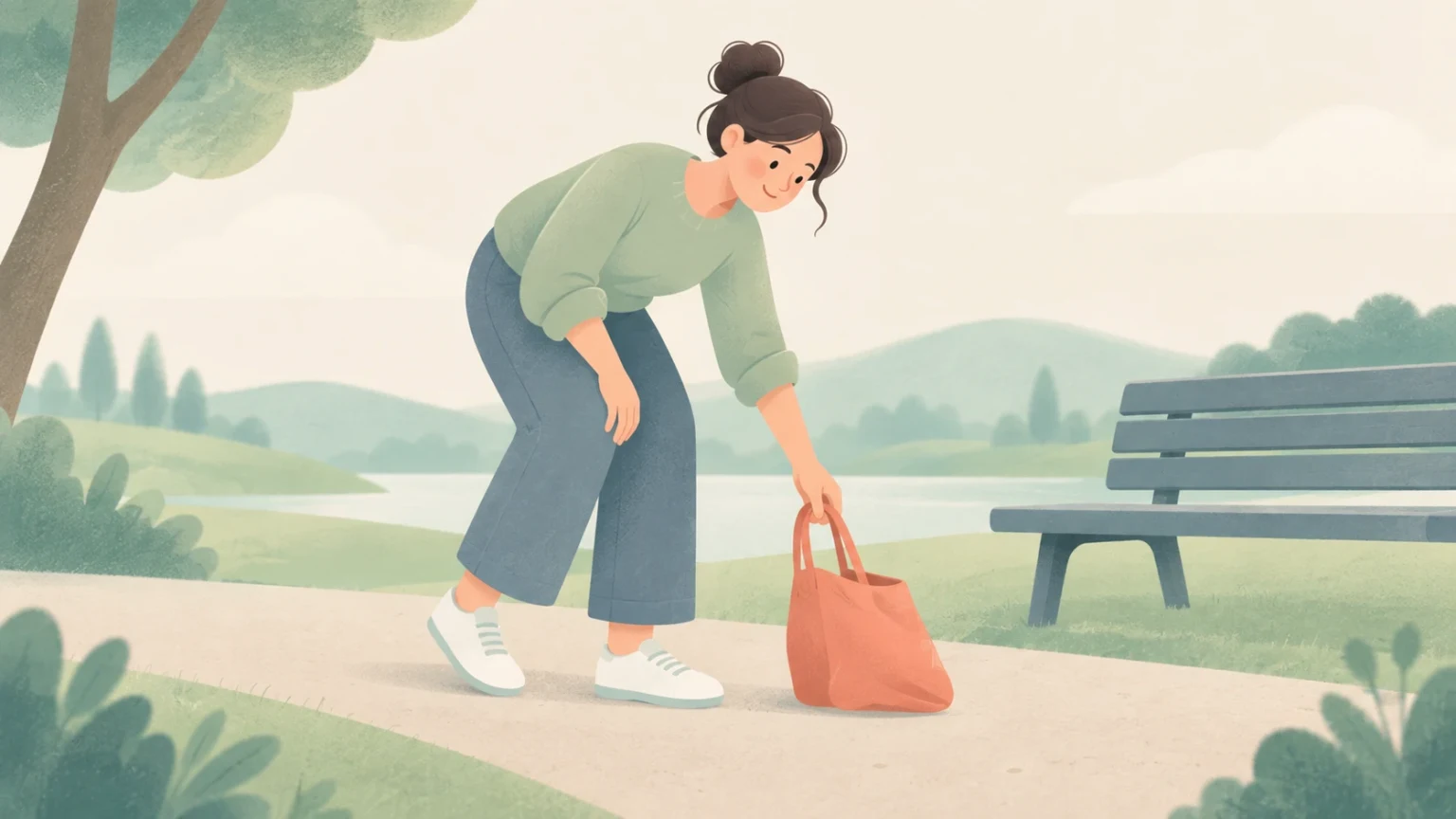

Stage 1 of 5
Understand
What it means, when to use it, and mistakes to avoid.
The full explanation
Pick up can mean collect or lift someone or something, learn through experience, become stronger or better, or continue something that stopped. The situation tells you which meaning fits.
Can you pick up our order before the store closes?
Why it works: Our order is something to collect.
3 more examples
-
I picked up a few cooking tips from my roommate.
The speaker learned through everyday contact.
-
Ticket sales picked up after the price changed.
Sales increased; nobody collected them.
-
We can pick up the discussion after dinner.
The discussion will continue after a pause.
Read the full guide
Choose a meaning from the situation
Start with the person or thing connected to pick up. At a repair shop, picking up a bike means collecting it. Picking up repair skills means learning them, often by watching or helping. If business picks up, the shop becomes busier. If a conversation stops and you pick it up later, you continue it. These clues help you make a first decision, but read or listen to the complete message before choosing. A noun alone does not always settle the meaning.
-
I picked up some useful skills while helping at the shop.
Why it works: Helping provided informal learning.
Your turn
What does picked up mean in the example?
Answer: Learned through experience
Show the answer
Answer: Learned through experience
Skills and while helping point to learning through experience.
Separate collecting from lifting
Use pick up when someone goes to get a person or something that is ready. Picking up a person often includes giving them a ride. A place or time helps make the arrangement clear. Pick up can also describe lifting something from a surface. If a cup falls, you pick it up from the floor. Compare the actions: collecting an order involves getting it from a store; lifting a cup involves moving it upward. Both uses can have an object after up.
-
Please pick up the towel from the floor.
Why it works: The towel's position makes lifting the likely meaning.
This also comes up in Get together and Come up with.
Your turn
Which sentence most clearly asks for a ride?
Answer: Can you pick me up outside my office?
Show the answer
Answer: Can you pick me up outside my office?
Me and the meeting place indicate collecting a person for transport.
Put it, them, and me before up
When you collect something, you can say pick up the package or pick the package up. Both positions work with this noun. When you replace the package with it, only pick it up works. The same pattern applies to people: pick your brother up becomes pick him up. Change pick to show time, while keeping up: yesterday I picked it up; tomorrow I will pick it up. Before speaking, check whether your object is a noun or a short replacement word such as it.
-
Your gloves are ready, and you can pick them up today.
Why it works: Them replaces your gloves and goes in the middle.
Your turn
Replace the tickets with them: I will pick up the tickets.
Answer: I will pick them up.
Show the answer
Answer: I will pick them up.
An object pronoun must go between pick and up.
Choose pick up for learning through contact
Use pick up for knowledge or skills you gain through contact, observation, or practice. You might pick up words by hearing coworkers use them. Learn is broader: it can describe this experience or organized study. Study focuses on deliberately spending time on a subject. Picking something up does not prove that you learned it quickly or completely. Use expressions such as a few words or some basic skills when you want to show the amount. You can also pick up an unwanted habit.
-
I picked up a few French words from the kitchen staff.
Why it works: A few limits the claim; from identifies the source.
Your turn
What does the example tell us?
Answer: The speaker learned some words through contact.
Show the answer
Answer: The speaker learned some words through contact.
The sentence describes limited informal learning, without claiming fluency.
Put the improving thing before pick up
When pick up means improve or increase, the thing changing usually comes before it. Business picks up, sales pick up, and the pace picks up. There is no object to collect in these sentences. Notice how changing the order changes the message: sales picked up describes an increase, while I picked up the sales report describes collection. Do not use this meaning for every improvement. For a developing language skill, my English is improving is a clearer everyday choice than my English is picking up.
-
Business picked up when the nearby offices reopened.
Why it works: The shop became busier.
Your turn
Which sentence says that more tickets were being sold?
Answer: Ticket sales picked up.
Show the answer
Answer: Ticket sales picked up.
Ticket sales is the thing increasing, and there is no object after up.
Continue without returning to the beginning
Use pick up a discussion or pick up where we left off when an activity continues after a pause. Where we left off means the point at which we stopped. It does not mean the beginning. In a message to coworkers, include a time and a stopping point if they might forget the plan. This makes pick up useful in everyday work writing. For a more formal message, resume is another option. Choose continue if you want a simple alternative that most readers will recognize.
-
Tomorrow we will pick up where we left off, at question six.
Why it works: Question six identifies the stopping point.
Your turn
What should the group do tomorrow?
Answer: Continue from question six
Show the answer
Answer: Continue from question six
The sentence names question six as the point for continuing.
Listen for up and the object position
In speech, the end of pick can connect closely to up, so the two words may sound like one unit. In pick it up, listen for the short word between them. Past forms need attention too: picked contains a final t sound, although it may be hard to hear before another consonant. Use time words and the rest of the message as additional clues. After a dictation, hide the transcript and recall one complete phrase. Check the verb ending, the object, and the word up.
-
I picked it up yesterday.
Why it works: Yesterday supports the past form; it stays before up.
Your turn
Which sentence correctly describes a completed collection yesterday?
Answer: I picked it up yesterday.
Show the answer
Answer: I picked it up yesterday.
Picked marks the past, and it is correctly placed before up.
Other meanings of "pick up"
This lesson practises one meaning. You may also hear these.
To learn something through contact, observation, or practice
She picked up useful phrases from her colleagues.
To improve or increase in strength, speed, or activity
Trade picked up during the summer.
To continue an activity after a pause
Let's pick up the conversation tomorrow.
To answer a telephone call or receive a signal
The radio cannot pick up a signal here.
Common mistakes with "pick up"
What learners often say, what to say instead, and why.
-
Not this:
I will pick up it after lunch.Say: I will pick it up after lunch.
Object pronouns must go between 'pick' and 'up'.
-
Not this:
She pick up some Italian from work yesterday.Say: She picked up some Italian from work yesterday.
The past-time word 'yesterday' requires the past form 'picked'.
-
Not this:
We can pick on the meeting tomorrow.Say: We can pick up the meeting tomorrow.
The continuation meaning needs the particle 'up', not 'on'.
-
Not this:
The sales picked up the evening.Say: Sales picked up in the evening.
For improvement, the changing thing comes before 'picked up'; no object follows it.
Use it naturally
How people really use “pick up”
Neutral Fine almost anywhere, at work or with friends.
Words it often goes with
- pick up an orderI'll pick up an order from the bakery on my way home.
- pick up tipsYou can pick up tips by watching other players.
- sales picked upOur sales picked up during the holiday season.
- pick up the discussionWe can pick up the discussion after our break.
What people also say
- “Can you pick me up?” instead of “Can you collect me in your car?” This is a common way to ask someone for a ride.
Questions about "Pick up"
Can I leave out up when I mean collect?
No. Keep up for the collection meaning. Pick alone often means choose, so leaving out up can change the action. Pick a jacket asks someone to choose one; pick up a jacket can ask them to collect or lift it.
Please pick a jacket for the trip.
Please pick up my jacket from the cleaner.
Does pick up always mean learn quickly?
No. Pick up emphasizes learning through experience or contact. It does not state how long the learning took. Add quickly if speed matters, or give a time period to describe gradual learning.
I picked up some computer skills over several months.
She picked up the basic rules quickly.
Should I write pick up as one word or two?
Write the verb as two words: pick up, picks up, or picked up. In American English, pickup can be a noun or describe another noun, as in pickup time. First decide whether the expression describes the action itself.
I will pick up the desk on Friday.
Please confirm the pickup time.
Does picking someone up always mean lifting them?
No. With a meeting place and a travel plan, it usually means collecting someone and giving them a ride. In a physical situation, such as helping a small child, it can mean lifting. Use the complete situation to decide.
My neighbor will pick me up before the appointment.
He picked up the child so she could see over the wall.
Before you go
Remember this
Identify what is collected, learned, improving, or continuing. Keep object pronouns between pick and up. To describe returning to the same stopping point, use pick up where we left off.
Stage 2 of 5
Listen
Hear it in real sentences, from short to long, and write what you hear.
0 of 4 done
Listening 1 of 4
Listen, then type what you hear. Replay as often as you need.
0:00
- I picked up a few cooking tips from my roommate.
- Ticket sales picked up after the price changed.
Listening 2 of 4
Listen, then type what you hear. Replay as often as you need.
0:00
- I picked up a few cooking tips from my roommate.
- Ticket sales picked up after the price changed.
Try a longer clip. Listen once, then replay the part you missed.
Listening 3 of 4
Listen, then type what you hear. Replay as often as you need.
0:00
- I picked up a few cooking tips from my roommate.
- Ticket sales picked up after the price changed.
This clip is longer. Follow the instruction above the answer field.
Listening 4 of 4
Listen, then type the missing words. The rest of the text is already there.
0:00
- I picked up a few cooking tips from my roommate.
- Ticket sales picked up after the price changed.
Practice complete
You listened closely.
Your result is saved in this browser.
Keep your progress. Your practice is saved on this device only. Create a free account to keep it everywhere.
Create a free accountThat was today's free lesson. Tomorrow you get another one. Want more today? See membership.
Create a free SubLearn account to keep this progress across devices.
Save my progressStage 3 of 5
Speak
Say it with the speaker, then use it in your own answer.
Shadow
Say it along with the speaker
Play the line slowly, then speak at the same time as the speaker. Copy the rhythm, not just the words.
Your turn
Say it your way
Speak for 30 to 60 seconds from memory about your first visit to a photography club in a park. Tell a friend what you went to collect, what you learned by watching someone, and what you want to photograph next.
Use: pick up picked up
Take ten seconds to think, then answer out loud without looking at the lesson. Speak for the time shown in the task above. Nothing is sent unless you ask for feedback.
0:00
Hear how someone else might say it
Yesterday I went to a photography club in the park. I needed to pick up a camera that the club was lending me. The leader had it ready, so I picked it up before we went outside. I also picked up some useful tips by watching another member. She showed me how to use the light near the trees. My first photos were dark, but the later ones looked much better. Next time, I want to take pictures of birds near the lake.
Try once more and answer this: Which tip helped you the most?
Stage 4 of 5
Write
Write your own response
AI feedback · it can make mistakes · Part of membership See membership
Check your own writing
Read one possible response
Draft saved on this device.
Use these checks to revise your message. Grammar and meaning are not automatically graded. Each task keeps its own draft in this browser tab.

You finished the free part of this lesson
- Understand
- Listen
- Speak
- Write
- CheckPart of membership
Worth another look
With a free account, the lessons you finish come back for review to help you remember them.Create a free account
Stage 5 of 5 · Part of membership
Check
New clips without hints.
Listening tests are included with membership. Try the free dictation first, then decide whether to continue.
Listening 1 of 2 Part of membership
Listening 2 of 2 Part of membership
Follow MicroEnglish
Find lesson updates, short videos and quick quizzes. Pick the app you already use.
Questions & comments
Ask about this lesson, share an example, or help another learner.
Example
Memory tip
Goes with
Related forms
Not to be confused with
In this lesson
This word isn't in our dictionary. Check the spelling, or try another form of the word.
We couldn't load this word. Try again.
