Micro-listening
Present perfect: use have and has
How do I know whether to use have or has?
The present perfect connects an earlier action directly to the current conversation. When you say that someone has packed the rain gear, the packing occurred in the past, but your focus is on the fact that the bag is ready now.
Key points
- You also use this structure to discuss lifetime experiences up to this moment and ongoing states that started in the past.
- Use have or has with a past participle for the present perfect.
- Choose have with I, you, we, they, and plural nouns; choose has with he, she, it, and singular nouns.
This lesson has 5 stages. You can stop at any time and continue later.

Stage 1 of 5
Understand
What it means, when to use it, and mistakes to avoid.
Examples
We have packed the tent, so we can load the car now.
Why it works: The tent packing finished earlier, and the bag is ready for loading right now.
2 more examples
-
Marcus has printed our boarding passes.
Marcus is a singular subject, so has pairs with the participle printed.
-
They haven't confirmed our hotel room yet.
Haven't forms the negative with a plural subject to show an unfinished preparation.
Read the full guide
Check what is ready before a weekend trip
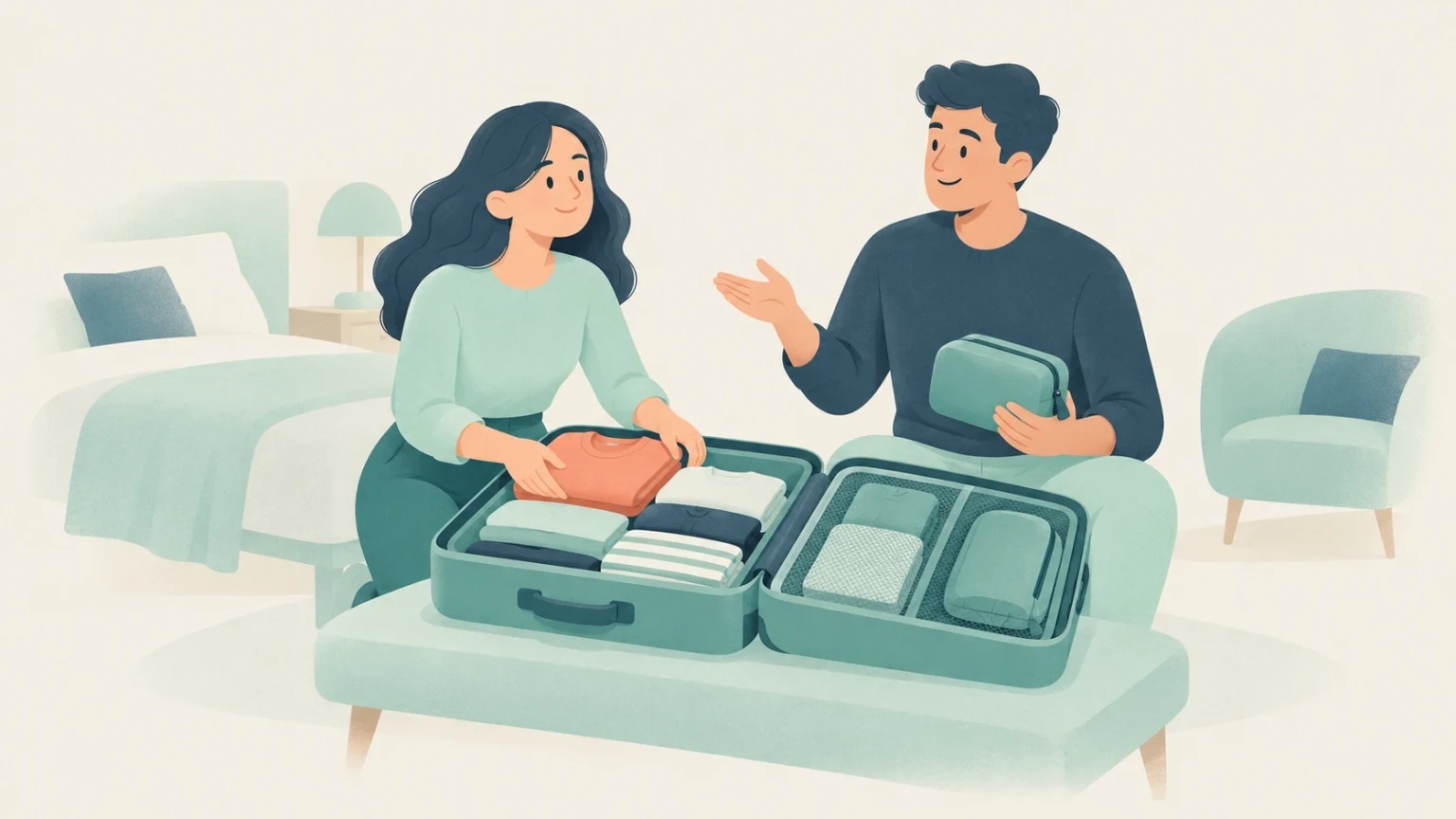
Two friends, Sam and Alex, are standing in their hallway thirty minutes before departure. They need to know which jobs are finished so they do not pack duplicate items or leave important gear behind. Sam asks, 'Have you packed the charging cables?' Alex answers, 'Yes, I have packed both cables, but I haven't found our road map yet.' Each statement tells the other person what action to take next.
Notice how each line in their conversation changes their immediate plan. Because Alex has packed the cables, Sam leaves that drawer closed. Because Alex has not found the map, Sam walks over to the bookshelf to search for it. In everyday English, this verb form delivers practical updates rather than dry historical facts.
-
Alex has packed both charging cables, so Sam does not need to look for them.
Why it works: The earlier action creates a direct practical result for the upcoming trip.
-
We haven't found our road map, so we must search the shelf.
Why it works: The negative present perfect highlights an incomplete task that needs attention now.
Your turn
Why does Alex say 'I have packed both cables' instead of talking about last night?
Answer: Alex wants Sam to know the cables are ready right now so Sam does not pack extras.
Show the answer
Answer: Alex wants Sam to know the cables are ready right now so Sam does not pack extras.
Alex uses the present perfect to give a practical update that affects what Sam does right now.
Choose have or has from the subject
In the present perfect, have and has function as helping verbs. They do not mean physical ownership in this pattern. Instead, they signal grammatical tense and agree with your subject. You must choose have when the subject is I, you, we, they, or any plural noun phrase. You must choose has when the subject is he, she, it, or a singular noun phrase.
Do not simply count how many people you see. The pronoun you always takes have, whether you speak to one friend or twenty friends. Similarly, singular they always takes have in modern English. Selecting the wrong helping verb creates an immediate grammatical mistake that confuses listeners.
| Subject Group | Helping Verb | Example Sentence |
|---|---|---|
| I / you / we / they / plural nouns | have | Our friends have booked a campsite. |
| he / she / it / singular nouns | has | Alex has printed our park permit. |
| singular they | have | Our driver said they have checked the tire pressure. |
-
You have packed enough warm layers for this mountain evening.
Why it works: You pairs with have even when addressing one individual person.
-
Our travel group has selected a scenic route.
Why it works: Our travel group is a singular noun phrase, so it requires has.
You can practise this again in Present perfect progressive: how to use have been working and Present Perfect: Connect Past to Now.
Your turn
Which sentence correctly pairs the helping verb with its subject?
Answer: Our driver has checked the weather forecast.
Show the answer
Answer: Our driver has checked the weather forecast.
Our driver is a third-person singular noun phrase, so it requires has rather than have.
Find the past participle you need
Every present perfect sentence combines have or has with a past participle. With regular verbs, the past participle ends in -ed and looks identical to the past simple. For instance, pack becomes packed, try changes to tried, and stop doubles its consonant to become stopped. Notice that only certain short verbs with a single vowel before a consonant double their final letter.
Irregular verbs follow distinct patterns that you must learn directly. Sometimes the past simple and past participle share the same form, as with make, made, made. In other verbs, the forms differ completely: write becomes wrote in the past simple but written as a participle, and go becomes went before turning into gone. Never use a past simple form like wrote after have or has.
| Base Form | Past Simple | Past Participle |
|---|---|---|
| pack | packed | packed |
| check | checked | checked |
| try | tried | tried |
| stop | stopped | stopped |
| be | was / were | been |
| go | went | gone |
| do | did | done |
| have | had | had |
| see | saw | seen |
| take | took | taken |
| write | wrote | written |
| make | made | made |
| buy | bought | bought |
-
We have written our packing checklist on paper.
Why it works: Written is the past participle of write; wrote is past simple and cannot follow have.
-
Alex has stopped at the market for extra fruit.
Why it works: Stop doubles its final consonant to form stopped before -ed.
Your turn
Which sentence uses the correct past participle form after has?
Answer: Sam has taken the camera from the table.
Show the answer
Answer: Sam has taken the camera from the table.
Taken is the irregular past participle of take; took is the past simple form.
Ask what is done and say what is not done
To make a negative statement, put not after have or has. In conversation, English speakers usually contract these words into haven't or hasn't. To form a question, move have or has in front of the subject. If you need more information, place a question word such as what or where at the start. Never add do, does, or did to form questions or negatives in the present perfect.
Short answers reuse the helping verb without repeating the main participle. If a friend asks whether you have packed your coat, answer 'Yes, I have' or 'No, I haven't'. Affirmative short answers always keep have or has in full. You cannot say 'Yes, I've' because an auxiliary verb at the end of a sentence requires full pronunciation.
-
We haven't downloaded our trail map yet.
Why it works: Haven't combines have and not to form the negative.
-
Have you checked the tire pressure? Yes, I have.
Why it works: The question moves have before you, and the short answer uses the full auxiliary have.
-
What has Sam packed in that small blue backpack?
Why it works: The question word what precedes has and the subject Sam.
Your turn
How should you answer the question 'Has Alex locked the apartment door?' positively?
Answer: Yes, Alex has.
Show the answer
Answer: Yes, Alex has.
Affirmative short answers repeat the helping verb in full without contraction.
Connect a completed action to the situation now
Speakers select the present perfect when an earlier action produces an outcome that matters directly to the current conversation. If someone drops a water bottle on the car seat, you say, 'Alex has spilled water', because the wet seat requires a towel right now. The action happened moments ago, but your attention stays on the present condition.
Be careful with two common assumptions. First, having a consequence does not make the present perfect mandatory: if you name the exact time of an event, you must switch to the past simple. Second, the tense does not promise that an outcome lasts forever. It simply shows that the speaker is presenting the result as active right now.
-
I have charged our portable battery, so our phones will stay powered.
Why it works: The battery charging happened earlier, and the full charge is ready right now.
-
Someone has moved the car keys from the hallway table.
Why it works: The speaker focuses on the present consequence: the keys are currently missing.
Your turn
Why would a driver say 'Someone has washed our windshield' before starting the car?
Answer: The clean glass is clearly visible right now and improves current driving safety.
Show the answer
Answer: The clean glass is clearly visible right now and improves current driving safety.
The present perfect draws attention to the visible, useful result in the immediate present.
Ask about experience with ever and never
The present perfect lets you ask about life experience without naming a specific date. Place ever between the helping verb and the participle to ask if an event happened at any point in someone's life. Place never in that same middle position to describe zero experience. Because never already carries a negative meaning, never combine it with not.
Natural conversations frequently begin with an open experience question and then narrow down to a specific past occasion. After someone confirms an experience, switch to the past simple to ask where or when it happened. In travel conversations, notice the difference between been to and gone to. Say 'Alex has been to Colorado' for a completed visit, but 'Alex has gone to the store' if Alex has not returned.
-
Have you ever driven on mountain roads? Did you feel nervous?
Why it works: The general experience question in the present perfect leads into a past simple question about that occasion.
-
I have never camped in cold weather.
Why it works: Never sits between have and camped to indicate zero life experience.
-
Sam has been to the national park twice.
Why it works: Been to indicates completed round trips where Sam visited and returned home.
Your turn
Which sentence correctly expresses that someone has zero lifetime experience driving a camper van?
Answer: I have never driven a camper van.
Show the answer
Answer: I have never driven a camper van.
Never provides the negative meaning; using not with never creates an incorrect double negative.
Describe time continuing up to now
You can use the present perfect to describe an open period of time that continues right now. Expressions like so far today, this morning, and this week show that more events could still happen before the period ends. However, the presence of the word today does not force you to use this tense. If you view an earlier event as an isolated finished incident, the past simple remains natural.
To show how long a state or situation has continued up to the present, combine stative verbs like know, have, or live with since or for. Use since before a specific starting point on the calendar or clock, such as since Monday or since seven o'clock. Use for before an amount of elapsed time, such as for two hours or for three years.
-
We have checked three hiking trails so far today.
Why it works: The day is still continuing, so the friends might check additional trails later.
-
Sam and Alex have known our cabin host since last summer.
Why it works: Since marks the specific starting point of an ongoing relationship.
-
We have owned this sturdy tent for four years.
Why it works: For introduces the total duration of ownership continuing into the present.
Your turn
Which sentence correctly pairs since or for with an ongoing situation?
Answer: We have waited for the park ranger for forty minutes.
Show the answer
Answer: We have waited for the park ranger for forty minutes.
Forty minutes is an amount of elapsed time, so it requires for rather than since.
Place just, already, and yet
The adverbs just, already, and yet clarify the timing of actions that connect to now. Just indicates that an action happened a very short time ago. Already shows that something happened sooner than expected, or is completed before another event. In standard learning patterns, place just and already directly between have or has and the past participle.
Use yet in negative statements and questions to talk about events you expect to happen soon. In these structures, yet typically sits at the very end of the sentence or question clause. In a negative sentence, yet confirms that the action is not complete now, but will likely finish later. In a question, yet asks whether an expected step is complete.
-
Alex has just shut the car trunk.
Why it works: Just sits between has and shut to show an action completed moments ago.
-
We have already purchased our park entry pass.
Why it works: Already sits between have and purchased to confirm an early completed task.
-
Have you filled the water canteens yet?
Why it works: Yet appears at the end of a question to ask about an expected preparation.
Your turn
Where does yet most naturally go when checking an unfinished task?
Answer: We haven't bought our camping snacks yet.
Show the answer
Answer: We haven't bought our camping snacks yet.
In standard negative statements, yet most naturally appears at the end of the sentence.
Switch to past simple for a finished past time
A common mistake is using the present perfect with words that describe a completed, closed time period. Words such as yesterday, last night, last week, and two days ago fix an action inside the past. Whenever a sentence mentions a finished time period, you must choose the past simple. For instance, say 'I bought extra water yesterday', not 'I have bought extra water yesterday'.
Do not assume that omitting a time expression automatically requires the present perfect. Both tenses can appear without a time word depending on whether you are reporting past history or current status. Additionally, speakers in American English frequently use the past simple with just, already, and yet in informal speech, such as 'I already packed'. Recognize this regional variation without treating it as an error.
-
Sam checked our car tire pressure yesterday afternoon.
Why it works: Yesterday afternoon names a finished past time, so the past simple checked is required.
-
We have checked our car tire pressure, so we are ready to drive.
Why it works: No finished past time is named, and the focus is on vehicle readiness now.
-
Did you pack the lantern yet?
Why it works: This past simple question with yet is common and accepted in informal American English.
Your turn
Which sentence is grammatically correct for an event dated to last night?
Answer: We cleaned our hiking boots last night.
Show the answer
Answer: We cleaned our hiking boots last night.
Last night specifies a finished past time period, which requires the past simple cleaned.
Hear have, has, and their contractions
In fast spoken English, have and has are rarely pronounced with full emphasis. Instead, speakers contract them onto pronouns as 've and 's. Listen for I've, you've, we've, and they've as single rhythmic beats. When have is not contracted, native speakers usually pronounce it with a weak /həv/ or /əv/ sound rather than an isolated, stressed word.
The contraction 's can represent has or is. Read the whole phrase: a past participle can follow has in a perfect form or is in a passive form. In 'She's taken the car keys', 's stands for has. In contrast, 'She's taking the keys' uses is. Listen to the whole verb phrase and use its meaning to decide.
-
We've packed three bottles of water inside our daypack.
Why it works: We've contracts we have into one quick syllable before the participle packed.
-
He's taken our road map off the kitchen table.
Why it works: In this sentence, 's means has: the person took the keys, so the phrase is present perfect.
Your turn
How can you tell that 'He's chosen a scenic route' contains has instead of is?
Answer: Chosen is a past participle, which follows the auxiliary verb has.
Show the answer
Answer: Chosen is a past participle, which follows the auxiliary verb has.
Because chosen is a past participle, 's must represent has rather than is.
Write six short updates with progressive hints
Listening to natural speech requires you to separate weak auxiliary sounds from nearby consonants. In this section, you will write down six short spoken updates about trip preparations. The sentences practice full forms of have and has, quick contractions like she's and we've, negative statements with haven't, questions, and duration expressions with since.
If you cannot understand every word on the first listening pass, rely on progressive clues. First, consider the practical situation and the speaker's purpose. Second, examine the subject to determine whether have or has belongs in the clause. Finally, look at partial spelling cues to confirm the exact past participle before checking the complete transcript.
-
I have packed our travel backpacks, and my brother has taken our car keys.
Why it works: Notice the balanced clauses pairing I have packed with my brother has taken.
-
We haven't loaded our luggage yet.
Why it works: Listen for haven't followed by loaded, with yet signaling an expected task.
Your turn
When you hear a fast sentence on audio, what should you identify first to predict have or has?
Answer: The subject noun or pronoun that performs the action.
Show the answer
Answer: The subject noun or pronoun that performs the action.
Identifying the subject immediately reveals whether the clause requires have or has.
Recall the pattern and give your own update
Now that you have explored forms, meanings, and listening cues, test your active recall. When you write an update, ask yourself two questions before you start. First, does the subject take have or has? Second, what is the exact past participle form of the main verb? Pausing to confirm these two elements prevents the most common errors.
Practice writing your own update about an upcoming weekend trip, an errand, or a household chore. State one task that is already finished and one task that you have not completed yet. Focus on creating complete sentences that deliver clear information to a listener. Use the self-review criteria below to check your helping verbs and participles.
-
I have packed our sleeping bags, but I haven't found our flashlights yet.
Why it works: This update clearly contrasts a completed action with an incomplete preparation.
-
My roommate has printed our train tickets, so we are ready to leave.
Why it works: Has matches the singular roommate, and printed supplies the regular past participle.
Your turn
Which pair of verbs correctly completes: 'We ___ our bags, but David ___ his shoes yet'?
Answer: have packed / hasn't found
Show the answer
Answer: have packed / hasn't found
We takes have with the participle packed; David is singular, so it takes hasn't with found.
Use it naturally
How people really use “have or has with a past participle”
Neutral Fine almost anywhere, at work or with friends.
Words it often goes with
- have already finishedI have already finished my homework, so I can come with you.
- have never triedI have never tried this dish before.
- have lived here forWe have lived here for three years.
- has just arrivedMy sister has just arrived, so we can leave now.
Questions about "Present perfect: use have and has"
How do I know whether to use have or has?
Look at your grammatical subject. Use have with I, you, we, they, and all plural noun phrases. Use has with he, she, it, and singular noun phrases. Remember that singular you and singular they also pair with have. In this tense, have and has serve as helping verbs rather than showing physical ownership.
My friends have reserved our vehicle.
Our driver has checked the highway route.
Why do I need written instead of wrote after has?
The present perfect requires a past participle after the helping verb, not a past simple form. For regular verbs, the past simple and past participle share the -ed ending. For many irregular verbs, however, the forms are distinct. Wrote is the past simple form, while written is the past participle. Pairing has with wrote produces a grammatical error.
She has written our packing checklist.
How do I make a question or a negative?
To make a negative, place not directly after have or has, which usually contract to haven't or hasn't. To form a question, invert word order by placing have or has in front of the subject. Never introduce do, does, or did into present perfect questions or negative statements.
We haven't printed our train tickets yet.
Have you checked our departure time?
Can I use the present perfect with yesterday or today?
You cannot use the present perfect with yesterday because yesterday describes a finished past time that has completely closed. That requires the past simple. Today, however, is an open time period that continues while you speak. You can use the present perfect with today if more actions can still happen, though past simple is also fine for an isolated event earlier today.
We bought fresh groceries yesterday.
We have bought three bottles of water today.
Does she's mean she is or she has?
The contraction she's can mean she is or she has. Read the whole verb phrase to decide. A past participle such as taken, visited, or gone does not settle the question by itself: has forms the present perfect, while is can form a passive or describe a state. Before an -ing form, she's means she is. Check the meaning as well as the ending.
She's taken the car keys from the table.
She's taking the car keys right now.
What is the difference between for and since?
Both words connect an earlier start to the present, but they measure time differently. Use since before a specific starting point on the clock or calendar, such as since nine o'clock or since Monday. Use for before an amount of elapsed duration, such as for two hours or for three weeks.
We have known our cabin host since last summer.
We have owned this camping equipment for four years.
Before you go
Remember this
Use have or has with a past participle for the present perfect. It can connect a past event with the present or describe experience or a continuing situation. Choose have with I, you, we, they, and plural nouns; choose has with he, she, it, and singular nouns. To report a completed event at a finished past time such as yesterday, use the simple past.
Stage 2 of 5
Listen
Hear it in real sentences, from short to long, and write what you hear.
0 of 4 done
Listening 1 of 4
Listening 2 of 4
Try a longer clip. Listen once, then replay the part you missed.
Listening 3 of 4
This clip is longer. Follow the instruction above the answer field.
Listening 4 of 4
Listen, then type the missing words. The rest of the text is already there.
0:00
Practice complete
You listened closely.
Your result is saved in this browser.
Keep your progress. Your practice is saved on this device only. Create a free account to keep it everywhere.
Create a free accountThat was today's free lesson. Tomorrow you get another one. Want more today? See membership.
Create a free SubLearn account to keep this progress across devices.
Save my progressStage 3 of 5
Speak
Say it with the speaker, then use it in your own answer.
Shadow
Say it along with the speaker
Play the line slowly, then speak at the same time as the speaker. Copy the rhythm, not just the words.
Your turn
Say it your way
Imagine you are at an airport, but your suitcase is missing. Speak for 30 to 60 seconds from memory to explain the problem to an airport worker. Describe what has happened, what you have tried, and what you need now.
Use: have already have not
Take ten seconds to think, then answer out loud without looking at the lesson. Speak for the time shown in the task above. Nothing is sent unless you ask for feedback.
0:00
Hear how someone else might say it
Hi, I need some help with my suitcase. My flight has arrived, but my bag is missing. I have already checked the other bags near the belt. I have not found mine yet, and most people have left. My suitcase is blue and has a yellow ribbon on the handle. I have never lost a bag before, so I don't know what to do next. My phone charger and all my clothes are inside. Can you check where it is? I can show you my ticket.
Try once more and answer this: What does your suitcase look like?
Stage 4 of 5
Write
Use what you've learned to write about your day or week, then write a message.
Write
Put it in your own words
- I used “have or has with a past participle”.
- It is about my life, not the lesson’s example.
- I read it once aloud to check it sounds right.
Write your own response
Choose a situation and write 30–50 words of your own. In this activity, you decide what to say rather than copy the words in a recording.
Check your own writing
Read one possible response
Use these checks to revise your message. Grammar and meaning are not automatically graded. Each task keeps its own draft in this browser tab.

You finished the free part of this lesson
- Understand
- Listen
- Speak
- Write
- CheckPart of membership
Worth another look
With a free account, the lessons you finish come back for review to help you remember them.Create a free account
Stage 5 of 5 · Part of membership
Check
New clips without hints.
Listening tests are included with membership. Try the free dictation first, then decide whether to continue.
Listening 1 of 2 Part of membership
Listening 2 of 2 Part of membership
Follow MicroEnglish
Find lesson updates, short videos and quick quizzes. Pick the app you already use.
Questions & comments
Ask about this lesson, share an example, or help another learner.
Example
Memory tip
Goes with
Related forms
Not to be confused with
In this lesson
This word isn't in our dictionary. Check the spelling, or try another form of the word.
We couldn't load this word. Try again.
