
Micro-listening
Home or House: Choose the Right Word
Can an apartment be my home?
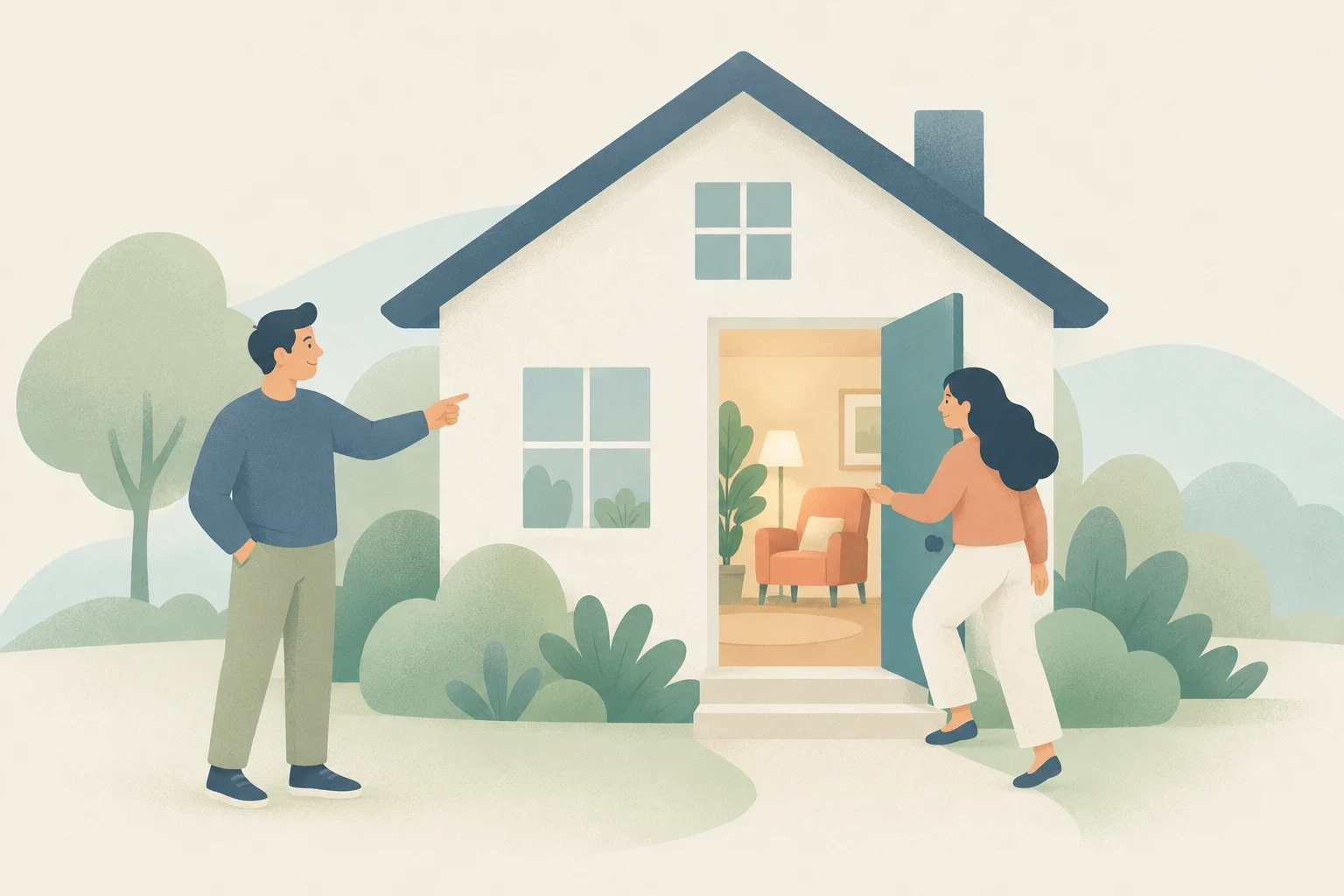
House names a physical residential structure with walls, a roof, and rooms. Home identifies the personal living space where someone resides, sleeps, and keeps personal belongings. Home can also describe a sense of comfort, safety, and community belonging.
Key points
- Choose house when describing a physical building, its rooms, or structural repairs.
- Choose home when referring to your residence, daily living environment, or comfort.
- Remember to say at home for location and go home for travel without adding to.
This lesson has 5 stages. You can stop at any time and continue later.

At a glance
| Feature | House | Home |
|---|---|---|
| Primary meaning | A physical residential building | The place where someone resides |
| Focus | Walls, roof, rooms, structure | Personal life, safety, comfort |
| Possible types | Freestanding residential buildings | Houses, apartments, rooms, boats |
| Grammar role | Countable noun with determiners | Countable noun or destination word |
Stage 1 of 5
Understand
What it means, when to use it, and mistakes to avoid.
Examples
They bought a brick house on Maple Street.
Why it works: House identifies the physical residential structure they purchased.
3 more examples
-
After three weeks away on business, I was glad to be back home.
Home highlights the personal living environment and comfort of returning.
-
We left our coats in the house before walking around the garden.
In the house specifies the interior of the building rather than the outdoor grounds.
-
You should go home and rest before tomorrow's examination.
Go home uses no preposition because home functions as a destination word.
Read the full guide
Choose House for the Building and Home for Where Someone Lives
When you choose between house and home, ask what idea you need to communicate first. Use house when you describe physical architecture, construction materials, exterior walls, or real estate transactions. Use home when you talk about where a person sleeps, eats, keeps personal possessions, and conducts daily life. The same building can be both, but your choice sets the emphasis.
A property developer builds a house out of concrete, wood, and glass. A resident transforms that physical structure into a home by living inside it and establishing daily routines. Distinguishing the physical object from the living space prevents common errors when you describe where people stay or invite visitors over.
-
The old house on the corner has three chimneys.
Why it works: House describes the physical building and its exterior features.
-
She created a warm home filled with books and plants.
Why it works: Home emphasizes her personal living atmosphere.
Your turn
Which word best completes this sentence about building maintenance: 'The painters repaired the outer walls of the _____.'?
Answer: house
Show the answer
Answer: house
Outer walls are physical architectural features, so house is the accurate choice.
An Apartment Can Be a Home
Many adult learners assume every home must be a detached building with a private garden. In natural English, your home is wherever your private residence is located. You can live in a downtown studio, a shared flat, an attic room, or a houseboat. Each of those dwellings is your home because you live there every day.
Using home does not require property ownership, marriage, or family life. A single tenant living in a small studio can speak about their home with complete grammatical accuracy. However, that tenant cannot say they live in a house if their residence sits inside a six-story apartment complex.
-
Marco rented an apartment near his office and quickly made it his home.
Why it works: Home describes his living space inside an apartment building.
-
Her cozy studio apartment feels like home even though she lives alone.
Why it works: Home works for single tenants living in rental flats.
You can practise this again in Him or His: Choose the Right Word and See or watch: Choose the right verb.
Your turn
A coworker lives in a studio on the fifth floor of a residential building. Which statement is correct?
Answer: The studio is her home.
Show the answer
Answer: The studio is her home.
An apartment functions as a person's home regardless of building type or rental contract.
Use a House, My House, a Home, and My Home
Both house and home operate as countable nouns in English. That means you can use determiners such as a, the, my, or our before either word. If you want further practice selecting definite and indefinite determiners, see our companion lesson at /micro-listenings/a-an-and-the-choose-an-article-listening-practice/ for detailed listening models.
Plural forms are also completely natural for both words. You can say several houses stand along the river, or city planners plan to build two hundred homes for new residents. When you place an article or possessive pronoun before home, it behaves like an ordinary countable noun naming a dwelling unit.
-
They purchased a new home near the regional hospital.
Why it works: A new home uses an indefinite article before an adjective and noun.
-
Five stone houses line the northern side of the square.
Why it works: Houses is a plural countable noun naming individual buildings.
-
We invited our neighbors over to inspect our new house.
Why it works: Our new house highlights the physical property acquired by the speakers.
Your turn
Choose the sentence that correctly uses home as a countable noun phrase.
Answer: They hope to purchase a home near the lake.
Show the answer
Answer: They hope to purchase a home near the lake.
When home functions as a countable noun, it takes an article like 'a' before an adjective or prepositional phrase.
Choose At Home or In the House for Location
When you report where you are or where an item is located, distinguish at home from in the house. Use at home to name your general domestic location. If a coworker calls during your day off to ask where you are resting, you say you are at home. You omit the article in that established phrase.
Use in the house when you want to highlight the interior space of a specific building rather than the garden, driveway, or garage outside. If your umbrella sits on the hallway table, it is in the house. Notice also that adult children often live at home with their parents, whereas a family lives in a house.
-
Carlos prefers to work at home on Mondays.
Why it works: At home refers to his general domestic workspace.
-
Please wait in the house while I sweep the front porch.
Why it works: In the house specifies being indoors inside the building.
Your turn
A friend calls while you are relaxing in your living room and asks where you are. What is the most natural reply?
Answer: I am at home right now.
Show the answer
Answer: I am at home right now.
'At home' is the standard set phrase for being present in your normal living space.
Say Go Home but Go to My House
Adding the preposition to before bare home is a frequent slip for English learners. Movement verbs like go, come, arrive, return, and get connect directly to home without to. You say go home, came home, arrived home, and get home. In these expressions, home functions as a directional destination word showing where movement ends.
In contrast, house is an ordinary noun phrase that requires a preposition of movement. Say go to my house, walk to the house, or drive to their house. Keep arrive separate from the to pattern as well: standard English requires arrive at the house or arrive home, never arrive to the house.
-
I usually get home around six in the evening.
Why it works: Get home connects directly without the preposition to.
-
Let us walk to my house to collect our coats.
Why it works: My house is a noun phrase, so the movement verb walk requires to.
Your turn
Which sentence correctly describes arriving after an evening concert?
Answer: We arrived home before midnight.
Show the answer
Answer: We arrived home before midnight.
Arrive home connects directly without 'to', whereas 'arrived to the house' incorrectly pairs arrive with 'to'.
Use Feel at Home for Comfort and Belonging
Beyond addresses and buildings, home conveys emotional security, ease, and belonging. The common expression feel at home means you feel relaxed and accepted in a place or group. Hosts often say make yourself at home to tell visitors to sit down, take off their jackets, and behave without rigid formality.
In a broader sense, home can also refer to your native city or country when context makes that connection clear. When people living overseas say they miss home, they usually mean their community, traditions, and family circle. Even in figurative contexts, remember that house cannot replace home in these expressions.
-
The warm welcome made every traveler feel at home.
Why it works: Feel at home describes an environment of comfort and hospitality.
-
Please sit on the sofa and make yourself at home.
Why it works: A polite phrase inviting guests to relax comfortably.
-
After four years living abroad, he longed to visit home.
Why it works: Home refers to his native town or country rather than a specific building.
Your turn
What does a colleague mean when saying 'I really feel at home in our new office'?
Answer: The colleague feels comfortable, accepted, and at ease in the new office.
Show the answer
Answer: The colleague feels comfortable, accepted, and at ease in the new office.
'Feel at home' expresses comfort, familiarity, and a sense of belonging in a space.
Listen for Home and House in Visitor Plans
In fast spoken English, unstressed function words weaken while key nouns retain stress. In the phrase at home, the preposition at often reduces to a quick unstressed syllable, but the /oʊ/ vowel and the closing /m/ sound of home remain audible. Listen carefully for that final /m/ to distinguish home from house.
The singular noun house ends in a clear voiceless /s/ sound. Notice how speakers switch between the two terms based on perspective. In the conversation below, Lucas speaks about his own destination as home, while Clara identifies Lucas's property as a house until Lucas invites her to feel comfortable inside.
-
Lucas walked home after completing his afternoon tasks.
Why it works: Home identifies his personal residence and follows walked without to.
-
Clara accompanied Lucas to his house to view the garden.
Why it works: His house identifies the physical building as Clara's destination.
Your turn
How does the noun 'house' differ in sound from 'home' in everyday spoken English?
Answer: House ends in a voiceless /s/ sound, while home ends in a voiced /m/ sound.
Show the answer
Answer: House ends in a voiceless /s/ sound, while home ends in a voiced /m/ sound.
House finishes with the /s/ consonant, whereas home finishes with the bilabial nasal /m/.
Recall Phrases to Describe Your Own Home
Combine these principles when you speak or write about where you live. Use house when describing physical facts: the number of bedrooms, the color of the roof, the heating system, or building renovations. Use home when you explain how your space feels, how you rest, or how you welcome friends into your life.
Before you complete the writing activities below, test your recall of the three primary movement and location patterns. Remember at home without an article, go home without the preposition to, and go to my house with both to and a determiner. Recalling these fixed combinations automatically will keep your English accurate and fluent.
-
Our family lives in an old wooden house, but it feels like a warm home.
Why it works: Contrasts the physical building material with the personal atmosphere.
-
I will get home around seven and prepare some soup.
Why it works: Applies the direct movement pattern with get home.
Your turn
Which pair of phrases correctly completes: 'I usually stay _____ on Fridays, but tonight I will go _____.'?
Answer: at home / to my house
Show the answer
Answer: at home / to my house
'At home' expresses domestic presence without an article, and 'to my house' correctly combines 'to' with the noun phrase 'my house'.
Use it naturally
How people really use “Home”
Neutral Fine almost anywhere, at work or with friends.
Words it often goes with
- go homeWe can go home after lunch.
- back homeI am happy to be back home.
- at homeMy brother is at home today.
- feel at homeYour family makes me feel at home.
What people also say
- “I'm going home.” instead of “I'm going to home.” Use go home without to when you mean the place where you live.
Questions about "Home or House: Choose the Right Word"
Can an apartment be my home?
Yes. Home refers to the place where you live, regardless of architectural design. An apartment, a condominium, a shared room, or a houseboat is your home if that is where your daily life happens. You only use house if the building is a standalone residential structure.
She moved into a third-floor apartment and soon felt right at home.
Can I use home and house for the same place?
Yes, you can describe the exact same property with either word, but your communicative emphasis changes. If you say you painted your house, you draw attention to the building and its exterior walls. If you say you love your home, you emphasize personal comfort, daily living, and family life.
We bought an old house last year and turned it into a wonderful home.
Why do we say go home without to?
In phrases such as go home, come home, and get home, the word home functions as a directional destination word rather than a standard noun phrase. Just as you say go abroad or go downtown without to, you omit the preposition before bare home. Adding to is ungrammatical unless a determiner is present.
They were tired after the workshop and wanted to go home immediately.
Is come to my home correct?
Yes, come to my home is grammatically correct because home is preceded by the possessive determiner my, forming a noun phrase. When home has a determiner, it requires a preposition for movement. However, native speakers more commonly say come to my house or come over to my place in casual conversation.
You are welcome to come to my home whenever you visit our city.
What's the difference between at home and in the house?
At home refers broadly to your presence in your domestic residence. In the house specifically means inside the interior walls of a building, contrasting with being in the garden, yard, or garage. For instance, if you are sitting on your front lawn, you are at home, but you are not in the house.
He was at home all morning reading on the patio, not in the house.
Can I say a home or two homes?
Yes. Home is a countable noun when it describes dwellings as individual units. Real estate developers, news reports, and social agencies frequently refer to a new home or building five hundred new homes. You can also say someone owns two homes if they maintain two separate residences.
The organization helped build thirty new homes for displaced families.
Before you go
Remember this
Choose house when describing a physical building, its rooms, or structural repairs. Choose home when referring to your residence, daily living environment, or comfort. Remember to say at home for location and go home for travel without adding to.
Stage 2 of 5
Listen
Hear it in real sentences, from short to long, and write what you hear.
0 of 4 done
Listening 1 of 4
Listening 2 of 4
Try a longer clip. Listen once, then replay the part you missed.
Listening 3 of 4
This clip is longer. Follow the instruction above the answer field.
Listening 4 of 4
Listen, then type the missing words. The rest of the text is already there.
0:00
Practice complete
You listened closely.
Your result is saved in this browser.
Keep your progress. Your practice is saved on this device only. Create a free account to keep it everywhere.
Create a free accountThat was today's free lesson. Tomorrow you get another one. Want more today? See membership.
Create a free SubLearn account to keep this progress across devices.
Save my progressStage 3 of 5
Speak
Say it with the speaker, then use it in your own answer.
Shadow
Say it along with the speaker
Play the line slowly, then speak at the same time as the speaker. Copy the rhythm, not just the words.
Your turn
Say it your way
Explain your evening routine after leaving work or school. Describe whether you head straight home or visit a friend's house, and mention what you do first.
You could start with “When I finish my daily work, I usually go home…”
Take ten seconds to think, then answer out loud without looking at the lesson. Speak for the time shown in the task above. Nothing is sent unless you ask for feedback.
0:00
Stage 4 of 5
Write
Write your own response
AI feedback · it can make mistakes · Part of membership See membership
Check your own writing
Read one possible response
Draft saved on this device.
Use these checks to revise your message. Grammar and meaning are not automatically graded. Each task keeps its own draft in this browser tab.

You finished the free part of this lesson
- Understand
- Listen
- Speak
- Write
- CheckPart of membership
Worth another look
With a free account, the lessons you finish come back for review to help you remember them.Create a free account
Stage 5 of 5 · Part of membership
Check
New clips without hints.
Listening tests are included with membership. Try the free dictation first, then decide whether to continue.
Listening 1 of 2 Part of membership
Listening 2 of 2 Part of membership
Follow MicroEnglish
Find lesson updates, short videos and quick quizzes. Pick the app you already use.
Questions & comments
Ask about this lesson, share an example, or help another learner.
Example
Memory tip
Goes with
Related forms
Not to be confused with
In this lesson
This word isn't in our dictionary. Check the spelling, or try another form of the word.
We couldn't load this word. Try again.
