Audio corto
See or watch: Choose the right verb
Why do native speakers say both see a movie and watch a movie?
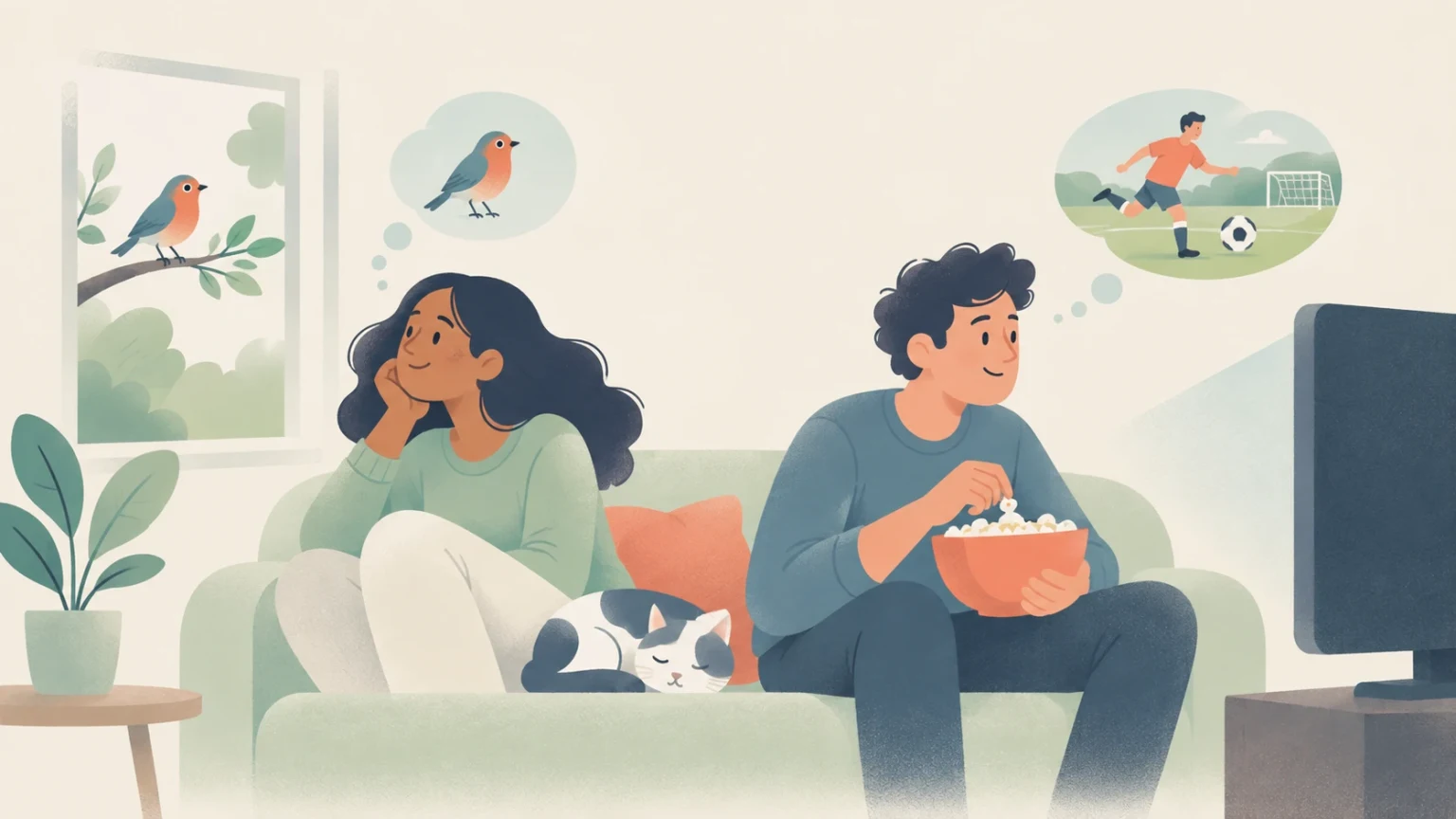
See can describe being able to perceive something visually, noticing it, or experiencing an event. It also means meeting someone in some contexts. Watch emphasizes attention to something over time, including monitoring an object that stays still.
Puntos clave
- See often describes perception or an experience; watch emphasizes attentive viewing or monitoring.
- Duration alone does not decide the choice.
- Check the meaning in the full sentence, including other uses such as seeing a friend.
Esta lección tiene 5 etapas. Puedes parar cuando quieras y continuar más tarde.

Etapa 1 de 5
Entender
Qué significa, cuándo usarlo y qué errores evitar.
Ejemplos
I saw an interesting poster outside the train station.
Por qué funciona: The poster simply entered the speaker's field of vision.
3 ejemplos más
-
We sat by the window to watch the snowfall cover the street.
The speaker followed the changing weather over a period of time.
-
Did you see your doctor about that cough?
See means visiting a professional for medical advice or treatment.
-
My family likes to watch comedy series together on Friday evenings.
Watch describes following a screen program over its duration.
Leer la guía completa
Decide whether your eyes notice or follow
When you choose between see and watch, start by looking at your attention. You see something when light hits your eyes and you become aware of it, even without trying. You watch something when you deliberately fix your eyes on an object or person to follow what happens over a period of time.
-
I saw a strange bird on the roof, so I paused.
Por qué funciona: The bird simply entered the speaker's field of vision.
-
We stood on the balcony to watch a strange bird build its nest.
Por qué funciona: The speakers intentionally spent time observing the bird's ongoing actions.
Tu turno
You want to say that you observed a street musician perform three songs during your lunch break. Which verb is correct?
Respuesta: watch
Mostrar la respuesta
Respuesta: watch
Because you stayed and kept your eyes on the musician over time, watch is the accurate verb.
Use see when something enters your view
Use see for moments when an object, person, or sign simply comes into your visual range. This action requires no special effort or extended concentration. You might see your neighbor walking down the road, see an email arrive in your inbox, or see an error message on your cash machine.
-
Did you see our supervisor in the lobby this morning?
Por qué funciona: The speaker is asking whether the supervisor came into view.
-
Drivers can see a warning sign from fifty yards away.
Por qué funciona: The sign is visible without requiring tracking over time.
Puedes practicar esto de nuevo en Too long or to long: Choose the right word y Then or Than: Choose the Right Word.
Tu turno
Choose the correct sentence to confirm that a road sign is visible from your passenger seat.
Respuesta: I can see the speed limit sign clearly from here.
Mostrar la respuesta
Respuesta: I can see the speed limit sign clearly from here.
A static sign enters your field of vision, so see is the natural verb.
Use watch for ongoing movement and activity
Choose watch when you mean paying attention to what happens or monitoring something. The activity can be brief or long: watch a short clip, a match, or a technician at work. The word does not require you to see the whole event.
-
The mechanic asked me to watch an engine belt while he started the car.
Por qué funciona: The speaker needed to follow the moving belt continuously.
-
Families often sit near the shore to watch incoming waves.
Por qué funciona: The waves move and change continuously, which rewards sustained attention.
Tu turno
Which verb correctly describes monitoring a cooking sauce so that it does not boil over?
Respuesta: Watch the sauce closely for five minutes.
Mostrar la respuesta
Respuesta: Watch the sauce closely for five minutes.
Monitoring a changing substance over several minutes requires watch.
Pick the natural verb for movies and screens
When you consume media on a screen at home, watch is the normal choice because you sit and follow moving pictures on a television, computer, or smartphone. However, English speakers use both see and watch for films, depending on whether they mean the social experience or the physical viewing act.
-
I watched an interesting documentary on my tablet last night.
Por qué funciona: The speaker spent time following the show on a digital display.
-
Did you see that documentary when it first came out?
Por qué funciona: Here see refers to the experience of having viewed the documentary as a whole.
Tu turno
Which sentence sounds most natural when asking about a friend's evening activity on their sofa?
Respuesta: Did you watch any television yesterday evening?
Mostrar la respuesta
Respuesta: Did you watch any television yesterday evening?
Sitting down to view a broadcast or streaming video is described with watch.
Describe live shows and social plans with see
When you attend a cultural event, sports match in a stadium, theater production, or cinema screening, see is common because it includes the entire public outing. You can say you saw a play downtown, even though you watched the actors move across the stage during the performance.
-
We went downtown to see a musical on Friday evening.
Por qué funciona: See emphasizes attending the cultural event as an outing.
-
Thousands of fans came to the arena to see their favorite band.
Por qué funciona: The focus is on attending the live performance in person.
Tu turno
You want to invite a coworker to go out to the local cinema hall on Friday. Which phrase should you use?
Respuesta: Do you want to see a movie at the cinema on Friday?
Mostrar la respuesta
Respuesta: Do you want to see a movie at the cinema on Friday?
Going out to an entertainment venue is typically phrased as seeing a movie or play.
Use see for visits, doctors, and meetings
See carries a special meaning of meeting someone or receiving professional advice. You see a doctor, see a lawyer, or see a counselor. You also use see when you spend social time with friends or family members. Watch is never used for these scheduled meetings or personal consultations.
-
Marcus has an appointment to see a specialist tomorrow.
Por qué funciona: See means to visit a professional for medical help.
-
I always see our relatives when I travel home for the holidays.
Por qué funciona: See means visiting and spending time together.
Tu turno
A colleague has severe back pain. What advice should you give?
Respuesta: You ought to see a doctor this afternoon.
Mostrar la respuesta
Respuesta: You ought to see a doctor this afternoon.
Consulting a medical professional always uses see, never watch.
Distinguish seeing an event from watching it unfold
See can report that you witnessed an event. Watch emphasizes following or monitoring it with attention. These meanings overlap, and the length of the event alone does not decide the verb. You can watch for a few seconds or see something happening over a longer period.
-
I saw an apple drop from the branch.
Por qué funciona: The drop was a sudden event that the speaker caught with their eyes.
-
We watched an apple tree grow over several summers.
Por qué funciona: The observers tracked the ongoing development over an extended period.
Tu turno
You noticed a delivery driver drop a parcel on the pavement as you walked past. Which sentence is best?
Respuesta: I saw the driver drop the parcel as I passed.
Mostrar la respuesta
Respuesta: I saw the driver drop the parcel as I passed.
Saw reports that the speaker witnessed the event. The sentence is not a rule that every brief event requires see.
Check your verb choice in everyday conversations
Ask whether you mean noticing something or paying attention to it. See can describe becoming aware of something in your view. Watch means following or monitoring it over time, even if it stays still, as when you watch someone's bags. For directing your eyes toward something, look at may fit.
-
Can you see our train on the departure screen yet?
Por qué funciona: Checking whether static text is visible uses see.
-
Please watch our bags while I purchase two platform tickets.
Por qué funciona: Guarding property requires active, ongoing attention, so watch is required.
Tu turno
You ask a friend at a railway station to guard your luggage for three minutes. What do you say?
Respuesta: Could you watch my bags for three minutes?
Mostrar la respuesta
Respuesta: Could you watch my bags for three minutes?
Guarding something requires continuous attention, so watch is the correct verb.
Preguntas sobre "See or watch: Choose the right verb"
Why do native speakers say both see a movie and watch a movie?
Both verbs are common with movies, but they carry a slight difference in emphasis. When you say see a movie, you usually refer to the total experience or attending a cinema screening. When you say watch a movie, you emphasize the activity of sitting down and looking at the screen over its duration.
We went to the theater to see a movie.
I stayed home to watch a movie on my laptop.
Does the phrasal verb watch out have the same meaning as watch?
No, watch out is an idiom that means be careful or pay attention to immediate danger. While regular watch describes looking at an activity over time, watch out functions as an urgent warning.
Watch out for that bicycle behind you!
Can I use see in progressive continuous forms like I am seeing?
For ordinary visual perception, the simple form or can see is usual: 'I can see a bird.' Progressive see is possible in other meanings, such as meeting someone, and in special perception contexts such as 'I'm seeing double.' Avoid treating the usual pattern as a ban on every progressive use.
I see an empty chair by the window.
She is seeing a specialist about her knee this week.
How does look at fit into the difference between see and watch?
Look at emphasizes directing your eyes toward something. See can describe perception or an experience. Watch emphasizes attention or monitoring over time, including watching something that stays still, such as another person's bags.
Look at this photograph on page four.
I saw the photograph, and then we watched a video about the same subject.
Antes de irte
Recuerda esto
See often describes perception or an experience; watch emphasizes attentive viewing or monitoring. Duration alone does not decide the choice. Check the meaning in the full sentence, including other uses such as seeing a friend.
Etapa 2 de 5
Escuchar
Escúchalo en frases reales, de la más corta a la más larga, y escribe lo que oyes.
0 de 4 completado
Escucha 1 de 4
Escucha y luego escribe lo que oyes. Repite tantas veces como necesites.
0:00
Escucha 2 de 4
Escucha y luego escribe lo que oyes. Repite tantas veces como necesites.
0:00
Intenta un clip más largo. Escucha una vez y luego reproduce la parte que te perdiste.
Escucha 3 de 4
Escucha y luego escribe lo que oyes. Repite tantas veces como necesites.
0:00
Este clip es más largo. Sigue la instrucción encima del campo de respuesta.
Escucha 4 de 4
Escucha y luego escribe las palabras que faltan. El resto del texto ya está ahí.
0:00
Práctica completada
Escuchaste con atención.
Tu resultado está guardado en este navegador.
Mantén tu progreso. Tu práctica se guarda solo en este dispositivo. Crea una cuenta gratuita para conservarla también cuando uses otros dispositivos.
Crear una cuenta gratuitaEsa fue la lección gratuita de hoy. Mañana tendrás otra. ¿Quieres más hoy? Consulta la membresía.
Crea una cuenta gratuita de SubLearn para mantener este progreso en todos tus dispositivos.
Guardar mi progresoEtapa 3 de 5
Hablar
Dilo junto con el hablante y luego úsalo en tu propia respuesta.
Imita
Dilo junto con el hablante
Reproduce la frase a velocidad lenta y repítela al mismo tiempo que la grabación. Imita también el ritmo.
Tu turno
Dilo a tu manera
Describe what you notice around you right now and what you plan to spend time observing later today.
Puedes empezar con “From my seat, I can see…”
Piensa durante diez segundos, luego responde en voz alta durante el tiempo que pida la tarea, sin mirar la lección. No se envía nada a menos que pidas retroalimentación.
0:00
Etapa 4 de 5
Escribir
Escribe tu propia respuesta
Retroalimentación de IA · puede cometer errores · Parte de la membresía Ver membresía
Revisa tu texto
Leer una posible respuesta
Borrador guardado en este dispositivo.
Usa estas comprobaciones para revisar tu mensaje. La gramática y el significado no se califican automáticamente. Cada tarea mantiene su propio borrador en esta pestaña del navegador.

Terminaste la parte gratuita de esta lección
- Entender
- Escuchar
- Hablar
- Escribir
- PruebaParte de la membresía
Vale la pena volver
Con una cuenta gratuita, las lecciones que terminas vuelven para que las repases, y eso te ayuda a recordarlas.Crear una cuenta gratuita
Etapa 5 de 5 · Parte de la membresía
Prueba
Grabaciones nuevas sin pistas.
Las pruebas de comprensión auditiva están incluidas con la membresía. Prueba primero el dictado gratuito y luego decide si quieres continuar.
Escucha 1 de 2 Parte de la membresía
Escucha 2 de 2 Parte de la membresía
Sigue a MicroEnglish
Encuentra lecciones, videos cortos y pruebas rápidas en la aplicación que ya usas.
Preguntas y comentarios
Pregunta sobre esta lección, comparte un ejemplo o ayuda a otro estudiante.
Ejemplo
Consejo para recordar
Combina con
Formas relacionadas
No confundir con
En esta lección
Esta palabra no está en nuestro diccionario. Revisa cómo se escribe o prueba otra forma de la palabra.
No pudimos cargar esta palabra. Inténtalo de nuevo.
