Micro-listening
Too long or to long: Choose the right word
Too long or to long: which is correct?
'Too long' is correct when something lasts longer than wanted or has more physical length than needed; 'to long' is not normally correct for this meaning. For example, 'The queue was too long for my break.' Use single-o 'to' before a verb, as in 'I need to leave.'
Key points
- Use 'too long' for unwanted extra time or length.
- Use 'to' before a base verb or for direction.
- 'Too long' often describes a practical problem or inconvenience.
- Use 'long enough' when the length is sufficient.
This lesson has 5 stages. You can stop at any time and continue later.

At a glance
| Form | Use it for | Example |
|---|---|---|
| too long | Excessive duration or physical length | The lesson was too long for me. |
| to + verb | Introduces an action | I want to leave now. |
| to + place | Shows direction | We walked to the station. |
| long enough | Sufficient duration or length | The cable is long enough. |
Stage 1 of 5
Understand
What it means, when to use it, and mistakes to avoid.
The full explanation
Too long describes a duration or measurement that exceeds what is practical, acceptable, or desirable. The adverb too modifies the adjective long to show an unwanted surplus. In contrast, the word to is either a preposition indicating direction or an infinitive particle that precedes a base verb. The spelling to long does not function as a standard phrase for excess in modern English.
The onboarding presentation was too long, so several employees asked for a coffee break.
Why it works: Too modifies long to show that the presentation duration exceeded what the audience could handle.
3 more examples
-
This desk cable is too long to leave loose on the floor.
Too expresses excess physical length, while to introduces the base verb leave.
-
We waited too long before ordering the replacement parts for the printer.
Too modifies long to emphasize that the delay caused an operational issue.
-
The company handbook is long enough to cover every company policy in detail.
Long enough indicates a suitable and sufficient length rather than an undesirable excess.
Read the full guide
Decide Between an Excess and an Action
When you hear the sound /tuː/ before the adjective long, determine whether you are describing an excessive amount or introducing an action. The word too with two o letters means more than necessary, suitable, or convenient. In contrast, the word to with one o serves as a preposition showing direction or as a marker before a base verb. Choosing between them depends on the grammatical job required by your sentence.
-
The meeting agenda is too long for a single morning.
Why it works: Too modifies long to show that the schedule exceeds the available time.
-
We need to schedule another appointment tomorrow.
Why it works: To introduces the verb schedule rather than describing a degree of length.
Your turn
Which spelling correctly describes a queue that lasts longer than you can wait?
Answer: The wait at the service counter is too long.
Show the answer
Answer: The wait at the service counter is too long.
Too modifies the adjective long to show that the duration is excessive. The spelling to cannot modify an adjective.
Identify the Word That Follows
A reliable way to choose the right spelling is to inspect the word immediately following /tuː/. When that next word is an adjective such as long, heavy, or expensive, you almost always need too. If the next word is a basic verb like wait, visit, or call, the single-o spelling to is required. Looking at the grammatical category of the following word eliminates guesswork in daily writing.
-
The flight delay was too long for the passengers in terminal two.
Why it works: Long is an adjective, so the preceding modifier must be spelled too.
-
The pilot stepped out to speak with the gate agents.
Why it works: Speak is a verb, so to serves as the infinitive marker.
You can practise this again in To, Too or Two: How to Choose and Then or Than: Choose the Right Word.
Your turn
Select the sentence where to introduces an action rather than an adjective.
Answer: We decided to walk up the stairs instead.
Show the answer
Answer: We decided to walk up the stairs instead.
In this sentence, to comes directly before the base verb walk, forming an infinitive. The other options describe excessive length with an adjective.
Describe Unwanted Duration in Schedules
In professional and academic schedules, too long signals that a duration creates an inconvenience or breaks an agreed limit. Merely stating that an event is long provides neutral information, while too long adds an evaluation of negative impact. When a lecture, phone call, or training session takes more time than participants can sustain, describe the duration with too long.
-
A ninety-minute introductory speech is too long for new clients.
Why it works: Too long expresses that the presentation duration surpasses what clients can absorb.
-
The video lasted forty minutes, which felt long but manageable.
Why it works: Long without too merely characterizes the duration without declaring it unacceptable.
Your turn
Why would a project coordinator write 'the review meeting was too long'?
Answer: To report that the duration caused fatigue and wasted productive hours.
Show the answer
Answer: To report that the duration caused fatigue and wasted productive hours.
Too long conveys an evaluation of excess, meaning the duration caused an inconvenient or negative outcome.
Measure Physical Length in Practical Tasks
Physical objects such as cables, furniture, clothing, and lumber require too long when their measurements exceed the space available for them. When a board extends past the frame or a curtain touches the floor with extra folds, the extra length prevents proper function. Use too long to justify cutting, exchanging, or folding the item so that it fits the intended area.
-
The replacement curtain rod is too long for this bedroom window.
Why it works: The physical dimension exceeds the width of the window frame.
-
The carpenter had to trim two inches from the board.
Why it works: To introduces the verb trim, which resolves the excess physical length.
Your turn
Which sentence explains why someone needs to return an item to a store?
Answer: The charging cable is too long and tangles around the office chair wheels.
Show the answer
Answer: The charging cable is too long and tangles around the office chair wheels.
Too long correctly uses the double-o spelling to describe excess physical measurement that causes a practical problem.
Combine Too Long With Action Verbs
English sentences frequently place too long and to near each other in the pattern 'too long to + verb'. In this structure, too modifies the adjective long, and to introduces the following action that becomes impossible or impractical. Separating the distinct jobs of each word prevents you from accidentally writing to long or too before the verb.
-
The technical report was too long to summarize in a five-minute email.
Why it works: Too modifies long, while to introduces the verb summarize.
-
The queue outside the embassy was too long to join before closing time.
Why it works: Too shows excessive queue length, and to begins the action join.
Your turn
Choose the sentence that applies the 'too long to + verb' construction correctly.
Answer: The contract is too long to read during our morning break.
Show the answer
Answer: The contract is too long to read during our morning break.
Too modifies the adjective long, and single-o to introduces the basic verb read.
Distinguish Too Long From Long Enough
Learners sometimes confuse too long with long enough because both phrases evaluate measurement against an expectation. Too long means the length is excessive and creates a problem, whereas long enough means the length meets the requirement and produces a successful result. Additionally, notice that too appears before long, but enough always appears after long in standard English word order.
-
The extension cord is long enough to reach the projector on the stage.
Why it works: The cord meets the required length, so the setup works properly.
-
The extension cord is too long, so extra coils clutter the stage floor.
Why it works: The cord has excess length that causes an unnecessary obstacle.
Your turn
A technician needs a network wire that reaches a desk fifteen feet away. If the wire measures exactly sixteen feet and works without clutter, what should the technician say?
Answer: The wire is long enough for the office.
Show the answer
Answer: The wire is long enough for the office.
Long enough indicates that the item satisfies the requirement, with enough correctly positioned after the adjective.
Hear the Difference in Connected Speech
In natural spoken English, too and to can sound identical when both are pronounced as /tuː/. However, in connected speech, the word to is usually reduced to a weak form with a neutral schwa vowel, sounding like /tə/. In contrast, too is an adverb of degree and almost always preserves its full vowel /uː/ because it carries sentence stress.
-
We waited too long to call customer service.
Why it works: Too carries primary stress with a full /uː/, while to reduces to a weak /tə/ before call.
-
The drive was too long to complete before sunset.
Why it works: Too long receives emphatic vocal stress, whereas to before complete is unstressed.
Your turn
In fluent conversation, how can a listener tell whether /tuː/ or /tə/ represents the word before a verb?
Answer: The preposition or infinitive marker to frequently reduces to a weak schwa sound /tə/.
Show the answer
Answer: The preposition or infinitive marker to frequently reduces to a weak schwa sound /tə/.
Grammatical function words like to reduce to /tə/ in unstressed positions, while content words and degree adverbs like too maintain their full vowel.
Avoid Common Spelling Traps in Writing
Automated spellcheckers frequently overlook the substitution of to long because to is a genuine English word. You must proofread your sentences manually by testing the meaning. If you can substitute excessively or more than needed, you must write too with two o letters. Remembering that too has an extra letter just like the situation has extra length serves as an effective memory hook.
-
Do not wait too long before confirming your conference registration.
Why it works: Excessive delay risks losing the seat, so the two-o spelling too is mandatory.
-
We went to the main hall to hear the keynote speaker.
Why it works: Both instances of to show direction and verb purpose, not excess.
Your turn
What practical self-check verifies that 'too long' is the correct spelling?
Answer: Replace the word with 'excessively' to confirm that you are expressing an unwanted surplus.
Show the answer
Answer: Replace the word with 'excessively' to confirm that you are expressing an unwanted surplus.
Because too means excessively, substituting that word tests whether the sentence describes an unwanted surplus rather than an action.
Common mistakes
What learners often say, what to say instead, and why.
-
Not this:
The online form is to long to complete.Say: The online form is too long to complete.
'Too' modifies the adjective 'long'; single-o 'to' introduces 'complete'.
-
Not this:
We need too check the address.Say: We need to check the address.
Single-o 'to' comes before the base verb 'check'.
-
Not this:
This cable is enough long for the printer.Say: This cable is long enough for the printer.
'Enough' follows the adjective 'long' in standard English word order.
Use it naturally
How people really use “too long”
Neutral Fine almost anywhere, at work or with friends.
Words it often goes with
- wait too longPlease do not wait too long to buy your ticket.
- take too longThese games take too long to finish.
- too long to wearThis skirt is too long to wear without high shoes.
- stay too longWe cannot stay too long because our children need to sleep.
Questions about "Too long or to long: Choose the right word"
Why is too spelled with two o letters in too long?
The word too with two o letters evolved as a stressed variant of the preposition to. Over time, English spelling assigned the double-o spelling to the adverb meaning also or excessively. An easy visual memory technique is to think of the extra o as representing an extra amount or an excess of length.
The seminar was too long.
That coat is too expensive.
Is there a difference between very long and too long?
Yes, there is an important difference in judgment. Very long simply emphasizes great duration or physical length without deciding whether it is good or bad. Too long specifically signals a problem, implying that the length exceeds acceptable limits and causes difficulty or inconvenience.
The novel is very long, but I enjoyed every chapter.
The novel is too long to finish during our one-week vacation.
Can the words to long ever appear next to each other correctly?
The sequence to long is only correct when long functions as a verb meaning to yearn or desire something strongly, preceded by the infinitive marker to. For example, in the sentence 'I began to long for quiet evenings,' long is an action verb. In everyday communication describing size or duration, to long is an error for too long.
After months abroad, she began to long for her hometown.
When should I use long enough instead of too long?
Use long enough when a measurement or duration satisfies a practical requirement. Unlike too long, which indicates a negative excess, long enough indicates that the length is sufficient for a specific purpose. Remember also that enough follows the adjective long, whereas too precedes it.
The charging cable is long enough to reach my bed.
The presentation was long enough to cover our questions.
Before you go
Remember this
Write too long with two o letters whenever length or time creates a problem or exceeds your needs. Use to with a single o when introducing a verb or showing direction. When both words appear in one sentence, verify each word individually: too modifies the adjective long, and to connects the action that follows.
Stage 2 of 5
Listen
Hear it in real sentences, from short to long, and write what you hear.
0 of 4 done
Listening 1 of 4
Listen, then type what you hear. Replay as often as you need.
0:00
Read the transcript
Our weekly meeting is too long on Mondays.
Too modifies the adjective long to show excessive duration, followed by the vowel in on.
Listen for
At natural speed these words change shape. Tap one to hear it again.
- The last sound of the first word runs straight into the next word.
- The last sound of the first word runs straight into the next word.
- In American English this t sounds like a quick, soft d.
Listen for
At natural speed these words change shape. Tap one to hear it again.
- The last sound of the first word runs straight into the next word.
- The last sound of the first word runs straight into the next word.
Listen for
At natural speed these words change shape. Tap one to hear it again.
- The last sound of the first word runs straight into the next word.
- The last sound of the first word runs straight into the next word.
- In American English this t sounds like a quick, soft d.
Listening 2 of 4
Listen, then type what you hear. Replay as often as you need.
0:00
Read the transcript
The new wooden shelf is too long.
Too modifies the adjective long at the end of the clause, carrying prominent sentence stress.
Listen for
At natural speed these words change shape. Tap one to hear it again.
- In "shelf is," listen for "shel-fis." The final f connects smoothly to "is."
Listen for
At natural speed these words change shape. Tap one to hear it again.
- In "shelf is," listen for "shel-fis." The final f connects smoothly to "is."
Try a longer clip. Listen once, then replay the part you missed.
Listening 3 of 4
Listen, then type what you hear. Replay as often as you need.
0:00
Read the transcript
We cannot hang this banner in our narrow hallway. The cloth is too long, and we plan to move our display into room six.
Too modifies long before a pause and coordinating conjunction, avoiding difficult consonant clusters.
Listen for
At natural speed these words change shape. Tap one to hear it again.
- The last sound of the first word runs straight into the next word.
- The last sound of the first word runs straight into the next word.
- The last sound of the first word runs straight into the next word.
Listen for
At natural speed these words change shape. Tap one to hear it again.
- The last sound of the first word runs straight into the next word.
- The last sound of the first word runs straight into the next word.
- The last sound of the first word runs straight into the next word.
Listen for
At natural speed these words change shape. Tap one to hear it again.
- The last sound of the first word runs straight into the next word.
- The last sound of the first word runs straight into the next word.
- The last sound of the first word runs straight into the next word.
This clip is longer. Follow the instruction above the answer field.
Listening 4 of 4
Listen, then type the missing words. The rest of the text is already there.
0:00
Read the transcript
Our manager thinks the training session is too long in the afternoon. People lose focus after lunch, so we must break the material into smaller units. She hopes to finish every presentation within twenty minutes. This change will give everyone time to ask questions, share quick opinions, and review the main points calmly.
Too long is stressed and followed by a vowel in the preposition in, with clean phonetic transitions throughout.
Listen for
At natural speed these words change shape. Tap one to hear it again.
- The last sound of the first word runs straight into the next word.
- The last sound of the first word runs straight into the next word.
- The last sound of the first word runs straight into the next word.
Listen for
At natural speed these words change shape. Tap one to hear it again.
- The last sound of the first word runs straight into the next word.
- The last sound of the first word runs straight into the next word.
- The last sound of the first word runs straight into the next word.
Listen for
At natural speed these words change shape. Tap one to hear it again.
- The last sound of the first word runs straight into the next word.
- The last sound of the first word runs straight into the next word.
- The last sound of the first word runs straight into the next word.
Practice complete
You listened closely.
Your result is saved in this browser.
Keep your progress. Your practice is saved on this device only. Create a free account to keep it everywhere.
Create a free accountThat was today's free lesson. Tomorrow you get another one. Want more today? See membership.
Create a free SubLearn account to keep this progress across devices.
Save my progressStage 3 of 5
Speak
Say it with the speaker, then use it in your own answer.
Shadow
Say it along with the speaker
Our weekly meeting is too long on Mondays.
Play the line slowly, then speak at the same time as the speaker. Copy the rhythm, not just the words.
Your turn
Say it your way
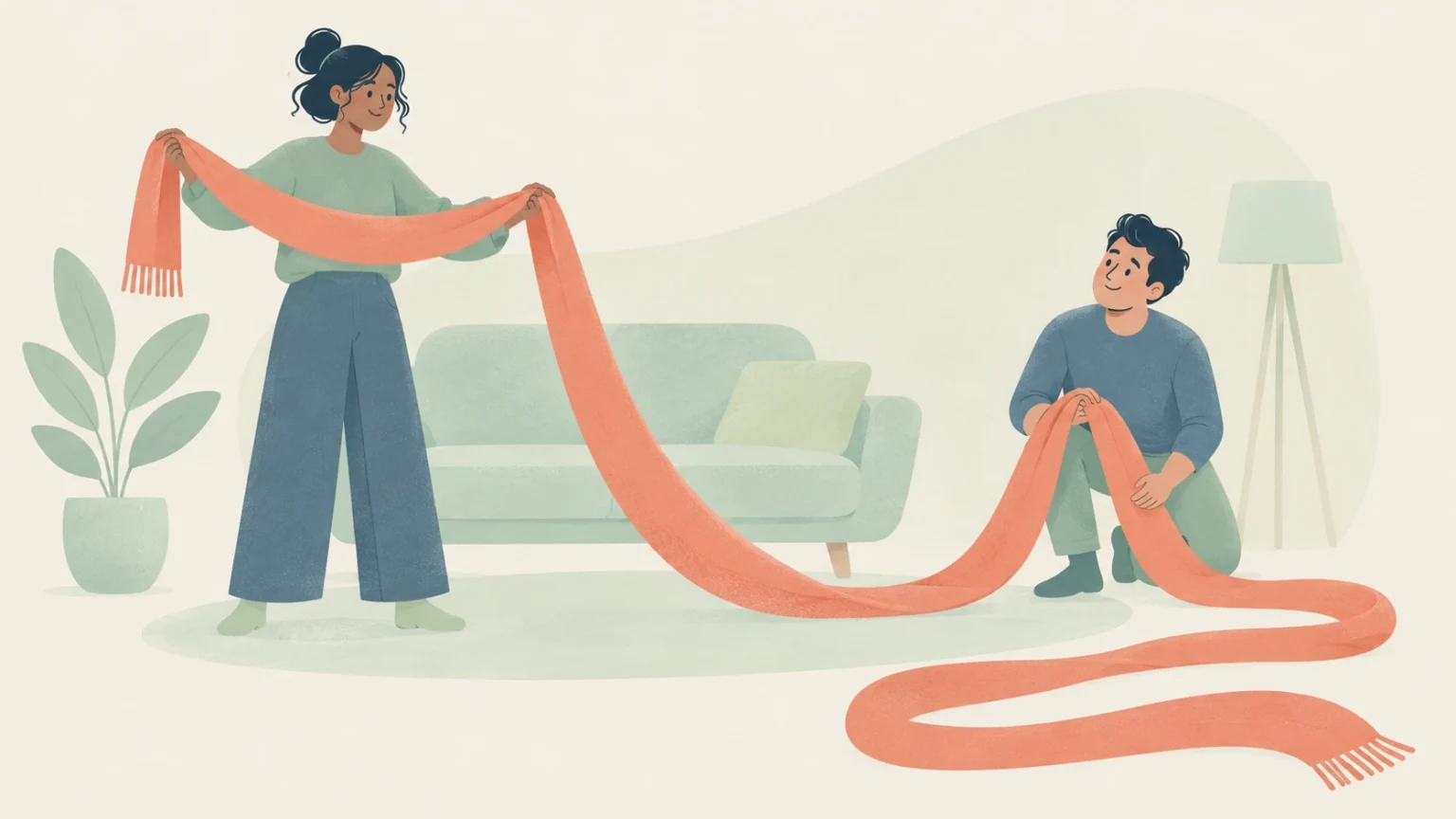
Speak for 30 to 60 seconds from memory. You are in a clothing store with a friend. Describe a scarf that is too long for you, explain the problem, and say what you want to buy instead.
Use: too long long enough
Think for ten seconds, then answer out loud for as long as the task above asks, without looking at the lesson. Nothing is sent unless you ask for feedback.
0:00
Hear how someone else might say it
I like this blue scarf, but it is too long for me. Look, the ends almost touch the floor! I cannot wear it like this because it will get dirty. I want a shorter scarf that is long enough to go around my neck. It is cold outside, so I need something warm. There is a green one on that table. It looks nice, and it costs less than this blue one. Can you hold my bag while I try it on?
Try once more and answer this: What color scarf would you like?
Stage 4 of 5
Write
Write about your own day or week using it, then write a message.
Write
Put it in your own words
- I used “too long”.
- It is about my life, not the lesson’s example.
- I read it once aloud to check it sounds right.
Write your own response
Choose a situation and write 30–50 words in your own wording. This is separate from typing the exact words in a recording.
Check your own writing
Read one possible response
Use these checks to revise your message. Grammar and meaning are not automatically graded. Each task keeps its own draft in this browser tab.

You finished the free part of this lesson
- Understand
- Listen
- Speak
- Write
- CheckPart of membership
Worth another look
With a free account, the lessons you finish come back for review to help you remember them.Create a free account
Stage 5 of 5 · Part of membership
Check
New clips without hints.
Listening tests are included with membership. Try the free dictation first, then decide whether to continue.
Listening 1 of 2 Part of membership
Listening 2 of 2 Part of membership
Follow MicroEnglish
New lessons, short videos and quick quizzes every day. Pick the app you already use.
Questions & comments
Ask about this lesson, share an example, or help another learner.
Example
Memory tip
Goes with
Related forms
Not to be confused with
In this lesson
This word isn't in our dictionary. Check the spelling, or try another form of the word.
We couldn't load this word. Try again.
