
Everyday listening
Start with short recordings, then work through longer phrases. Listen once for the situation and again for the words.
Showing 19–36 of 565 lessons
-

Keep your eyes peeled: meaning and everyday use
Keep your eyes peeled is an informal idiom that means watching with steady attention. It does not describe physical peeling. Instead, it creates an image of wide, open eyes ready to spot something important. You use it when you expect a target to appear, especially when finding that target requires active visual effort.
-

Whose or who's: choose the right word
Whose is a possessive word that identifies which person owns or is connected to something. Who's is a contraction representing either who is or who has. The apostrophe in who's marks the omitted letters from the auxiliary verbs is or has, rather than indicating ownership.
-

Do or does: questions and negatives guide
In the present simple tense, do and does act as helper words for questions and negatives with ordinary main verbs. They do not add extra meaning; instead, they signal the question or negative structure and show the subject group.
-

Common abbreviations: practical everyday usage
An abbreviation is a shortened representation of a word or phrase used to save space in writing and time in communication. While some abbreviations represent single words, others represent multiword expressions. Recognizing the letters alone does not indicate how to speak the form or what action the message requires.
-

A or an before an acronym: Spoken sound rules
An abbreviation represents a longer phrase or title. Some forms, called initialisms, are pronounced letter by letter, while others, called acronyms, are pronounced as ordinary words. In both cases, the indefinite article reflects the very first sound spoken in the phrase.
-

Him or His: Choose the Right Word
Him is the object pronoun for a male person. English uses it when an action affects that person directly or when the person follows a preposition. His is the possessive form. It shows that an object, schedule, relationship, or responsibility connects to that person.
-
Membership
Open every lesson free for 7 days
- 814 lessons with dictation and listening tests
- Three accents: British, American and Australian
- Your progress is saved
No card needed. Then from $7.50 a month if you want to keep going.
Start free trial -

Semi- and bi-: Understand Schedule Words
Prefixes provide clues about meaning, but the complete word determines how the idea works in a sentence. Semi- describes a half or partial state, such as a semicircle or a semi-private room. Bi- indicates two items, such as two languages in bilingual or two sides in bilateral. Time words with bi- require extra care because usage can vary across organizations.
-

A few or a little: choose the right word
A few means a small number of separate things that you can count individually. A little means a small quantity or portion of something that you measure as a whole. Both expressions describe modest amounts, but English strictly separates them based on the grammar of the noun.
-

Eat, ate, or eaten: choose the right form
The verb eat means to put food into your mouth, chew it, and swallow it. The core meaning never changes whether you say eat, ate, or eaten. The change in form tells your listener when the meal happened and whether it connects to another moment in time.
-

Head over heels: meaning and use
Head over heels means deeply, completely, and enthusiastically in love. It describes intense romantic attraction rather than everyday friendship or physical tumbling. The most common structures are be head over heels for someone to express a continuous state, and fall head over heels for someone to mark the moment strong love begins.
-

Insist on: use the right preposition
To insist means to say firmly that something is true or must happen. When you name the exact demand or required action, use insist on. The phrase signals that the speaker is not willing to drop the matter or accept a simple no.
-

Order of adjectives: describe nouns naturally
Adjectives add specific details to nouns. When you combine them, English groups adjectives by their communicative function. Opinion words such as wonderful or awkward come first. Physical descriptions such as size, age, shape, and color follow. Descriptions closest to the noun name origin, material, and purpose.
-

Ought to or must: advice or strict rules
Ought to means that an action is a sensible idea or that an event is probable under normal conditions. It shares a similar meaning with should, though it often sounds slightly more thoughtful. Must expresses a necessity that people cannot ignore, an official regulation, or a deduction where the evidence points to one clear fact. The context shows whether you are giving guidance, demanding action, or making a deduction.
-

Site or sight: which word fits?
Site refers to a place where an activity occurs, including construction areas, campsites, and online platforms. Sight relates to the physical ability to see, the act of looking, or a memorable visual scene.
-

Already, still, yet: choose the right word
These four words connect the present moment to an expectation or a past state. Already signals completion and sometimes pleasant surprise. Still emphasizes continuation over time. Yet looks forward toward an expected completion. No longer marks a clear division between what was true in the past and what is true today.
-
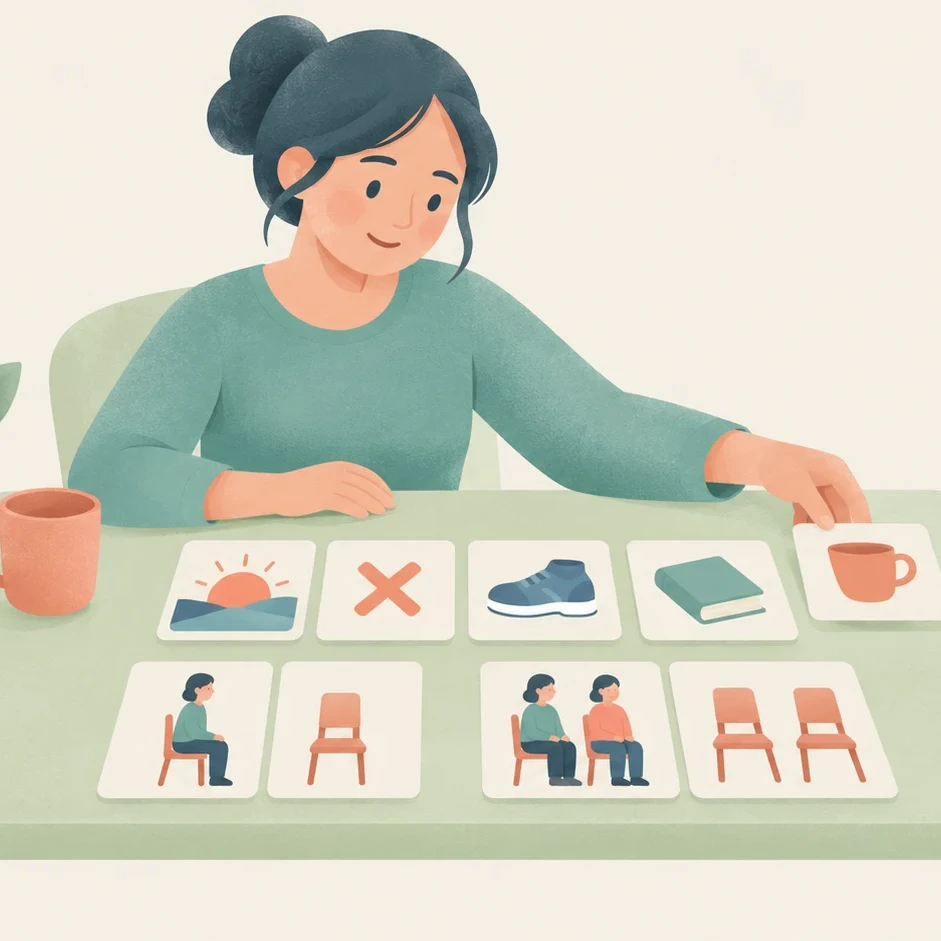
Simple past negatives: how to use didn't
A simple past negative tells the listener that a specific event did not take place at an earlier time. The auxiliary word did carries the past tense signal. Because did already marks the time as past, the main action verb remains in its plain base dictionary form without extra endings.
-

See, look, or watch: choose the right verb
The distinction between these verbs depends on the type of attention you give. See describes receiving visual information because an object is visible or enters your sight. Look describes the deliberate action of pointing your eyes toward a specific target, usually followed by the preposition at. Watch describes sustained attention over time, especially when an event develops, moves, or changes.
-

À la carte: Meaning and Restaurant Use
When a restaurant offers food à la carte, you choose individual dishes from the menu instead of accepting a preset combination. Each dish has its own listed price. In dining terms, a dish is a single prepared food item, such as tomato soup or grilled fish. A course is one stage of a meal, such as a starter or dessert. You can choose any dish you want, or skip courses entirely.
Not ready for a trial? Get a free lesson every day
Get one short dictation by email each day for 7 days. You can practice wherever you are, without an account.
Can't find a lesson on what you need?
Lesson requests come with membership.
See membership