
Écoute courte
Eat, ate, or eaten: choose the right form
When should I use eat, ate or eaten?
Use 'eat' for routines and after helping verbs such as 'did' or 'will', 'ate' for a finished past action, and 'eaten' after 'have', 'has' or 'had'. For example: 'We ate at the café on Tuesday.' Check the words around the verb before choosing its form.
À retenir
- Use 'eat' for routines and after helping verbs such as 'did' or 'will'.
- Use 'ate' for a completed action at a past time.
- Use 'eaten' after 'have', 'has' or 'had'.
- Do not use 'eaten' alone as the main past verb.
Cette leçon comporte 5 étapes. Vous pouvez vous arrêter à tout moment et reprendre plus tard.
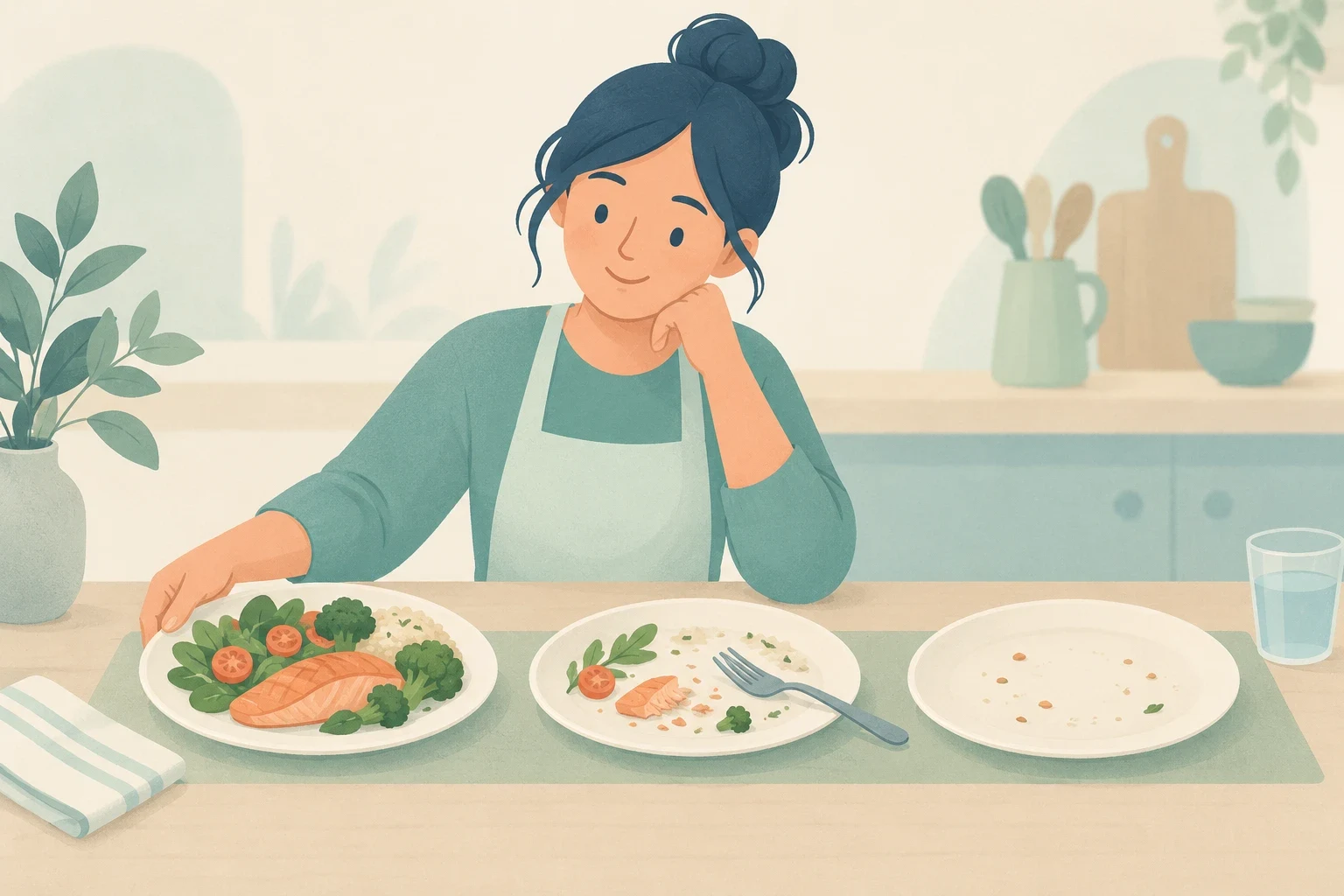

Comparer les formes
| Forme | Quand l’employer | Exemple |
|---|---|---|
| eat | For routines, and after helping verbs such as 'did' or 'will'. | They eat lunch at work. |
| ate | For a completed action at a specific past time. | I ate pasta last night. |
| eaten | After 'have', 'has' or 'had'. | Mina has eaten already. |
Étape 1 sur 5
Comprendre
Comprenez le sens, les situations d’emploi et les erreurs à éviter.
L’explication détaillée
The verb eat means to put food into your mouth, chew it, and swallow it. The core meaning never changes whether you say eat, ate, or eaten. The change in form tells your listener when the meal happened and whether it connects to another moment in time.
We eat vegetable curry together every Sunday evening.
Pourquoi cette forme convient : Every Sunday describes a regular routine, which calls for the present base form eat.
3 autres exemples
-
Kenji ate two bowls of noodles after his gym workout yesterday.
Yesterday indicates a completed past event, so the simple past ate is required.
-
I have eaten breakfast already, so I only want a cup of green tea.
Have links the completed breakfast to the present situation, requiring the participle eaten.
-
Before the train departed, the tourists had eaten their boxed lunches.
Had eaten shows that the meal finished before another past event occurred.
Lire le guide complet
Use eat for daily habits and general facts
Use eat when you talk about repeated meals, regular schedules, or general facts about food. With subjects like I, you, we, or they, the verb stays in its simple base form. When the subject is he, she, or a singular noun, add an s to make eats. This present form shows that the action happens regularly, not that someone is chewing right now.
-
They eat lunch together in the office kitchen every weekday.
Pourquoi cette forme convient : Every weekday signals a repeated routine, so the base form eat is correct.
-
Carlos eats fresh fruit before his morning run.
Pourquoi cette forme convient : Carlos is a singular subject, so the verb takes an s in the present tense.
À vous
Which form completes: 'Our team members ___ breakfast before the morning meeting every day'?
Réponse : eat
Voir la réponse
Réponse : eat
Every day shows a regular daily routine with a plural subject, so use the base form eat.
Keep eat after helping verbs
When a sentence uses helping verbs like do, does, will, can, or should, keep the main verb as eat. Even when a question or negative statement refers to the past using did, the main verb stays in the base form. Many learners mistakenly change both verbs to the past. Let did carry the past tense and leave eat alone.
-
Did you eat dinner before you arrived at the theater?
Pourquoi cette forme convient : The helping verb did already marks the past tense, so use the base form eat.
-
We will eat at the new Italian restaurant on Friday evening.
Pourquoi cette forme convient : The modal verb will must be followed by the base form eat.
Pour retravailler ce point, essayez Comparatives and superlatives: choose the right form et Possessive Pronouns: Choose the Right Form.
À vous
Choose the correct verb for this question: 'Did Maya ___ all the leftover rice last night?'
Réponse : eat
Voir la réponse
Réponse : eat
The auxiliary verb did already signals the past tense, so Maya did eat, never did ate.
Choose ate for completed past meals
Use ate when an action finished completely at a specific past time. Words like yesterday, last night, two hours ago, or on Tuesday clearly signal this finished past. The word ate never changes form for different subjects. Say I ate, she ate, and they ate. You do not need any helping verb before ate in a positive sentence.
-
We ate a quick vegetable salad before our evening walk yesterday.
Pourquoi cette forme convient : Yesterday is a finished past time, which requires the simple past form ate.
-
Elena ate warm soup at her desk an hour ago.
Pourquoi cette forme convient : An hour ago marks a specific completed time in the past, so ate fits.
À vous
Which word best fills the gap: 'Last night, we ___ warm noodles at the night market'?
Réponse : ate
Voir la réponse
Réponse : ate
Last night is a finished past time reference, which requires the simple past form ate.
Pair eaten with have or has for recent meals
Eaten is the past participle form of the verb. When you want to describe an action that happened recently and still affects the present moment, pair eaten with have or has. For example, if you finished lunch ten minutes ago, you are not hungry right now. This present perfect structure connects the earlier meal directly to your current feeling.
-
I have eaten a bowl of rice, so I do not need a large dinner.
Pourquoi cette forme convient : Have eaten connects the past meal to the current state of not being hungry.
-
Marcus has eaten three slices of pizza and wants dessert now.
Pourquoi cette forme convient : Use has eaten for a third-person singular subject in the present perfect tense.
À vous
Select the form that correctly completes: 'Priya is not hungry because she has ___ already.'
Réponse : eaten
Voir la réponse
Réponse : eaten
The helping verb has must be followed by the past participle eaten, not the past form ate.
Use have you eaten for life experience
Questions about life experience up to the present moment use have plus eaten. If you want to know whether a friend tried a specific dish at any point in their life, ask Have you ever eaten it. Do not name a finished day or time when using this pattern. If you add yesterday, switch back to did you eat.
-
Have you ever eaten street food in Bangkok during your travels?
Pourquoi cette forme convient : This question asks about general life experience up to the present day.
-
They have never eaten raw oysters because they dislike cold seafood.
Pourquoi cette forme convient : Have never eaten describes an ongoing experience up to the current moment.
À vous
Which sentence asks about overall life experience correctly?
Réponse : Have you ever eaten grilled octopus?
Voir la réponse
Réponse : Have you ever eaten grilled octopus?
Present perfect questions about life experience require have plus the past participle eaten.
Choose had eaten before another past event
When two events happened in the past, use had eaten for the one that finished first. This past perfect pattern helps the listener understand the clear order of events without confusion. For example, if you finished your meal at six and your friends arrived at seven, you had eaten before they arrived. Had remains the same for all subjects.
-
By the time the delivery driver arrived, we had eaten our leftover soup.
Pourquoi cette forme convient : Eating the soup finished before the driver arrived, so had eaten makes the sequence clear.
-
Sofia refused the sandwich because she had already eaten at home.
Pourquoi cette forme convient : The action of eating at home happened before her refusal in the past.
À vous
Fill the blank: 'When the meeting started at two o clock, David ___ his lunch.'
Réponse : had already eaten
Voir la réponse
Réponse : had already eaten
Had eaten indicates that the lunch finished before the two o clock meeting began.
Never use eaten without a helping verb
A frequent mistake in English writing is using eaten alone as the main past verb. Sentences like I eaten an apple or We eaten early are incorrect in standard English. Eaten always requires an auxiliary verb such as have, has, had, was, or were. If you do not have a helping verb, use ate for the simple past.
-
We ate fresh bread from the bakery down the street.
Pourquoi cette forme convient : Without a helping verb, the simple past ate is the only correct choice.
-
The sweet pastries were eaten within ten minutes.
Pourquoi cette forme convient : In a passive sentence, eaten appears after the past helping verb were.
À vous
Which sentence is grammatically correct in standard English?
Réponse : I ate a bowl of oatmeal before work.
Voir la réponse
Réponse : I ate a bowl of oatmeal before work.
The simple past requires ate when there is no helping verb. Eaten cannot stand alone.
Notice fast spoken contractions
In daily conversations, native speakers rarely say have eaten or has eaten as separate words. Instead, they use quick contractions like I have eaten spoken as I've eaten, or he has eaten becoming he's eaten. The first syllable of eaten carries the main stress. The second syllable is a soft, quiet sound that drops quickly.
-
We've eaten at that diner twice this month, and the food was delicious.
Pourquoi cette forme convient : We've is the spoken contraction of we have before the participle eaten.
-
She's eaten all the berries that were on the kitchen counter.
Pourquoi cette forme convient : She's here stands for she has, followed by the participle eaten.
À vous
In the sentence 'They've eaten their meal,' what does the contraction 'They've' stand for?
Réponse : They have
Voir la réponse
Réponse : They have
They've stands for they have, which pairs with the past participle eaten.
Erreurs fréquentes
Comparez la formulation à corriger et celle qui convient, puis lisez l’explication.
-
À éviter :
Did Leo ate before the film?Dites : Did Leo eat before the film?
'Did' marks the past, so the main verb stays in its base form.
-
À éviter :
We eaten before the lesson.Dites : We ate before the lesson.
'Eaten' needs a helping verb; use 'ate' for a simple past action.
-
À éviter :
She has ate lunch.Dites : She has eaten lunch.
Use the past participle 'eaten' after 'has'.
Vos questions sur « Eat, ate, or eaten: choose the right form »
Can I ever say 'I eaten' without have or had?
No. In standard English, eaten is a past participle and cannot act as the main verb by itself. You always need a helping verb like have, has, or had before eaten. If you want to describe a simple finished action without a helping verb, use the past form ate.
I ate an orange after lunch.
I have eaten an orange already.
What is the difference between 'Did you eat?' and 'Have you eaten?'
Use 'Did you eat?' when you are asking about a specific finished time in the past, such as earlier this morning or yesterday. Use 'Have you eaten?' when you want to know if someone is hungry right now or whether they had a meal recently.
Did you eat breakfast before eight o'clock?
Have you eaten lunch yet, or should we order together?
Can I use 'have eaten' with time words like yesterday or last night?
No. Specific finished time words like yesterday, last night, or two hours ago require the simple past tense ate. The present perfect form have eaten connects past actions to the present, so it cannot pair with closed past time periods.
We ate grilled fish last night.
We have eaten grilled fish many times.
Why do we say 'Did you eat?' instead of 'Did you ate?'
In English questions and negative sentences with did, the helping verb already carries the past tense. Because did shows the past time, the main verb must remain in its base form. Saying 'did you ate' repeats the past tense twice, which is incorrect.
Did you eat the remaining pasta?
She did not eat any cake at the party.
Avant de terminer
À retenir
Check the surrounding words before choosing your verb. If the sentence describes a routine or follows do, does, or will, pick eat. If the meal finished at a named past time, choose ate. When you see have, has, or had, use the participle eaten.
Étape 2 sur 5
Écouter
Écoutez des phrases, des plus courtes aux plus longues, et écrivez les mots entendus.
0 sur 4 terminés
Écoute 1 sur 4
Écoutez, puis écrivez ce que vous entendez. Réécoutez autant de fois que nécessaire.
0:00
Écoute 2 sur 4
Écoutez, puis écrivez ce que vous entendez. Réécoutez autant de fois que nécessaire.
0:00
Essayez un extrait plus long. Écoutez-le une fois, puis reprenez le passage qui vous a échappé.
Écoute 3 sur 4
Écoutez, puis écrivez ce que vous entendez. Réécoutez autant de fois que nécessaire.
0:00
Cet extrait est plus long. Suivez la consigne au-dessus du champ de réponse.
Écoute 4 sur 4
Écoutez, puis complétez les mots manquants. Le reste du texte est déjà affiché.
0:00
Entraînement terminé
Votre séance d’écoute est terminée.
Votre résultat est enregistré dans ce navigateur.
Conserver votre progression. Votre pratique est enregistrée uniquement sur cet appareil. Créez un compte gratuit pour la retrouver partout.
Créer un compte gratuitVous avez terminé la leçon gratuite du jour. Vous pourrez en choisir une autre demain. Vous souhaitez poursuivre aujourd’hui ? Consultez les abonnements.
Créez un compte SubLearn gratuit pour retrouver votre progression sur vos autres appareils.
Enregistrer ma progressionÉtape 3 sur 5
Parler
Répétez en même temps que l’enregistrement, puis réutilisez ce que vous avez appris dans votre propre réponse.
Répétition simultanée
Parlez en même temps que la voix
Écoutez la phrase au ralenti, puis parlez en même temps que la voix. Reproduisez aussi le rythme, pas seulement les mots.
À vous de parler
Exprimez-vous avec vos mots
Describe what you usually eat for lunch on busy workdays and what you ate yesterday afternoon when you had more free time.
Vous pouvez commencer par “On busy workdays, I usually eat…”
Réfléchissez dix secondes, puis répondez à voix haute pendant la durée indiquée ci-dessus, sans regarder la leçon. Rien n’est envoyé tant que vous ne demandez pas de retour.
0:00
Étape 4 sur 5
Écrire
Rédigez votre propre réponse
Retour de l’IA · des erreurs sont possibles · Inclus dans l’abonnement Voir l’abonnement
Relisez votre texte
Lire une réponse possible
Brouillon enregistré sur cet appareil.
Appuyez-vous sur ces points pour améliorer votre message. La grammaire et le sens ne sont pas évalués automatiquement. Chaque consigne conserve son propre brouillon dans cet onglet.

Vous avez terminé la partie gratuite de cette leçon
- Comprendre
- Écouter
- Parler
- Écrire
- Faire le pointInclus dans l’abonnement
À reprendre
Avec un compte gratuit, les leçons terminées reviennent en révision pour vous aider à les retenir.Créer un compte gratuit
Étape 5 sur 5 · Inclus dans l’abonnement
Faire le point
Essayez de nouveaux extraits sans indice.
Les tests d’écoute sont inclus dans l’abonnement. Essayez d’abord la dictée gratuite pour décider si vous souhaitez continuer.
Écoute 1 sur 2 Inclus dans l’abonnement
Écoute 2 sur 2 Inclus dans l’abonnement
Suivre MicroEnglish
Retrouvez des leçons, de courtes vidéos et des quiz sur l’application que vous utilisez déjà.
Questions et commentaires
Posez une question sur la leçon, proposez un exemple ou aidez une autre personne à comprendre.
Exemple
Pour retenir ce mot
Mots souvent associés
Formes de la même famille
À ne pas confondre avec
Dans cette leçon
Ce mot ne figure pas dans notre dictionnaire. Vérifiez son orthographe ou essayez une autre forme du mot.
Ce mot n’a pas pu être chargé. Réessayez.