Conversación cotidiana
Explora expresiones para conversaciones normales. Observa cómo el ejemplo conecta la expresión con una situación real.
Mostrando 19–36 de 54 lecciones
-

Speak English fluently: clear daily speaking steps
Fluency is the ability to keep a conversation moving so that people understand your meaning without unnecessary struggle. It does not require rapid speech, an advanced vocabulary, or an error-free grammar record. Fluent speakers naturally pause between thoughts to plan their words, and they handle small slip-ups without freezing.
-

Capricious Meaning: Unpredictable Changes
Capricious describes a sudden change driven by passing moods or arbitrary impulse rather than stable logic. When applied to people, it suggests that their opinions or choices cannot be relied upon to remain steady. When applied to rules, markets, or weather, it highlights unpredictable shifts that make planning difficult.
-

Punctuation Marks: Rules and Everyday Examples
Punctuation marks guide readers through written English by signaling sentence boundaries, pauses between related thoughts, grammatical relationships, and speaker tone. Unlike spoken conversation, where listeners rely on rhythm, pitch, and physical gestures, written text depends entirely on visual symbols to show where complete statements finish, which descriptive details are extra, and whose exact words are being reported.
-

Articles in English: How to Choose
Articles show how a noun connects to the shared context of a conversation. The indefinite articles, a and an, introduce a single countable person or thing that has not been identified yet. The definite article, the, points to a specific person, place, or thing that both you and your listener already know from earlier words or the immediate situation. When you speak about plural items or uncountable concepts as a general category, English usually uses no article at all.
-

Bored or boring: Talk about your class
Boring refers to an activity, condition, or person that creates dullness. Bored describes the inner feeling of a person who experiences that lack of interest. In English, this distinction marks the difference between a cause and a personal state. Both people and things can be boring, while only living beings with feelings can be bored.
-

Will or be going to: choose your future form
Both forms point to time after the present moment, but each one shows how you present the action. A decision happens while you speak. An intention is a choice you made before the conversation started. An offer shows immediate willingness to help, and a promise creates a clear commitment. Predictions describe what you expect to happen, either from your general knowledge or from visible signs in front of you.
-
Membresía
Accede a todas las lecciones gratis durante 7 días
- 570 lecciones con dictado y pruebas de escucha
- Elige entre los acentos disponibles en cada lección
- Nuevas lecciones cada día, y tu progreso se guarda
No se necesita tarjeta. Luego desde $7.50 al mes si quieres continuar.
Empezar prueba gratis -

Present perfect: use have and has
The present perfect connects an earlier action directly to the current conversation. When you say that someone has packed the rain gear, the packing occurred in the past, but your focus is on the fact that the bag is ready now. You also use this structure to discuss lifetime experiences up to this moment and ongoing states that started in the past.
-

Infinitives: When to Use To
An infinitive names an action directly without changing its shape for time or person. It connects two ideas by showing what action completes a main verb, what action explains a feeling, or why an action happened.
-

Who Said What? Passing On a Message
Quoted speech repeats someone's exact words. Reported speech puts their message into your own sentence. Both can describe the same conversation.
-

Nowhere to Put It: Explain a Space Problem
Nowhere means no place, in no place or to no place. In everyday conversation, it often means there is no suitable place for a particular action.
-

Talk into
Talk someone into something means you persuade another person through conversation to agree to an idea or take an action. The phrase highlights the spoken exchange that changes a person's mind from doubt or reluctance to agreement.
-

Run into
Run into has four common meanings: meeting an acquaintance by chance, encountering an obstacle or difficulty, physically colliding with an object or vehicle, and reaching a large total amount.
-

Pick up
Pick up can mean collect or lift someone or something, learn through experience, become stronger or better, or continue something that stopped. The situation tells you which meaning fits.
-

Hold up
The two main meanings of hold up depend on how the sentence works. When something holds up a person, event, or task, it causes a delay. When an object, material, or argument holds up, it stays strong, remains reliable, or continues to seem true under pressure.
-
 Video · 8 min
 Get over
Get over means recover: become well or feel better again after an illness or an upsetting experience.
-
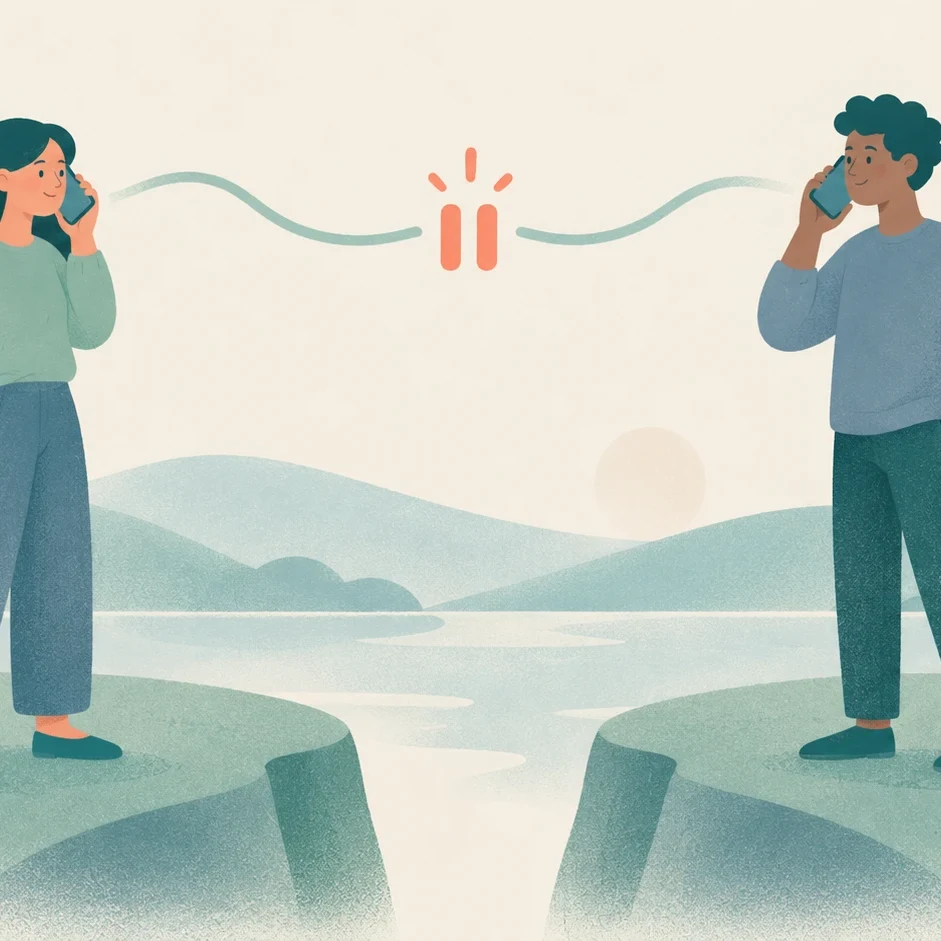
Cut off
Cut off describes a phone conversation ending suddenly because the connection fails, or a person or place becoming separated from normal access or social contact.
-

Chip away
Chip away literally describes breaking off tiny pieces from a hard surface with repeated small strikes. In everyday figurative use, chip away at describes making steady progress against a large task or slowly diminishing a quantity, feeling, or barrier through small efforts over time. It shows that the target is diminishing, but it does not claim that the work is finished.
-

Bump into
Bump into means to meet someone unexpectedly without prior arrangement, or to hit an object or person accidentally with your body.
¿No estás listo para una prueba? Recibe una lección gratis cada día
Un dictado corto en tu bandeja de entrada cada día durante 7 días. Practica donde estés, sin necesidad de cuenta.
¿No encuentras la frase o situación que necesitas?
Las solicitudes de lecciones requieren una membresía.
Ver membresía