Phrasal verb
Cut off
What does cut off mean on the phone?
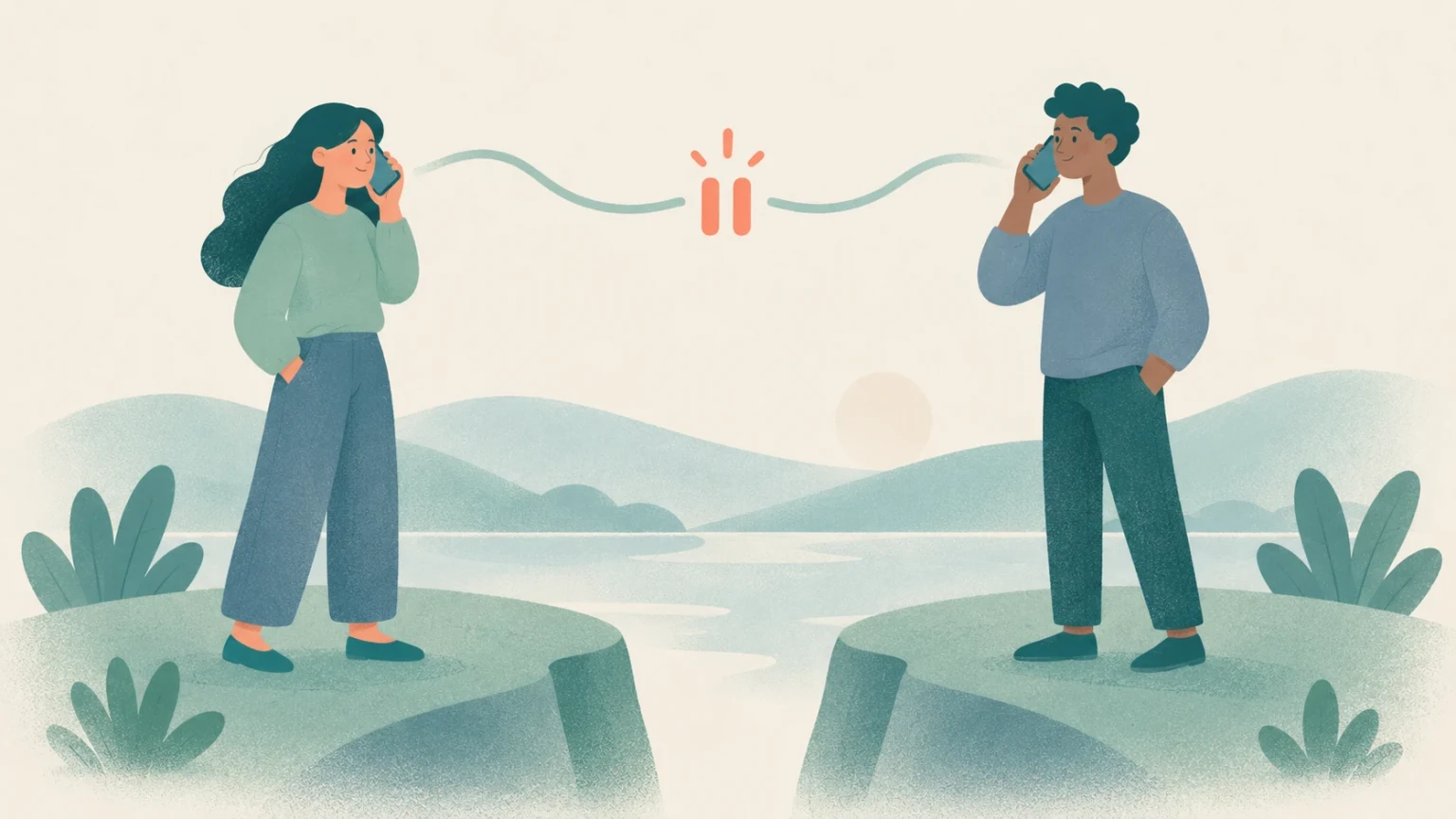
Cut off describes a phone conversation ending suddenly because the connection fails, or a person or place becoming separated from normal access or social contact.
Key points
- Use cut off when an unexpected break stops a conversation, blocks physical access, or separates someone from people they know.
- Place pronouns between cut and off, keep cut identical in the past, and pair from with the place or community left behind.
- Use cut off as a two-word verb.
This lesson has 5 stages. You can stop at any time and continue later.

Stage 1 of 5
Understand
What it means, when to use it, and mistakes to avoid.
Examples
I was confirming our arrival time when the tunnel cut us off.
Why it works: The physical barrier caused the phone connection to end suddenly before the speakers finished talking.
2 more examples
-
Heavy construction work cut the bakery off from the sidewalk for three days.
The preposition from introduces the sidewalk that customers could no longer reach.
-
After moving to the countryside, he cut himself off from his former colleagues.
The reflexive pronoun himself sits between cut and off to show deliberate social withdrawal.
Read the full guide
Use cut off when a phone connection suddenly ends
When you speak on the phone and the call ends without warning, use the phrasal verb cut off. The connection drops because of poor reception, a battery failure, or a technical fault on the network. Neither speaker chose to hang up, so cut off tells the listener that the disruption was unexpected. Always write the verb as two words: cut off. A hyphenated spelling like cut-off functions as a noun for a limit or deadline, not an action on the phone.
-
We were discussing the budget when the mobile network cut us off.
Why it works: The sudden drop happened while the people were still speaking.
-
If the signal drops inside the parking garage, it will cut off our call.
Why it works: The technical interruption breaks the line before the caller finishes.
Your turn
Which sentence correctly describes a call that stopped because the signal disappeared?
Answer: The bad signal cut us off while we were speaking.
Show the answer
Answer: The bad signal cut us off while we were speaking.
Cut off describes a telephone connection that drops unexpectedly due to technical or signal problems.
Use cut off from for separation from places or people
Beyond telephone calls, cut off describes removing access between a person or place and the surrounding area. Road repairs can cut a shop off from passing traffic, meaning customers cannot enter easily. Use the preposition from to introduce the place or people no longer connected. You can also use this pattern for social isolation. A busy worker might feel cut off from friends, or someone experiencing stress might cut themselves off from their community. Feeling isolated describes the emotional experience of loneliness, while cutting yourself off describes choosing to withdraw completely. Notice that cutting oneself off socially is stronger than simply speaking less often; it conveys a complete or deliberate break in contact. When someone feels socially isolated, learning how to come out of your shell (see /idioms/come-out-of-your-shell/) helps them reconnect with friends.
-
Water pipe repairs cut the clinic off from the main road for six hours.
Why it works: From identifies the roadway that vehicles could not reach during the work.
-
Working late every night made him feel cut off from his family.
Why it works: The pattern describes a feeling of isolation rather than physical blockage.
-
During exam preparation, she cut herself off from social media to concentrate.
Why it works: The phrase shows an intentional decision to step away from communication.
This also comes up in Call off and Rip off.
Your turn
What does the preposition 'from' introduce in the phrase 'cut the remote work site off from the main road'?
Answer: The place or route that is no longer accessible.
Show the answer
Answer: The place or route that is no longer accessible.
In this pattern, from marks the location, road, or group of people that can no longer be reached.
Put object pronouns between cut and off
In active sentences with a full noun, you have two natural choices. You can say the fallen tree cut off the street or the fallen tree cut the street off. However, when you replace the noun with an object pronoun such as me, us, or it, the pronoun must go between cut and off. Say the tree cut it off, never cut off it. Reflexive pronouns follow the exact same rule: someone cuts themselves off or cuts herself off. To use this verb accurately across different tenses, learn its complete paradigm forms: base form cut, third-person singular cuts, present participle cutting, past tense cut, and past participle cut. Because the verb is irregular, the past form remains cut; the form cutted does not exist in English and should never be used.
-
The tunnel interrupted my call and cut me off immediately.
Why it works: The object pronoun me belongs directly between cut and off.
-
The fallen branches blocked the garage and cut it off from the street.
Why it works: The pronoun it replaces the noun garage and sits between the two verb parts.
-
After the disagreement, he cut himself off from the study circle.
Why it works: The reflexive pronoun himself sits between cut and off.
Your turn
Which sentence uses the correct pronoun position and verb form?
Answer: Our mobile battery died and cut us off during the conversation.
Show the answer
Answer: Our mobile battery died and cut us off during the conversation.
Object pronouns like us must sit between cut and off, and the past tense of cut is cut, not cutted.
Use was or got cut off to describe what happened
When a conversation drops, people rarely focus on the cellular tower or battery that caused the failure. Instead, they focus on their own experience by using passive patterns: we were cut off or we got cut off. Contrast an active cause doing the action with the passive experience of the speakers: you can say a signal failure cut us off when emphasizing the cause, whereas we were cut off focuses on what happened to the people on the line. In everyday speech, got cut off sounds natural and relaxed, while was cut off fits both casual speech and neutral written reports. If you want to name the cause in a passive sentence, use by: the shop was cut off from the street by road repairs. You can also ask Did we get cut off? or confirm We weren't cut off when clarifying a dropped line.
-
Sorry about that, we got cut off when my commuter train entered the tunnel.
Why it works: Got cut off expresses the speaker's experience in informal conversation.
-
The warehouse was cut off from the port by fallen electrical lines.
Why it works: Was cut off describes the state, while by names the cause of the blockage.
-
Did you get cut off, or did your laptop battery shut down?
Why it works: The question uses did get cut off to ask about the sudden interruption.
Your turn
How do you explain the cause of a blockage after 'the store was cut off from foot traffic'?
Answer: With by followed by the physical cause.
Show the answer
Answer: With by followed by the physical cause.
Use by to name the cause of the separation, while from identifies the place or access that was lost.
Choose cut off, hang up or interrupt to explain a broken conversation
Learners often confuse cut off with hang up or interrupt. Hanging up is an intentional physical action to end a call, usually after saying goodbye. Getting cut off is an unintentional technical drop. If an angry caller slams the receiver, that person hung up. In face-to-face conversations, saying you cut me off means you interrupted before the speaker finished, leaving no room to get a word in edgeways (see /idioms/to-get-a-word-in-edgeways/). On a telephone, context tells you whether cut off means a dropped signal or an impolite interruption.
-
I did not hang up on you; my elevator lost reception and we got cut off.
Why it works: Distinguishes an accidental loss of signal from a deliberate decision to end the call.
-
Please let me finish my explanation instead of cutting me off mid-sentence.
Why it works: Here cut off means interrupting someone who is speaking face-to-face.
-
We said our goodbyes politely and hung up around five o'clock.
Why it works: Hung up describes ending a finished phone call intentionally.
Your turn
A customer was still talking to you when their phone line suddenly went silent. What happened?
Answer: The customer got cut off because of a connection problem.
Show the answer
Answer: The customer got cut off because of a connection problem.
An unexpected loss of sound or line failure means the call was cut off, not an intentional hang up.
Follow a repair call that ends before the instructions are complete
Consider this practical situation. An apartment tenant phones a plumbing technician to fix a kitchen drain. As the technician gives instructions about which building door to unlock, the tenant steps into the basement hallway. The call disconnects. When the technician calls back to confirm the appointment details (see /micro-listenings/2-2/), both speakers clarify what happened without frustration. Here is their spoken dialogue: Tenant: Hello? Can you hear me? Technician: Yes! We got cut off for a second. I was explaining which entrance to unlock. Tenant: The signal dropped because I walked into the basement. I missed which entrance you want me to unlock.
-
We got cut off right when you mentioned the parking code.
Why it works: Explains precisely which detail was lost during the phone disconnection.
-
Sorry, you cut out for a moment, and then the line cut us off.
Why it works: Shows the common spoken sequence of fading audio followed by a dropped line.
Your turn
In the repair dialogue, why did the call drop before the instructions finished?
Answer: The tenant walked into a basement where phone reception was lost.
Show the answer
Answer: The tenant walked into a basement where phone reception was lost.
The tenant walked into the basement, causing the cellular signal to drop and cutting them off.
Hear cut off and cut us off in six short dictations
In natural English speech, words connect together. In the phrase cut off, the final consonant of cut links directly to the vowel in off. In American English, this t often sounds like a light tap or flap rather than a sharp release. When an unstressed pronoun sits in the middle, as in cut us off or cut it off, speakers pronounce the pronoun very quickly with little emphasis. Furthermore, function words like was and from often appear in weak, unstressed forms. Notice the surrounding past context, because cut sounds identical in the present and past.
-
The underground tunnel cut off our call before we finished.
Why it works: Notice how the final consonant of cut links directly into the vowel of off.
-
A low battery cut us off before we finished.
Why it works: The word us is unstressed and links closely between cut and off.
Your turn
Why might the pronoun in 'cut us off' be difficult to hear in rapid speech?
Answer: The pronoun is unstressed and spoken quickly between the two verb words.
Show the answer
Answer: The pronoun is unstressed and spoken quickly between the two verb words.
Unstressed object pronouns receive little vocal energy and link rapidly between cut and off.
Recall the patterns and write three situations using cut off
Before rereading the explanations, test your memory on the core patterns. Recall the two primary meanings: a broken phone connection and physical or social separation. Next, confirm word order: object pronouns always sit between cut and off, as in cut me off. Remember that the past form of cut remains cut. You can now practice composing your own original messages. Use the writing tasks below to draft a quick text after a dropped call, describe a building with blocked access, or offer advice to someone feeling cut off from friends.
-
I am sending this text because our call got cut off a moment ago.
Why it works: A clear opening message to reestablish contact after an unexpected drop.
-
Snowfall cut the cabin off from the supply road for two whole days.
Why it works: Applies the physical isolation meaning with correct preposition usage.
Your turn
Which of the following is an accurate grammar rule for using cut off?
Answer: Object pronouns must sit between cut and off, and the past tense remains cut.
Show the answer
Answer: Object pronouns must sit between cut and off, and the past tense remains cut.
Cut never takes an -ed ending, and object or reflexive pronouns must be placed between cut and off.
Use it naturally
How people really use “cut off”
Neutral Fine almost anywhere, at work or with friends.
Words it often goes with
- got cut offWe got cut off before I could give her my address.
- completely cut offThe island was completely cut off during the storm.
- cut off from friendsWorking alone at home can leave you feeling cut off from friends.
- cut off from the outside worldWithout phones or internet, we felt cut off from the outside world.
What people also say
- “We got cut off.” instead of “Our telephone connection ended unexpectedly.” This is a natural way to explain a dropped call.
Questions about "Cut off"
What does cut off mean on the phone?
On the phone, cut off means that the call ends abruptly because of a signal failure, low battery, or technical network disruption. It indicates that neither caller chose to end the call.
The line was bad, and entering the tunnel suddenly cut us off.
Should I say cut me off or cut off me?
Always say cut me off. When using pronouns like me, us, him, her, them, or it, the pronoun must go between cut and off. Placing the pronoun at the end is incorrect in standard English.
A sudden signal drop cut me off before I could give my address.
Is the past tense cut or cutted?
The past tense and past participle are both cut. The word cutted does not exist in standard English. You can identify the past by looking at the surrounding context, such as words like yesterday or was.
Yesterday morning, poor cellular coverage cut our phone meeting short.
What's the difference between we got cut off and we hung up?
Getting cut off happens accidentally when the technology fails. Hanging up is an intentional decision made by a person to end the conversation, either politely after finishing or abruptly out of anger.
We did not hang up; the subway tunnel cut us off.
What does cut off from mean?
Cut off from describes physical separation or social isolation. The preposition from introduces the place, route, or group of people that is no longer accessible or connected to the subject.
Fallen trees cut the remote work site off from emergency supplies.
Does you cut me off mean the call ended or that you interrupted me?
It can mean either depending on the situation. During a phone call, it often means the line disconnected. In a face-to-face conversation or meeting, it usually means you interrupted someone before they finished speaking.
I could not finish my proposal because my colleague cut me off in the meeting.
Before you go
Remember this
Use cut off when an unexpected break stops a conversation, blocks physical access, or separates someone from people they know. Place pronouns between cut and off, keep cut identical in the past, and pair from with the place or community left behind.
Stage 2 of 5
Listen
Hear it in real sentences, from short to long, and write what you hear.
0 of 4 done
Listening 1 of 4
Listen, then type what you hear. Replay as often as you need.
0:00
- Heavy construction work cut the bakery off from the sidewalk for three days.
- After moving to the countryside, he cut himself off from his former colleagues.
Listening 2 of 4
Listen, then type what you hear. Replay as often as you need.
0:00
- Heavy construction work cut the bakery off from the sidewalk for three days.
- After moving to the countryside, he cut himself off from his former colleagues.
Try a longer clip. Listen once, then replay the part you missed.
Listening 3 of 4
Listen, then type what you hear. Replay as often as you need.
0:00
- Heavy construction work cut the bakery off from the sidewalk for three days.
- After moving to the countryside, he cut himself off from his former colleagues.
This clip is longer. Follow the instruction above the answer field.
Listening 4 of 4
Listen, then type the missing words. The rest of the text is already there.
0:00
- Heavy construction work cut the bakery off from the sidewalk for three days.
- After moving to the countryside, he cut himself off from his former colleagues.
Practice complete
You listened closely.
Your result is saved in this browser.
Keep your progress. Your practice is saved on this device only. Create a free account to keep it everywhere.
Create a free accountThat was today's free lesson. Tomorrow you get another one. Want more today? See membership.
Create a free SubLearn account to keep this progress across devices.
Save my progressStage 3 of 5
Speak
Say it with the speaker, then use it in your own answer.
Shadow
Say it along with the speaker
Play the line slowly, then speak at the same time as the speaker. Copy the rhythm, not just the words.
Your turn
Say it your way
Speak for 30 to 60 seconds from memory. Imagine your cousin spends every weekend gaming alone and has stopped seeing friends. Describe how he has cut himself off from others and suggest a way to help him reconnect.
Use: cut himself off
Take ten seconds to think, then answer out loud without looking at the lesson. Speak for the time shown in the task above. Nothing is sent unless you ask for feedback.
0:00
Hear how someone else might say it
My cousin Ben used to play basketball with us every Saturday, but now he spends the whole weekend gaming in his room. He has cut himself off from his friends, and we miss him. Last week, he didn't answer any of our messages. I think he might feel nervous about joining us again after so long. I'd visit him and ask how he's doing. Then I'd invite him for a short walk or a snack. He doesn't have to meet everyone at once. We could start with something simple.
Try once more and answer this: What did you enjoy doing together before?
Stage 4 of 5
Write
Write your own response
AI feedback · it can make mistakes · Part of membership See membership
Check your own writing
Read one possible response
Draft saved on this device.
Use these checks to revise your message. Grammar and meaning are not automatically graded. Each task keeps its own draft in this browser tab.

You finished the free part of this lesson
- Understand
- Listen
- Speak
- Write
- CheckPart of membership
Worth another look
With a free account, the lessons you finish come back for review to help you remember them.Create a free account
Stage 5 of 5 · Part of membership
Check
New clips without hints.
Listening tests are included with membership. Try the free dictation first, then decide whether to continue.
Listening 1 of 2 Part of membership
Listening 2 of 2 Part of membership
Follow MicroEnglish
Find lesson updates, short videos and quick quizzes. Pick the app you already use.
Questions & comments
Ask about this lesson, share an example, or help another learner.
Example
Memory tip
Goes with
Related forms
Not to be confused with
In this lesson
This word isn't in our dictionary. Check the spelling, or try another form of the word.
We couldn't load this word. Try again.
