Phrasal verb
Rip off
What does 'rip off' mean?
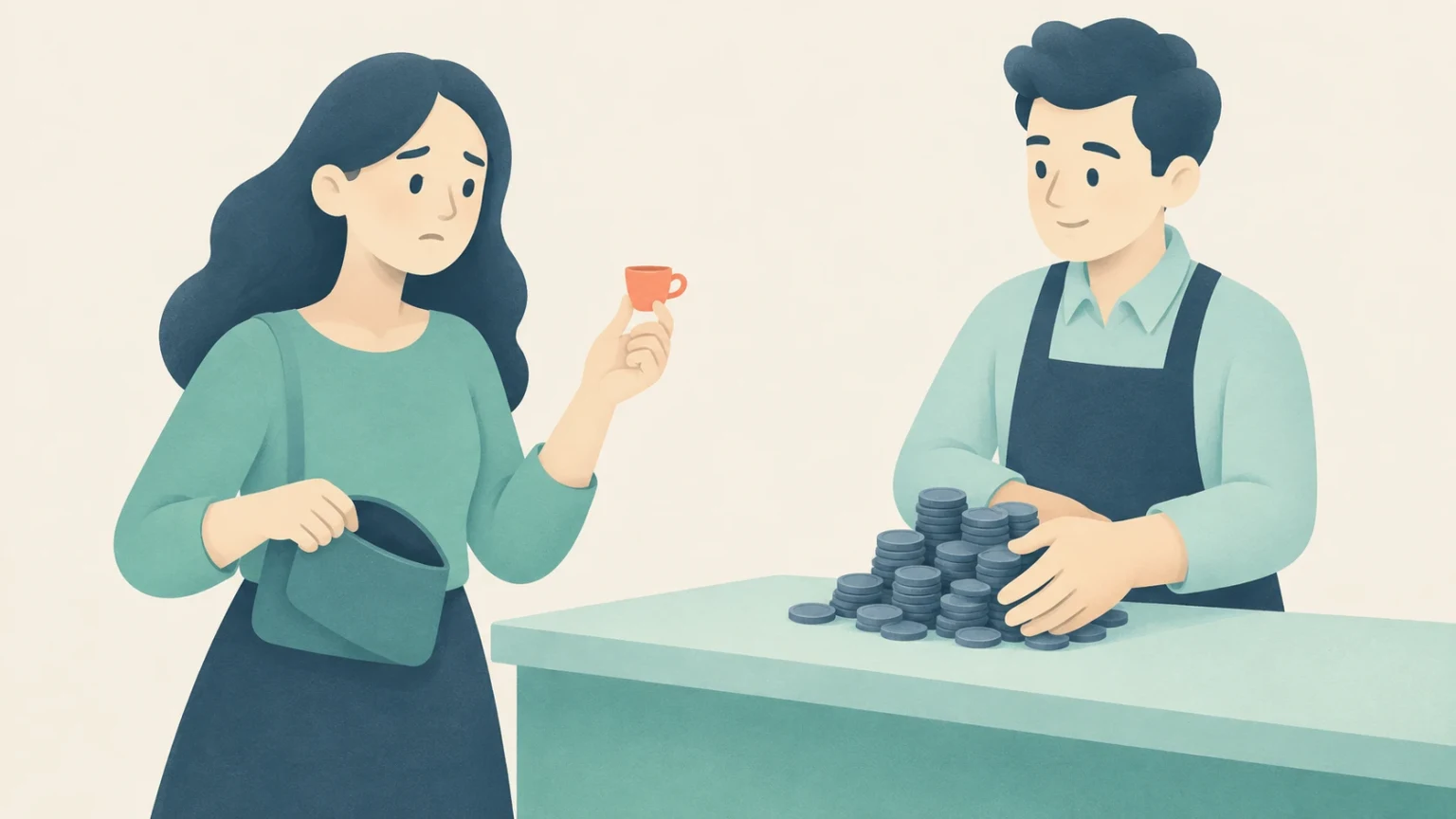
'Rip off' means to cheat someone by charging an unfair price, or to remove something roughly and quickly. 'Rip me off' means cheat me, while 'rip it off' means remove it. The noun 'a rip-off' describes a bad or overpriced deal. For polite complaints, ask for an explanation instead of accusing someone.
Key points
- 'Rip off' can describe unfair prices or rough physical removal.
- Pronoun objects go between 'rip' and 'off'.
- The past form is 'ripped off', with a double p.
- 'A rip-off' is a hyphenated noun for a bad deal.
Can you use "Rip off" yourself?
This lesson has 5 stages. You can stop at any time and continue later.

Stage 1 of 5
Understand
What it means, when to use it, and mistakes to avoid.
The full explanation
Rip off as a verb means to cheat someone by charging an unfair amount, or to pull something away quickly and roughly. As a hyphenated noun, a rip-off describes an unfair deal or an overpriced item.
The rental company tried to rip us off with hidden cleaning fees.
Why it works: Rip off describes unfair extra charges added without warning.
2 more examples
-
Be careful when you rip that old mailing label off the cardboard box.
Rip off here refers to removing something forcefully and quickly.
-
Paying twelve dollars for a small bottle of water is an absolute rip-off.
The hyphenated noun describes an item with poor value.
Read the full guide
Decide When a Deal Counts as Unfair
When a shop, service provider, or individual charges you an unreasonable amount of money, you can use the phrasal verb rip off. The person or business taking the cash is the subject, while the person paying the unfair price is the object. Consider this conversation between two friends after an afternoon bike excursion: Sam asks how the canal bicycle trip went, and Marco explains that the ride was pleasant but the rental shop ripped them off by adding a sixty-dollar cleaning fee that was never mentioned during booking. Marco feels cheated because the surprise fee violated an honest transaction.
-
The garage ripped off the driver by charging triple the normal price for an oil change.
Why it works: The garage took advantage of the driver by demanding an unreasonable fee.
-
Street vendors often rip tourists off because visitors do not know local rates.
Why it works: The seller charges more than is fair to someone unfamiliar with prices.
Your turn
In the sentence 'The hotel ripped off my brother with hidden booking fees', who lost money unfairly?
Answer: My brother, who paid the unannounced booking fees.
Show the answer
Answer: My brother, who paid the unannounced booking fees.
The object of rip off is the person who pays the unfair charge and loses money.
Recognize Rough Physical Removal
Beyond financial cheating, rip off carries a physical meaning: to pull, peel, or tear something away with quick, forceful motion. For example, when you prepare an old storage box for recycling, you rip the heavy packing tape off the cardboard flaps. Here, the object is a physical item, not a person paying money. Notice that context dictates the interpretation. A person object almost always points to financial exploitation, while a physical object often suggests rough removal. In casual discussions about creative work, people sometimes use rip off to describe copying someone else's idea or design without permission, though removal and price exploitation remain the most frequent everyday patterns.
-
She ripped the shipping label off the package before tossing the box into the recycling bin.
Why it works: Ripped off here indicates removing a paper label forcefully and quickly.
-
The fierce wind ripped several shingles off the roof during the overnight storm.
Why it works: The storm tore the roofing materials away with physical force.
This also comes up in Let off and Cut off.
Your turn
Which sentence demonstrates the physical removal meaning of rip off?
Answer: He ripped the old transit sticker off the front windshield of his car.
Show the answer
Answer: He ripped the old transit sticker off the front windshield of his car.
Removing a sticker with physical force illustrates the literal tearing sense of the phrasal verb.
Place Pronouns Correctly Between the Words
Phrasal verbs behave differently depending on whether the object is a full noun or a pronoun. You can place a full noun after both words or between them. For instance, you may say 'The taxi driver ripped off my friend' or 'The taxi driver ripped my friend off.' Both sentences are natural. However, when the object is a pronoun such as me, him, her, us, them, or it, the pronoun must go between rip and off. Saying 'The taxi driver ripped off me' is an error. This rule applies equally to physical removal: you say 'Rip it off,' never 'Rip off it.' You can examine related patterns at /idioms/take-advantage-of/ for other expressions where people exploit someone.
-
The landlord tried to rip us off by withholding our deposit without an explanation.
Why it works: The pronoun object us sits between rip and off.
-
That adhesive bandage hurts, so rip it off quickly.
Why it works: The pronoun it must separate rip and off in physical removal.
Your turn
Which sentence shows the correct placement of a pronoun with rip off?
Answer: The travel agent tried to rip us off with nonexistent service fees.
Show the answer
Answer: The travel agent tried to rip us off with nonexistent service fees.
Pronoun objects must sit between rip and off, making 'rip us off' the only correct choice.
Spell the Verb and Noun Forms Accurately
The base verb forms are rip, rips, ripped, and ripping. Because rip ends with a single vowel followed by a single consonant, you must double the p when adding ed or ing. In questions and negative sentences with did or didn't, always return to the base form: 'Did the agency rip you off?' or 'They didn't rip me off.' If you want to emphasize the person who suffered the unfair charge, use the passive structure: 'I was ripped off.' Be careful to distinguish the two-word verb rip off from the countable noun a rip-off. The noun requires a hyphen and an article when singular: 'That used laptop is a rip-off.' The noun names the bad deal, while the verb describes the action.
-
We didn't rip you off; our prices are listed clearly on the menu wall.
Why it works: Negative sentences with didn't use the base form rip, not ripped.
-
Paying thirty dollars for cold coffee is an absolute rip-off.
Why it works: The hyphenated noun phrase an absolute rip-off describes an item of terrible value.
Your turn
Which sentence correctly uses the noun form to describe an overpriced purchase?
Answer: That museum ticket was a complete rip-off because half the galleries were closed.
Show the answer
Answer: That museum ticket was a complete rip-off because half the galleries were closed.
A rip-off functions as a hyphenated countable noun describing something of poor value.
Choose the Right Tone for Price Complaints
An expensive item is not automatically a rip-off. A luxury watch or a fine restaurant meal may carry a large price tag, but if the buyer receives excellent materials and service as promised, the transaction is above board (see /idioms/above-board/). Calling a price a rip-off conveys a strong, informal accusation of unfairness or broken faith. If you say directly to a customer service agent, 'You are ripping me off,' you create immediate conflict. When your intention is to resolve a billing confusion or ask for a correction politely, choose neutral phrases. Say 'That seems rather expensive' or 'Could you please explain this additional charge?' Reserve rip off for conversations with friends or reviews where you want to describe an unfair deal.
-
Could you explain this cleaning fee on our final bill?
Why it works: A polite and professional question suitable for talking directly to hotel staff.
-
I told my brother that the airport taxi was a rip-off after they doubled the evening fare.
Why it works: Rip-off expresses personal frustration to a friend about an unfair transaction.
Your turn
You notice an unfamiliar twenty-dollar fee on your hotel checkout receipt. Which question is most effective to resolve the issue calmly at the front desk?
Answer: Could you please explain what this twenty-dollar fee covers on my bill?
Show the answer
Answer: Could you please explain what this twenty-dollar fee covers on my bill?
Asking for an explanation keeps the tone professional and productive when addressing front desk staff.
Hear Word Endings and Natural Linking
Listening to natural speech requires recognizing how consonants attach to following vowels. In the base form rip off, the short vowel /ɪ/ in rip ends with /p/, which links smoothly into the vowel /ɒ/ or /ɔː/ of off: /rɪp-ɒf/. In the past form ripped off, the ed ending sounds like /t/. Because off begins with a vowel, the /t/ sound connects directly to it, sounding like 'rip-toff'. In fast speech, speakers place main sentence stress on off when using the verb at the end of a phrase, whereas the noun a rip-off often places heavier stress on rip. You can practice recognizing fast spoken transactions in real contexts at /micro-listenings/8-2/.
-
They ripped off every driver who parked in that private lot.
Why it works: The past /t/ sound in ripped connects directly to the opening vowel of off.
-
Did that seller rip you off when you bought the tablet?
Why it works: The pronoun you sits between rip and off, keeping the base verb clear.
Your turn
When a native speaker says 'He ripped off his jacket', how does the past ending sound?
Answer: The /t/ consonant links into the vowel of off, sounding like 'rip-toff'.
Show the answer
Answer: The /t/ consonant links into the vowel of off, sounding like 'rip-toff'.
The ed in ripped is pronounced /t/, which links smoothly to the beginning vowel of off.
Avoid Common Word Order and Grammar Slips
Learners frequently make three specific mistakes with this expression. First, placing a pronoun after both words creates ungrammatical phrasing like 'The company ripped off me.' Always put the pronoun inside: 'The company ripped me off.' Second, using the past form after an auxiliary verb produces errors like 'Did they ripped you off?' Remember that did requires the base form: 'Did they rip you off?' Third, omitting the article or hyphen from the noun results in broken sentences like 'It is rip off.' When using the noun to describe bad value, always include the article and hyphen: 'It is a rip-off.' Keeping these three boundaries in mind guarantees natural phrasing in both speech and writing.
-
Did the repair shop rip you off, or was the estimate accurate?
Why it works: Did pairs with the base form rip, never the past form ripped.
-
Paying fifty dollars for plain parking was a rip-off.
Why it works: The singular noun requires the indefinite article a and a hyphen.
Your turn
Which sentence corrects the error in 'The taxi driver did ripped off me'?
Answer: The taxi driver ripped me off during the trip from the station.
Show the answer
Answer: The taxi driver ripped me off during the trip from the station.
In past affirmative statements, use ripped with the pronoun me positioned between ripped and off.
Recall Verb and Noun Patterns from Memory
To ensure you have mastered both meanings, review how to select the right structure under pressure. When an unfair bill arrives, identify whether you need a verb action or a descriptive noun. If you want to say that a company treated you unfairly, write 'They ripped us off.' If you want to characterize the price itself as unacceptable, write 'That price is a rip-off.' When you describe physical removal, verify that you have placed any pronoun between the two words, as in 'Rip it off before painting the board.' Testing your ability to produce these forms without looking at notes reinforces correct spelling, pronoun placement, and register.
-
The festival food was a rip-off because a tiny burger cost fifteen dollars.
Why it works: The noun a rip-off labels an overpriced product with poor value.
-
Before you recycle that shipping carton, rip off the plastic address envelope.
Why it works: Rip off indicates pulling away a physical covering.
Your turn
You want to tell a friend that a mobile repair shop cheated you on screen replacement costs. Which sentence is grammatically accurate?
Answer: The phone shop ripped me off with an extra charge.
Show the answer
Answer: The phone shop ripped me off with an extra charge.
The past verb ripped combines with the pronoun me in the middle to express financial cheating.
Other meanings of "rip off"
This lesson practises one meaning. You may also hear these.
To pull, tear, or remove something quickly and forcefully
She ripped the label off her new suitcase.
To copy someone else's work or idea without permission
The design was ripped off from a smaller company.
Common mistakes with "rip off"
What learners often say, what to say instead, and why.
-
Not this:
The café ripped off me after dinner.Say: The café ripped me off after dinner.
A pronoun object must come between 'rip' and 'off'.
-
Not this:
Did the company ripped you off?Say: Did the company rip you off?
After 'did', use the base form 'rip', not 'ripped'.
-
Not this:
The ticket was a complete rip off.Say: The ticket was a complete rip-off.
The noun needs a hyphen; singular uses normally include an article.
Use it naturally
How people really use “rip off”
Informal Relaxed; better with friends and colleagues than in formal writing.
Words it often goes with
- rip off a labelYou can rip off a label if one corner is already loose.
- rip off the tapePlease rip off the tape before you open the box.
- rip off customersSome sellers rip off customers by charging twice the normal price.
- an absolute rip-offTwenty dollars for that tiny sandwich is an absolute rip-off.
What people also say
- “They ripped me off.” instead of “They charged me a price that was unfair.” This is a common informal complaint when you feel cheated.
Related forms
- rip-off nounThis broken toy was a rip-off.
Questions about "Rip off"
Does rip off mean something is expensive?
No, expensive simply means an item costs a lot of money, whereas rip off implies the price is unfair, deceptive, or grossly disproportionate to the value received. An authentic luxury handbag might be expensive but genuine. In contrast, charging fifty dollars for an ordinary cup of tea is a rip-off because the price violates reasonable expectations of fair trade.
The five-star hotel was expensive, but the outstanding service justified the price.
Charging ten dollars for tap water is a rip-off.
Do I say rip me off or rip off me?
You must always say rip me off. When the object of this phrasal verb is a pronoun such as me, you, him, her, us, them, or it, it must go between rip and off. Placing the pronoun at the end is ungrammatical in standard English.
The dishonest cashier tried to rip me off by returning incorrect change.
They realized the broker was trying to rip them off.
What is the difference between rip off and a rip-off?
Rip off as two separate words is a verb describing an action: someone rips another person off. With a hyphen and an article, a rip-off is a countable noun naming an overpriced purchase, bad deal, or fraudulent offer.
Unscrupulous sellers rip off unsuspecting buyers every day.
Paying twenty dollars for parking was a complete rip-off.
Why does ripped have two p's?
In English spelling rules, when a single-syllable verb ends in one vowel followed by one consonant, you must double the final consonant before adding suffixes starting with a vowel, like -ed or -ing. This keeps the short vowel sound intact, distinguishing ripped from reaped.
The customer complained that the garage ripped her off.
He was ripping off the damaged wallpaper all afternoon.
Can rip off mean pull something away?
Yes. In its literal physical sense, rip off means to remove or tear something away forcefully and quickly. You often hear this when people discuss removing tape, peeling stickers, opening cardboard cartons, or tearing labels off clothing.
Make sure you rip off the price tag before wrapping the gift.
The worker ripped off the protective plastic sheet from the metal door.
Is it rude to say you're ripping me off?
Yes, saying this directly to a seller, clerk, or server sounds aggressive and accusatory because it implies deliberate dishonesty. If you want to question an unexpected charge politely in a shop or hotel, ask 'Could you clarify this charge on my invoice?' rather than making an accusation.
I felt that the mechanic was ripping me off, but I stayed calm.
Could you please review this invoice to confirm the charges are correct?
Before you go
Remember this
Use rip off to describe unfair prices or rough removal. Put pronouns in the middle, spell the past verb as ripped off, and include the hyphen when using the noun a rip-off.
Stage 2 of 5
Listen
Hear it in real sentences, from short to long, and write what you hear.
0 of 4 done
Listening 1 of 4
Listen, then type what you hear. Replay as often as you need.
0:00
- Be careful when you rip that old mailing label off the cardboard box.
- Paying twelve dollars for a small bottle of water is an absolute rip-off.
Listening 2 of 4
Listen, then type what you hear. Replay as often as you need.
0:00
- Be careful when you rip that old mailing label off the cardboard box.
- Paying twelve dollars for a small bottle of water is an absolute rip-off.
Try a longer clip. Listen once, then replay the part you missed.
Listening 3 of 4
Listen, then type what you hear. Replay as often as you need.
0:00
- Be careful when you rip that old mailing label off the cardboard box.
- Paying twelve dollars for a small bottle of water is an absolute rip-off.
This clip is longer. Follow the instruction above the answer field.
Listening 4 of 4
Listen, then type the missing words. The rest of the text is already there.
0:00
- Be careful when you rip that old mailing label off the cardboard box.
- Paying twelve dollars for a small bottle of water is an absolute rip-off.
Practice complete
You listened closely.
Your result is saved in this browser.
Keep your progress. Your practice is saved on this device only. Create a free account to keep it everywhere.
Create a free accountThat was today's free lesson. Tomorrow you get another one. Want more today? See membership.
Create a free SubLearn account to keep this progress across devices.
Save my progressStage 3 of 5
Speak
Say it with the speaker, then use it in your own answer.
Shadow
Say it along with the speaker
Play the line slowly, then speak at the same time as the speaker. Copy the rhythm, not just the words.
Your turn
Say it your way
Speak for 30 to 60 seconds from memory. You and a friend are turning old boxes into a toy castle at home. Explain which labels or pieces of paper to rip off, how to remove them, and how you will decorate the castle.
Use: rip off
Take ten seconds to think, then answer out loud without looking at the lesson. Speak for the time shown in the task above. Nothing is sent unless you ask for feedback.
0:00
Hear how someone else might say it
First, let's put the boxes on the kitchen table. We need to rip off the old labels before we paint the walls. This big label is already loose, so I'll pull it away quickly. That small one is stuck. We can leave it there and cover it with paper because I don't want to damage the box. Then we can join the boxes with tape and paint them gray. I'd like to add a red door and some little windows. My younger sister can choose a flag for the top.
Try once more and answer this: What will you use to make the castle doors?
Stage 4 of 5
Write
Use what you've learned to write about your day or week, then write a message.
Write
Put it in your own words
- I used “rip off”.
- It is about my life, not the lesson’s example.
- I read it once aloud to check it sounds right.
Write your own response
Choose a situation and write 30–50 words of your own. In this activity, you decide what to say rather than copy the words in a recording.
Check your own writing
Read one possible response
Use these checks to revise your message. Grammar and meaning are not automatically graded. Each task keeps its own draft in this browser tab.

You finished the free part of this lesson
- Understand
- Listen
- Speak
- Write
- CheckPart of membership
Worth another look
With a free account, the lessons you finish come back for review to help you remember them.Create a free account
Stage 5 of 5 · Part of membership
Check
New clips without hints.
Listening tests are included with membership. Try the free dictation first, then decide whether to continue.
Listening 1 of 2 Part of membership
Listening 2 of 2 Part of membership
Follow MicroEnglish
Find lesson updates, short videos and quick quizzes. Pick the app you already use.
Questions & comments
Ask about this lesson, share an example, or help another learner.
Example
Memory tip
Goes with
Related forms
Not to be confused with
In this lesson
This word isn't in our dictionary. Check the spelling, or try another form of the word.
We couldn't load this word. Try again.
