Micro-listening
Nowhere to Put It: Explain a Space Problem
When should I use anywhere instead of nowhere?
Nowhere means no place, in no place or to no place. In everyday conversation, it often means there is no suitable place for a particular action.
Key points
- Write nowhere as one word.
- Name the action with to + a base verb, and check that you have not added an unnecessary negative.
- Listen for the difference between no available place, not close and no progress.
This lesson has 5 stages. You can stop at any time and continue later.

Stage 1 of 5
Understand
What it means, when to use it, and mistakes to avoid.
Examples
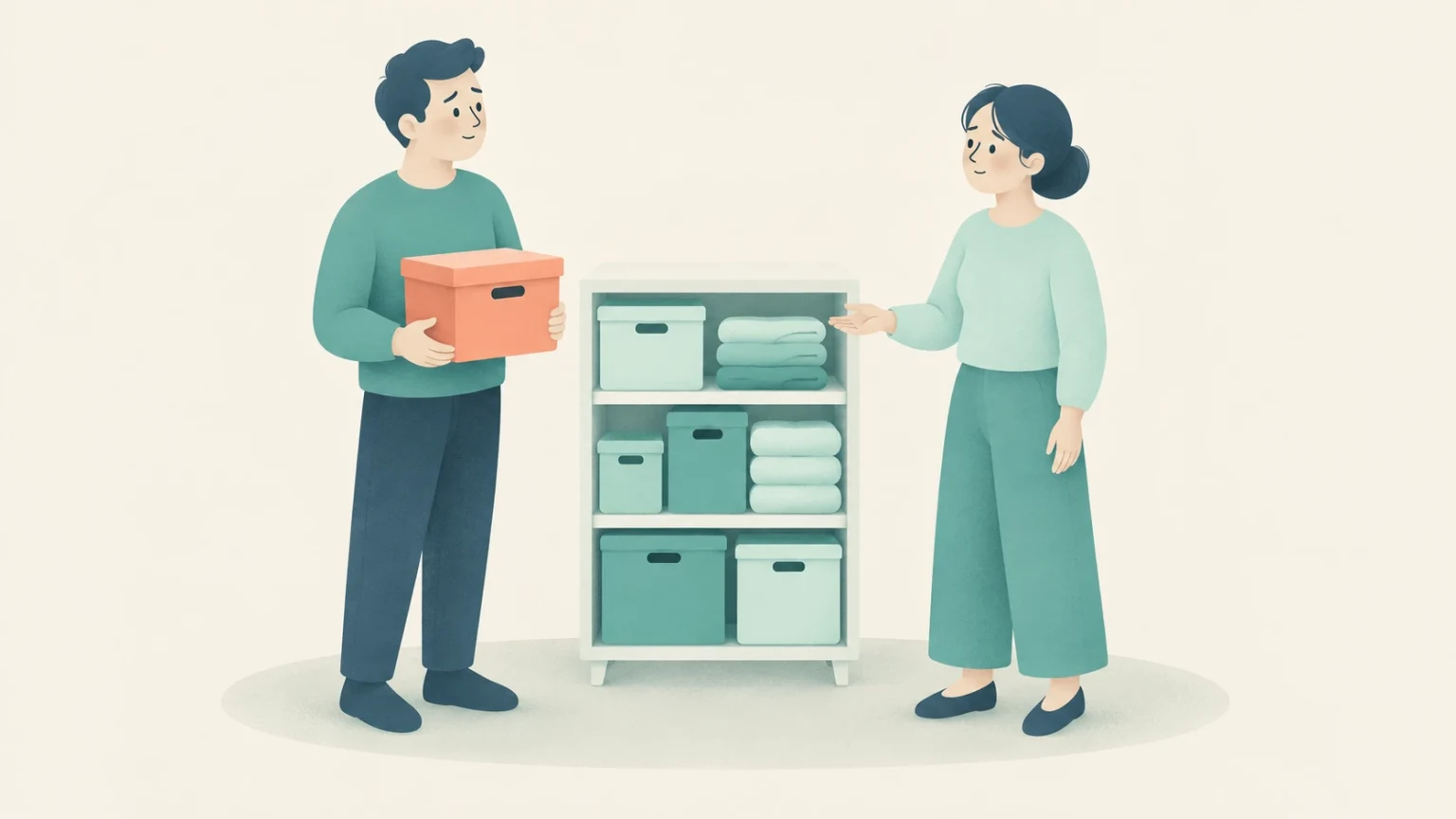
We have nowhere to hang the long coats.
Why it works: No suitable hanging space is available.
2 more examples
-
The spare table is nowhere near the door.
The table is not close to the door.
-
We are getting nowhere with this broken printer.
The speakers are failing to make progress.
Read the full guide
Explain what space is missing
Start with a useful distinction: nowhere says that no suitable place is available; somewhere says that a place exists, even if you do not name it. Maya can see plenty of floor space, but she needs a place where coats will stay clean. Nowhere describes the space needed for her purpose.
-
There is nowhere to hang these coats.
Why it works: The missing space must be suitable for hanging coats.
-
There is somewhere to leave the empty bags.
Why it works: A suitable place exists.
Your turn
Every hook is full. Which sentence explains the problem?
Answer: There is nowhere to hang my jacket.
Show the answer
Answer: There is nowhere to hang my jacket.
Nowhere expresses the lack of an available hanging place.
Use the situation to understand nowhere
People usually understand nowhere within the situation they share. If Maya says there is nowhere to put a box, she probably means in this room or among the spaces they can use. She is not making a claim about every building. Add here, downstairs or another location when the limit needs to be clear.
-
There is nowhere downstairs to store the boxes.
Why it works: Downstairs limits the area being discussed.
You can practise this again in TOEFL Study Response: Explain What You Hear and Volunteer arrival instructions.
Your turn
What does 'There is nowhere here to wash our hands' usually mean?
Answer: This location has no suitable washing place.
Show the answer
Answer: This location has no suitable washing place.
Here limits the statement to the speakers' current location.
Follow nowhere with an action
To explain what someone cannot do, use nowhere followed by to and the base form of a verb. Useful beginnings include there is nowhere, we have nowhere and I had nowhere. Change the first verb for time, but keep the action after to unchanged. This pattern gives the listener a clear practical problem.
-
Yesterday, we had nowhere to keep the spare chairs.
Why it works: Had places the problem in the past; keep stays in its base form.
Your turn
Which sentence has the correct action pattern?
Answer: We have nowhere to put the sign.
Show the answer
Answer: We have nowhere to put the sign.
Use to followed by the base verb put.
Choose nowhere or not anywhere
Nowhere already makes a sentence negative. In standard English, say we have nowhere or we do not have anywhere. These patterns can express the same problem. Avoid combining do not with nowhere for this meaning in your own standard writing. You may hear that combination in some dialects, but it follows a different usage pattern.
-
We do not have anywhere to display the shoes.
Why it works: Not supplies the negative meaning, so anywhere fits.
-
We have nowhere to display the shoes.
Why it works: Nowhere supplies the negative meaning.
Your turn
Which version means 'We have nowhere to wait' in standard English?
Answer: We do not have anywhere to wait.
Show the answer
Answer: We do not have anywhere to wait.
Not anywhere expresses the same lack of a place without combining two negatives.
Write nowhere and no place correctly
For the ordinary meaning of no location, nowhere is one word. No place is also a possible expression, but it contains the noun place. Both can fit many everyday messages. Do not split nowhere into no where. When checking a message, read the whole sentence and decide whether you mean a location or a separate reply.
-
There is no place for another table.
Why it works: No place is a two-word noun phrase.
-
No, where should I leave the receipt?
Why it works: No is a separate reply before a question.
Your turn
Choose the correctly written message about unavailable storage.
Answer: We have nowhere to keep this.
Show the answer
Answer: We have nowhere to keep this.
The location word is nowhere, followed by to and the base verb keep.
Distinguish place, distance and progress
The words around nowhere help you choose its meaning. Nowhere to sit concerns an available place. Nowhere near the entrance concerns distance. Getting nowhere with a task means making no progress. Nobody needs to be travelling. You can also say nowhere near ready when much more work is needed before something will be ready.
-
The shoe table is nowhere near the entrance.
Why it works: This describes physical distance.
-
We are getting nowhere with the price list.
Why it works: This describes a task that is not progressing.
Your turn
What does 'The room is nowhere near ready' mean?
Answer: The room still needs a lot of preparation.
Show the answer
Answer: The room still needs a lot of preparation.
Nowhere near ready describes how far the preparation is from completion.
Listen for the words around nowhere
Nowhere normally has stress on its first syllable. In quick speech, to in nowhere to put may sound weak, like tuh. There is may become there's, so listen for the small ending before nowhere. First catch the main action, then replay to recover these quieter words. Sound alone does not tell you where written spaces belong.
-
There's nowhere to put the mirror.
Why it works: There's means there is; to may be weak in speech.
Your turn
What does there's represent in the example?
Answer: There is
Show the answer
Answer: There is
The sentence describes a present situation using there is nowhere.
Add a next step and practise recall
A message becomes more useful when you follow the problem with a request or possible solution. Say what lacks a place, then explain what would help. For recall practice, cover an example and rebuild its meaning using your own object and action. Afterwards, check the spelling, the negative pattern and whether your request answers the problem.
-
We have nowhere to keep the drinks cold, so could you bring a cool bag?
Why it works: The request offers a practical response to the problem.
Your turn
Which request best follows 'We have nowhere to hang the coats'?
Answer: Could you bring a clothes rail?
Show the answer
Answer: Could you bring a clothes rail?
A clothes rail provides the hanging space that the first sentence says is missing.
Use it naturally
How people really use “nowhere”
Neutral Fine almost anywhere, at work or with friends.
Words it often goes with
- nowhere to putWe have nowhere to put the extra chairs.
- nowhere to hangThere is nowhere to hang a towel in this bathroom.
- nowhere nearThe bus stop is nowhere near our hotel.
- getting nowhereWe are getting nowhere with this old computer.
What people also say
- “There's nowhere to put my bag.” instead of “There is no suitable place available for my bag.” This is a shorter, everyday way to explain the space problem.
A stronger way to say it
The box is too small. → The box is nowhere near big enough.
The box is nowhere near big enough for all these shoes.
Questions about "Nowhere to Put It: Explain a Space Problem"
When should I use anywhere instead of nowhere?
Use anywhere with a negative verb to express the absence of a place: do not have anywhere. Use nowhere with an affirmative verb for the same basic meaning. Anywhere is also common in questions asking whether a suitable place exists.
I do not have anywhere to charge my tablet.
I have nowhere to charge my tablet.
Is there anywhere to charge my tablet?
Can I say nowhere when I can see an empty space?
Yes, if the space is unsuitable for the action you mean. An empty corner may be too wet for paper boxes, for example. Naming the action after nowhere helps the listener understand what kind of space is missing.
The floor is wet, so there is nowhere to put these paper bags.
Does nowhere near always describe a physical distance?
No. It can describe physical distance, but it can also mean not nearly when discussing a condition or amount. With ready or finished, it means substantial work remains. Use the following words and the situation to identify the meaning.
The cash machine is nowhere near our hotel.
The sandwiches are nowhere near ready.
Does going nowhere always mean that a task is failing?
No. With a task or discussion, it can mean no progress. With a person, it can describe having no plan to go out or travel. The subject and surrounding information make the intended meaning clearer.
This discussion is going nowhere because we keep changing the question.
I'm going nowhere this evening because I want an early night.
Before you go
Remember this
Write nowhere as one word. Name the action with to + a base verb, and check that you have not added an unnecessary negative. Listen for the difference between no available place, not close and no progress.
Stage 2 of 5
Listen
Hear it in real sentences, from short to long, and write what you hear.
0 of 4 done
Listening 1 of 4
Listening 2 of 4
Try a longer clip. Listen once, then replay the part you missed.
Listening 3 of 4
This clip is longer. Follow the instruction above the answer field.
Listening 4 of 4
Listen, then type the missing words. The rest of the text is already there.
0:00
Practice complete
You listened closely.
Your result is saved in this browser.
Keep your progress. Your practice is saved on this device only. Create a free account to keep it everywhere.
Create a free accountThat was today's free lesson. Tomorrow you get another one. Want more today? See membership.
Create a free SubLearn account to keep this progress across devices.
Save my progressStage 3 of 5
Speak
Say it with the speaker, then use it in your own answer.
Shadow
Say it along with the speaker
Play the line slowly, then speak at the same time as the speaker. Copy the rhythm, not just the words.
Your turn
Say it your way
Speak for 20-30 seconds as a sale volunteer. Explain that you have nowhere to display some books, suggest a new location and ask another volunteer for help.
You could start with “We have nowhere to display these books, so…”
Take ten seconds to think, then answer out loud without looking at the lesson. Speak for the time shown in the task above. Nothing is sent unless you ask for feedback.
0:00
Stage 4 of 5
Write
Write your own response
AI feedback · it can make mistakes · Part of membership See membership
Check your own writing
Read one possible response
Draft saved on this device.
Use these checks to revise your message. Grammar and meaning are not automatically graded. Each task keeps its own draft in this browser tab.

You finished the free part of this lesson
- Understand
- Listen
- Speak
- Write
- CheckPart of membership
Worth another look
With a free account, the lessons you finish come back for review to help you remember them.Create a free account
Stage 5 of 5 · Part of membership
Check
New clips without hints.
Listening tests are included with membership. Try the free dictation first, then decide whether to continue.
Listening 1 of 2 Part of membership
Listening 2 of 2 Part of membership
Follow MicroEnglish
Find lesson updates, short videos and quick quizzes. Pick the app you already use.
Questions & comments
Ask about this lesson, share an example, or help another learner.
Example
Memory tip
Goes with
Related forms
Not to be confused with
In this lesson
This word isn't in our dictionary. Check the spelling, or try another form of the word.
We couldn't load this word. Try again.
