Phrasal verb
Chip away
What does chip away at mean?
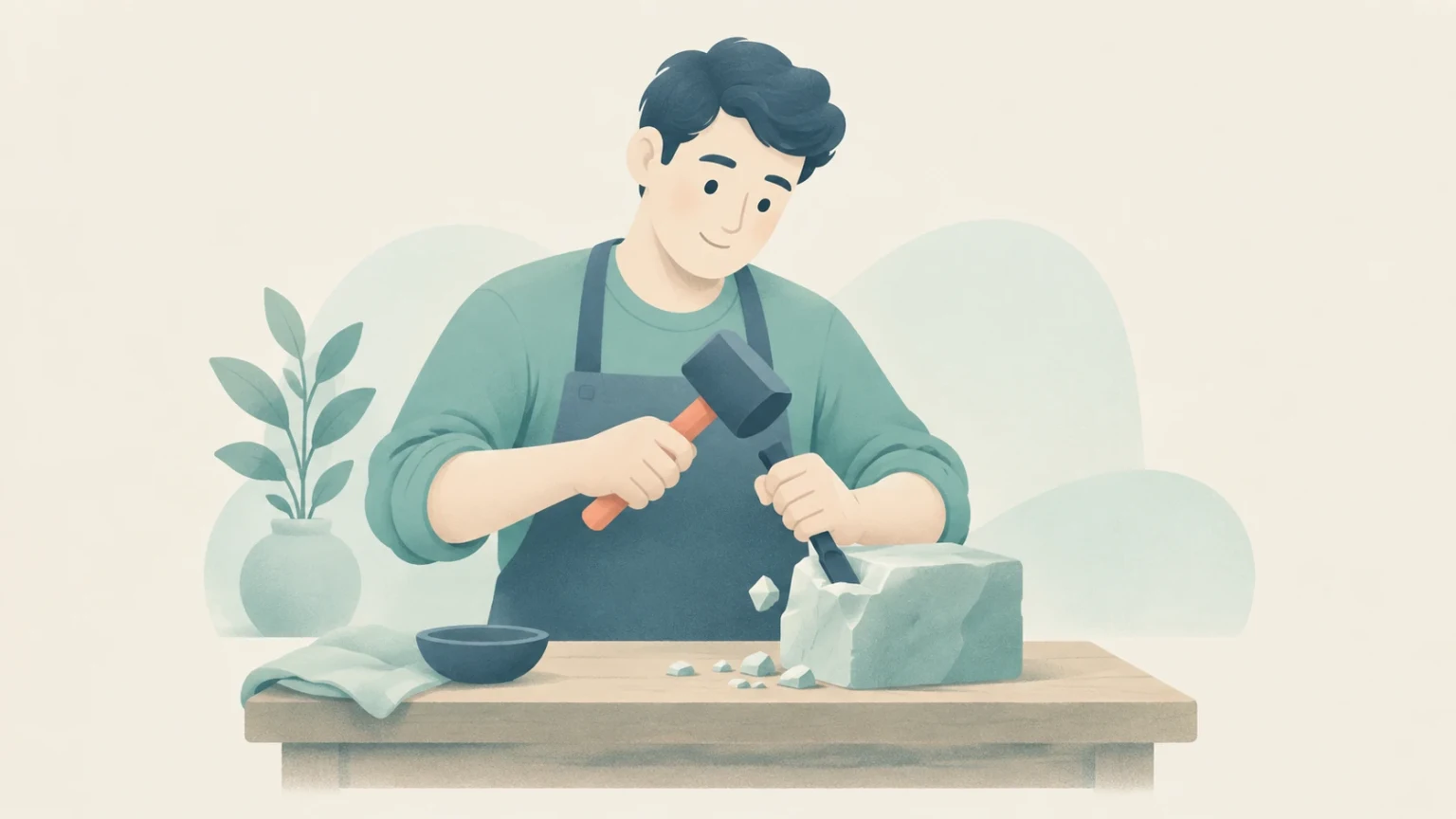
Chip away literally describes breaking off tiny pieces from a hard surface with repeated small strikes. In everyday figurative use, chip away at describes making steady progress against a large task or slowly diminishing a quantity, feeling, or barrier through small efforts over time.
Key points
- Remember that chip away at focuses on ongoing reduction rather than sudden completion.
- Keep the item being reduced after at, remember the double p in chipped and chipping, and check whether your sentence describes positive steady effort or slow gradual damage.
- In the figurative pattern, place the noun or pronoun directly after at: chip away at the workload, chip away at it.
This lesson has 5 stages. You can stop at any time and continue later.

Stage 1 of 5
Understand
What it means, when to use it, and mistakes to avoid.
The full explanation
Chip away literally describes breaking off tiny pieces from a hard surface with repeated small strikes. In everyday figurative use, chip away at describes making steady progress against a large task or slowly diminishing a quantity, feeling, or barrier through small efforts over time. It shows that the target is diminishing, but it does not claim that the work is finished.
We spent thirty minutes every afternoon to chip away at the garden weeds.
Why it works: Shows small repeated efforts gradually reducing an overwhelming physical chore.
2 more examples
-
Unexpected repair bills continue to chip away at their emergency fund.
Illustrates harmful gradual loss where an amount becomes smaller over time.
-
Elena felt nervous before each presentation, but practice chipped away at her hesitation.
Describes a gradual weakening of a negative feeling through consistent practice.
Read the full guide
Decide when small actions reduce a larger whole
Imagine using a small metal hammer on a large block of stone. Each light strike removes only a tiny fragment. The stone remains large after one strike, but continuous small taps make it smaller. In spoken English, chip away at applies this exact physical image to daily tasks, problems, or amounts. When you say you are chipping away at something, you mean that small, repeated actions are steadily reducing it over time. The expression highlights continuous effort rather than an instant finish.
-
I read fifteen pages every night to chip away at the thick textbook.
Why it works: Small regular reading sessions slowly reduce the remaining pages.
-
The company paid an extra fifty dollars a week to chip away at the balance.
Why it works: Repeated small financial payments gradually lower the total amount owed.
Your turn
What does someone mean when they say they are chipping away at a project?
Answer: They are making steady progress by doing small parts over time.
Show the answer
Answer: They are making steady progress by doing small parts over time.
Chip away at emphasizes gradual reduction through small, repeated actions rather than instant completion or quitting.
Describe everyday tasks that cannot be finished at once
Consider two housemates looking at a cluttered garage filled from floor to ceiling with old furniture, cardboard boxes, and broken appliances. One housemate feels defeated and says they will never clear enough space for their commuter bicycles. The other housemate suggests taking out two boxes every evening after dinner. Instead of trying to finish everything in one go (/idioms/in-one-go/), small steps make practical progress. By proposing to chip away at the pile, the second housemate turns an impossible weekend chore into manageable daily steps.
-
Mark looked at the messy garage and sighed, 'This will take months.' Sarah replied, 'We can chip away at the boxes each night.'
Why it works: Sarah uses the phrase to encourage small daily contributions instead of giving up.
-
If we chip away at the clutter before dinner, we will have room for our bikes by next week.
Why it works: The speaker links regular short efforts to a visible practical result.
This also comes up in Flat viewing costs and dates and Project status update.
Your turn
Why is chip away at suitable for the garage cleanup situation?
Answer: The pile is too large to clear in one go, so small steps make practical progress.
Show the answer
Answer: The pile is too large to clear in one go, so small steps make practical progress.
The expression fits large, messy situations where doing small amounts steadily is the only realistic way to finish.
Place the reduced item directly after the preposition at
When you use chip away at to talk about a task or amount, the word order is fixed. The structure is subject plus chip away at plus the noun phrase or pronoun. You must say chip away at the pile or chip away at it. Do not split the phrase by placing the noun between away and at, and do not put a pronoun between chip and away when you mean gradual reduction. Keeping the three words together ensures your listener follows the figurative meaning immediately.
-
The committee continues to chip away at the budget deficit.
Why it works: The target noun phrase the budget deficit sits directly after at.
-
The workload seems enormous, but our team will chip away at it together.
Why it works: The pronoun it follows at; saying chip it away at is incorrect.
Your turn
Which sentence uses the correct word order for figurative reduction?
Answer: We have five reports left, so let us chip away at them tonight.
Show the answer
Answer: We have five reports left, so let us chip away at them tonight.
In the figurative pattern, the preposition at must stay connected to chip away, and the pronoun follows at.
Spell the past form and participle with a double letter
The verb appears in four forms across different tenses: base form chip, third-person singular present chips, past simple and past participle chipped, and present participle chipping. The base verb chip follows a single short vowel and single consonant pattern. Because of this spelling rule, you must double the letter p before adding vowel suffixes, giving chipped and chipping rather than chiped or chiping. In spoken English, the past ending ed in chipped sounds like a clean /t/ sound attached to the p sound without an extra vowel syllable, sounding like /tʃɪpt/. The singular present form chips simply adds the standard s ending.
-
Last winter, the volunteers chipped away at the fallen branches along the trail.
Why it works: The past tense verb doubles the p and ends in a crisp /t/ sound.
-
The new software is slowly chipping away at data entry mistakes.
Why it works: The progressive form doubles the p before the ing suffix.
Your turn
Which written sentence spells the past-tense form correctly?
Answer: She chipped away at the backlog until her inbox was finally empty.
Show the answer
Answer: She chipped away at the backlog until her inbox was finally empty.
English spelling rules require doubling the consonant after a single short vowel in a one-syllable base verb.
Distinguish positive progress from gradual damage
A common mistake is assuming that chip away at only describes positive accomplishments like paying debts or organizing rooms. In natural English, the phrase also describes harmful erosion. Small recurring expenses can chip away at your emergency savings, and constant harsh comments can chip away at an employee's confidence or team trust. Before you use the phrase, identify the target. If you are reducing an unwanted obstacle, the effect is positive; if you are wearing down a valuable resource or feeling, the effect is harmful.
-
Unclear instructions slowly chipped away at the crew's confidence.
Why it works: Here the phrase describes a negative loss of confidence over several weeks.
-
By walking fifteen minutes daily, he chipped away at his high blood pressure.
Why it works: Here the reduction targets a health risk, representing positive personal progress.
Your turn
In which sentence does chip away at describe an undesirable or harmful change?
Answer: Daily disagreements began to chip away at their mutual trust.
Show the answer
Answer: Daily disagreements began to chip away at their mutual trust.
Mutual trust is a positive quality being slowly destroyed, showing the harmful erosion sense of the phrase.
Spot the linking sounds between away and at in natural speech
In fluent everyday speech, native speakers link words together without pausing. When someone says away at, the final vowel sound of away glides into the unstressed vowel of at, creating a smooth transition that can sound like a single word. Do not let this connected pronunciation fool you into writing away without at. In the past tense, chipped away blends the final /t/ sound into the first vowel of away. You will hear /tʃɪptəˈweɪ/, but you must recognize both the past ending and the preposition.
-
They chipped away at the old plaster until the brick appeared.
Why it works: The past /pt/ sound links smoothly to the initial weak vowel of away.
-
I listen closely when speakers say away at so I do not drop the preposition.
Why it works: Recognizing connected speech prevents leaving out short unstressed function words.
Your turn
What happens to the pronunciation of chipped away in natural connected speech?
Answer: The final /t/ sound of chipped links directly to the vowel in away.
Show the answer
Answer: The final /t/ sound of chipped links directly to the vowel in away.
In fluent English, final consonant sounds connect smoothly into following vowel sounds without adding an extra syllable.
Test your memory of the phrase structure before writing
Before drafting your own sentences, pause for a structured closed-book recall step without checking earlier sections. First, retrieve the core meaning from memory: recall what kind of repeated action is happening and whether the target task is finished or still ongoing. Second, reconstruct the grammatical pattern: remember the exact order of the verb and both linking particles before a noun or pronoun. Third, identify what is being reduced in your situation, such as an office backlog (/idioms/backlog/) or personal debt. In terms of register, chip away at is common in casual conversation and everyday workplace updates (/micro-listenings/20-3/), while gradually reduce serves as a plainer alternative when formal clarity is required.
-
Every morning, I answer ten customer emails to chip away at the inbox backlog.
Why it works: Applies the pattern to an office task where small efforts reduce accumulated work.
-
He put ten dollars into the envelope each week to chip away at his debt.
Why it works: Demonstrates consistent action aimed at shrinking a financial liability.
Your turn
Which part of the phrase is mandatory when you name the specific problem being reduced?
Answer: The word at must follow chip away before the noun or pronoun.
Show the answer
Answer: The word at must follow chip away before the noun or pronoun.
When naming the specific problem or quantity, at is required: chip away at the debt, not chip away the debt.
Determine whether to include at, move the object, or stand alone
To choose the correct pattern, determine what action is taking place. In physical contexts, notice the difference in focus: saying you chip away at the ice describes working on the surface, while saying you chip the ice away or chip away the ice focuses on removing pieces of the material; it does not always mean every piece was removed. When using a pronoun in that removal pattern, place it between the verb and particle, as in chip it away. For figurative reduction of tasks, keep all elements together: chip away at the backlog or chip away at it. Finally, when the context is already understood by your listener, chip away can stand alone without an object to indicate steady progress.
-
The worker used a chisel to chip the old tiles away from the wall.
Why it works: In physical removal, the noun can appear between chip and away.
-
We still have several boxes to check, but we are chipping away.
Why it works: The phrasal verb stands alone because the task was already mentioned.
Your turn
When is it grammatically correct to use chip away without the word at?
Answer: When the context is already understood and you do not name the object.
Show the answer
Answer: When the context is already understood and you do not name the object.
Chip away can function as an intransitive phrase when the surrounding conversation already makes the task clear.
Use it naturally
How people really use “chip away at”
Neutral Fine almost anywhere, at work or with friends.
Words it often goes with
- chip away at the backlogWe answer five old requests each morning to chip away at the backlog.
- chip away at confidenceRepeated rude comments can chip away at confidence.
- chip away at savingsSmall daily purchases can chip away at savings.
- chip away at the problemEach short practice session helps us chip away at the problem.
What people also say
- “We're chipping away at the work.” instead of “We are reducing the amount of unfinished work through repeated small efforts.” This is a shorter, natural way to describe gradual progress.
Questions about "Chip away"
What does chip away at mean?
The phrase chip away at means to reduce something gradually through repeated small actions. It originates from the physical action of using a tool to strike off tiny fragments of stone or ice. In everyday conversations, speakers use it to describe making steady progress on an intimidating task, lowering a debt, or wearing down an obstacle little by little.
We decided to chip away at the long report by writing two sections every morning.
Do I always need at after chip away?
Use chip away at when naming a task or problem you are gradually reducing. If the task is already understood, chip away can stand alone. For physical removal, the separable pattern chip something away is also possible, with a noun or a pronoun between chip and away.
My brother asked about the painting project, and I told him I was slowly chipping away.
Should I say chip away at it or chip it away?
Chip away at it is the usual pattern for gradual work on a task or problem. Chip it away is the separable removal pattern, often used for material such as ice or paint. Choose the pattern from the intended meaning rather than assuming that every use has exactly the same structure.
The spreadsheet is huge, but I will chip away at it today.
There was thick ice on the front step, so he chipped it away with a metal shovel.
Can chip away at describe something bad?
Yes, chip away at often describes negative erosion. It is frequently used when repeated small events weaken a valuable resource, feeling, or relationship. People often speak about unexpected fees chipping away at personal savings, or ongoing doubt chipping away at someone's self-confidence.
His sarcastic remarks began to chip away at her confidence during team meetings.
Does it mean I have finished the job?
No, chip away at does not mean the job is finished. The expression focuses specifically on gradual progress and ongoing effort over time. If you say you chipped away at the paperwork, your listener understands that you made it smaller, but some unfinished work likely remains.
I chipped away at the yard work before lunch, but the lawn still needs mowing.
How do I spell and pronounce chipped?
The past tense form is spelled chipped with two letter p's because the short vowel in chip requires consonant doubling before the ed suffix. In spoken English, the word has one syllable and ends in a /pt/ sound. When spoken naturally before a vowel, the /t/ sound links directly to the next word, as in chipped away.
The mechanic chipped away at the rusted bolt until it finally turned.
Before you go
Remember this
Remember that chip away at focuses on ongoing reduction rather than sudden completion. Keep the item being reduced after at, remember the double p in chipped and chipping, and check whether your sentence describes positive steady effort or slow gradual damage.
Stage 2 of 5
Listen
Hear it in real sentences, from short to long, and write what you hear.
0 of 4 done
Listening 1 of 4
Listen, then type what you hear. Replay as often as you need.
0:00
- Unexpected repair bills continue to chip away at their emergency fund.
- Elena felt nervous before each presentation, but practice chipped away at her hesitation.
Listening 2 of 4
Listen, then type what you hear. Replay as often as you need.
0:00
- Unexpected repair bills continue to chip away at their emergency fund.
- Elena felt nervous before each presentation, but practice chipped away at her hesitation.
Try a longer clip. Listen once, then replay the part you missed.
Listening 3 of 4
Listen, then type what you hear. Replay as often as you need.
0:00
- Unexpected repair bills continue to chip away at their emergency fund.
- Elena felt nervous before each presentation, but practice chipped away at her hesitation.
This clip is longer. Follow the instruction above the answer field.
Listening 4 of 4
Listen, then type the missing words. The rest of the text is already there.
0:00
- Unexpected repair bills continue to chip away at their emergency fund.
- Elena felt nervous before each presentation, but practice chipped away at her hesitation.
Practice complete
You listened closely.
Your result is saved in this browser.
Keep your progress. Your practice is saved on this device only. Create a free account to keep it everywhere.
Create a free accountThat was today's free lesson. Tomorrow you get another one. Want more today? See membership.
Create a free SubLearn account to keep this progress across devices.
Save my progressStage 3 of 5
Speak
Say it with the speaker, then use it in your own answer.
Shadow
Say it along with the speaker
Play the line slowly, then speak at the same time as the speaker. Copy the rhythm, not just the words.
Your turn
Say it your way
Speak for 30 to 60 seconds from memory. Imagine you helped your younger cousin feel less afraid of water at a swimming pool. Describe the small steps you tried, how your cousin felt afterward, and what you would try together next.
Use: chip away at chipped away at
Take ten seconds to think, then answer out loud without looking at the lesson. Speak for the time shown in the task above. Nothing is sent unless you ask for feedback.
0:00
Hear how someone else might say it
My younger cousin was afraid of getting into the pool, so we started by sitting at the edge. I wanted to chip away at his fear without making him feel rushed. We put our feet in the water and played a little game. Then he held my hand and stood in the shallow water. These small steps chipped away at his fear, and he began to smile. He still wasn't ready to swim. Next time, we'll practice moving through the water together, close to the edge.
Try once more and answer this: Which activity did your cousin enjoy most?
Stage 4 of 5
Write
Write your own response
AI feedback · it can make mistakes · Part of membership See membership
Check your own writing
Read one possible response
Draft saved on this device.
Use these checks to revise your message. Grammar and meaning are not automatically graded. Each task keeps its own draft in this browser tab.

You finished the free part of this lesson
- Understand
- Listen
- Speak
- Write
- CheckPart of membership
Worth another look
With a free account, the lessons you finish come back for review to help you remember them.Create a free account
Stage 5 of 5 · Part of membership
Check
New clips without hints.
Listening tests are included with membership. Try the free dictation first, then decide whether to continue.
Listening 1 of 2 Part of membership
Listening 2 of 2 Part of membership
Follow MicroEnglish
Find lesson updates, short videos and quick quizzes. Pick the app you already use.
Questions & comments
Ask about this lesson, share an example, or help another learner.
Example
Memory tip
Goes with
Related forms
Not to be confused with
In this lesson
This word isn't in our dictionary. Check the spelling, or try another form of the word.
We couldn't load this word. Try again.
