Micro-listening
telling the time: past, to, and digital
The short answer
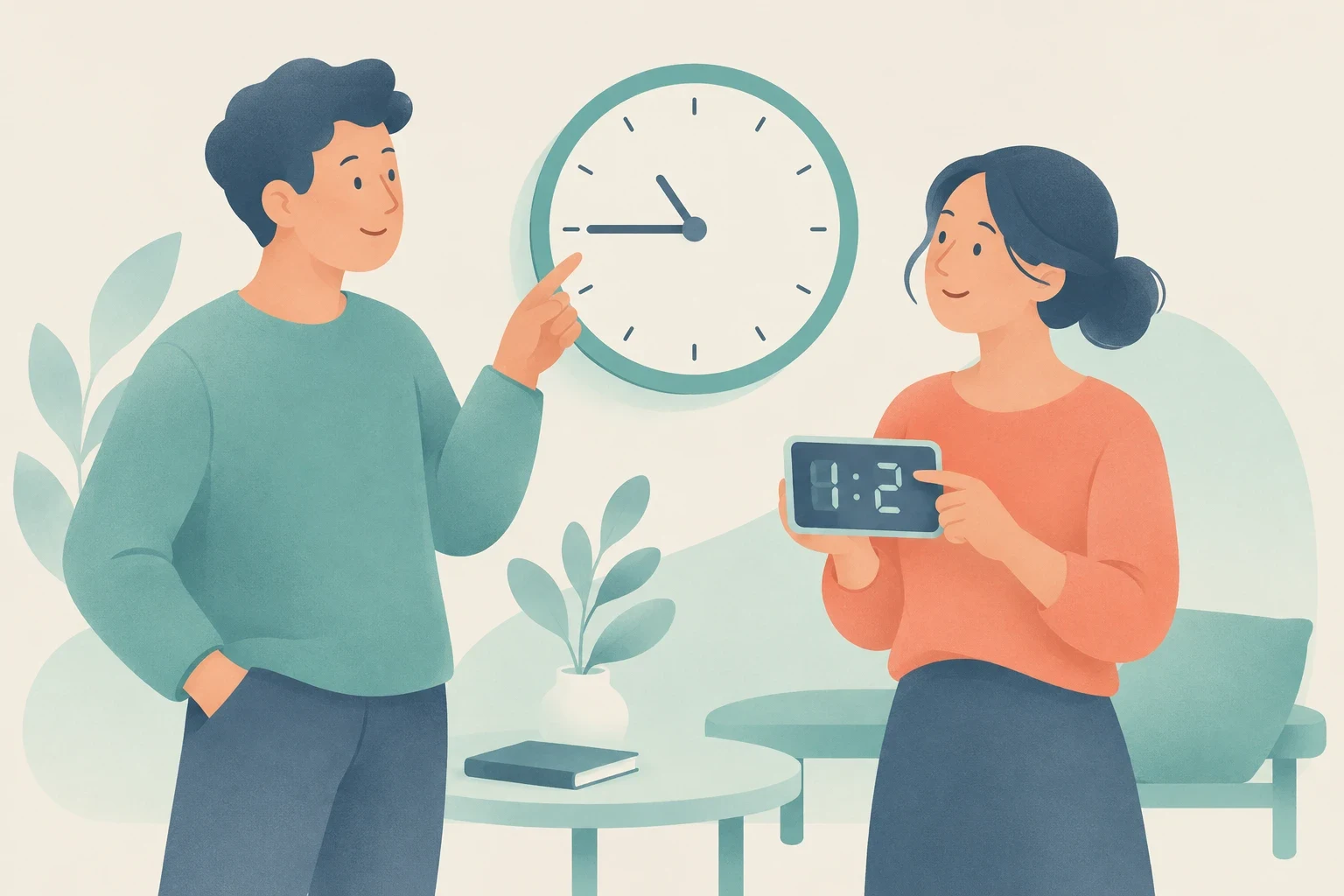
A time expression points to a specific minute in the day. The word past indicates time elapsed after a stated hour, while to shows the number of minutes remaining before the next hour arrives. Digital time states the hour number first, followed immediately by the minute number.
Key points
- Check whether a spoken phrase looks backward with past or forward with to before confirming an appointment.
- Remember that quarter represents fifteen minutes, half past represents thirty minutes, and single-digit minutes in digital speech use the sound oh.
- Reserve o'clock strictly for times with zero minutes, such as nine o'clock.
This lesson has 5 stages. You can stop at any time and continue later.

Stage 1 of 5
Understand
What it means, when to use it, and mistakes to avoid.
Examples
Our morning team briefing starts at nine o'clock sharp.
Why it works: The speaker uses o'clock because the event begins precisely on the hour with no additional minutes.
3 more examples
-
The dentist can see you at twenty past two.
Twenty past two means 2:20, indicating twenty minutes after the second hour.
-
We should board the shuttle at ten to six.
Ten to six means 5:50 because ten minutes remain before the sixth hour.
-
The express train departs platform four at seven oh five.
The speaker uses oh for the zero in 7:05 to read the digital time clearly.
Read the full guide
Name the exact hour without extra minutes
Use o'clock only when the minute hand points directly to twelve and zero minutes have passed. You can say seven o'clock or seven in natural speech. Never attach o'clock to a time that includes minutes. Saying seven o'clock twenty is an error; choose either seven twenty or twenty past seven instead.
-
The library doors open at eight o'clock.
Why it works: The time is exactly 8:00, so o'clock is appropriate.
-
The staff meeting concludes at four.
Why it works: Native speakers often omit o'clock in casual conversation when the hour is obvious.
Your turn
Which sentence correctly states an exact hour without minutes?
Answer: The museum opens at ten o'clock.
Show the answer
Answer: The museum opens at ten o'clock.
The word o'clock only accompanies full hours with zero minutes.
Count forward using past for the first thirty minutes
When minutes have elapsed after an hour, name the minutes first, say past, and then name the hour that recently began. For example, ten past eight corresponds to 8:10. This structure applies to the right half of the analog clock face, from one minute to thirty minutes after the hour.
-
Dr. Adams called the patient in at five past eleven.
Why it works: Five past eleven means 11:05 because five minutes have passed since eleven.
-
The workshop resumes at twenty-five past one.
Why it works: Twenty-five minutes have passed since 1:00, so the time is 1:25.
You can practise this again in English Contractions: When to Shorten Words and Threw or through? Listen at the new flat.
Your turn
If an announcement states that a ferry arrives at twenty past four, what time does it dock?
Answer: 4:20
Show the answer
Answer: 4:20
Twenty past four means twenty minutes have elapsed after four o'clock, which is 4:20.
Count down to the approaching hour with to
When the clock shows between thirty-one and fifty-nine minutes, English speakers look forward toward the next hour. Calculate how many minutes remain before that upcoming hour, say to, and name the next hour. For example, twenty to seven means 6:40 because twenty minutes remain before the clock strikes seven.
-
The supervisor leaves the office at ten to five.
Why it works: Ten to five means 4:50 because ten minutes remain until five o'clock.
-
Our connecting flight boards at twenty-five to three.
Why it works: Twenty-five minutes remain before 3:00, which means 2:35.
Your turn
A colleague says, 'Let us wrap up this call at five to twelve.' What time should the call end?
Answer: 11:55
Show the answer
Answer: 11:55
Five to twelve means five minutes remain before twelve o'clock, which is 11:55.
Use quarter past and quarter to for fifteen-minute marks
A quarter of an hour equals fifteen minutes. Instead of saying fifteen past four, English speakers almost always say quarter past four or a quarter past four. Similarly, forty-five minutes after an hour is expressed as quarter to the following hour. For instance, quarter to eight indicates 7:45.
-
The technician arrives at quarter past nine.
Why it works: Quarter past nine means 9:15 because fifteen minutes have passed since nine.
-
The restaurant kitchen closes at quarter to eleven.
Why it works: Quarter to eleven means 10:45 because fifteen minutes remain before eleven.
Your turn
Which phrase corresponds to the digital clock time 6:45?
Answer: quarter to seven
Show the answer
Answer: quarter to seven
At 6:45, fifteen minutes remain before seven o'clock, making quarter to seven the correct expression.
Use half past for thirty minutes after the hour
Thirty minutes after an hour represents half of the clock cycle. In standard British and international English, speakers say half past followed by the current hour, such as half past ten for 10:30. Notice that English never uses half to name the coming hour in this construction, so half past ten always refers to the ten o'clock hour.
-
Lunch is served in the main dining hall at half past twelve.
Why it works: Half past twelve indicates 12:30, exactly thirty minutes after noon.
-
Our weekly progress check begins at half past three.
Why it works: The phrase names the current hour, meaning the event takes place at 3:30.
Your turn
A project manager schedules an interview for half past two. What digital time should you enter on your calendar?
Answer: 2:30
Show the answer
Answer: 2:30
Half past two means thirty minutes after two o'clock, which is 2:30.
Say digital numbers for schedules and transportation
Digital time simply states the hour followed by the minute digits. This style is especially common in transportation hubs, broadcast schedules, and corporate meetings. When reading minutes from one to nine, pronounce the leading zero as oh. For example, 8:04 is spoken aloud as eight oh four rather than eight four.
-
The express bus departs bay nine at seven oh eight.
Why it works: The speaker reads 7:08 by pronouncing the single digit zero as oh.
-
The webinar platform opens at two forty.
Why it works: Two forty presents the digital digits directly for 2:40.
Your turn
How does a station announcer typically read the scheduled departure time 9:06?
Answer: nine oh six
Show the answer
Answer: nine oh six
Single-digit minutes between 01 and 09 are spoken with the letter sound oh.
Specify the time of day to prevent mistakes
English uses a twelve-hour clock in social conversation, which means seven o'clock occurs twice each day. To prevent scheduling errors, clarify the timing by adding in the morning, in the afternoon, or in the evening. For midday and midnight, use noon and midnight instead of confusing abbreviations like twelve a.m.
-
The delivery driver will arrive around eight in the morning.
Why it works: Adding in the morning ensures the receiver does not expect an evening delivery.
-
Please submit all expense claims before twelve noon.
Why it works: Using noon avoids ambiguity between day and night deadlines.
Your turn
Which option avoids ambiguity when setting an evening dinner reservation?
Answer: Table reserved for seven thirty in the evening.
Show the answer
Answer: Table reserved for seven thirty in the evening.
Adding in the evening clarifies the 12-hour clock, and seven thirty correctly states the minutes without o'clock.
Confirm spoken times when listening in busy places
Background noise at train stations, cafes, and airports can make past and to sound similar. When a speaker shares a critical deadline, mirror the information using digital numbers or asking a direct verification question. Repeating Did you say twenty to six or twenty past five removes uncertainty before you commit to travel plans.
-
Just to confirm, did you say we are meeting at quarter to two?
Why it works: Repeating the exact phrase allows the speaker to correct any misheard detail.
-
So that is three forty-five on the confirmation slip, right?
Why it works: Translating a clock phrase into digital numbers verifies that both parties agree on the precise time.
Your turn
You hear a colleague mention an event at 'twenty to four', but the room is loud. How should you confirm the time digitally?
Answer: Did you mean three forty?
Show the answer
Answer: Did you mean three forty?
Twenty to four means twenty minutes before four o'clock, which is 3:40.
Use it naturally
How people really use “quarter to four”
Neutral Fine almost anywhere, at work or with friends.
Words it often goes with
- at quarter to fourThe game starts at quarter to four.
- by quarter to fourPlease finish your lunch by quarter to four.
- until quarter to fourWe can stay here until quarter to four.
- around quarter to fourI'll call you around quarter to four.
What people also say
- “It's three forty-five.” instead of “It's fifteen minutes before four o'clock.” The digital form is a short, common way to give this time.
Questions about "telling the time: past, to, and digital"
Can I say 'eight o'clock thirty' if I want to be polite?
No. In English, o'clock connects exclusively to the full hour with zero minutes. Saying o'clock with minute numbers is a common learner error. Instead, say eight thirty or half past eight. Politeness in English comes from phrases like please or could we meet, not from adding o'clock to minutes.
The presentation starts at eight thirty.
We can discuss the contract at half past eight.
Do American speakers say 'after' instead of 'past'?
Yes, American English speakers frequently use after in place of past for minutes following an hour. You might hear ten after four instead of ten past four. Both forms are fully understood across English-speaking regions, but past remains standard worldwide, especially in British English.
Our bus pulled up at ten after four.
She called the office at twenty after nine.
Should I say 'quarter past' or 'a quarter past'?
Both versions are grammatically correct and natural. British speakers frequently drop the article and say quarter past five, while many American speakers include the article and say a quarter after five or a quarter past five. You can comfortably use either pattern without causing confusion.
The meeting adjourned at quarter past five.
We walked into the station at a quarter past five.
Why is it better to say noon or midnight instead of 12 a.m. or 12 p.m.?
12 p.m. normally means midday and 12 a.m. means midnight, but the labels can be confusing. Twelve noon is clearer for midday. For midnight, also give the date and make clear which night you mean, especially for travel or deadlines. The word midnight by itself does not resolve whether you mean the start or end of a particular date.
Hotel checkout is at twelve noon.
The online submission portal closes at midnight.
Before you go
Remember this
Check whether a spoken phrase looks backward with past or forward with to before confirming an appointment. Remember that quarter represents fifteen minutes, half past represents thirty minutes, and single-digit minutes in digital speech use the sound oh.
Stage 2 of 5
Listen
Hear it in real sentences, from short to long, and write what you hear.
0 of 4 done
Listening 1 of 4
Listening 2 of 4
Try a longer clip. Listen once, then replay the part you missed.
Listening 3 of 4
This clip is longer. Follow the instruction above the answer field.
Listening 4 of 4
Listen, then type the missing words. The rest of the text is already there.
0:00
Practice complete
You listened closely.
Your result is saved in this browser.
Keep your progress. Your practice is saved on this device only. Create a free account to keep it everywhere.
Create a free accountThat was today's free lesson. Tomorrow you get another one. Want more today? See membership.
Create a free SubLearn account to keep this progress across devices.
Save my progressStage 3 of 5
Speak
Say it with the speaker, then use it in your own answer.
Shadow
Say it along with the speaker
Play the line slowly, then speak at the same time as the speaker. Copy the rhythm, not just the words.
Your turn
Say it your way
Describe your personal daily routine on a typical workday, mentioning at least three specific times using past, to, and digital numbers.
You could start with “On a regular weekday, my day starts around…”
Take ten seconds to think, then answer out loud without looking at the lesson. Speak for the time shown in the task above. Nothing is sent unless you ask for feedback.
0:00
Stage 4 of 5
Write
Write your own response
AI feedback · it can make mistakes · Part of membership See membership
Check your own writing
Read one possible response
Draft saved on this device.
Use these checks to revise your message. Grammar and meaning are not automatically graded. Each task keeps its own draft in this browser tab.

You finished the free part of this lesson
- Understand
- Listen
- Speak
- Write
- CheckPart of membership
Worth another look
With a free account, the lessons you finish come back for review to help you remember them.Create a free account
Stage 5 of 5 · Part of membership
Check
New clips without hints.
Listening tests are included with membership. Try the free dictation first, then decide whether to continue.
Listening 1 of 2 Part of membership
Listening 2 of 2 Part of membership
Follow MicroEnglish
Find lesson updates, short videos and quick quizzes. Pick the app you already use.
Questions & comments
Ask about this lesson, share an example, or help another learner.
Example
Memory tip
Goes with
Related forms
Not to be confused with
In this lesson
This word isn't in our dictionary. Check the spelling, or try another form of the word.
We couldn't load this word. Try again.
