Micro-listening
Who Said What? Passing On a Message
Do I always need that after said?
Quoted speech repeats someone's exact words. Reported speech puts their message into your own sentence. Both can describe the same conversation.
Key points
- Choose a quotation for exact words and a report for the message.
- Check people, time, tense and sentence structure.
- Keep the speaker's level of certainty.
This lesson has 5 stages. You can stop at any time and continue later.

Stage 1 of 5
Understand
What it means, when to use it, and mistakes to avoid.
Examples
The volunteer said, "Your lamp needs a new switch."
Why it works: Quotation marks show the volunteer's exact words.
2 more examples
-
The volunteer said that my lamp needed a new switch.
The report changes the point of view from your to my.
-
I asked whether the repair was expensive.
A reported yes-or-no question uses whether and statement word order.
Read the full guide
Choose words or meaning
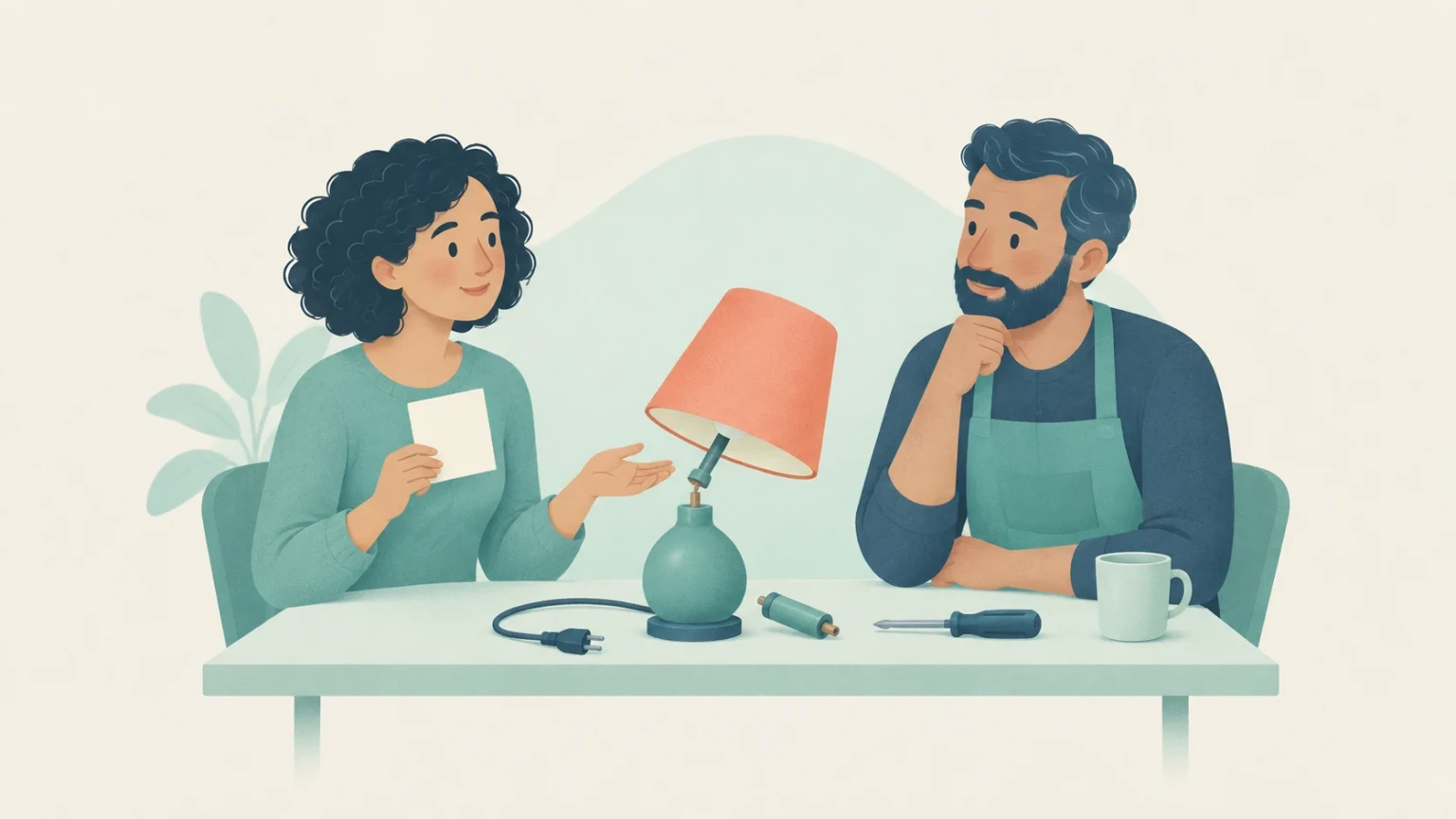
Imagine that a volunteer examines your lamp and says, "The switch is broken." At home, your partner mainly needs the result. You can report that the volunteer said the switch was broken. Use a quotation when the particular words matter, perhaps because someone wants to check a promise. A report can be shorter, but it must keep the original meaning.
-
The volunteer said, "I cannot fix it tonight."
Why it works: These are presented as exact words.
-
The volunteer said that the repair could not be done that evening.
Why it works: The wording changes while the central message stays.
Your turn
You need to record the volunteer's exact promise. Which approach fits?
Answer: Quote the words the volunteer used.
Show the answer
Answer: Quote the words the volunteer used.
A quotation preserves the wording of the promise.
Keep speaker and listener clear
Before changing pronouns, work out who each word describes. If a volunteer tells you, "I can repair your lamp," I means the volunteer and your means you. Your report might use she and my. Names are useful when two people could be she or he. Do not replace pronouns from a fixed list without checking the people.
-
Rita told Ben that Rita's tools were in the cupboard.
Why it works: Repeating Rita's name makes ownership clear.
-
Rita told me that she could repair my lamp.
Why it works: She identifies Rita; my identifies the person reporting.
You can practise this again in Rule out and Took or have taken? Choose the form for your message.
Your turn
Ben tells you, "I have your receipt." Which report preserves the people?
Answer: Ben said that he had my receipt.
Show the answer
Answer: Ben said that he had my receipt.
I refers to Ben, while your refers to you, the reporter.
Make the timing easy to follow
After said or told, English often moves the message's tense back: is becomes was, can becomes could, and will becomes would. An earlier past action can use had plus the past participle. Time words also need a check. If you report Monday's tomorrow on Wednesday, say Tuesday or the next day. A named day can make practical arrangements clearer.
-
On Monday, Jo said that she would collect the lamp on Tuesday.
Why it works: Would reports will; Tuesday gives a clear collection day.
-
Jo said that she had ordered the switch the day before.
Why it works: Had ordered places the order before Jo's conversation.
Your turn
On Wednesday, you report Monday's message: "I will come tomorrow." Which day was intended?
Answer: Tuesday
Show the answer
Answer: Tuesday
Tomorrow in the original Monday conversation means Tuesday.
Recognise information that still applies
Learn the usual tense changes first, then check whether the information still applies. You can keep a present tense for a current fact, such as the café's regular location. With a present reporting verb like says, there is usually no move into the past. Also, a past form after said does not automatically tell us that a fact has changed.
-
The organiser said that the café meets every Saturday.
Why it works: The present tense presents the schedule as current.
-
The organiser says that volunteers bring their own tools.
Why it works: A present reporting verb introduces a present routine.
Your turn
The Saturday schedule is still correct. Which report clearly presents it as current?
Answer: She said that the café meets on Saturdays.
Show the answer
Answer: She said that the café meets on Saturdays.
Meets describes the schedule that still applies.
Change the structure for questions and requests
When reporting a question, put the subject before the verb: where the box was, rather than where was the box. For a yes-or-no question, use if or whether. Requests need another pattern: asked someone to do something. Told someone to do something often presents the message as an instruction. Choose a reporting verb that fits what the speaker was doing.
-
A customer asked where the queue started.
Why it works: The reported question has statement word order.
-
The volunteer asked me to unplug the lamp.
Why it works: Asked me to reports a request.
Your turn
Report the question "Is the lamp ready?"
Answer: He asked if the lamp was ready.
Show the answer
Answer: He asked if the lamp was ready.
If introduces the question, and the subject comes before was.
Listen for quiet words and contractions
In conversation, small words such as that and had may be quiet. That can also be absent after said: both versions are grammatical. Listen for contractions too. In she'd finished, she'd means she had; in she'd return, it means she would. For dictation, recover the words you hear. For recall practice afterwards, cover the transcript and explain the message in your own words.
-
She said she'd finished the repair.
Why it works: Before finished, she'd means she had.
-
She said she'd return after lunch.
Why it works: Before return, she'd means she would.
Your turn
What does she'd mean in "She said she'd brought a spare bulb"?
Answer: She had
Show the answer
Answer: She had
Had brought describes an action completed before the conversation.
Write a clear update without changing the message
In a written update, name the source and include what the reader needs to do next. Use said with a statement, or told with a listener: told me, told us, told Anna. Put quotation marks around exact words only. Keep uncertainty too: might be ready is not a promise. After writing, check the people, the timing and how certain the original speaker sounded.
-
The volunteer told us that the part might arrive on Friday.
Why it works: Told has an object, and might preserves uncertainty.
-
The volunteer said that we should call before travelling.
Why it works: Said introduces useful advice without naming a listener.
Your turn
The volunteer says, "The part might arrive on Friday." Which update keeps the uncertainty?
Answer: She said that the part might arrive on Friday.
Show the answer
Answer: She said that the part might arrive on Friday.
Might keeps the arrival possible rather than certain.
Use it naturally
How people really use “said that”
Neutral Fine almost anywhere, at work or with friends.
Words it often goes with
- said that we couldThe guide said that we could take photos.
- said that she wouldMaya said that she would call after lunch.
- said that it wasThe worker said that it was free for children.
What people also say
- “She told me that” instead of “She said to me that” Use told me to make the listener clear in a simple, natural way.
Questions about "Who Said What? Passing On a Message"
Do I always need that after said?
No. In reported statements, that is often optional after said. Including it can help readers follow a longer sentence. In dictation, write it if it is spoken; do not add it simply because both versions are grammatical.
Maya said she needed a receipt.
Maya said that she needed a receipt.
Can I keep today when I report a message?
Yes, if today still refers to the same day. When you report on another day, use that day or name the original day. The aim is to identify the correct time, so a date or weekday can be clearer than a relative expression.
I spoke to the organiser ten minutes ago, and she said the room is available today.
On Thursday, I explained that the room had been available on Tuesday.
Why is she told me correct but she said me incorrect?
Told normally takes a listener directly in this pattern: told me that something happened. Said does not take that direct object. You can use said that, or said to me, depending on the sentence.
She told me that the entrance was locked.
She said to me, "Use the other entrance."
What should I do if I remember the message but not the exact words?
Use reported speech and avoid quotation marks. Keep the meaning, including words that show uncertainty. If you are also unsure about the message, say that you are unsure instead of presenting your memory as certain.
I think the assistant said that the shop closed at six.
The assistant said that the order might be late.
Before you go
Remember this
Choose a quotation for exact words and a report for the message. Check people, time, tense and sentence structure. Keep the speaker's level of certainty. After dictation, practise recalling the meaning in a new sentence.
Stage 2 of 5
Listen
Hear it in real sentences, from short to long, and write what you hear.
0 of 4 done
Listening 1 of 4
Listening 2 of 4
Try a longer clip. Listen once, then replay the part you missed.
Listening 3 of 4
This clip is longer. Follow the instruction above the answer field.
Listening 4 of 4
Listen, then type the missing words. The rest of the text is already there.
0:00
Practice complete
You listened closely.
Your result is saved in this browser.
Keep your progress. Your practice is saved on this device only. Create a free account to keep it everywhere.
Create a free accountThat was today's free lesson. Tomorrow you get another one. Want more today? See membership.
Create a free SubLearn account to keep this progress across devices.
Save my progressStage 3 of 5
Speak
Say it with the speaker, then use it in your own answer.
Shadow
Say it along with the speaker
Play the line slowly, then speak at the same time as the speaker. Copy the rhythm, not just the words.
Your turn
Say it your way
Speak for 30 to 60 seconds from memory. Imagine you called a museum about taking your younger cousin there. Tell a friend what the museum worker said about tickets and activities, and report a question you asked.
Use: said that I asked whether
Take ten seconds to think, then answer out loud without looking at the lesson. Speak for the time shown in the task above. Nothing is sent unless you ask for feedback.
0:00
Hear how someone else might say it
I called the museum this morning because I want to take my cousin there on Saturday. The worker said that children under twelve could enter for free. My cousin is ten, so that's good news. I asked whether we needed to book tickets before we arrived. She explained that we could buy them at the door. She also told me about a drawing activity upstairs. It starts at eleven, so I'd like to arrive at ten thirty. My cousin loves drawing animals, and I think she'll enjoy it.
Try once more and answer this: Which activity would your cousin enjoy most?
Stage 4 of 5
Write
Use what you've learned to write about your day or week, then write a message.
Write
Put it in your own words
- I used “said that”.
- It is about my life, not the lesson’s example.
- I read it once aloud to check it sounds right.
Write your own response
Choose a situation and write 30–50 words of your own. In this activity, you decide what to say rather than copy the words in a recording.
Check your own writing
Read one possible response
Use these checks to revise your message. Grammar and meaning are not automatically graded. Each task keeps its own draft in this browser tab.

You finished the free part of this lesson
- Understand
- Listen
- Speak
- Write
- CheckPart of membership
Worth another look
With a free account, the lessons you finish come back for review to help you remember them.Create a free account
Stage 5 of 5 · Part of membership
Check
New clips without hints.
Listening tests are included with membership. Try the free dictation first, then decide whether to continue.
Listening 1 of 2 Part of membership
Listening 2 of 2 Part of membership
Follow MicroEnglish
Find lesson updates, short videos and quick quizzes. Pick the app you already use.
Questions & comments
Ask about this lesson, share an example, or help another learner.
Example
Memory tip
Goes with
Related forms
Not to be confused with
In this lesson
This word isn't in our dictionary. Check the spelling, or try another form of the word.
We couldn't load this word. Try again.
