Audio corto
Infinitives: When to Use To
La respuesta corta
An infinitive names an action directly without changing its shape for time or person. It connects two ideas by showing what action completes a main verb, what action explains a feeling, or why an action happened.
Puntos clave
- Infinitives keep the base verb unchanged after to.
- Modals like can and must do not take to, while fixed prepositions require an -ing form.
- Place to before the base form of a verb after common verbs of thinking and intending, after adjectives that describe feelings or tasks, and after question words.
Esta lección tiene 5 etapas. Puedes parar cuando quieras y continuar más tarde.
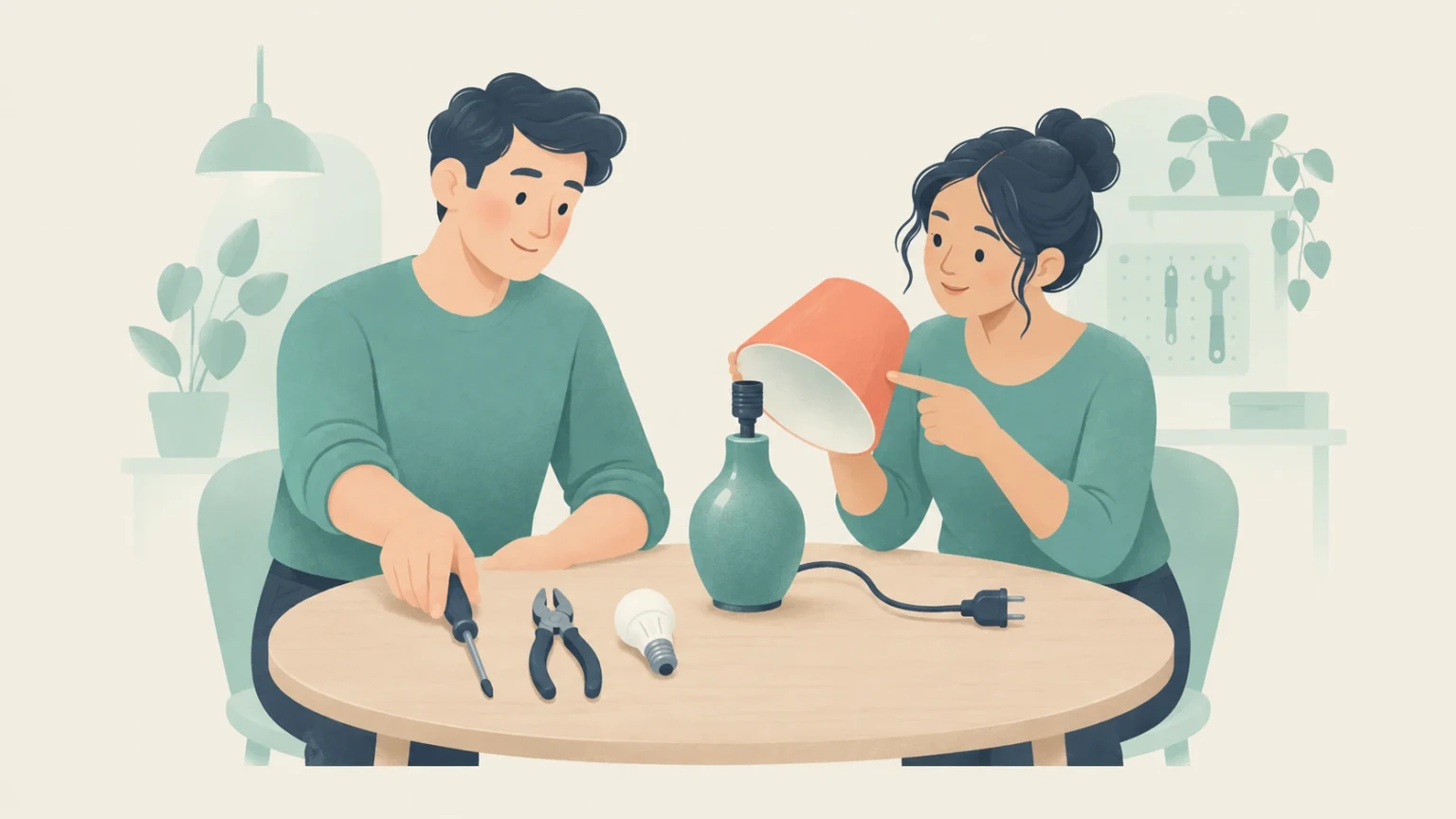

Etapa 1 de 5
Entender
Qué significa, cuándo usarlo y qué errores evitar.
Ejemplos
Marcus agreed to repair the broken switch on Saturday morning.
Por qué funciona: The verb agree takes to followed by the base form repair.
2 ejemplos más
-
The volunteers are ready to inspect the wire.
The adjective ready connects to the action inspect with to.
-
I brought a small screwdriver to open the plastic case.
The infinitive to open expresses the purpose of bringing the tool.
Leer la guía completa
Recognize when to names an action
Fix is an action word. When you say I want to fix this lamp, the phrase to fix names the action you intend to perform. In everyday English, this combination of the particle to and the base form of a verb is called an infinitive. The base form is the simple version of a verb before you add endings such as -s, -ed, or -ing. Verbs like open, clean, and fix are base forms. When to sits directly before a base form, it links the action into your sentence.
-
I hope to fix our table lamp today.
Por qué funciona: The phrase to fix combines to with the base verb fix to name the desired action.
-
We plan to open the community workshop at nine o'clock.
Por qué funciona: To open identifies the specific action that the group plans to carry out.
Tu turno
Which phrase contains an infinitive naming an action?
Respuesta: to repair
Mostrar la respuesta
Respuesta: to repair
The particle to followed directly by the base verb repair forms an infinitive.
Keep the verb after to in its base form
When you change the time or person of your sentence, you change the main verb, but the verb following to never changes. If you talk about today, you say she wants to fix the lamp. If you talk about yesterday, you say she wanted to fix the lamp. The first verb marks the past tense, while the infinitive to fix remains identical. Never attach -s, -ed, or -ing to the verb following infinitival to. This rule applies equally to irregular verbs and to be.
-
Elena decides to be patient while testing the connection.
Por qué funciona: The main verb decides changes for Elena, but be stays in its base form.
-
They wanted to inspect the wire before connecting the battery.
Por qué funciona: The main verb wanted marks the past tense, leaving inspect in its base form.
Puedes practicar esto de nuevo en English Infinitives: When to Use To y Nevertheless or never the less: One Word Contrast.
Tu turno
Which sentence correctly keeps the infinitive in its base form?
Respuesta: He plans to fix the broken switch today.
Mostrar la respuesta
Respuesta: He plans to fix the broken switch today.
The verb after to must remain in its base form without any suffix like -ing or -ed.
Match common verbs with an infinitive
Many common English verbs naturally connect to a second action using an infinitive. These verbs often express desires, intentions, decisions, or commitments about an upcoming step. You do not need to memorize every verb in the language immediately, but you should recognize the most frequent patterns. When you use verbs like want, need, decide, agree, promise, or refuse, practice joining them directly with to and a base verb so the pattern becomes automatic in speech.
| Pattern | Meaning Cue | Original Example |
|---|---|---|
| want to + verb | express a desire | I want to repair my reading lamp. |
| need to + verb | express necessity | We need to buy a three-amp fuse. |
| hope to + verb | express a wish | She hopes to finish before lunch. |
| plan to + verb | organize future steps | They plan to visit the repair café. |
| decide to + verb | make a firm choice | Marcus decided to replace the cord. |
| agree to + verb | accept a suggestion | The volunteer agreed to test the plug. |
| promise to + verb | make a personal commitment | I promise to return the tools safely. |
| offer to + verb | show readiness to help | David offered to carry the toolbox. |
| learn to + verb | gain a practical skill | We want to learn to solder wires. |
| manage to + verb | succeed after difficulty | She managed to loosen the rusty bolt. |
| refuse to + verb | decline an action firmly | The old motor refuses to start. |
| would like to + verb | state a polite request | I would like to borrow your pliers. |
-
Marcus agreed to inspect the internal fuse on Saturday.
Por qué funciona: The verb agree connects to the action inspect using an infinitive.
-
We would like to join the morning repair session.
Por qué funciona: Would like is followed by to join to state a polite intention.
Tu turno
Which verb correctly completes the sentence: 'She _____ to help us with the wiring'?
Respuesta: offered
Mostrar la respuesta
Respuesta: offered
Offer takes an infinitive with to, whereas enjoy and finish require an -ing form.
Add a person before the infinitive
Sometimes the person speaking wants another individual to perform the action. Compare I want to repair the lamp with I want you to repair the lamp. In the first sentence, the speaker repairs the lamp. In the second sentence, the listener repairs it. Verbs such as ask, tell, invite, and remind use this pattern: verb + object pronoun + to + verb. Use object pronouns such as me, him, her, us, and them directly before the infinitive to identify clearly who carries out the second action.
-
The technician asked me to hold the flashlight steady.
Por qué funciona: The technician makes the request, but me (the speaker) holds the flashlight.
-
I reminded them to bring extra insulated wire.
Por qué funciona: The pronoun them identifies the people who must bring the wire.
Tu turno
In the sentence 'She asked us to check the plug', who will check the plug?
Respuesta: The people represented by 'us'
Mostrar la respuesta
Respuesta: The people represented by 'us'
In the pattern ask + object + to + verb, the object performs the action named by the infinitive.
Connect feelings and qualities to actions
Adjectives often pair with an infinitive to describe how someone feels about an action or how easy an action is to complete. You can express emotions with patterns like ready to go, happy to help, and pleased to meet you. You can also evaluate tasks using patterns like easy to fix or difficult to open. Notice that in the sentence The lid is easy to open, the lid does not open anything. A person opens the lid, while the adjective easy describes the quality of that action.
-
Our volunteer is happy to explain how the circuit works.
Por qué funciona: Happy describes the volunteer's feeling about explaining the circuit.
-
This small plastic casing is difficult to remove without pliers.
Por qué funciona: Difficult describes the task of removing the casing, not an action the casing does.
Tu turno
What does 'The battery cover is simple to remove' mean?
Respuesta: Removing the battery cover is an uncomplicated task.
Mostrar la respuesta
Respuesta: Removing the battery cover is an uncomplicated task.
The adjective simple describes the difficulty of the action remove performed on the cover.
State your purpose using to plus verb
An infinitive can explain why someone performs an action. When you want to express a purpose or goal, use to + base verb. If someone asks why you went to the community center, you can say I went to repair my lamp. In this basic pattern, the same subject completes both the main action and the purpose action. Do not say for fix or for carry. Use for with a noun phrase, such as for repairs, but use to + verb when naming the action itself.
-
I brought a magnifying glass to inspect the tiny circuit board.
Por qué funciona: To inspect explains the purpose behind bringing the magnifying glass.
-
He stopped at the hardware shop to buy electrical tape.
Por qué funciona: To buy answers the question of why he stopped at the shop.
Tu turno
Which sentence correctly states the purpose of the action?
Respuesta: She attended the workshop to learn soldering.
Mostrar la respuesta
Respuesta: She attended the workshop to learn soldering.
Express purpose with to + base verb; avoid using for directly before a base verb.
Use an infinitive to describe a noun
You can place an infinitive directly after a noun or an indefinite pronoun to describe what can or must be done with it. Everyday expressions such as something to eat, time to talk, and a place to stay rely on this compact structure. The infinitive functions like a short description without requiring a longer relative clause. In a workshop, you might say I need a tool to strip these wires or Do you have a box to hold these screws? The action completes the meaning of the noun.
-
We need a quiet place to test the audio speaker.
Por qué funciona: To test describes the intended purpose of the place.
-
She brought something to drink while we waited for the workbench.
Por qué funciona: To drink describes the indefinite pronoun something.
Tu turno
Which sentence uses an infinitive to describe what a noun is for?
Respuesta: I brought a small container to hold the tiny screws.
Mostrar la respuesta
Respuesta: I brought a small container to hold the tiny screws.
The phrase to hold the tiny screws directly describes the purpose of the container.
Show ability with too and enough
You can explain whether an action is possible or impossible by combining an infinitive with too or enough. Use too before an adjective to show that an excess prevents the action: this cord is too short to reach the socket. In contrast, place enough after an adjective to indicate that an action is possible: the wire is long enough to reach the socket. Pay close attention to word order. Too sits before the adjective, while enough sits after it, followed by to and the base verb.
-
The metal casing is too hot to touch without gloves.
Por qué funciona: Too hot indicates that touching the casing is currently unsafe or impossible.
-
The work area is bright enough to see the small screws.
Por qué funciona: Bright enough indicates sufficient lighting to make seeing possible.
Tu turno
Which sentence shows correct word order with enough and an infinitive?
Respuesta: The bolt is loose enough to turn by hand.
Mostrar la respuesta
Respuesta: The bolt is loose enough to turn by hand.
Enough must follow the adjective loose: adjective + enough + to + verb.
Combine question words with infinitives
Question words such as what, where, when, and how frequently link to an infinitive to describe a decision, a process, or a practical skill. You will often hear expressions like I know how to use it, We need to decide where to meet, and Tell me what to do next. Notice that this construction does not apply mechanically to why. English speakers do not say I do not know why to do it; instead, they say I do not know why I should do it. Stick to what, where, when, and how.
-
The manual explains how to replace the internal fuse safely.
Por qué funciona: How to replace describes the method or procedure for the task.
-
We have not decided where to put the soldering station.
Por qué funciona: Where to put identifies the location choice that needs to be resolved.
Tu turno
Which sentence uses a question word with an infinitive correctly?
Respuesta: He explained to me how to solder the broken wire.
Mostrar la respuesta
Respuesta: He explained to me how to solder the broken wire.
Question words like how combine naturally with an infinitive; why does not follow this pattern.
Form questions and place negatives correctly
When you create questions or main-clause negatives, make changes to the main verb, not the infinitive. For a question, use an auxiliary verb before the subject: Do you want to join our repair session? For a negative sentence about the main verb, use do not or did not: I do not want to break the delicate switch. However, when the negative idea belongs specifically to the second action, place not directly before the infinitive: She told me not to open the machine. Use not to as your standard pattern.
-
Do you plan to attend the repair café this weekend?
Por qué funciona: The question is formed on the main verb plan using the auxiliary do.
-
The instructor told us not to plug in the device yet.
Por qué funciona: Not sits directly before to plug to create a negative infinitive.
Tu turno
Which sentence correctly advises someone to avoid an action?
Respuesta: She advised me not to touch the metal contacts.
Mostrar la respuesta
Respuesta: She advised me not to touch the metal contacts.
The standard pattern places not directly before the infinitive: not to + base verb.
Drop to after modals, let, and make
Not every verb followed by an action requires the particle to. Modal auxiliary verbs such as can, could, must, should, may, and might connect directly to a base verb without to: you must wear safety glasses. Compare this with need to and have to, which require to. In active sentences, the causative verbs let and make also drop to after their object: they let me use the drill and the noise made him jump. Note that help allows either pattern: help me carry or help me to carry.
-
You should unplug the lamp before opening the base.
Por qué funciona: The modal verb should connects directly to unplug without to.
-
The teacher let us practice with the wire strippers.
Por qué funciona: The causative verb let takes an object and a bare verb without to.
Tu turno
Which sentence contains an error with the infinitive marker to?
Respuesta: You must to unplug the machine before testing.
Mostrar la respuesta
Respuesta: You must to unplug the machine before testing.
Modal verbs like must take the base verb directly; they do not use to.
Distinguish infinitives from -ing patterns
Different English verbs require different grammar patterns. Verbs like enjoy, avoid, and consider are followed by an -ing form, never an infinitive: I enjoy repairing old radios. Furthermore, be careful when to acts as a preposition rather than an infinitive marker. In the expression look forward to, the word to is a preposition, so it must be followed by a noun or an -ing form: I look forward to meeting you. A few verbs like stop, try, and remember can take either form with a change in meaning; see /grammar/gerunds-and-infinitives-1-stop-try-remember-need/ for full details.
-
I look forward to visiting the community workshop on Saturday.
Por qué funciona: In look forward to, to is a preposition followed by the -ing form visiting.
-
We avoid buying disposable electronics when we can repair them.
Por qué funciona: Avoid takes an -ing form rather than an infinitive with to.
Tu turno
Which sentence correctly pairs the verb with its required pattern?
Respuesta: We hope to see the repair demonstration tomorrow.
Mostrar la respuesta
Respuesta: We hope to see the repair demonstration tomorrow.
Hope takes to + base verb, whereas look forward to requires an -ing form and enjoy requires an -ing form.
Practice infinitives in a repair workshop dialogue
When people organize everyday activities, infinitives appear constantly to express intentions, assign tasks, and give reasons. Read this original conversation between two neighbors, Maya and Liam, as they prepare to visit a local repair café. Notice how their choices about what tools to bring, who will help with specific steps, and why they are going shape the infinitive patterns they select.
-
I brought my multimeter to test the electrical circuit.
Por qué funciona: Maya uses to test to express the purpose of bringing her meter.
-
I will ask the volunteer electrician to show me how to solder.
Por qué funciona: Liam combines ask + object + to + verb with the question pattern how to solder.
Tu turno
Why did Maya bring her multimeter to the workshop?
Respuesta: To test the electrical circuit before disassembly
Mostrar la respuesta
Respuesta: To test the electrical circuit before disassembly
Maya explicitly says she brought the multimeter to test the electrical circuit.
Notice the weak pronunciation of to
In spoken English, words that carry grammatical structure rather than main vocabulary meaning are often pronounced in a reduced, weak form. When the word to appears before a consonant sound, native speakers across British, American, and Australian accents rarely pronounce it with a full /tuː/ sound. Instead, they reduce the vowel to a quick schwa, sounding like /tə/. In a phrase like plan to fix, to connects smoothly to the following word: /plæn tə fɪks/. Training your ear to catch this short /tə/ helps you identify infinitives instantly in rapid speech.
-
They need to replace the blown fuse immediately.
Por qué funciona: In natural speech, need to sounds like /niːd tə/ before the consonant /r/.
-
I hope to learn how the switch functions.
Por qué funciona: Hope to sounds like /hoʊp tə/, with to reducing to a short unstressed vowel.
Tu turno
How does the word 'to' usually sound before a consonant in natural connected speech?
Respuesta: Like a short, unstressed 'tuh' (/tə/)
Mostrar la respuesta
Respuesta: Like a short, unstressed 'tuh' (/tə/)
Before consonant sounds in connected speech, to typically reduces to the weak form /tə/.
Review infinitive rules and write a practical message
To make infinitive structures permanent in your memory, practice identifying the grammatical trigger that requires the infinitive and naming who performs the action. When writing practical messages such as a workshop request or an invitation, verify whether each to introduces a base verb, an adjective complement, or a statement of purpose. Review the trigger before each infinitive: does it follow a decision verb, an object pronoun, or an adjective of readiness? Answering these questions ensures your written English remains clear and accurate.
-
We invited our neighbor to join our morning repair table.
Por qué funciona: The verb invited triggers the object pattern our neighbor to join.
-
I stopped by the shop to pick up spare screws.
Por qué funciona: To pick up explains the practical reason for stopping by the shop.
Tu turno
In 'The organizer invited Mark to inspect the machine', what triggers the infinitive 'to inspect'?
Respuesta: The verb and object pattern 'invited Mark'
Mostrar la respuesta
Respuesta: The verb and object pattern 'invited Mark'
The pattern invite + object + to + verb triggers the infinitive to inspect.
Úsalo naturalmente
Cómo se usa "ready to"
Neutral Funciona en casi cualquier situación, en el trabajo o con amigos.
Palabras con las que suele ir
- ready to leaveWe are ready to leave after breakfast.
- ready to startThe students are ready to start their project.
- ready to helpMy brother is ready to help with dinner.
- ready to tryI am ready to try a new sport.
Preguntas sobre "Infinitives: When to Use To"
When do I put to before a verb?
Put to before a verb when you form an infinitive. This happens after common verbs like want, plan, and decide, after adjectives that describe feelings or difficulty like happy or easy, and when you explain the purpose of an action. You also use to after question words such as how, what, and where.
We decided to wait outside the community hall.
I came here to collect my repaired lamp.
Which verbs are followed by to + verb?
Common verbs followed by an infinitive include want, need, hope, plan, decide, agree, promise, offer, learn, manage, refuse, and would like. These verbs usually point toward a future action, intention, or choice that completes the thought of the main verb.
She promised to bring her screwdriver set.
They offered to help us carry the tables.
Why is it wants to go, not wants to goes?
In English, only the main verb changes its form to match the subject and tense. In the sentence 'She wants to go', the verb wants already shows that the subject is third-person singular. The verb following to is an infinitive and must remain in its base form without -s, -ed, or -ing.
He needs to check the electrical cord.
Maria hopes to finish her repair before noon.
When should I use -ing instead of to + verb?
Learn the pattern with each verb. Enjoy, finish, and avoid take an -ing form; plan and decide take a to-infinitive. Also use -ing after a preposition, including to in look forward to. Meaning alone does not always tell you which form a verb needs.
We enjoy working on practical projects together.
I look forward to meeting the repair volunteers tomorrow.
How do I make an infinitive negative?
To make an infinitive negative, place the word not directly before to and the base verb. This creates the pattern not to do something. If you want to make the entire sentence negative, change the main verb instead by using do not or does not.
The instructor warned us not to touch the exposed wires.
I do not want to break the delicate plastic clip.
Why do we say can go but need to go?
The word can is a modal auxiliary verb. Modal verbs, including can, could, must, should, may, and might, connect directly to the base verb without to. In the pattern need to do something, need is an ordinary verb followed by a to-infinitive.
You must wear safety glasses near the grinder.
We need to wear safety glasses near the grinder.
Antes de irte
Recuerda esto
Infinitives keep the base verb unchanged after to. They follow verbs like want and decide, object patterns like tell someone to go, adjectives like ready and easy, and question words like how to use. Modals like can and must do not take to, while fixed prepositions require an -ing form.
Etapa 2 de 5
Escuchar
Escúchalo en frases reales, de la más corta a la más larga, y escribe lo que oyes.
0 de 4 completado
Escucha 1 de 4
Escucha y luego escribe lo que oyes. Repite tantas veces como necesites.
0:00
Escucha 2 de 4
Escucha y luego escribe lo que oyes. Repite tantas veces como necesites.
0:00
Intenta un clip más largo. Escucha una vez y luego reproduce la parte que te perdiste.
Escucha 3 de 4
Escucha y luego escribe lo que oyes. Repite tantas veces como necesites.
0:00
Este clip es más largo. Sigue la instrucción encima del campo de respuesta.
Escucha 4 de 4
Escucha y luego escribe las palabras que faltan. El resto del texto ya está ahí.
0:00
Práctica completada
Escuchaste con atención.
Tu resultado está guardado en este navegador.
Mantén tu progreso. Tu práctica se guarda solo en este dispositivo. Crea una cuenta gratuita para conservarla también cuando uses otros dispositivos.
Crear una cuenta gratuitaEsa fue la lección gratuita de hoy. Mañana tendrás otra. ¿Quieres más hoy? Consulta la membresía.
Crea una cuenta gratuita de SubLearn para mantener este progreso en todos tus dispositivos.
Guardar mi progresoEtapa 3 de 5
Hablar
Dilo junto con el hablante y luego úsalo en tu propia respuesta.
Imita
Dilo junto con el hablante
Reproduce la frase a velocidad lenta y repítela al mismo tiempo que la grabación. Imita también el ritmo.
Tu turno
Dilo a tu manera
Speak for 30 to 60 seconds from memory. Imagine you are planning a picnic at a lake with friends. Explain what you agreed to bring, what you are ready to do, and why you want to arrive early.
Usa: agreed to ready to
Piensa durante diez segundos, luego responde en voz alta durante el tiempo que pida la tarea, sin mirar la lección. No se envía nada a menos que pidas retroalimentación.
0:00
Escucha cómo lo diría otra persona
My friends and I are planning a picnic at the lake on Sunday. I agreed to bring sandwiches and some fruit. My friend Anna will bring drinks, and Ben wants to bring a ball. We are ready to leave at nine in the morning. We want to arrive early to find a table near the water. I need to ask Anna to check the weather before we leave. If it rains, we can eat at my apartment and play games together.
Intenta una vez más y responde esto: What will you do if it rains?
Etapa 4 de 5
Escribir
Úsalo para escribir sobre tu día o semana y luego escribe un mensaje.
Escribe
Ponlo en tus propias palabras
- Usé "ready to".
- Es sobre mi vida, no el ejemplo de la lección.
- Lo leí una vez en voz alta para comprobar que suena bien.
Escribe tu propia respuesta
Elige una situación y escribe tu propio mensaje de 30-50 palabras. En esta actividad decides qué decir; en un dictado escribes las palabras exactas de la grabación.
Revisa tu texto
Leer una posible respuesta
Usa estas comprobaciones para revisar tu mensaje. La gramática y el significado no se califican automáticamente. Cada tarea mantiene su propio borrador en esta pestaña del navegador.

Terminaste la parte gratuita de esta lección
- Entender
- Escuchar
- Hablar
- Escribir
- PruebaParte de la membresía
Vale la pena volver
Con una cuenta gratuita, las lecciones que terminas vuelven para que las repases, y eso te ayuda a recordarlas.Crear una cuenta gratuita
Etapa 5 de 5 · Parte de la membresía
Prueba
Grabaciones nuevas sin pistas.
Las pruebas de comprensión auditiva están incluidas con la membresía. Prueba primero el dictado gratuito y luego decide si quieres continuar.
Escucha 1 de 2 Parte de la membresía
Escucha 2 de 2 Parte de la membresía
Sigue a MicroEnglish
Encuentra lecciones, videos cortos y pruebas rápidas en la aplicación que ya usas.
Preguntas y comentarios
Pregunta sobre esta lección, comparte un ejemplo o ayuda a otro estudiante.
Ejemplo
Consejo para recordar
Combina con
Formas relacionadas
No confundir con
En esta lección
Esta palabra no está en nuestro diccionario. Revisa cómo se escribe o prueba otra forma de la palabra.
No pudimos cargar esta palabra. Inténtalo de nuevo.
