Micro-listening
Returning an online order
The short answer
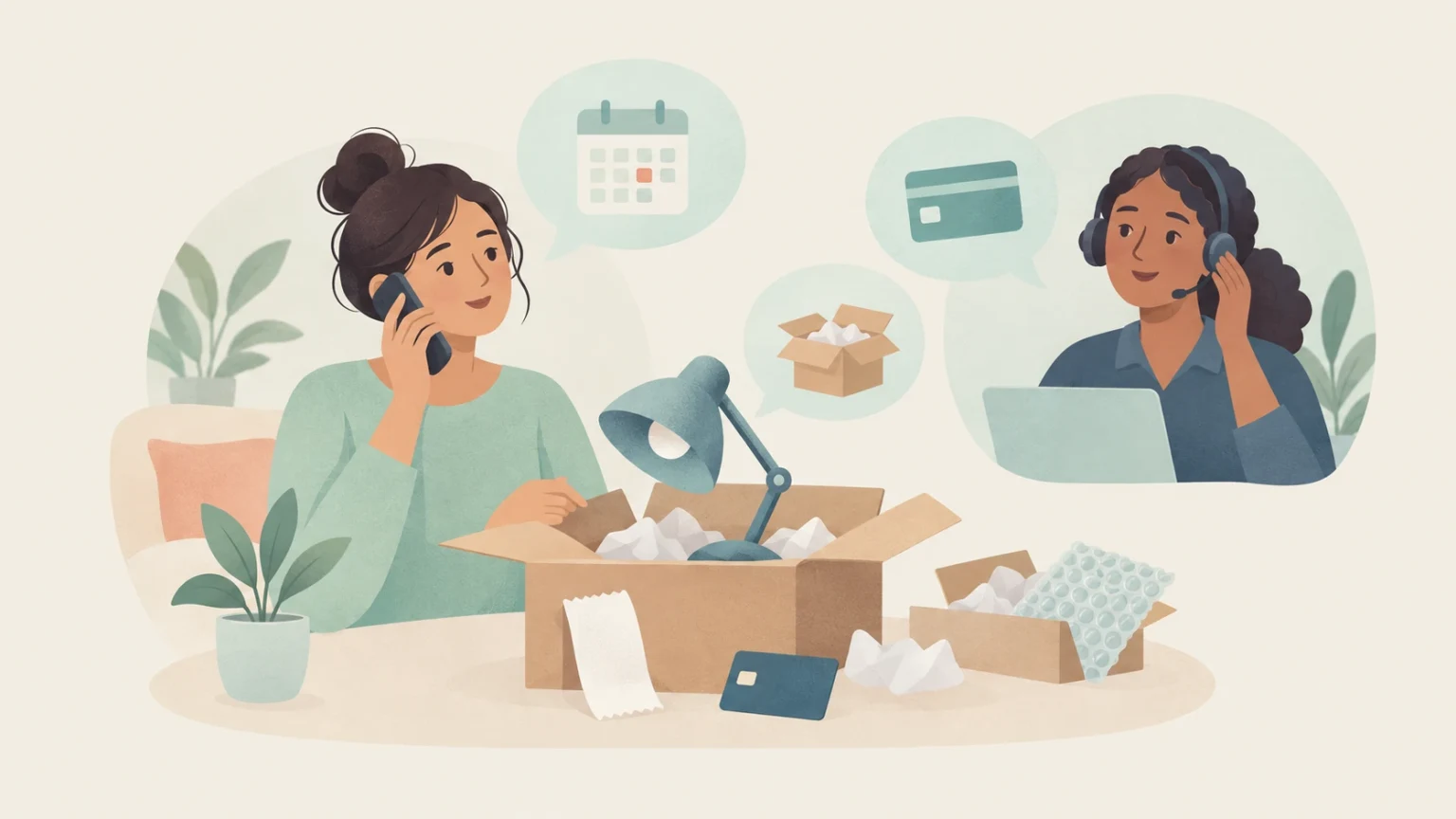
The customer can return the faulty desk lamp without its original box, but must hand the parcel to the courier by Tuesday, include a printed copy of the email receipt, and expect the refund back to the payment card.
Key points
- When returning a faulty item, distinguish between optional packaging and mandatory conditions.
- Hand the parcel over by Tuesday with your email receipt enclosed, and your refund will return to your payment card.
- 'By Tuesday' establishes Tuesday as the final day for dispatch.
This lesson has 5 stages. You can stop at any time and continue later.

Stage 1 of 5
Understand
What it means, when to use it, and mistakes to avoid.
Examples
Please return the desk lamp by Tuesday to receive your refund.
Why it works: 'By Tuesday' sets Tuesday as the final acceptable day for dispatch.
2 more examples
-
You do not need the original box because the lamp is faulty.
'Do not need' indicates absence of obligation for the packaging.
-
The refund will go back to the card you paid with.
'Back to' identifies the payment instrument receiving the money.
Read the full guide
Explain the Problem: An Online Purchase Does Not Work
Returning an online order means sending something you bought back to the seller. A refund is money the seller gives back to you. In everyday shopping, an item is faulty when it does not work properly or has an unexpected defect. When your purchase fails immediately, you must describe the problem clearly to customer support. Many buyers worry if they have already recycled packaging, but faulty goods follow special rules. In this call, listen for what the customer needs to do to get that money back.
-
My new desk lamp will not switch on, so it is faulty.
Why it works: Use 'faulty' to describe broken or defective goods clearly.
-
I am requesting a full refund back to my card.
Why it works: A refund returns money rather than offering replacement goods.
-
You can return the broken unit within our standard schedule.
Why it works: Return describes sending the physical product back.
Your turn
What does calling an item 'faulty' mean during a customer-service call?
Answer: The item arrived damaged or fails to function as intended.
Show the answer
Answer: The item arrived damaged or fails to function as intended.
'Faulty' means that the product is broken, defective, or does not operate correctly.
First Listen: Identify Why the Customer Wants a Return
On your first listen, focus only on the main reason for the conversation. Do not try to write down dates, packaging details, or payment numbers yet. Listen for words describing the product's condition, such as 'lamp', 'turns on', or 'switch'. Customer service conversations often open with a short summary statement before discussing company rules. Deciding whether the customer simply changed their mind or received a broken product helps you predict which store policies will apply.
-
The customer explains that the desk lamp never turns on.
Why it works: This statement reveals product failure as the core reason for the call.
-
The buyer does not say that they dislike the style or brightness.
Why it works: Listening for what is absent prevents assuming an ordinary change of mind.
You can practise this again in Choosing an evening course and Returning faulty headphones.
Your turn
Why does the customer in this call request a return?
Answer: The customer received a desk lamp that does not turn on.
Show the answer
Answer: The customer received a desk lamp that does not turn on.
The customer clearly states that the desk lamp will not switch on, making it a faulty item return.
Second Listen: Record the Deadline, Receipt, Box and Refund Details
During your second listen, track four specific pieces of information: the return deadline, proof of purchase, packaging condition, and refund method. When customer representatives explain policies, they use organizing words to signal key facts. Listen for time prepositions like 'by' before weekdays, nouns like 'receipt', and phrases specifying payment cards. If a sentence moves fast, focus on stressed content words rather than connecting grammar. Recording these four details gives you an exact picture of your obligations.
-
Give the parcel to our courier by Tuesday.
Why it works: This specifies the exact day and action required for the deadline.
-
Include a printed digital receipt with your shipment.
Why it works: This identifies the required proof of payment.
Your turn
Which group of four details must you record during the second listen?
Answer: Handover deadline, email receipt proof, packaging exception, and card refund destination.
Show the answer
Answer: Handover deadline, email receipt proof, packaging exception, and card refund destination.
The call focuses specifically on handing over the package by Tuesday, including the receipt, waiving the original box, and returning funds to the payment card.
Read the Transcript: Separate the Packaging Exception from the Remaining Rules
When reading the conversation, notice how connecting words organize store policy. The word 'normally' introduces standard company rules, while 'but' or 'however' signals an exception. In this dialogue, the adviser explains that original packaging is normally mandatory, but unnecessary because the lamp is faulty. Importantly, an exception to packaging does not cancel other requirements. The customer still must include the receipt and meet the deadline. Furthermore, skipping the original box does not mean mailing bare metal; protective wrapping remains necessary.
-
Normally we require the original box, but faulty items are exempt.
Why it works: 'Normally' presents standard practice, while 'but' introduces the exception.
-
You do not need the retail carton, but you still need your receipt.
Why it works: 'Still' highlights that the receipt requirement remains unchanged.
Your turn
What does the store packaging exception allow the customer to do?
Answer: Send the lamp back in any safe carton rather than the original manufacturer box.
Show the answer
Answer: Send the lamp back in any safe carton rather than the original manufacturer box.
The exception applies only to the original branded box; the customer still needs safe outer packaging and purchase proof.
Use By for the Deadline and To for the Refund Destination
'By Tuesday' means no later than Tuesday, but it does not specify an hour. In this call, the deadline is for handing the parcel to the courier, rather than its arrival at the warehouse. Check the courier's last collection time if you plan to send it on Tuesday. In 'back to your card', 'to' identifies where the refund goes; it does not tell you when it arrives.
-
Hand the parcel to the delivery driver by Tuesday.
Why it works: 'By Tuesday' sets Tuesday as the final acceptable day for dispatch.
-
We send the refund back to the card used for payment.
Why it works: 'To' marks the destination card account receiving the reimbursement.
Your turn
If an agent says 'drop off your package by Tuesday,' what is your final dispatch day?
Answer: Tuesday.
Show the answer
Answer: Tuesday.
By Tuesday includes Tuesday, but the phrase alone gives no exact hour.
Check the Difference Between Not Needing a Box and Not Needing a Receipt
A frequent learner mistake is assuming that one waived condition cancels all paperwork. When an agent says 'you do not need the original box,' the phrase indicates an absence of obligation, not permission to abandon proof of purchase. The shop cannot verify when or where you bought the item without evidence. Therefore, a printed copy of your digital invoice remains essential. Treating packaging and receipts as independent requirements prevents rejected returns and processing delays.
-
You do not need the box, but you must enclose your receipt.
Why it works: The negative applies strictly to packaging, while 'must' reinforces the receipt requirement.
-
Missing packaging is permitted; missing proof is not.
Why it works: Always verify whether an exception covers physical wrapping or financial documentation.
Your turn
What happens if a customer returns the faulty lamp without any receipt?
Answer: The shop rejects or delays the refund because proof of purchase is missing.
Show the answer
Answer: The shop rejects or delays the refund because proof of purchase is missing.
The exception covers only the original box; proof of purchase is strictly required to process the refund.
Write Six Short Sentences from the Return Conversation
Transcribing spoken English requires listening closely for reduced vowels, connected consonants, and silent letters. For instance, 'receipt' contains a silent 'p', pronounced /rɪˈsiːt/, so learners must not expect a /p/ sound. Similarly, modal structures like 'do not need to' convey an absence of obligation, which differs fundamentally from a prohibition. In fast connected speech, function words such as 'by' and 'to' link smoothly to neighboring nouns, making prepositions easy to miss. Working through these six focused dictations trains your ear to catch essential return terms accurately under authentic customer service conditions.
-
My new desk lamp will not switch on.
Why it works: Problem dictation. Listening difficulty: 'will not' reduces and links directly into the consonant cluster of 'switch', while phrasal verb stress falls on 'on'.
-
Please hand the parcel to our courier by Tuesday.
Why it works: Deadline dictation. Listening difficulty: the weak preposition 'by' links into 'Tuesday', indicating the dispatch cut-off day rather than warehouse arrival.
-
Please include a printed copy of the receipt.
Why it works: Receipt dictation. Listening difficulty: 'receipt' /rɪˈsiːt/ has an entirely silent letter 'p', which often leads listeners to mishear or misspell the noun.
-
You do not need the original box because the lamp is faulty.
Why it works: Packaging exception dictation. Listening difficulty: contrastive stress falls on 'do not need' to signal no obligation, distinct from 'must not'.
-
The money will go back to the same card.
Why it works: Refund destination dictation. Listening difficulty: 'back to' links smoothly before 'the same card', clarifying the destination account rather than speed.
-
Do I still need to include the receipt?
Why it works: Confirmation question dictation. Listening difficulty: 'still' takes prominence to verify that the receipt rule remains mandatory despite the box exception.
Your turn
Which sentence confirms that a policy requirement remains mandatory even after an exception is granted?
Answer: Do I still need to include the receipt?
Show the answer
Answer: Do I still need to include the receipt?
The question uses 'still' to verify whether proof of purchase remains strictly necessary after packaging has been waived.
Recall the Return Instructions and Confirm Your Next Step
Before ending a call or closing an online support chat, always summarize the agreed actions in writing or speech. Confirm the four essential facts: why the item is returning, what packaging you will use, which document you will enclose, and when the courier will receive it. Stating your plan clearly prevents misunderstandings and creates a reliable record of your return. Use concise, polite sentences that specify exact days and payment destinations.
-
I will pack the broken lamp safely and hand it over by Tuesday.
Why it works: States the physical preparation and meeting the agreed handover deadline.
-
I have printed the receipt and expect a refund to my payment card.
Why it works: Confirms documentation compliance and the expected reimbursement method.
Your turn
What is the best way to conclude a return conversation with customer service?
Answer: Summarize your packaging, receipt inclusion, handover deadline, and refund method.
Show the answer
Answer: Summarize your packaging, receipt inclusion, handover deadline, and refund method.
Summarizing the key return conditions confirms understanding and prevents processing disputes.
Use it naturally
How people really use “refund”
Neutral Fine almost anywhere, at work or with friends.
Words it often goes with
- receive a refundYou will receive a refund after the shop checks the item.
- request a refundI would like to request a refund for this broken lamp.
- a full refundThe shop offered me a full refund.
- process your refundWe will process your refund when your package arrives.
What people also say
- “I'd like my money back.” instead of “I wish to receive a refund.” This sounds natural in an everyday conversation with a store employee.
A stronger way to say it
get my money back → receive a full refund
The shop confirmed that I would receive a full refund.
Related forms
- refund verbThe store will refund the delivery fee.
- refundable adjectiveThe delivery fee is refundable.
Questions about "Returning an online order"
Does 'by Tuesday' mean I can send it on Tuesday?
Yes. 'By Tuesday' means no later than Tuesday. In this fictional policy, you must hand the parcel to the courier on or before that day. The phrase alone gives no exact hour, so check the last collection time if needed.
You can drop off the package on Tuesday afternoon and still meet the deadline.
Can I return it if I have thrown away the box?
Yes, in this call the assistant says the original box is not needed because the lamp is faulty. Follow the return instructions given for this order. If the packing requirements are unclear, ask the seller how to pack it.
A plain brown shipping box is acceptable because the item is defective.
Do I still need the receipt if the item is faulty?
Yes, you must still provide proof of purchase. The exception for faulty goods applies only to the original box. A printed copy of your email receipt or invoice is necessary so the seller can verify your order details and process the refund.
Please print your digital invoice and place it inside the parcel.
Does 'you don't need to' mean I must not do it?
No, 'you do not need to' means there is no obligation or requirement. It does not mean prohibition. If you still happen to have the original box, you may certainly use it, but failing to provide it will not prevent your return.
You do not need to use the original carton, but you may use it if you still have it.
Will the money go back to my card or come as cash?
In this call, the assistant says the money will go back to the card used for payment. Listen for the destination and ask separately when to expect the refund.
Your bank card will receive the full credit once the warehouse inspects the return.
Before you go
Remember this
When returning a faulty item, distinguish between optional packaging and mandatory conditions. Hand the parcel over by Tuesday with your email receipt enclosed, and your refund will return to your payment card.
Stage 2 of 5
Listen
Hear it in real sentences, from short to long, and write what you hear.
0 of 4 done
Listening 1 of 4
Listening 2 of 4
Try a longer clip. Listen once, then replay the part you missed.
Listening 3 of 4
This clip is longer. Follow the instruction above the answer field.
Listening 4 of 4
Listen, then type the missing words. The rest of the text is already there.
0:00
Practice complete
You listened closely.
Your result is saved in this browser.
Keep your progress. Your practice is saved on this device only. Create a free account to keep it everywhere.
Create a free accountThat was today's free lesson. Tomorrow you get another one. Want more today? See membership.
Create a free SubLearn account to keep this progress across devices.
Save my progressStage 3 of 5
Speak
Say it with the speaker, then use it in your own answer.
Shadow
Say it along with the speaker
Play the line slowly, then speak at the same time as the speaker. Copy the rhythm, not just the words.
Your turn
Say it your way
Speak for 30 to 60 seconds from memory. Your roommate will take your return package to the post office because you are working. You bought a jacket in the wrong size. Explain what to pack, when to send it, and where the refund will go.
Use: by Tuesday original box to the card
Take ten seconds to think, then answer out loud without looking at the lesson. Speak for the time shown in the task above. Nothing is sent unless you ask for feedback.
0:00
Hear how someone else might say it
Thanks for taking my package to the post office. The jacket I ordered is too small, so I'm sending it back. The shop says I need to send it by Tuesday. I've put the jacket in its original box, and the printed receipt is on the kitchen table. Please put that inside before you close the box. The return label is ready, too. My refund will go back to the card I paid with. Please keep the shipping receipt so I can check where the package is.
Try once more and answer this: Where did you put the printed receipt?
Stage 4 of 5
Write
Use what you've learned to write about your day or week, then write a message.
Write
Put it in your own words
- I used “refund”.
- It is about my life, not the lesson’s example.
- I read it once aloud to check it sounds right.
Write your own response
Choose a situation and write 30–50 words of your own. In this activity, you decide what to say rather than copy the words in a recording.
Check your own writing
Read one possible response
Use these checks to revise your message. Grammar and meaning are not automatically graded. Each task keeps its own draft in this browser tab.

You finished the free part of this lesson
- Understand
- Listen
- Speak
- Write
- CheckPart of membership
Worth another look
With a free account, the lessons you finish come back for review to help you remember them.Create a free account
Stage 5 of 5 · Part of membership
Check
New clips without hints.
Listening tests are included with membership. Try the free dictation first, then decide whether to continue.
Listening 1 of 2 Part of membership
Listening 2 of 2 Part of membership
Follow MicroEnglish
Find lesson updates, short videos and quick quizzes. Pick the app you already use.
Questions & comments
Ask about this lesson, share an example, or help another learner.
Example
Memory tip
Goes with
Related forms
Not to be confused with
In this lesson
This word isn't in our dictionary. Check the spelling, or try another form of the word.
We couldn't load this word. Try again.
