Micro-listening
Returning faulty headphones
What does faulty mean?
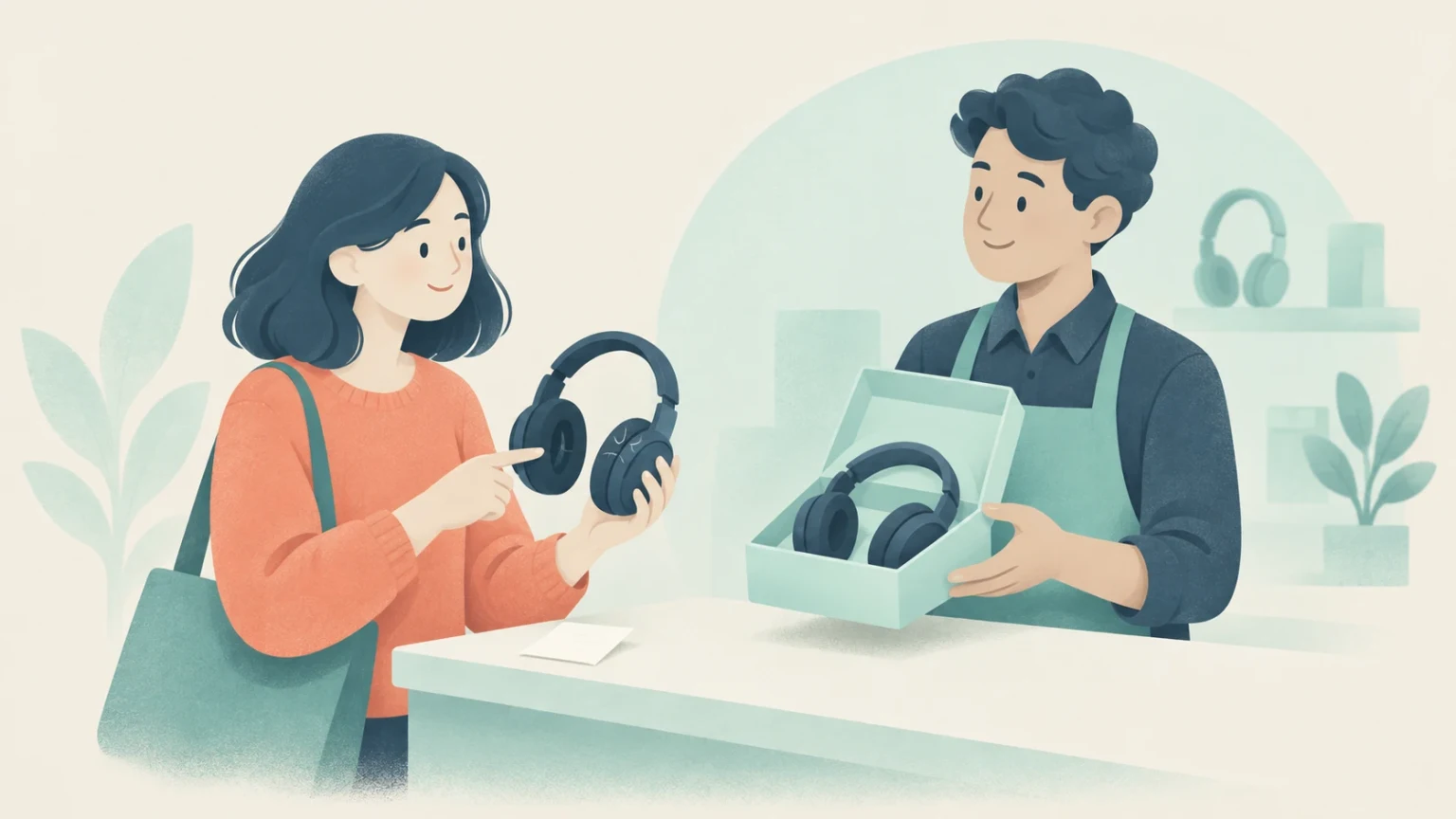
The customer returns a pair of wireless headphones because the battery fails and power cuts out after a few minutes of listening. Instead of a paper slip, the customer presents a digital receipt in an email on a smartphone, which the shop assistant accepts as valid proof of purchase.
Key points
- Although the assistant initially proposes a payment refund, the customer requests an exchange to receive another pair of working headphones for an upcoming trip, and the assistant agrees.
- In this store conversation, the customer identifies a power-loss fault, verifies the purchase with an email receipt, and successfully requests an exchange instead of the offered refund.
- Use the adjective faulty when goods have an operational defect rather than cosmetic wear.
This lesson has 5 stages. You can stop at any time and continue later.

Stage 1 of 5
Understand
What it means, when to use it, and mistakes to avoid.
Examples
These headphones are faulty because they switch off after two minutes.
Why it works: Faulty describes an operational defect in the product rather than buyer regret.
2 more examples
-
I have the receipt on my phone if you accept an email confirmation.
Receipt contains a silent p and refers to purchase documentation.
-
Could I exchange them for another pair rather than receiving a refund?
Exchange specifies receiving replacement goods instead of returned payment.
Read the full guide
Recognise a Faulty Product and Explain Why It Is Being Returned
When you return an item to a store, the word faulty describes merchandise that does not work as intended. Returning an item means bringing it back to the counter because of a defect or damage. The shop assistant is the store employee who handles customer service, inspects the item, and approves a solution. Stating the exact malfunction immediately saves time and prevents confusion about whether you simply changed your mind.
-
These headphones are faulty because they switch off after two minutes of playback.
Why it works: Faulty clearly explains that the item is defective rather than unwanted.
-
I am returning this headset because the battery does not hold a charge.
Why it works: Returning indicates taking the purchased goods back to the retailer.
-
The shop assistant examined the power button to confirm the defect.
Why it works: Shop assistant refers to the store employee handling customer service.
Your turn
What does calling an electronic item 'faulty' communicate to the assistant?
Answer: The product has an operational defect and does not work correctly.
Show the answer
Answer: The product has an operational defect and does not work correctly.
Calling a product faulty specifically means that it is broken or defective in its normal operation.
Listen Once to Identify the Headphone Problem
During a first listen, your primary goal is to catch the main issue before focusing on store rules or receipts. Listen specifically for action verbs that describe failure, such as lose power, cut out, or stop working. Customers usually state their primary complaint in their opening lines. Do not try to write down every single word immediately. Instead, focus on understanding why the customer has brought the headphones back to the counter and what specific problem prevents normal playback.
-
The customer explained that the headphones lose power after three minutes of playback.
Why it works: Identifying the specific failure explains the immediate reason for the return.
-
Sound cuts out repeatedly even though the battery indicator shows a full charge.
Why it works: Noticing action verbs like cuts out pinpoints the exact operational defect.
-
I need to return these wireless headphones because they switch off automatically.
Why it works: Stating the practical breakdown distinguishes product failure from buyer regret.
You can practise this again in Choosing an evening course and Checking a café order.
Your turn
Why is the customer returning the headphones to the shop?
Answer: The headphones lose power and stop working after a few minutes of use.
Show the answer
Answer: The headphones lose power and stop working after a few minutes of use.
The customer returns the headphones because they lose power after about three minutes of playback.
Replay to Find Which Purchase Record the Assistant Accepts
A receipt is a written or electronic record of payment, while proof of purchase refers to any valid evidence showing that you bought the merchandise at that specific business. When you replay the dialogue, listen for the exact format the customer offers and the assistant's response. In this recorded dialogue, the assistant accepts a digital email receipt displayed on a smartphone screen. Acceptance of an email receipt is a detail of this specific store interaction rather than an automatic rule across all retail stores.
-
I do not have the paper slip, but I have the email receipt on my phone.
Why it works: The speaker contrasts a physical paper slip with a digital confirmation.
-
The order confirmation email serves as valid proof of purchase for this return.
Why it works: Proof of purchase encompasses digital documentation verifying the sale.
-
The assistant scanned the digital barcode directly from the customer's screen.
Why it works: This action confirms that digital documentation satisfied the store policy.
Your turn
Which purchase record does the store assistant accept in this dialogue?
Answer: A digital confirmation email displayed on a smartphone.
Show the answer
Answer: A digital confirmation email displayed on a smartphone.
The assistant explicitly accepts the customer's confirmation email shown on the smartphone.
Distinguish an Offered Refund from an Accepted Exchange
A refund returns your payment money back to your card or account, whereas an exchange replaces the defective item with another working unit. Store credit provides a voucher balance to spend later at that shop, though it is not part of this dialogue. When listening to retail negotiations, track the difference between what the assistant suggests first and what the customer actually chooses. The assistant initially offers a card refund, but the conversation only concludes once the customer requests another pair and the assistant agrees.
-
I can process a full refund to your payment card right now.
Why it works: Refund signifies returning the paid purchase money to the buyer.
-
Could I exchange these faulty headphones for another pair instead?
Why it works: Exchange means replacing the broken unit with a working equivalent.
-
The assistant agreed to fetch a replacement pair from the stockroom.
Why it works: This turn confirms that both parties finalized an exchange rather than a refund.
Your turn
What solution does the customer finally receive in this dialogue?
Answer: A replacement pair of headphones from the store stock.
Show the answer
Answer: A replacement pair of headphones from the store stock.
Although the clerk initially offers a card refund, the customer asks for and receives an exchange for another working pair.
Use Staged Hints Before Checking the Return Dialogue
Staged listening helps you reconstruct fast spoken exchanges before relying on the full text. When you encounter a challenging service conversation, follow three gradual scaffolding steps: replay the specific turn where the decision is made, focus your attention on clue phrases, and attempt a short gap prompt before checking the transcript. Practicing this sequence sharpens your listening comprehension and ensures you decode words accurately without jumping straight to written answers.
Follow these progressive support steps before reading the dialogue: 1. Replay the choice turn: Listen closely to the turn right after the assistant proposes a card refund. 2. Focus on clue phrases: Notice how the customer introduces their preference with 'Actually' and uses 'tomorrow's journey' and 'exchange them'. 3. Attempt the gap prompt: Test your recall on the customer's request: 'Could I _______ them for another _______, please?' (Target words: exchange / pair). 4. Reveal the full transcript: Once you have attempted the prompt, read the complete script below to verify every detail.
Complete Store Dialogue: Assistant: Good morning. How can I help you today? Customer: Hello. These headphones are faulty. They lose power after about three minutes of use. Assistant: I see. Do you have your receipt or proof of purchase? Customer: I do not have the paper slip, but I have the confirmation email right here on my phone. Assistant: That email receipt works fine. It shows the date and transaction code. I can offer you a full refund to your card. Customer: Actually, I need headphones for tomorrow's journey. Could I exchange them for another pair, please? Assistant: Certainly. We have that model in stock. Let me fetch a replacement box from the back. Customer: Thank you. That is much better than a refund for my trip. Assistant: Here is your new pair, along with an updated receipt for the warranty. Customer: Wonderful, thanks for your help.
-
Replaying the choice turn isolates the customer's polite request to swap the item.
Why it works: Replaying specific turns lets you catch words that blur together in fast speech.
-
Clue phrases like 'another pair' signal that the buyer is rejecting a refund.
Why it works: Targeting clue phrases reveals the speaker's true goal before the turn finishes.
-
Attempting a gap prompt before viewing the transcript reinforces auditory memory.
Why it works: Active recall before reading confirms whether your listening was accurate.
Your turn
What progressive scaffolding step should you complete before reading the full dialogue script?
Answer: Replay the key decision turn, focus on clue phrases, and attempt a short gap prompt.
Show the answer
Answer: Replay the key decision turn, focus on clue phrases, and attempt a short gap prompt.
Progressive listening guides you through replay, clue phrases, and a gap prompt before transcript revelation.
Ask Politely for a Refund or Another Pair
In English retail interactions, polite customer requests rely on modal verbs such as could and expressions like would like rather than direct demands. Saying 'Could I exchange them, please?' or 'I'd like another pair' sounds cooperative and courteous. In natural speech, notice pronunciation features: the letter p in receipt is completely silent, the contraction I'd in I'd like shortens the pronoun and modal, and could you uses a weak vowel sound. Master reusable spoken chunks like 'These headphones are faulty' and 'I've got the receipt on my phone'. Note that headphones is plural and takes they or them, while a pair takes singular agreement.
-
These headphones are faulty, so could I exchange them, please?
Why it works: Headphones takes plural pronoun them, and could I softens the request.
-
I've got the receipt on my phone if you need proof of purchase.
Why it works: This reusable chunk politely introduces electronic documentation.
-
This pair of headphones is defective, and I would like a replacement.
Why it works: A pair takes singular verb agreement with is and singular pronoun it.
Your turn
Which sentence shows correct grammatical agreement and polite customer register?
Answer: Could I exchange these headphones, please, as they lose power quickly?
Show the answer
Answer: Could I exchange these headphones, please, as they lose power quickly?
This option correctly combines plural agreement for headphones with the polite modal 'Could I... please?'
Avoid Reversing the Fault or Choosing the First Offer
Two common mistakes often mislead intermediate listeners during retail conversations. The first mistake is assuming that the assistant's initial proposal is the final outcome. Counter clerks often propose a standard card refund before the buyer explains what they actually need. The second mistake is reversing speaker roles by confusing who experienced the breakdown. The customer reports the malfunction, while the clerk verifies transaction details and retrieves stock. Tracking the conversation until both speakers verbally confirm the outcome avoids these errors.
-
The assistant mentioned a refund, but the customer explicitly chose an exchange.
Why it works: Listening until the end avoids mistaking an initial offer for the final agreement.
-
The customer reported the power loss, not the store employee.
Why it works: Keeping roles distinct ensures you do not reverse who experienced the malfunction.
-
Both speakers confirmed that a replacement pair was in stock and ready.
Why it works: Agreement requires mutual verbal confirmation between customer and clerk.
Your turn
Why is it a mistake to stop listening when the assistant first mentions a refund?
Answer: Because the customer might politely decline the refund and request an exchange instead.
Show the answer
Answer: Because the customer might politely decline the refund and request an exchange instead.
Conversations evolve; the customer can refuse the initial suggestion in favor of a replacement unit.
Write Six Short Dictations and Recall the Agreed Solution
Consolidating your listening skills requires active recall and accurate transcription. Review the three core components of this retail transaction: the specific product fault, the accepted proof of purchase, and the agreed remedy. When transcribing dictation sentences, pay attention to spelling features such as the silent letter p in receipt and compound nouns like smartphone. Producing customer service requests from memory solidifies useful shopping chunks so you can communicate clearly at any service counter.
Three-part recall summary: 1. Problem: The headphones lose power after roughly three minutes of playback. 2. Proof: The assistant accepts an order confirmation email shown on a smartphone screen. 3. Solution: The customer requests and receives an exchange for another working pair. Unassisted recall request: Produce this spoken request from memory without looking: 'Could I exchange them for another pair, please?'
-
The customer returned the headphones because power cut out within minutes.
Why it works: Recalling the fault summarizes why the customer visited the store.
-
The clerk approved the return after inspecting the digital email receipt.
Why it works: Recalling the proof clarifies how the customer satisfied store requirements.
-
The agreed resolution provided another pair of headphones for upcoming travel.
Why it works: Recalling the resolution confirms that an exchange concluded the dialogue.
Your turn
What three elements must you recall to summarize this customer service interaction accurately?
Answer: The device fault, the accepted proof of purchase, and the agreed resolution.
Show the answer
Answer: The device fault, the accepted proof of purchase, and the agreed resolution.
Accurately summarizing a return requires identifying the defect, the evidence accepted, and the final agreed remedy.
Use it naturally
How people really use “faulty”
Neutral Fine almost anywhere, at work or with friends.
Words it often goes with
- faulty headphonesI took the faulty headphones back to the store.
- faulty batteryThe phone has a faulty battery.
- faulty productYou can return the faulty product with your receipt.
- faulty switchThe lamp has a faulty switch.
What people also say
- “It keeps switching off.” instead of “It repeatedly stops its operation.” Use this for a device that turns off again and again.
A stronger way to say it
These headphones don't work properly. → These headphones are faulty.
These headphones are faulty because they switch off after two minutes.
Related forms
- fault nounThere is a fault in the battery.
Questions about "Returning faulty headphones"
What does faulty mean?
Faulty means something has a fault or does not work properly. For these headphones, the problem is that they lose power after a few minutes. The word describes the problem; it does not explain what caused it.
The kettle is faulty because the switch does not stay down when pressed.
Retailers must replace faulty goods that break shortly after purchase.
What is the difference between a refund and an exchange?
A refund returns the money you spent back to your payment card, bank account, or cash in hand. An exchange replaces the broken item with an identical or equivalent product from the store shelf. Store credit differs from both options by providing a shop voucher balance that you can spend only at that specific merchant on a future purchase.
I opted for a refund to my credit card because the store had no alternative models.
The assistant offered an immediate exchange so I could take working headphones home today.
What does proof of purchase mean?
Proof of purchase is any official documentation that shows you bought an item from that retailer on a specific date. A traditional paper till receipt is the most common form, but modern retailers often accept digital email receipts, bank transaction records, or loyalty account entries. Always check whether an individual retailer requires physical paperwork.
The confirmation email on my smartphone served as valid proof of purchase.
Some retailers accept a credit card bank statement as proof of purchase if the paper slip is lost.
How do I know which offer the customer accepts?
Do not assume the first solution mentioned in a conversation is the final agreement. Store assistants frequently propose a standard refund before asking if the buyer wants another option. Listen past the initial offer for the customer's response, looking for preference phrases such as 'Could I exchange them instead?' or 'I would prefer another pair.' Then check that the clerk confirms the choice.
The clerk suggested money back, but the customer replied, 'I would rather have another pair.'
The transaction ended when the clerk confirmed, 'Certainly, I will fetch a new pair from stock.'
How can I politely ask for another pair?
To ask politely, use modal verbs like could or phrases like would like instead of direct commands. For instance, say 'Could I exchange these, please?' or 'I would like to swap them for another pair.' Because headphones is grammatically plural, refer to them using the plural pronoun them, or say 'another pair' to refer to one replacement unit.
Could I exchange these headphones for another pair, please?
I would like to replace this faulty headset with a working one if possible.
Before you go
Remember this
In this store conversation, the customer identifies a power-loss fault, verifies the purchase with an email receipt, and successfully requests an exchange instead of the offered refund.
Stage 2 of 5
Listen
Hear it in real sentences, from short to long, and write what you hear.
0 of 4 done
Listening 1 of 4
Listening 2 of 4
Try a longer clip. Listen once, then replay the part you missed.
Listening 3 of 4
This clip is longer. Follow the instruction above the answer field.
Listening 4 of 4
Listen, then type the missing words. The rest of the text is already there.
0:00
Practice complete
You listened closely.
Your result is saved in this browser.
Keep your progress. Your practice is saved on this device only. Create a free account to keep it everywhere.
Create a free accountThat was today's free lesson. Tomorrow you get another one. Want more today? See membership.
Create a free SubLearn account to keep this progress across devices.
Save my progressStage 3 of 5
Speak
Say it with the speaker, then use it in your own answer.
Shadow
Say it along with the speaker
Play the line slowly, then speak at the same time as the speaker. Copy the rhythm, not just the words.
Your turn
Say it your way
Imagine you are returning a faulty computer keyboard at a local shop. Explain the power problem, mention your email receipt on your smartphone, and politely request an exchange for another unit.
You could start with “Hello, this keyboard is faulty because…”
Take ten seconds to think, then answer out loud without looking at the lesson. Speak for the time shown in the task above. Nothing is sent unless you ask for feedback.
0:00
Stage 4 of 5
Write
Write your own response
AI feedback · it can make mistakes · Part of membership See membership
Check your own writing
Read one possible response
Draft saved on this device.
Use these checks to revise your message. Grammar and meaning are not automatically graded. Each task keeps its own draft in this browser tab.

You finished the free part of this lesson
- Understand
- Listen
- Speak
- Write
- CheckPart of membership
Worth another look
With a free account, the lessons you finish come back for review to help you remember them.Create a free account
Stage 5 of 5 · Part of membership
Check
New clips without hints.
Listening tests are included with membership. Try the free dictation first, then decide whether to continue.
Listening 1 of 2 Part of membership
Listening 2 of 2 Part of membership
Follow MicroEnglish
Find lesson updates, short videos and quick quizzes. Pick the app you already use.
Questions & comments
Ask about this lesson, share an example, or help another learner.
Example
Memory tip
Goes with
Related forms
Not to be confused with
In this lesson
This word isn't in our dictionary. Check the spelling, or try another form of the word.
We couldn't load this word. Try again.
