Micro-listening
Redelivered parcel
The short answer
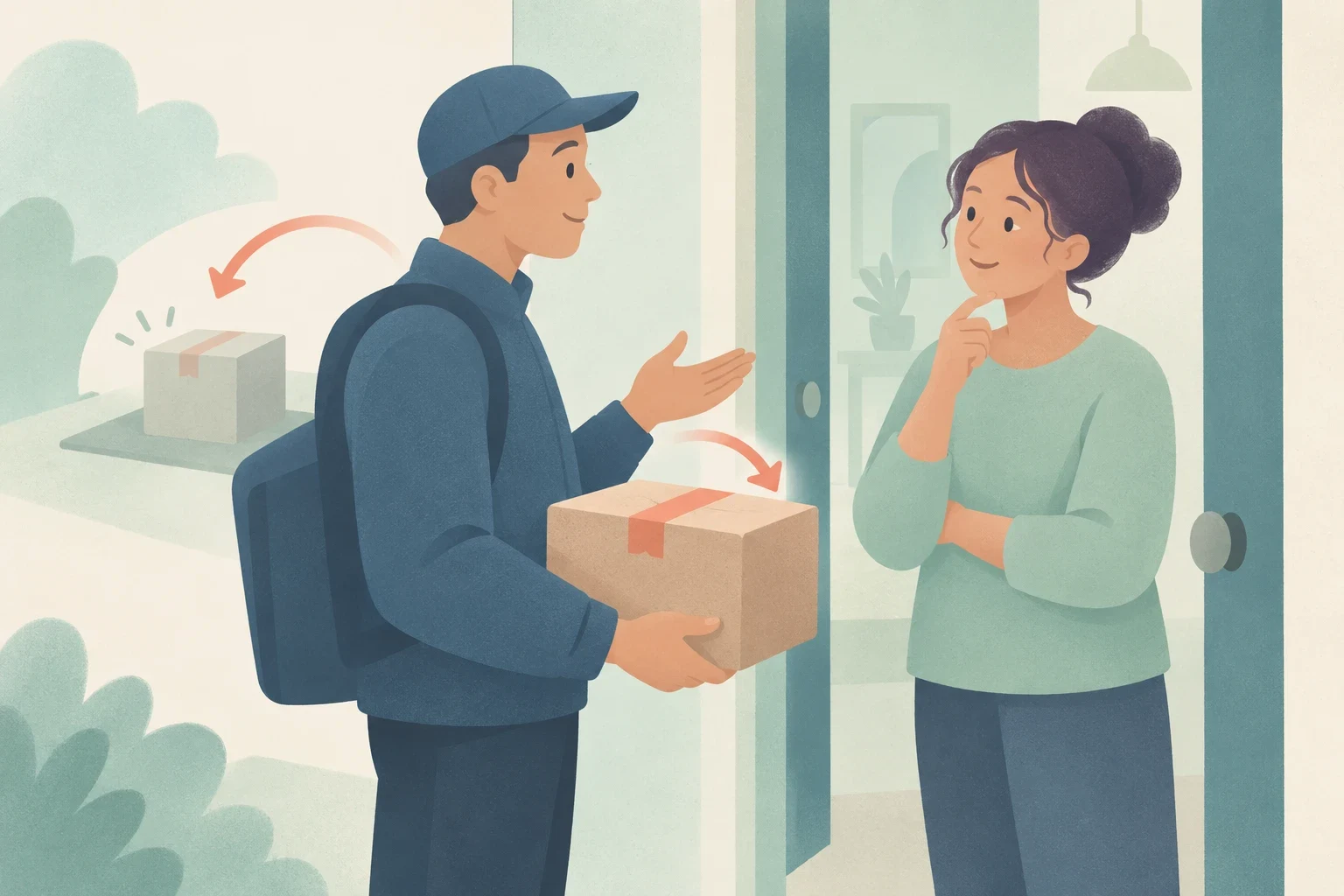
A courier made an unsuccessful delivery attempt earlier today. The recipient rejects traveling to a storage depot and arranges a redelivery for the next day, requesting that the parcel be left with a neighbor if nobody answers the door.
Key points
- Separate an attempted visit from a confirmed delivery and the next agreed step.
- Listen for where the parcel is and whether collection or redelivery is arranged.
- Leave with can name a proposed recipient, but check that the delivery company accepts the request.
This lesson has 5 stages. You can stop at any time and continue later.

Stage 1 of 5
Understand
What it means, when to use it, and mistakes to avoid.
Examples
A driver attempted a delivery at noon, but nobody was home to sign for the box.
Why it works: The driver attempted delivery while nobody was home to sign. The whole sentence explains the missed handover; attempted alone does not prove failure.
2 more examples
-
I cannot get to your regional depot before six, so please schedule another delivery.
'Cannot get to' indicates that traveling to the pickup location is impossible within operating hours.
-
If our buzzer goes unanswered tomorrow, please leave the carton with number fourteen.
'Leave the carton with number fourteen' designates the neighbor at that address as the recipient.
Read the full guide
Decide If an Action Already Happened
First, separate what happened earlier from what the courier is offering to do next. Arrived and stopped by describe a visit, but they do not tell you whether the parcel was handed over. Was unable to deliver clearly says the delivery failed. Listen for that result before deciding whether you need to collect the parcel or arrange another delivery.
-
A courier stopped by your address this morning while you were out.
Why it works: Stopped by describes a visit. Being out explains why the customer may have missed it, but the sentence does not say where the parcel ended up.
-
We can send our driver again tomorrow morning.
Why it works: 'Can send' presents a future possibility that requires confirmation.
Your turn
Which statement describes a visit without confirming that the parcel was handed over?
Answer: The courier stopped by your address at noon to drop off the carton.
Show the answer
Answer: The courier stopped by your address at noon to drop off the carton.
Stopped by reports a visit. This sentence does not state whether the parcel was handed over.
Distinguish an Attempt from a Success
Attempted a drop-off and sought to obtain a signature describe efforts; the words alone do not confirm failure. Was unable to reports an unsuccessful action. Delivered, handed over, and left can report completed actions. Listen for the outcome and the parcel’s location before deciding what needs to happen next.
-
Our driver made an effort to reach your flat before noon.
Why it works: This describes the driver trying to reach the flat. It does not tell you whether the driver arrived or delivered the parcel.
-
Our driver delivered the parcel to your front reception desk.
Why it works: 'Delivered' directly marks a completed and successful transaction.
You can practise this again in Adverb Placement: Where Adverbs Go and Advice that changed meaning.
Your turn
What does the phrase 'our driver was unable to leave the parcel' imply?
Answer: The driver could not leave the parcel.
Show the answer
Answer: The driver could not leave the parcel.
Was unable to leave reports an unsuccessful handover. It does not by itself give the parcel's current location.
Choose Between Depot Collection and Redelivery
In this conversation, the customer considers collection and redelivery. Phrases such as cannot get to or am unable to visit explain why collection is difficult. Ask what alternatives are available. Rejecting collection does not automatically book another delivery or establish the carrier’s general policy.
-
I cannot get to the sorting depot before it shuts at six.
Why it works: 'Cannot get to' communicates that travel constraints rule out collecting the package.
-
Could you book another delivery run for Friday afternoon instead?
Why it works: The customer requests redelivery. A request needs confirmation before it becomes an agreed plan.
Your turn
Why would a customer say 'I cannot get to the depot before six'?
Answer: To reject depot pickup and prompt the carrier to arrange redelivery.
Show the answer
Answer: To reject depot pickup and prompt the carrier to arrange redelivery.
Explaining that one cannot reach the depot rules out personal pickup and moves the conversation toward arranging another delivery attempt.
Interpret Delivery to a Neighbor
In residential areas, delivery drivers frequently ask for permission to leave a package next door. In British address terminology, speakers routinely use the preposition with followed by an address number to refer to the occupants of that property. Saying leave it with number fourteen means giving the item directly to the person who lives at number fourteen. This differs substantially from leave it outside number fourteen, which instructs the driver to drop the box on the ground by that entrance.
-
Please leave our parcel with number eight if we are not back.
Why it works: 'With number eight' authorizes the neighbor at house eight to accept the parcel.
-
Do not leave the carton outside number eight in the rain.
Why it works: 'Outside number eight' denotes the physical doorstep, not the resident.
Your turn
What does an instruction to 'leave the parcel with number ten' tell the driver to do?
Answer: Hand the package to the resident living at address number ten.
Show the answer
Answer: Hand the package to the resident living at address number ten.
Using 'with' before an address number means entrusting the item to the neighbor living at that address.
Set Clear Conditional Drop-off Rules
Effective delivery instructions rely on conditional sentences to handle uncertainty. When you might be away during the delivery window, construct a clear conditional sentence using if. The condition names the situation, such as nobody answering the intercom, while the main clause specifies the secondary action. Drivers process these instructions quickly, so keeping the condition short and placing the exact instruction in the main clause guarantees that your secondary plan is executed without confusion.
-
If nobody answers my buzzer, please leave the parcel next door.
Why it works: The if-clause sets the condition under which the backup delivery should happen.
-
If I am home, I will sign for the parcel directly.
Why it works: This clarifies the primary action if the recipient is present.
Your turn
Which sentence provides a clear backup instruction for an absent recipient?
Answer: If our buzzer goes unanswered, please leave the box with apartment four.
Show the answer
Answer: If our buzzer goes unanswered, please leave the box with apartment four.
This conditional sentence tells the driver exactly what alternative action to take if nobody answers the intercom.
Catch Fast Spoken Delivery Updates
Customer service agents and couriers often speak rapidly on the telephone, linking final consonants into following vowels. Phrasal combinations like pick it up sound like a single word, with the /k/ linking directly to /ɪ/ and the /t/ tapping before /ʌ/. Similarly, prepositions such as at or from frequently reduce to unstressed weak forms. Focusing on the stressed content words, which are nouns, dates, and house numbers, helps you track the essential arrangement despite rapid speech.
-
You can pick it up from our counter tomorrow morning.
Why it works: 'Pick it up' links together into a smooth three-syllable stream.
-
Our van will be in your area between eight and ten.
Why it works: Stress falls on the time markers 'eight' and 'ten' rather than function words.
Your turn
Why do phrases like 'pick it up' often sound difficult to separate in natural speech?
Answer: Final consonants link smoothly into the vowels that follow them.
Show the answer
Answer: Final consonants link smoothly into the vowels that follow them.
Connected speech links word-final consonants directly to following vowel sounds, creating a seamless stream.
Prevent Delivery Misunderstandings
A common mistake among language learners is confusing the carrier holding period with the redelivery date. When an automated notification says your item will be held for seven days, that phrase indicates the maximum storage window at the facility, not the day of the next delivery attempt. Unless you actively request another delivery date, the package remains static on a warehouse shelf. Always verify whether an action is scheduled automatically or waiting for your explicit instruction.
-
We will hold your parcel for five days before returning it to the sender.
Why it works: This specifies the total storage window, not an upcoming delivery date.
-
Your next delivery attempt is scheduled for Thursday morning.
Why it works: This statement confirms an active plan for a specific day.
Your turn
If a carrier states 'we will hold your box for five days', what does this mean?
Answer: The parcel will be kept at the depot for up to five days before return.
Show the answer
Answer: The parcel will be kept at the depot for up to five days before return.
Holding a parcel for five days refers to the storage window allowed before returning the item to sender, not a scheduled delivery.
Confirm Clear Redelivery Instructions
When finalizing your delivery preferences in an online form or leaving a note for the driver, clarity is essential. Keep your message brief, professional, and free of unnecessary background explanation. State your primary request first, followed by your conditional backup plan. Mentioning an authorized recipient and their exact apartment or door number eliminates hesitation and ensures that the courier leaves your parcel safely instead of taking it back to the warehouse.
-
Please deliver tomorrow afternoon, or leave with number six if I am out.
Why it works: A concise instruction that gives the courier an immediate backup option.
-
My neighbor at flat two is authorized to accept and sign for this package.
Why it works: Clear written authorization provides formal consent for neighbor receipt.
Your turn
What makes a redelivery note most effective for a courier driver?
Answer: A brief request stating the delivery window and an exact neighbor backup plan.
Show the answer
Answer: A brief request stating the delivery window and an exact neighbor backup plan.
Couriers work quickly, so a concise note specifying the preferred time and an exact authorized backup location works best.
Use it naturally
How people really use “sign for”
Neutral Fine almost anywhere, at work or with friends.
Words it often goes with
- sign for a packageCan you sign for a package while I am out?
- sign for the deliverySomeone must sign for the delivery before the driver can leave.
- sign for the boxMy coworker will sign for the box when it arrives.
What people also say
- “Can you sign for it?” instead of “Can you write your signature to receive it?” Use this when someone needs to accept a delivery with a signature.
Related forms
- signature nounThe driver needs your signature before leaving the package.
Questions about "Redelivered parcel"
Does 'leave it with number twelve' mean leave it outside the door or with a person?
In British English and everyday courier speech, saying 'with number twelve' means leaving the parcel with the person living at address twelve. If you want the driver to leave it outside your own entrance or on a porch, use 'outside' or 'by the door'. Using 'with' before an address number always implies handing it to a neighbor.
Please leave the parcel with number twelve if I do not answer.
Do not leave the box outside number twelve because it might rain.
What is the difference between 'the driver tried to deliver' and 'the driver delivered'?
Tried to deliver describes an attempt. In a missed-delivery message, it usually means the driver could not leave the parcel, but check the rest of the message. Delivered says the delivery was completed. Listen for where it was left and who received it.
The courier tried to deliver the parcel at ten o'clock, but our office was closed.
The courier delivered the parcel to reception this afternoon.
Why do speakers say 'I cannot get to the depot' instead of 'I cannot go'?
'Get to' emphasizes reaching a destination successfully despite practical obstacles such as distance, lack of transport, or limited time. While 'go to' simply describes travel direction, 'get to' focuses on the ability or difficulty of arriving there before closing hours.
I finish work at six, so I cannot get to the depot before it shuts.
Can you get to the sorting office on Saturday morning?
How do I clearly ask for another delivery instead of picking it up myself?
Use 'arrange a redelivery' or ask 'Could you deliver it again tomorrow?' To decline depot collection politely, state that you cannot collect it in person and request an alternative day or time slot.
I cannot collect the item in person, so please arrange a redelivery for Thursday.
Could your driver attempt another delivery on Monday morning?
Before you go
Remember this
Separate an attempted visit from a confirmed delivery and the next agreed step. Listen for where the parcel is and whether collection or redelivery is arranged. Leave with can name a proposed recipient, but check that the delivery company accepts the request.
Stage 2 of 5
Listen
Hear it in real sentences, from short to long, and write what you hear.
0 of 4 done
Listening 1 of 4
Listening 2 of 4
Try a longer clip. Listen once, then replay the part you missed.
Listening 3 of 4
This clip is longer. Follow the instruction above the answer field.
Listening 4 of 4
Listen, then type the missing words. The rest of the text is already there.
0:00
Practice complete
You listened closely.
Your result is saved in this browser.
Keep your progress. Your practice is saved on this device only. Create a free account to keep it everywhere.
Create a free accountThat was today's free lesson. Tomorrow you get another one. Want more today? See membership.
Create a free SubLearn account to keep this progress across devices.
Save my progressStage 3 of 5
Speak
Say it with the speaker, then use it in your own answer.
Shadow
Say it along with the speaker
Play the line slowly, then speak at the same time as the speaker. Copy the rhythm, not just the words.
Your turn
Say it your way
You work in a small bookstore. A box of books will arrive while you are at lunch. Speak to a coworker for 30 to 60 seconds from memory. Explain who can sign for it, where to put it, and what to do if the driver arrives after closing.
Use: sign for another delivery
Take ten seconds to think, then answer out loud without looking at the lesson. Speak for the time shown in the task above. Nothing is sent unless you ask for feedback.
0:00
Hear how someone else might say it
I'm going out for lunch at twelve, and a box of books should arrive while I'm away. Can you sign for it, please? The driver needs someone to write their name before leaving the box. Please put it in the back room, next to the desk. Keep it away from the door because people need space to walk through. We close at five today. If the driver calls after that, please ask for another delivery on Monday morning. I'll be here then, so I can receive the books.
Try once more and answer this: Where should I put the books if the back room is full?
Stage 4 of 5
Write
Use what you've learned to write about your day or week, then write a message.
Write
Put it in your own words
- I used “sign for”.
- It is about my life, not the lesson’s example.
- I read it once aloud to check it sounds right.
Write your own response
Choose a situation and write 30–50 words of your own. In this activity, you decide what to say rather than copy the words in a recording.
Check your own writing
Read one possible response
Use these checks to revise your message. Grammar and meaning are not automatically graded. Each task keeps its own draft in this browser tab.

You finished the free part of this lesson
- Understand
- Listen
- Speak
- Write
- CheckPart of membership
Worth another look
With a free account, the lessons you finish come back for review to help you remember them.Create a free account
Stage 5 of 5 · Part of membership
Check
New clips without hints.
Listening tests are included with membership. Try the free dictation first, then decide whether to continue.
Listening 1 of 2 Part of membership
Listening 2 of 2 Part of membership
Follow MicroEnglish
Find lesson updates, short videos and quick quizzes. Pick the app you already use.
Questions & comments
Ask about this lesson, share an example, or help another learner.
Example
Memory tip
Goes with
Related forms
Not to be confused with
In this lesson
This word isn't in our dictionary. Check the spelling, or try another form of the word.
We couldn't load this word. Try again.
