Áudio curto em inglês
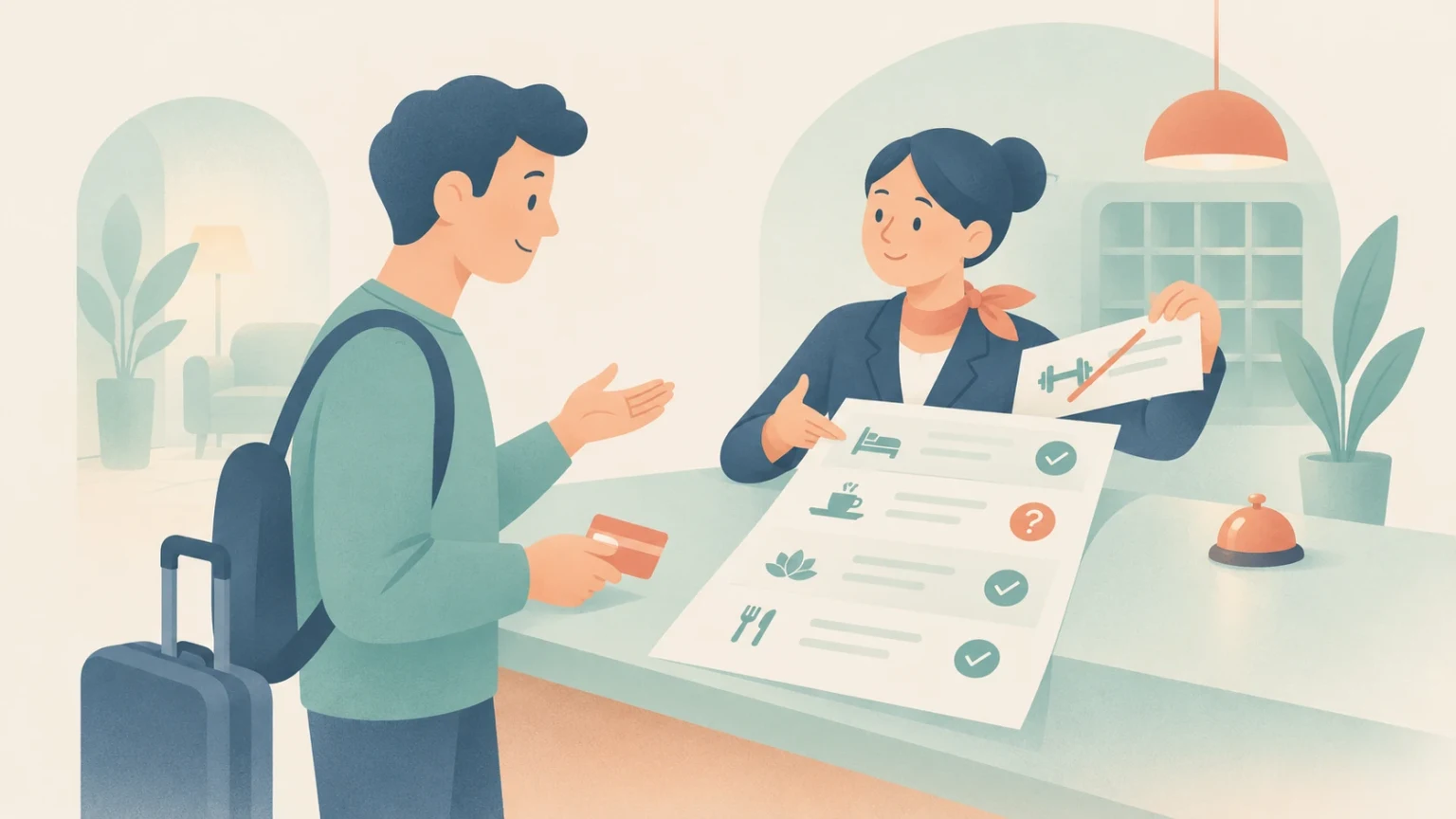
Checking a hotel bill
A resposta curta
A hotel bill may list the room price, included services and separately charged extras. If a charge looks wrong, name the item and ask staff to check it. An adjustment changes the amount due, so compare the revised bill with your booking and the services you used.
Pontos principais
- Check what each charge represents.
- A polite question asks for a review; a confirmed adjustment changes the bill.
- Keep the revised total separate from any statement that payment is complete.
Esta aula tem 5 etapas. Você pode parar quando quiser e continuar depois.

Etapa 1 de 5
Entender
O que significa, quando usar e quais erros evitar.
Exemplos
Breakfast was included in your booking, so I'll take that charge off your bill.
Por que funciona: The clerk recognizes that breakfast is included and promises to remove the extra charge.
Mais 2 exemplos
-
Could you check that late checkout fee, please?
The guest uses a polite modal question to prompt a review without making an accusation.
-
The bicycle hire is ten pounds, which brings your corrected total to one hundred pounds.
The clerk explains that the legitimate rental fee remains on the revised invoice.
Leia o guia completo
At checkout, check what each amount on the bill is for
A bill lists the amounts charged for a stay. The room rate is the agreed accommodation price. Other charges may cover services such as bicycle hire. The total combines the listed amounts, but it may change if an error is corrected. Check what each number represents instead of treating every amount as the final payment.
-
The room rate for the night is ninety pounds.
Por que funciona: This states the base accommodation cost agreed during booking.
-
There is an extra charge of ten pounds for bicycle hire.
Por que funciona: This identifies a separate fee added to the base price.
Sua vez
What does the term 'room rate' refer to on a hotel bill?
Resposta: The agreed price for your room accommodation.
Mostrar a resposta
Resposta: The agreed price for your room accommodation.
The room rate is the base cost agreed upon when reserving the room, excluding extra purchases or late fees.
Included services do not need a second payment
If a service is included in your room rate, its cost is covered by that price. You do not need to pay for it separately. Extras, such as bicycle hire in the written model, are charged separately. If your bill adds a second charge for something included in your booking, ask the receptionist to check it.
-
Breakfast was included in your booking, so there is no extra fee.
Por que funciona: The morning meal is covered by the room rate and requires no separate payment.
-
Bicycle hire is an extra service that costs ten pounds per day.
Por que funciona: This separate written example states a per-day price. Do not assume every recording uses that price basis unless it says so.
Você pode praticar isso novamente em Booking a hotel room e Estimated energy bill.
Sua vez
Why should an included breakfast not appear as an additional charge?
Resposta: Its cost is already covered by the agreed room rate.
Mostrar a resposta
Resposta: Its cost is already covered by the agreed room rate.
Included amenities are covered within the initial reservation price, so adding a separate charge for them is an error.
Ask about a charge and read the reply
When you question a charge, name the service or point to its line on the bill, then explain why it needs checking. Read the two short written examples below: one asks for a check and the other agrees to examine a record. Neither sentence gives the result of that check.
In a longer exchange, follow what happens after the question: which record is checked, what staff find and whether they change the bill. The next section has a complete written model. For listening, use the actual recordings in Practice.
-
Could you check that charge, please?
Por que funciona: A polite opening question signals that a specific line item on the bill requires verification.
-
Let me check the system log.
Por que funciona: The receptionist agrees to examine desk records to see if the entry is accurate.
Sua vez
A receptionist replies, 'Let me check the system log.' What can the guest conclude at that point?
Resposta: The receptionist is going to examine a record.
Mostrar a resposta
Resposta: The receptionist is going to examine a record.
The reply agrees to check the record. It does not yet give a result, a corrected total or payment confirmation.
Read the model: track which charges stay and which are removed
Try the long Practice recording before reading this worked example if you want to check your listening first; it uses the same figures. Then read the written dialogue to follow the guest's question, the clerk's check and the adjustment. Use the table to compare which charges remain with which one is removed.
- Guest
Good morning. I am checking out of room 204.
- Receptionist
Good morning. Let me bring up your bill. You have the room rate at ninety pounds, breakfast, ten pounds for bicycle hire, and a twenty-pound late checkout fee. That brings your total to one hundred and twenty pounds.
- Guest
Could you check that late checkout fee, please? I brought my key down at ten thirty, well before eleven o'clock.
- Receptionist
Let me check the system log. Yes, the desk recorded your key return at ten thirty. I'll take that twenty pounds off the bill right now.
- Guest
Thank you. Does the new total include the bicycle hire?
- Receptionist
Yes, the room is ninety pounds and the bicycle hire is ten pounds. Your corrected total is one hundred pounds.
- Guest
That matches my notes. I'll pay by card now.
- Receptionist
Perfect. Here is your receipt showing one hundred pounds paid.
| Item or stage | Amount | What the written example says |
|---|---|---|
| Room rate | £90 | Remains on the bill |
| Breakfast | £0 extra | Included in the room price |
| Bicycle hire | £10 | Valid extra charge that remains |
| Late checkout fee | £20 | Removed after checking |
| Initial total | £120 | Before the adjustment |
| Corrected total | £100 | After removing £20 |
| Receipt | £100 paid | Completed payment in this written model |
-
I'll take that twenty pounds off the bill right now.
Por que funciona: The receptionist promises to remove the fee after checking the records.
-
Your corrected total is one hundred pounds.
Por que funciona: The final balance retains the ninety-pound room rate and ten-pound bicycle hire, eliminating the disputed fee.
Sua vez
In the written dialogue, what is the status of the bicycle hire charge?
Resposta: It is a valid extra charge of ten pounds that remains on the bill.
Mostrar a resposta
Resposta: It is a valid extra charge of ten pounds that remains on the bill.
The guest hired a bicycle in this written example, so that fee stays on the bill alongside the room rate.
Use a polite question to challenge an unexpected charge
The written examples below ask staff to check a charge and state a relevant fact. Explain what you know, such as when you handed in the key, then listen to the reply. You can name the service or point to the line you are asking about.
-
Could you check this charge, please?
Por que funciona: This polite question opens an inquiry into the invoice without assuming or proving that a mistake was made.
-
I left before eleven, so I did not request a late checkout.
Por que funciona: Providing a clear, neutral statement of fact helps the receptionist verify timestamps in the computer log.
-
Does that total include the bike hire?
Por que funciona: This question confirms which legitimate extra services remain on the updated bill before payment.
Sua vez
What does asking 'Could you check this charge, please?' achieve at checkout?
Resposta: It opens an inquiry to verify the charge rather than confirming a mistake.
Mostrar a resposta
Resposta: It opens an inquiry to verify the charge rather than confirming a mistake.
Querying a charge opens an inquiry so staff can inspect records; a question alone does not confirm that an error was made.
Hear negatives and linked words that change the bill
'I'll' means 'I will', and 'didn't' contains the negative 'not'. The medium Practice recording about bicycle hire contains 'didn't'; replay it to hear that form. The sentences below are written examples, not additional recordings. 'Take it off' may flow together in speech, but it is still three words. Pronunciation varies with the speaker and context.
-
I'll take it off the bill right now.
Por que funciona: Here 'I'll' expresses a decision or promise to act. The words in 'take it off' may link, but the sentence does not show that the bill has already changed.
-
We didn't request a late checkout, so I'll check my booking email.
Por que funciona: Keep the negative didn't and the meaning of I'll. The exact sounds depend on the speaker; do not omit a word just because it is quick.
Sua vez
What happens when 'take it off' is linked in speech?
Resposta: The words may flow together, but all three still belong in an exact dictation.
Mostrar a resposta
Resposta: The words may flow together, but all three still belong in an exact dictation.
Connected speech does not remove words. In an exact dictation, write every word you hear, even when the words run together.
Confirm the corrected total before deciding what is paid
A promise to remove a charge, a corrected balance and a completed payment are different stages. Check what the speaker actually confirms. If the amount was never paid, removing it changes the bill; it does not show that money has been refunded. In the written model, the final receipt supplies the evidence of payment.
-
I'll update the system log and show you the corrected total of one hundred pounds.
Por que funciona: The clerk promises to update the record and show the corrected total. Wait for the updated bill or screen before treating the removal as done.
-
That matches my notes. I'll pay by card now.
Por que funciona: The guest accepts the spoken corrected total after checking it against their notes. 'I'll pay' states an intention; the receipt later confirms payment.
Sua vez
Which item in the written model confirms that payment is complete?
Resposta: The final receipt showing the amount paid.
Mostrar a resposta
Resposta: The final receipt showing the amount paid.
A promise describes a future action, and a corrected total gives the amount due. The final receipt confirms payment in this model.
Use the recordings, then try a new charge question
Use the Practice and Test recordings for dictation. The written examples below adapt a polite question to a parking fee; the check then tries a laundry charge. Ask staff to check the charge, listen to their reply and inspect any revised bill before paying.
-
Could you check this parking fee, please?
Por que funciona: This question adapts the polite inquiry structure to challenge a different hotel service.
-
I'll take that parking fee off your bill.
Por que funciona: The receptionist promises to remove the parking fee.
Sua vez
How can you ask staff to check an unexpected laundry fee politely?
Resposta: Could you check this laundry charge, please?
Mostrar a resposta
Resposta: Could you check this laundry charge, please?
'Check this laundry charge' names the billed item and asks for a review. The first option asks about the laundry itself; the second does not ask staff to examine the fee.
Perguntas sobre "Checking a hotel bill"
What does included in the room rate mean?
Included in the room rate means covered by the agreed room price for that booking. In these examples, breakfast should not be charged a second time. Check your particular booking terms rather than assuming every guest or every service has the same arrangement.
Breakfast is included in your room rate, so there is no extra charge.
WiFi access is already covered by your nightly room price.
How can I politely ask about a charge I do not recognize?
Ask about the specific item with a polite question, such as the first example below. Then explain the relevant fact, such as a service you did not use, and listen to the reply.
Could you check this mini-fridge fee, please?
I did not open the minibar during my stay.
What does take it off the bill mean?
To 'take a charge off the bill' means remove it from the amount payable. If the guest has not paid, this lowers the bill rather than returning money. Use 'refund' when money already paid is returned.
The receptionist said she would take the late fee off the bill.
Once you take off that charge, my total is seventy pounds.
How do I know which amount is the final total?
Listen for the amount confirmed after any adjustments, such as 'the corrected total' or 'the new balance'. Check which charges remain. A final balance tells you how much is due; it does not by itself prove that someone has already paid it.
Your corrected total is one hundred pounds after removing the late fee.
Please check the terminal screen to verify the final total before paying.
Does removing a charge mean I get a refund?
Removing an unpaid charge lowers the bill. A refund returns an earlier payment. Check whether the guest has already paid before choosing which expression fits.
Taking that charge off means you do not pay it now, so no refund is needed.
A refund is processed only if your card was already charged previously.
Antes de ir
Lembre-se disto
Check what each charge represents. A polite question asks for a review; a confirmed adjustment changes the bill. Keep the revised total separate from any statement that payment is complete. Each recording has its own amounts and services, so do not transfer a figure from the written model to a different clip.
Etapa 2 de 5
Ouvir
Ouça frases reais, das curtas às longas, e escreva o que você ouve.
0 de 4 concluído
Áudio 1 de 4
Ouça e escreva as palavras da gravação. Repita quantas vezes precisar.
0:00
Áudio 2 de 4
Ouça e escreva as palavras da gravação. Repita quantas vezes precisar.
0:00
Tente um áudio mais longo. Ouça uma vez e depois repita a parte que não conseguiu entender.
Áudio 3 de 4
Ouça e escreva as palavras da gravação. Repita quantas vezes precisar.
0:00
Este clipe é mais longo. Siga a instrução acima do campo de resposta.
Áudio 4 de 4
Ouça e escreva as palavras que faltam. O restante do texto já está preenchido.
0:00
Prática concluída
Você ouviu com atenção.
Seu resultado está salvo neste navegador.
Mantenha seu progresso. Sua prática é salva apenas neste dispositivo. Crie uma conta gratuita para mantê-la em todos os lugares.
Criar uma conta gratuitaEsta foi a aula gratuita de hoje. Amanhã você ganha outra. Quer mais hoje? Veja a assinatura.
Crie uma conta gratuita no MicroEnglish para manter este progresso em todos os seus dispositivos.
Salvar meu progressoEtapa 3 de 5
Falar
Fale junto com a gravação. Depois, use o que aprendeu em uma resposta sua.
Imitar
Fale junto com a gravação
Ouça a frase devagar. Depois, fale ao mesmo tempo que a gravação e tente acompanhar o ritmo, além das palavras.
Sua vez
Diga do seu jeito
Imagine you are checking out of a hotel and see an unexpected thirty-pound room service charge on your bill that you did not order. Speak to the desk clerk for 20 to 30 seconds explaining the situation and asking for an updated total.
Você pode começar com “Good morning. Could you please check this room service charge on my bill?…”
Pense por dez segundos. Depois, responda em voz alta pelo tempo indicado na tarefa, sem olhar a aula. Sua gravação só é enviada se você pedir feedback.
0:00
Etapa 4 de 5
Escrever
Escreva sua própria resposta
Feedback da IA · pode conter erros · Parte da assinatura Ver assinatura
Revise seu texto
Leia uma possível resposta
Rascunho salvo neste dispositivo.
Use essas verificações para revisar sua mensagem. Gramática e significado não são avaliados automaticamente. Cada tarefa mantém seu próprio rascunho nesta aba do navegador.

Você concluiu a parte gratuita desta aula
- Entender
- Ouvir
- Falar
- Escrever
- VerificarParte da assinatura
Vale a pena rever
Com uma conta gratuita, as aulas que você concluir voltam para revisão. Assim fica mais fácil lembrar delas.Criar uma conta gratuita
Etapa 5 de 5 · Parte da assinatura
Verificar
Novos clipes sem dicas.
Os testes de escuta estão incluídos na assinatura. Experimente o ditado grátis primeiro, depois decida se quer continuar.
Áudio 1 de 2 Parte da assinatura
Áudio 2 de 2 Parte da assinatura
Siga o MicroEnglish
Acompanhe as novidades sobre aulas, vídeos curtos e testes. Escolha o aplicativo que você já usa.
Perguntas e comentários
Pergunte sobre esta aula, compartilhe um exemplo ou ajude outro aluno.
Exemplo
Dica de memória
Combina com
Formas relacionadas
Não confundir com
Nesta aula
Esta palavra não está no nosso dicionário. Confira a grafia ou tente outra forma da palavra.
Não foi possível carregar esta palavra. Tente novamente.