Phrasal verb
Hand in
Can I say give instead of hand in when speaking to a teacher?
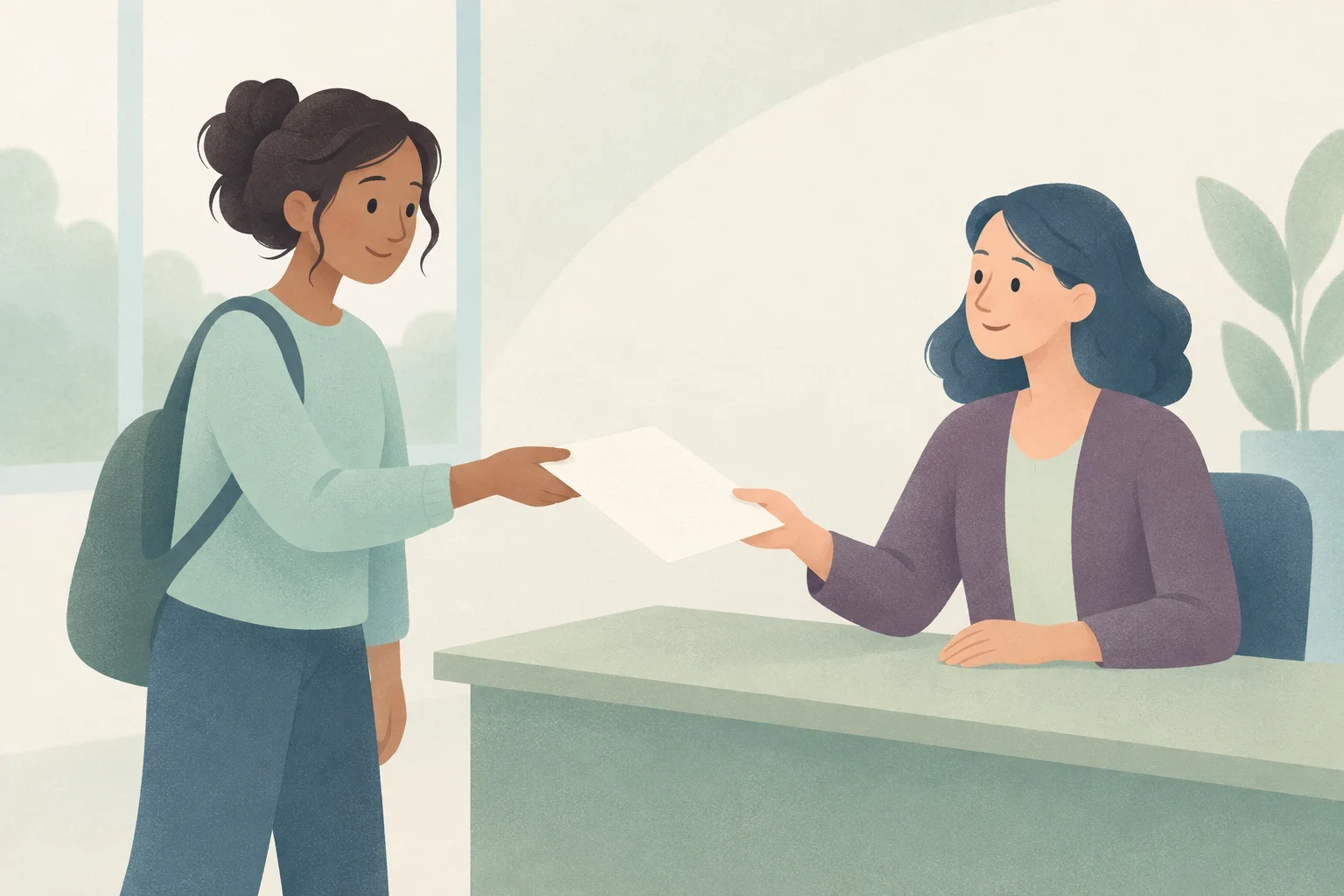
Hand in means to deliver an official document, assignment, key, or notice to a person in authority or a designated desk.
Key points
- Use hand in whenever an item moves to a person with administrative responsibility.
- Keep pronouns in the middle, and listen for the linked consonant sound when people speak quickly.
- Hand in is a separable phrasal verb.
This lesson has 5 stages. You can stop at any time and continue later.

Stage 1 of 5
Understand
What it means, when to use it, and mistakes to avoid.
Examples
Every morning, drivers hand in their route logs at the depot window.
Why it works: The logs go directly to the supervisor on duty.
2 more examples
-
I finished the travel claim early and handed it in through the staff portal.
The pronoun it sits between the verb and the preposition.
-
Tenants must hand their keys in before noon on moving day.
The keys are returned to building management.
Read the full guide
Decide Between Simple Giving and Formal Delivery
You might give a colleague a pen or give a friend a cup of coffee, but those exchanges are personal and informal. When an exchange involves an official requirement, such as submitting an evaluation, returning an apartment key, or offering a resignation letter, choose hand in. The phrase tells your listener that an authorized recipient receives the item for a formal purpose.
-
I gave Sarah my spare pen during the meeting.
Why it works: This is an everyday casual transfer between peers.
-
I handed in my final test paper to the examiner.
Why it works: This delivery transfers an official document to a person in authority.
Your turn
Which situation calls for hand in rather than give?
Answer: Delivering a completed visa application to an embassy official.
Show the answer
Answer: Delivering a completed visa application to an embassy official.
Hand in applies when delivering an official document to a person with authority or responsibility.
Identify Who Can Receive Your Item
You only hand in an item when the person receiving it holds specific responsibility for that item. Teachers take homework, front desk clerks take visitor passes, police officers take lost wallets, and personnel managers take resignation letters. If someone lacks the authority to review, register, or safeguard the item, hand in is usually the wrong expression.
-
A passerby found a lost wallet and handed it in at the station desk.
Why it works: The police desk clerk is the official receiver of lost property.
-
New employees must hand their tax forms in to the payroll clerk.
Why it works: The payroll clerk is authorized to process employee financial records.
This also comes up in Measure up and Drop out.
Your turn
Why would you hand in a lost phone at hotel reception?
Answer: The hotel reception staff is responsible for managing lost property.
Show the answer
Answer: The hotel reception staff is responsible for managing lost property.
Hand in requires an authorized receiver who is responsible for logging and returning lost items.
Place Pronouns Between the Verb and Particle
Put personal object pronouns such as it and them between hand and in. Say hand it in or hand them in, not hand in it or hand in them. A full noun phrase can go in either position: hand in the form or hand the form in.
-
I finished my travel schedule and handed it in this morning.
Why it works: The pronoun it sits strictly between handed and in.
-
When you finish your inspection sheets, please hand them in.
Why it works: The plural pronoun them stands in the middle position.
Your turn
Which sentence places the pronoun correctly?
Answer: She completed her assessment and handed it in before noon.
Show the answer
Answer: She completed her assessment and handed it in before noon.
Object pronouns like it must appear between the verb and the particle.
Position Longer Noun Phrases Without Confusion
When your object is a noun phrase instead of a pronoun, you have grammatical flexibility. You can say hand in the badge or hand the badge in. However, when the noun phrase includes descriptive words, placing the whole phrase after in prevents the sentence from feeling awkward or heavy. Balance your sentence by keeping verb and particle together before long phrases.
-
Please hand in the temporary parking pass from your rental company.
Why it works: The long noun phrase sits comfortably after the particle in.
-
Drivers should hand their daily keys in before four o'clock.
Why it works: A short noun phrase fits neatly between hand and in.
Your turn
Where should you place a five-word noun phrase for the most natural rhythm?
Answer: After the particle in so the sentence sounds balanced.
Show the answer
Answer: After the particle in so the sentence sounds balanced.
Placing long descriptive noun phrases after in prevents heavy awkward structures in the middle of the verb.
Choose Between Hand In and Turn In
You will encounter turn in frequently in North American speech. In school and workplace settings, Americans use turn in and hand in almost interchangeably. However, submit is more formal and commonly appears on printed forms or software interfaces. Hand in remains standard and natural across both British and American English, making it your safest choice in international communication.
-
The teacher asked the class to turn in their essays by Friday.
Why it works: Turn in is common in American school contexts.
-
Applicants must submit their paperwork through the government portal.
Why it works: Submit is formal and common in official written instructions.
Your turn
How does hand in compare to submit?
Answer: Hand in is standard everyday English, while submit is more formal and administrative.
Show the answer
Answer: Hand in is standard everyday English, while submit is more formal and administrative.
Hand in works naturally in conversation, whereas submit is preferred in formal written instructions.
Recognize the Linked Consonant in Fast Speech
When fluent speakers say hand in, they do not pronounce two isolated words with a distinct break. The final consonant of hand connects directly to the vowel in in. In rapid conversational speech, the letter d can soften or blend, making hand in sound almost like han-in. Recognizing this smooth linking helps you identify the phrase instantly during fast dialogue.
-
Did you hand in your badge?
Why it works: Hand in links together as /hændɪn/ in natural speech.
-
We handed it in early.
Why it works: Handed it in links across vowels as /hændɪdɪtɪn/.
Your turn
What happens to the pronunciation of hand in during fast speech?
Answer: The final consonant of hand links smoothly into the vowel sound of in.
Show the answer
Answer: The final consonant of hand links smoothly into the vowel sound of in.
Consonant-to-vowel linking connects the end of hand directly to the start of in.
Avoid Common Preposition and Word Order Errors
Language learners frequently confuse hand in with hand out. Hand in moves work from you to an authority, whereas hand out means distributing materials to a group. Another frequent mistake is omitting the direct object, as in please hand in to the desk. You must name what you are delivering: please hand your key in to the desk.
-
The assistant handed out the worksheets to every student.
Why it works: Hand out means distribute from one person to many.
-
Please hand your visitor pass in at the front desk.
Why it works: The sentence clearly includes the object visitor pass.
Your turn
What is the difference between hand in and hand out?
Answer: Hand in means submitting an item, while hand out means distributing items to others.
Show the answer
Answer: Hand in means submitting an item, while hand out means distributing items to others.
Hand in submits an item inward to an authority, while hand out distributes items outward to people.
Use Hand In for Official Employment Notices
In professional workplaces, hand in your notice is an established phrase meaning that you officially resign from your job. The word notice represents the formal announcement period, such as two weeks or one month. You can also say hand in your resignation. Because this action changes your legal employment status, using the precise phrasal verb signals professional clarity.
-
After securing a new job offer, David handed in his notice.
Why it works: David formally informed his employer that he is resigning.
-
Employees must hand in their resignation in writing to human resources.
Why it works: A written letter makes the employment departure official.
Your turn
What does someone do when they hand in their notice?
Answer: They formally inform their employer that they are leaving their position.
Show the answer
Answer: They formally inform their employer that they are leaving their position.
To hand in your notice means to submit your formal resignation to an employer.
Use it naturally
How people really use “hand in”
Neutral Fine almost anywhere, at work or with friends.
Words it often goes with
- hand in your keysPlease hand in your keys before you leave.
- hand in an assignmentYou can hand in an assignment through the class website.
- hand in your noticeYou should speak to your manager before you hand in your notice.
- hand it in earlyIf your form is ready, you can hand it in early.
What people also say
- “Please hand it in.” instead of “Please hand in it.” Put the pronoun between hand and in.
- “I handed in my claim.” instead of “I gave my claim to the office.” Handed in makes the official purpose clear.
Questions about "Hand in"
Can I say give instead of hand in when speaking to a teacher?
Yes, give is grammatically correct, but hand in communicates official delivery to someone with authority. Using hand in makes it clear that you are formally submitting work for grading or review rather than simply passing a physical object to a person.
I gave my teacher a pen during class.
I handed in my research essay before three o'clock.
Why is it incorrect to say hand in it when using a pronoun?
Put personal object pronouns such as it and them between hand and in: hand it in, hand them in. A full noun phrase can go before or after in: hand the form in or hand in the form.
Here is my report, so please hand it in now.
The manager asked for the forms and told us to hand them in promptly.
Can I use hand in for electronic files and online submissions?
Yes. Modern English uses hand in for digital uploads, portal submissions, and emails sent to supervisors or teachers. Even though the word hand refers to physical movement, native speakers use the expression for any official delivery channel.
Our team handed in the budget file through the shared drive.
Did you hand in your registration online?
What does the workplace phrase hand in your notice mean?
To hand in your notice means to formally tell your employer that you plan to leave your job. In this fixed phrase, notice refers to the required advance announcement, which is usually written as a resignation letter.
After finding a new position, she handed in her four-week notice.
He decided to hand in his resignation on Monday.
Before you go
Remember this
Use hand in whenever an item moves to a person with administrative responsibility. Keep pronouns in the middle, and listen for the linked consonant sound when people speak quickly.
Stage 2 of 5
Listen
Hear it in real sentences, from short to long, and write what you hear.
0 of 4 done
Listening 1 of 4
Listen, then type what you hear. Replay as often as you need.
0:00
- I finished the travel claim early and handed it in through the staff portal.
- Tenants must hand their keys in before noon on moving day.
Listening 2 of 4
Listen, then type what you hear. Replay as often as you need.
0:00
- I finished the travel claim early and handed it in through the staff portal.
- Tenants must hand their keys in before noon on moving day.
Try a longer clip. Listen once, then replay the part you missed.
Listening 3 of 4
Listen, then type what you hear. Replay as often as you need.
0:00
- I finished the travel claim early and handed it in through the staff portal.
- Tenants must hand their keys in before noon on moving day.
This clip is longer. Follow the instruction above the answer field.
Listening 4 of 4
Listen, then type the missing words. The rest of the text is already there.
0:00
- I finished the travel claim early and handed it in through the staff portal.
- Tenants must hand their keys in before noon on moving day.
Practice complete
You listened closely.
Your result is saved in this browser.
Keep your progress. Your practice is saved on this device only. Create a free account to keep it everywhere.
Create a free accountThat was today's free lesson. Tomorrow you get another one. Want more today? See membership.
Create a free SubLearn account to keep this progress across devices.
Save my progressStage 3 of 5
Speak
Say it with the speaker, then use it in your own answer.
Shadow
Say it along with the speaker
Play the line slowly, then speak at the same time as the speaker. Copy the rhythm, not just the words.
Your turn
Say it your way
Speak for 30 to 60 seconds from memory. Imagine you found a wallet at a festival in a park. Tell a friend where you found it, who you chose to hand it to, and how you felt afterward.
Use: hand in hand it in handed it in
Take ten seconds to think, then answer out loud without looking at the lesson. Speak for the time shown in the task above. Nothing is sent unless you ask for feedback.
0:00
Hear how someone else might say it
Yesterday, I found a wallet under a bench at a festival in the park. I wanted to hand in the wallet, but I couldn't see a lost property desk. My friend suggested giving it to someone selling food. I decided to hand it in to a police officer near the entrance instead. I handed it in and explained where I had found it. The officer thanked me and said someone had already asked about a missing wallet. I felt happy that its owner might get it back soon.
Try once more and answer this: What made you choose that person?
Stage 4 of 5
Write
Write your own response
AI feedback · it can make mistakes · Part of membership See membership
Check your own writing
Read one possible response
Draft saved on this device.
Use these checks to revise your message. Grammar and meaning are not automatically graded. Each task keeps its own draft in this browser tab.

You finished the free part of this lesson
- Understand
- Listen
- Speak
- Write
- CheckPart of membership
Worth another look
With a free account, the lessons you finish come back for review to help you remember them.Create a free account
Stage 5 of 5 · Part of membership
Check
New clips without hints.
Listening tests are included with membership. Try the free dictation first, then decide whether to continue.
Listening 1 of 2 Part of membership
Listening 2 of 2 Part of membership
Follow MicroEnglish
Find lesson updates, short videos and quick quizzes. Pick the app you already use.
Questions & comments
Ask about this lesson, share an example, or help another learner.
Example
Memory tip
Goes with
Related forms
Not to be confused with
In this lesson
This word isn't in our dictionary. Check the spelling, or try another form of the word.
We couldn't load this word. Try again.
