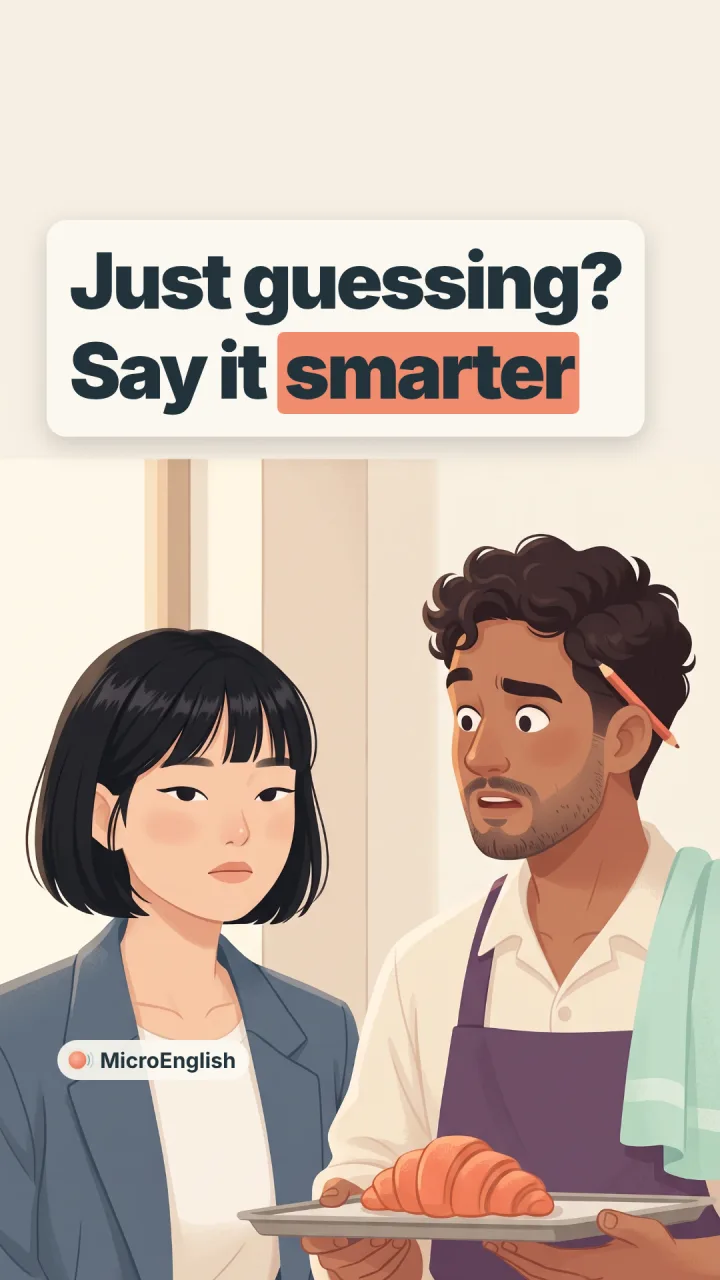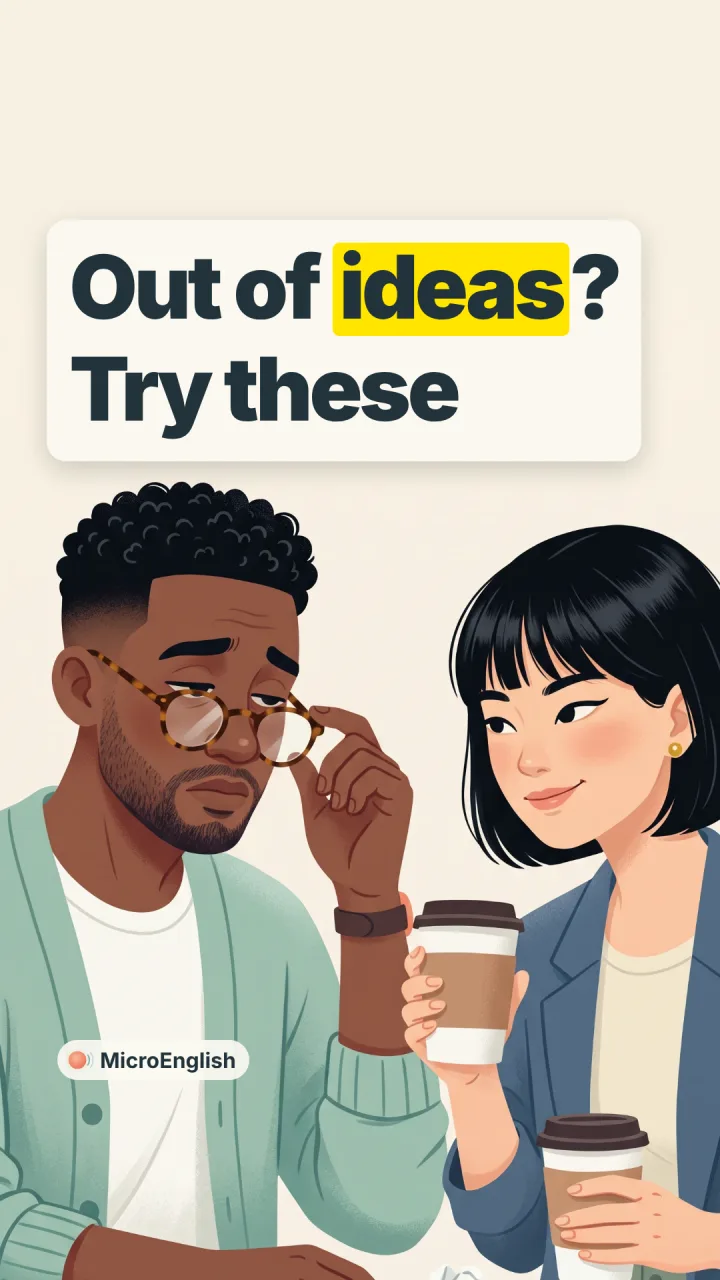
What happens in the video
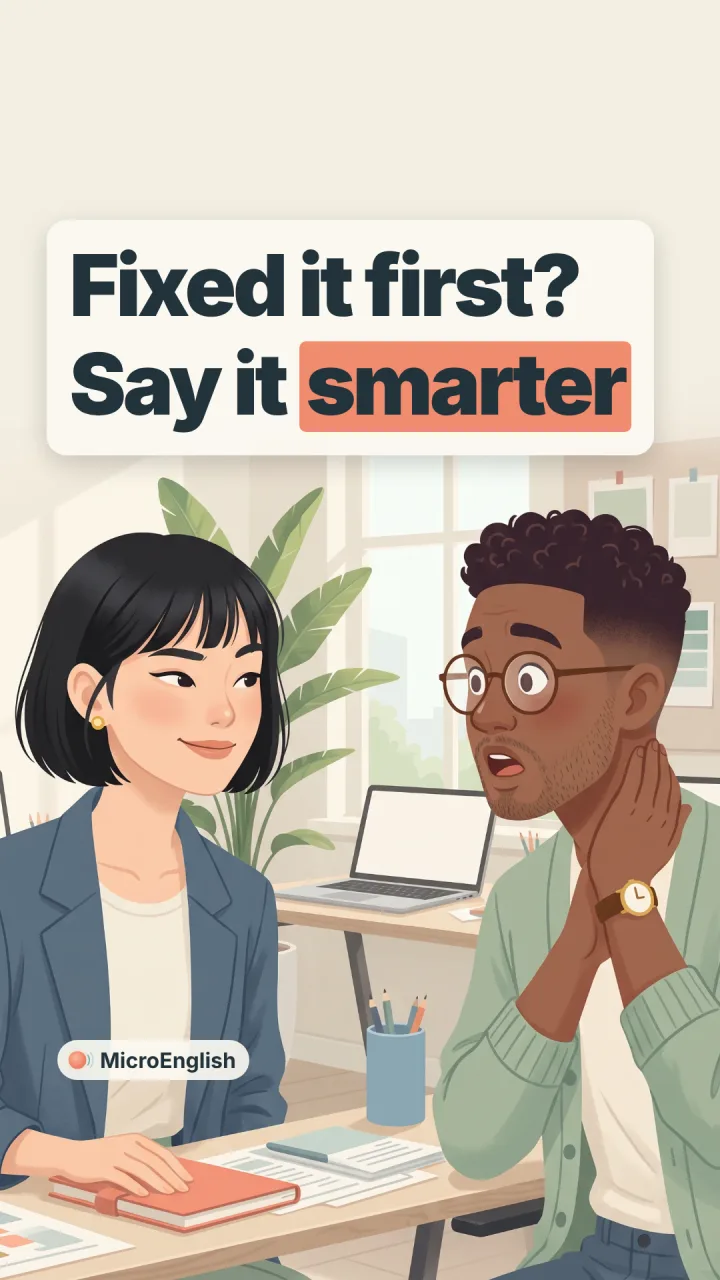
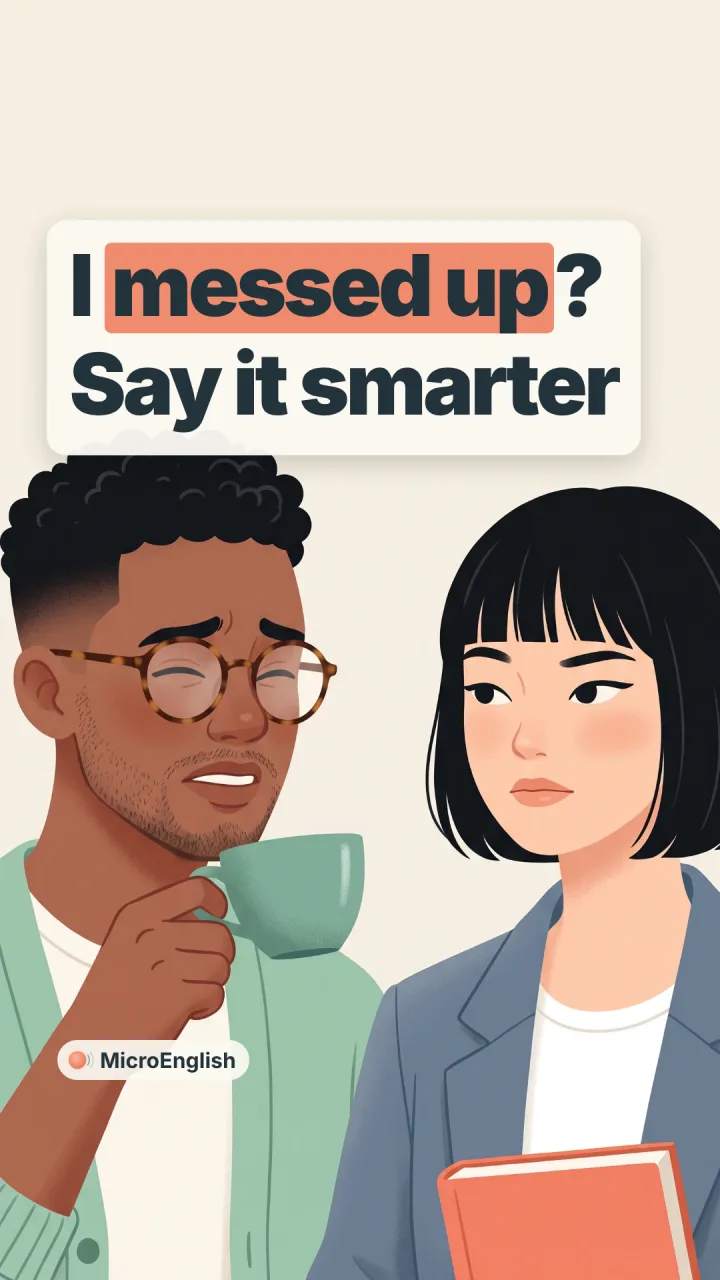
Theo starts the Short with no ideas left, only coffee and regret, and Hana jokes that the regret wants a refill. Later, Theo says, "I'm at my wit's end with these fonts." Hana's answer is simple: use the second one, the font Hana picked hours ago.
1 We draw a blank again.
Tone Casual, a bit embarrassed
Use "draw a blank" when your mind is empty for a moment, for example when you can't remember a name or think of an answer. It is light and short-term, so don't use it for a long, serious problem.
We draw a blank again.
For example:
A: What was the name of that restaurant we liked?
B: Sorry, I'm drawing a blank. It started with an M, I think.
2 I've hit a brick wall here.
Tone Frustrated and stuck
Use this when your work or plan stops and nothing you try moves it forward. It fits projects, research, and problems at work. It sounds frustrated, but not desperate.
I've hit a brick wall here.
For example:
A: How's the report going?
B: I've hit a brick wall here. The numbers just don't match.
A: Want me to take a look?
3 I'm at my wit's end.
Tone Serious, very stressed
Use this when you have tried everything and you feel worn out and stressed. It is strong, so save it for real problems. For a small problem, it sounds dramatic, which can also be a joke.
I'm at my wit's end.
For example:
A: Is the baby still not sleeping?
B: No. We've tried everything. I'm at my wit's end.
4 I'm out of ideas.
Tone Plain and honest
This is the most direct and neutral way to say it. It works at work, at home, and with friends, and it doesn't sound too emotional.
For example:
A: Any more suggestions for the team name?
B: I'm out of ideas. Can someone else try?
5 I'm stuck.
Tone Short and casual
Use this when you can't continue with a task, like homework or a puzzle. It is very common in speech. It often comes before a request for help.
For example:
A: Can you help me with question five? I'm stuck.
B: Sure. Show me what you've done so far.
6 My mind just went blank.
Tone Surprised, a little embarrassed
Use this when you suddenly forget what you wanted to say, often in a meeting, a test, or a speech. It describes one moment, not a long problem.
For example:
A: You stopped in the middle of your talk. Are you OK?
B: Yes, my mind just went blank for a second.
7 I'm stumped.
Tone Puzzled, informal
Use this when a question or problem is too hard and you can't find the answer. It sounds more curious than stressed, so it is good for riddles and tricky questions.
For example:
A: Why does the printer only fail on Mondays?
B: I'm stumped. I have no idea.
8 I don't know what else to try.
Tone Tired, asking for help
Use this when you have tried several things and none worked. It is a full, clear sentence, so it works well in emails and with people you don't know well.
For example:
A: Did restarting the app help?
B: No, and I cleared the cache too. I don't know what else to try.
Common mistakes
-
Not quite
I'm at my wits end.Better I'm at my wit's end.
The fixed phrase has an apostrophe: wit's. In speech you can't hear the difference, but in writing the apostrophe is the standard form. Also keep "my": not "at wit's end."
-
Not quite
I drew blank when she asked my name.Better I drew a blank when she asked my name.
The phrase always has "a": draw a blank. In the past tense, use "drew." You can also say "I'm drawing a blank" for right now.
-
Not quite
I'm at my wit's end. I can't decide what to eat.Better I'm out of ideas. I can't decide what to eat.
"At my wit's end" means very stressed after trying everything. For a small choice it sounds too strong, unless you mean it as a joke, like Theo with the fonts.
Quick quiz
Choose your answer for each question, then open the answer to check it.
-
You forget a coworker's name for a second. Which line fits best?
- I'm at my wit's end.
- I'm drawing a blank.
- I've hit a brick wall.
Show the answer (Question 1)
Answer: I'm drawing a blank. "Draw a blank" describes a short moment when your mind is empty.
-
Your project has stopped and nothing you try moves it forward. What do you say?
- I've hit a brick wall here.
- My mind just went blank.
- I'm stumped by the riddle.
Show the answer (Question 2)
Answer: I've hit a brick wall here. "Hit a brick wall" means your work stops and can't move on.
-
Which line sounds the most serious and stressed?
- I'm stuck.
- I'm out of ideas.
- I'm at my wit's end.
Show the answer (Question 3)
Answer: I'm at my wit's end. "At my wit's end" means you tried everything and feel very stressed.
-
Choose the correct sentence.
- I drew a blank in the exam.
- I drew blank in the exam.
- I drew the blank in the exam.
Show the answer (Question 4)
Answer: I drew a blank in the exam. The fixed phrase is "draw a blank," with "a."
-
You want to tell a support team, politely and clearly, that nothing has worked. Which line fits best?
- I'm stumped.
- I don't know what else to try.
- We draw a blank again.
Show the answer (Question 5)
Answer: I don't know what else to try. It is a full, neutral sentence that shows you tried things and need help.
Questions learners ask
What does "at my wit's end" mean?
It means you have tried everything you can think of and you feel very stressed or worn out. "Wits" here means your ability to think clearly. People often say it about a long problem, like a child who won't sleep or a machine that keeps breaking.
Is it "wit's end" or "wits' end"?
The common form is "at my wit's end." You may also see "wits' end" in some writing. Both sound the same when you speak, so in conversation you don't need to worry about it.
What is the difference between "draw a blank" and "hit a brick wall"?
"Draw a blank" is about your mind: for a moment, you can't remember or think of anything. "Hit a brick wall" is about your work or plan: it stops and won't move forward. The first is usually short and light, and the second is more frustrating.
Can I use these phrases at work?
Yes. "I'm out of ideas," "I've hit a brick wall," and "I don't know what else to try" are fine in meetings and emails. "I'm at my wit's end" is fine too, but it shows strong stress, so use it when you want people to know the problem is serious.
Film lines are short quotes used for language teaching. The dialogue belongs to its rightsholders. Theo and Hana are animated characters made with Google Flow.