
Écoute courte
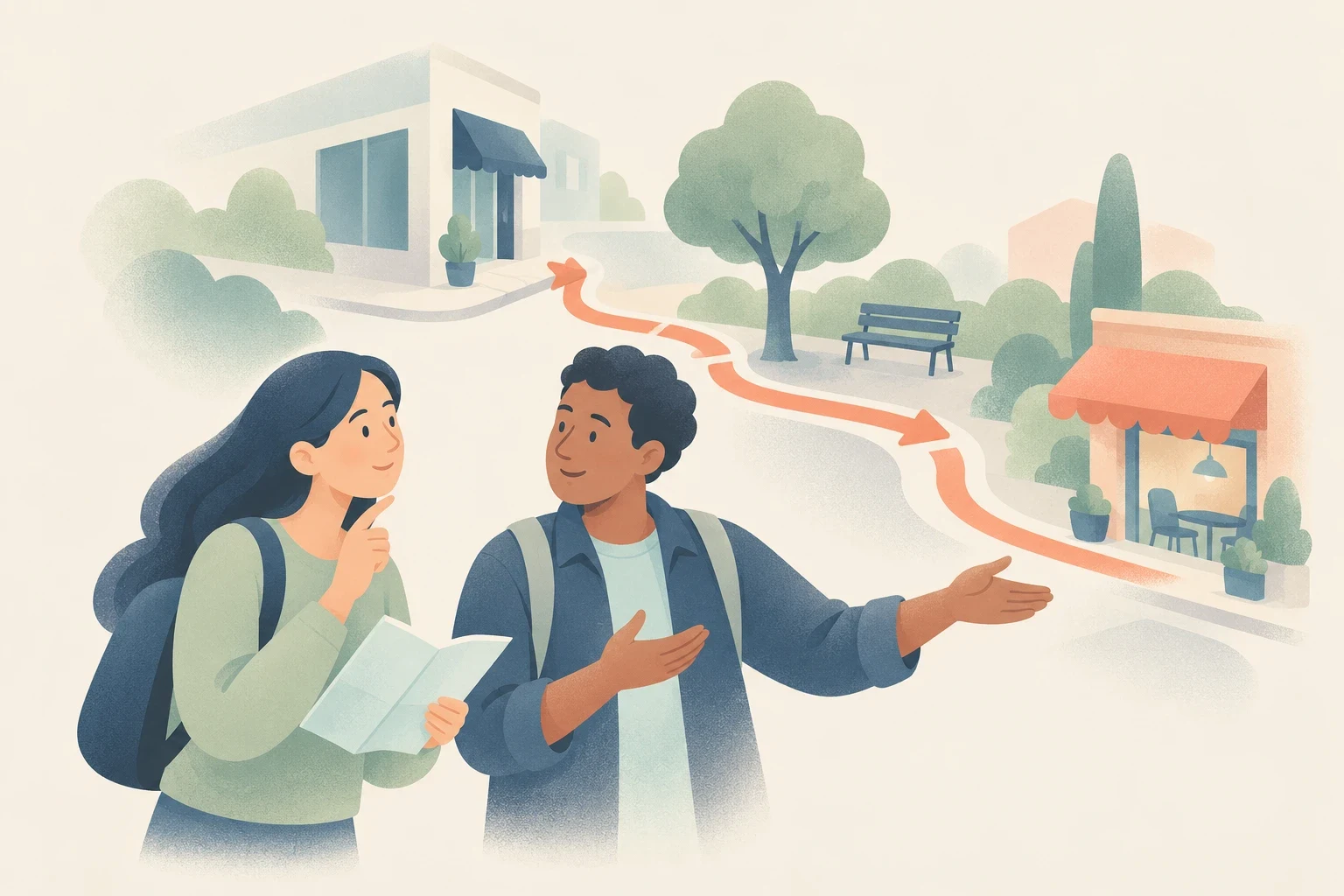
Giving directions: clear spoken routes
What is the difference between opposite and across from in directions?
Direction phrases describe movement from a starting point toward a destination, telling the traveler how to change direction and how far to walk. Location phrases describe physical position, explaining where a building or landmark sits in relation to nearby objects. Combining both language types gives a listener a complete route they can follow without getting lost.
À retenir
- To ask for directions, open politely with Excuse me.
- When giving directions, use base action verbs and visible landmarks to guide each turn.
- Use at for turning junctions, on for streets, and spatial words like opposite, next to, or between to identify the destination.
Cette leçon comporte 5 étapes. Vous pouvez vous arrêter à tout moment et reprendre plus tard.

Étape 1 sur 5
Comprendre
Comprenez le sens, les situations d’emploi et les erreurs à éviter.
Exemples
Walk straight ahead for two blocks, then turn left at the pharmacy.
Pourquoi cette forme convient : Walk straight ahead gives the first movement, and at the pharmacy marks the turning spot.
3 autres exemples
-
The town library is on King Street, directly opposite the public park.
On King Street gives the road name, while opposite the public park identifies its position.
-
Go past the bank and look for the cafe between the flower shop and the bakery.
Past shows movement beyond a landmark, and between describes the cafe in the middle of two shops.
-
Cross the pedestrian bridge and follow the canal path until you reach the museum.
Cross and follow give consecutive action instructions that guide the route clearly.
Lire le guide complet
Ask for directions politely
When you need help finding a place, always begin with a polite opening like Excuse me. This short phrase catches a stranger's attention in a respectful way. After the greeting, ask a direct question using where or how. You can say Excuse me, where is the train station? or Excuse me, how do I get to the city museum? Both forms sound natural and help the listener respond immediately.
-
Excuse me, where is the nearest pharmacy?
Pourquoi cette forme convient : Excuse me gets polite attention, and nearest asks for the closest location.
-
Excuse me, how do I get to the central bus station?
Pourquoi cette forme convient : How do I get to asks for a route with step-by-step movement instructions.
À vous
Which opening is the most natural and polite way to ask a stranger for route help?
Réponse : Excuse me, could you tell me how to reach the post office?
Voir la réponse
Réponse : Excuse me, could you tell me how to reach the post office?
Beginning with Excuse me and using a polite question structure helps the listener understand your request respectfully.
Start directions with an action verb
Clear directions rely on imperative verbs, which are base forms used without a grammatical subject. Action verbs like go, walk, turn, cross, and follow give immediate clarity because they tell the traveler exactly what physical move to make first. Adding specific distance or timing details, such as walk for five minutes or go straight ahead for two blocks, helps the listener visualize the route before they start walking.
-
Turn left onto River Street and walk two blocks.
Pourquoi cette forme convient : Turn and walk are base verbs that tell the listener the sequence of actions.
-
Cross the pedestrian bridge and follow the riverside path.
Pourquoi cette forme convient : Cross and follow describe how to navigate the physical route smoothly.
Pour retravailler ce point, essayez Past Simple or Past Continuous: A Clear Guide et English imperatives: give clear instructions.
À vous
What verb form should you use to give an instruction like moving to the left?
Réponse : Turn left onto Market Street.
Voir la réponse
Réponse : Turn left onto Market Street.
Directions use imperative base verbs without a subject so the instruction is direct and easy to follow.
Use landmarks to guide each turn
Landmarks give travelers visual reference points so they know when to change direction. Useful landmarks include buildings, traffic lights, statues, bridges, and shops that stand out clearly from the surroundings. Use the preposition past when the person should continue beyond a reference point, and use at when the person must make a turn. Saying walk past the bank and turn right at the traffic lights divides a long journey into manageable steps.
-
Walk past the old cinema and turn left at the fountain.
Pourquoi cette forme convient : Past shows you move beyond the cinema, while at marks the fountain as the turning spot.
-
Go past the supermarket until you see the clock tower.
Pourquoi cette forme convient : The supermarket and clock tower serve as visual checkpoints along the route.
À vous
Which sentence tells someone to continue beyond a building without stopping there?
Réponse : Walk past the post office.
Voir la réponse
Réponse : Walk past the post office.
The word past indicates that you travel beyond a landmark and continue along your route.
Describe where the destination sits
Once the traveler reaches the final street, you must describe the destination's exact position relative to nearby buildings. Use next to when two buildings are side by side on the same sidewalk. Use opposite or across from when the destination faces another building on the other side of the road. Use between when two landmarks flank the building. These spatial phrases confirm that the visitor has found the correct entrance.
-
The pharmacy is directly opposite the train station entrance.
Pourquoi cette forme convient : Opposite means the pharmacy faces the station across the street.
-
Our clinic sits between the bookshop and a small bakery.
Pourquoi cette forme convient : Between requires two reference points and places the clinic in the middle.
À vous
Which prepositional phrase means a building faces another place across the road?
Réponse : Opposite the library
Voir la réponse
Réponse : Opposite the library
Opposite means facing another building directly across the street or open space.
Choose the right preposition for locations
Prepositions of place often confuse learners because each word handles a different spatial scale. Use at for an exact point, junction, or specific corner, such as at the bus stop or at the corner of Elm Street. Use on for streets, avenues, or specific floors, like on High Street or on the second floor. Use in for enclosed spaces, neighborhoods, or large public areas, such as in the park or in the shopping mall.
-
Meet our tour guide at the corner of Queen Street.
Pourquoi cette forme convient : At marks an exact physical meeting point where two streets meet.
-
The Italian restaurant is on Market Avenue, in the old quarter.
Pourquoi cette forme convient : On identifies the street address, while in describes the larger neighborhood area.
À vous
Which preposition correctly completes: Our dental office is located ___ Fifth Avenue?
Réponse : on
Voir la réponse
Réponse : on
We use the preposition on for street names, roads, and avenues.
Notice stressed words in spoken directions
When listening to native speakers give directions, you do not need to catch every single grammatical word. English speakers naturally stress content words that carry critical route information, such as action verbs, turn directions, street names, and major landmarks. Smaller words like to, the, and at are often reduced or spoken quickly. Focusing your attention on the stressed pairs, like turn left or past bank, helps you follow fast speech without feeling overwhelmed.
-
Go straight ahead and turn right at the traffic lights.
Pourquoi cette forme convient : The speaker places heavy stress on straight, right, and traffic lights.
-
Walk past the cathedral, then look across from the fountain.
Pourquoi cette forme convient : Past, cathedral, across, and fountain carry the primary sentence rhythm.
À vous
When listening to quick spoken directions, which types of words carry the most important route information?
Réponse : Stressed content words like verbs, turn directions, and landmarks
Voir la réponse
Réponse : Stressed content words like verbs, turn directions, and landmarks
Speakers naturally emphasize verbs, directions, and landmarks because they provide the core steps of the route.
Check the route before you walk
Before you walk away, always confirm the instructions by repeating the key steps back to the speaker. You can start with so or let me check, followed by the main turn and landmark. Saying So I turn left after the church, right? gives the speaker an immediate chance to correct any misunderstanding. This simple confirmation habit prevents you from walking several blocks in the wrong direction and saves valuable travel time.
-
So I walk two blocks along Park Road and turn right, correct?
Pourquoi cette forme convient : Repeating the distance and turning action confirms the primary route instructions.
-
Just to check, the museum is opposite the post office?
Pourquoi cette forme convient : This question verifies the final destination's position before the traveler walks.
À vous
What is an effective way to confirm that you understood a direction correctly?
Réponse : Repeat the key steps back as a question starting with So or Let me check.
Voir la réponse
Réponse : Repeat the key steps back as a question starting with So or Let me check.
Repeating the steps as a question lets the other person confirm your understanding or fix an error.
Avoid common navigation mistakes
Learners often make predictable errors when speaking about routes. One common mistake is using turn in instead of turn at when referring to a junction. Another mistake is mixing up opposite and behind. Opposite means facing directly across the street, whereas behind means at the back of the building. Finally, remember that street addresses take on, while exact turning spots take at. Remembering these boundaries keeps your English directions accurate and professional.
-
Turn right at the roundabout, not on the roundabout.
Pourquoi cette forme convient : At specifies the junction point where the vehicle or person turns.
-
The cafe is opposite the hotel, so look across the street.
Pourquoi cette forme convient : Opposite means across the street, never behind or inside the building.
À vous
Which sentence contains the correct prepositions for giving a route instruction?
Réponse : Turn right at the traffic lights and look on King Street.
Voir la réponse
Réponse : Turn right at the traffic lights and look on King Street.
Use at for the decision point (the traffic lights) and on for the street name (King Street).
Vos questions sur « Giving directions: clear spoken routes »
What is the difference between opposite and across from in directions?
Both opposite and across from mean that two places face each other with a street or path between them. In British and international English, people often say opposite, as in opposite the station. In American English, across from is more common, as in across from the park. Both are fully understood in everyday travel.
The pharmacy is opposite the bank.
Our office is across from the city park.
Should I say turn at the traffic lights or turn on the traffic lights?
Say turn at the traffic lights. We use at for a specific physical location or junction where the traveler must make a decision. Turn on means activating an electrical device like a switch or lamp. Using on for a turning point is a common mistake that confuses listeners.
Turn left at the roundabout.
Turn right at the second traffic lights.
Do we say a shop is in King Street or on King Street?
In American English, places are always located on a street, such as on King Street or on Main Avenue. In British English, speakers sometimes say in King Street, but on King Street is widely used and understood everywhere. For international learners, using on for street names is the most reliable choice.
The bookstore is on Market Street.
There is a nice coffee shop on Elm Road.
How can I ask a stranger for directions without sounding rude?
Always begin with Excuse me before you ask your question. Follow it with a polite, direct structure such as Could you tell me where the library is? or How do I get to the bus terminal? Starting directly with Where is the bank? without a polite opening can sound abrupt to native speakers.
Excuse me, could you tell me how to get to the museum?
Excuse me, is there a post office near here?
Avant de terminer
À retenir
To ask for directions, open politely with Excuse me. When giving directions, use base action verbs and visible landmarks to guide each turn. Use at for turning junctions, on for streets, and spatial words like opposite, next to, or between to identify the destination. Always confirm important steps before you walk away.
Étape 2 sur 5
Écouter
Écoutez des phrases, des plus courtes aux plus longues, et écrivez les mots entendus.
0 sur 4 terminés
Écoute 1 sur 4
Écoutez, puis écrivez ce que vous entendez. Réécoutez autant de fois que nécessaire.
0:00
Écoute 2 sur 4
Écoutez, puis écrivez ce que vous entendez. Réécoutez autant de fois que nécessaire.
0:00
Essayez un extrait plus long. Écoutez-le une fois, puis reprenez le passage qui vous a échappé.
Écoute 3 sur 4
Écoutez, puis écrivez ce que vous entendez. Réécoutez autant de fois que nécessaire.
0:00
Cet extrait est plus long. Suivez la consigne au-dessus du champ de réponse.
Écoute 4 sur 4
Écoutez, puis complétez les mots manquants. Le reste du texte est déjà affiché.
0:00
Entraînement terminé
Votre séance d’écoute est terminée.
Votre résultat est enregistré dans ce navigateur.
Conserver votre progression. Votre pratique est enregistrée uniquement sur cet appareil. Créez un compte gratuit pour la retrouver partout.
Créer un compte gratuitRappel quotidien de pratique
Un court e-mail les jours où vous n’avez pas encore pratiqué. Pour le recevoir, créez un compte gratuit et confirmez votre adresse e-mail.
Créer un compte gratuitVous avez terminé la leçon gratuite du jour. Vous pourrez en choisir une autre demain. Vous souhaitez poursuivre aujourd’hui ? Consultez les abonnements.
Créez un compte SubLearn gratuit pour retrouver votre progression sur vos autres appareils.
Enregistrer ma progressionÉtape 3 sur 5
Parler
Répétez en même temps que l’enregistrement, puis réutilisez ce que vous avez appris dans votre propre réponse.
Répétition simultanée
Parlez en même temps que la voix
Écoutez la phrase au ralenti, puis parlez en même temps que la voix. Reproduisez aussi le rythme, pas seulement les mots.
À vous de parler
Exprimez-vous avec vos mots
Describe how to walk from your local train station to a nearby pharmacy, mentioning at least two street actions and one clear landmark.
Vous pouvez commencer par “To get to the pharmacy from the station exit, first…”
Réfléchissez dix secondes, puis répondez à voix haute pendant la durée indiquée ci-dessus, sans regarder la leçon. Rien n’est envoyé tant que vous ne demandez pas de retour.
0:00
Étape 4 sur 5
Écrire
Rédigez votre propre réponse
Retour de l’IA · des erreurs sont possibles · Inclus dans l’abonnement Voir l’abonnement
Relisez votre texte
Lire une réponse possible
Brouillon enregistré sur cet appareil.
Appuyez-vous sur ces points pour améliorer votre message. La grammaire et le sens ne sont pas évalués automatiquement. Chaque consigne conserve son propre brouillon dans cet onglet.

Vous avez terminé la partie gratuite de cette leçon
- Comprendre
- Écouter
- Parler
- Écrire
- Faire le pointInclus dans l’abonnement
À reprendre
Avec un compte gratuit, les leçons terminées reviennent en révision pour vous aider à les retenir.Créer un compte gratuit
Étape 5 sur 5 · Inclus dans l’abonnement
Faire le point
Essayez de nouveaux extraits sans indice.
Les tests d’écoute sont inclus dans l’abonnement. Essayez d’abord la dictée gratuite pour décider si vous souhaitez continuer.
Écoute 1 sur 2 Inclus dans l’abonnement
Écoute 2 sur 2 Inclus dans l’abonnement
Suivre MicroEnglish
Retrouvez des leçons, de courtes vidéos et des quiz sur l’application que vous utilisez déjà.
Questions et commentaires
Posez une question sur la leçon, proposez un exemple ou aidez une autre personne à comprendre.
Exemple
Pour retenir ce mot
Mots souvent associés
Formes de la même famille
À ne pas confondre avec
Dans cette leçon
Ce mot ne figure pas dans notre dictionnaire. Vérifiez son orthographe ou essayez une autre forme du mot.
Ce mot n’a pas pu être chargé. Réessayez.