
Micro-listening
Who's calling: polite ways to ask
The short answer
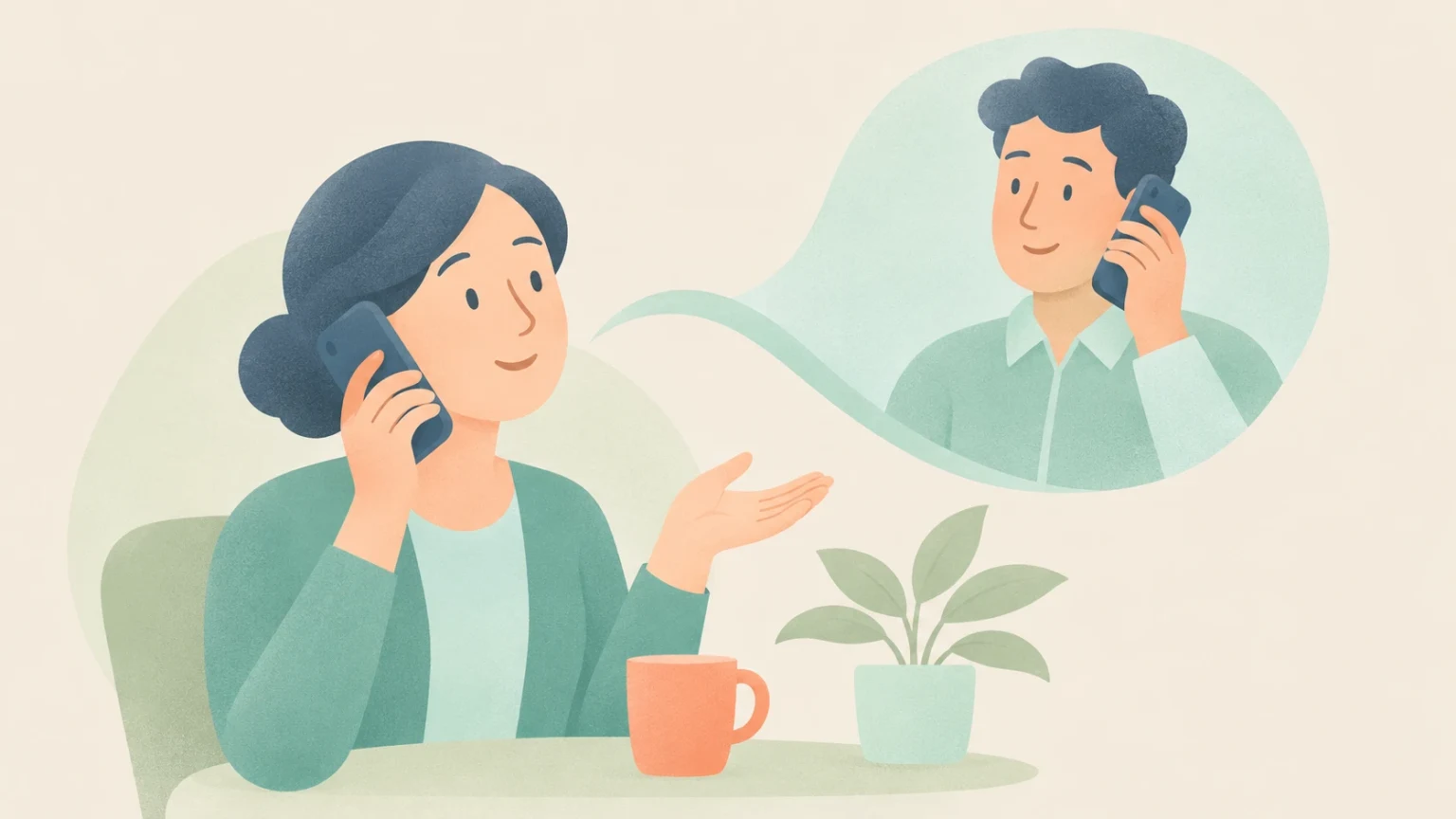
In English phone calls, 'Who are you?' sounds like an unfriendly challenge. Speakers ask about the call with 'Who's calling, please?' or 'May I ask who's calling?', check the other person on an active line with 'Who am I speaking to?', and collect details for a message or booking with 'Can I take your name?'.
Key points
- Choose 'Who's calling, please?' for everyday calls and 'May I ask who's calling?' before transferring a work call.
- Use 'Who am I speaking to?' to identify the person already on the line, and 'Can I take your name?' to record a message or booking.
- When you are the caller, introduce yourself with 'This is' or 'It's' instead of 'I am'.
This lesson has 5 stages. You can stop at any time and continue later.

Stage 1 of 5
Understand
What it means, when to use it, and mistakes to avoid.
Examples
Good morning. May I ask who's calling before I transfer your call to the director?
Why it works: Polite workplace question used to screen a call before connecting the line.
3 more examples
-
Hello, Jack isn't at his desk right now. Who's calling, please?
Everyday polite question to find out the caller's name before offering help.
-
I called the service number on my receipt, so who am I speaking to, please?
Natural way to ask which person answered during an active phone call.
-
Can I take your name and phone number so the doctor can call you back?
Practical question for writing down caller details for a message or callback.
Read the full guide
Ask who is on the phone without sounding rude
In face-to-face conversation, you can see the person speaking to you. On the phone, you only hear a voice on the line. Many learners ask 'Who are you?' because that question works in their first language. In English, 'Who are you?' sounds blunt and rude on a phone call. It sounds like you are challenging a stranger.
Polite English speakers ask about the phone call instead of challenging the person directly. They use 'Who's calling, please?' for everyday calls or 'May I ask who's calling?' at work. Focusing on the call keeps your tone calm and helpful. Choose your phrase based on how formal the call feels.
-
Sorry, I do not recognize this number. Who's calling, please?
Why it works: Asks for an unknown mobile caller's name without sounding angry or defensive.
-
Ms. Diaz is in a meeting right now. May I ask who's calling?
Why it works: Polite workplace question that focuses on the call rather than challenging the speaker.
Your turn
An unknown caller rings your office and asks for your manager without giving a name. Why should you avoid asking 'Who are you?'?
Answer: It sounds blunt and confrontational on the phone in English.
Show the answer
Answer: It sounds blunt and confrontational on the phone in English.
In English phone calls, 'Who are you?' feels like a rude challenge, so speakers ask 'Who's calling, please?' or 'May I ask who's calling?' instead.
Use Who's calling, please? for everyday calls
Use 'Who's calling, please?' when someone rings your home, mobile, or shared desk and asks for another person. The contraction 'Who's' means 'Who is', so you are asking who is making the call right now. Adding 'please' at the end softens the question and shows normal phone politeness. You can ask this before passing the phone to a family member or colleague.
-
Hold on a second while I check if my brother is home. Who's calling, please?
Why it works: Friendly everyday question before passing a phone call to someone else.
-
Who's calling, please? I will let Anna know you are on the line.
Why it works: Gets the caller's name smoothly so you can announce them to the next person.
You can practise this again in Polite emails: how to ask clearly and Whose or who's: choose the right word.
Your turn
Someone calls your shared apartment phone and asks to speak to your roommate. Which question is most natural before you hand over the phone?
Answer: Who's calling, please?
Show the answer
Answer: Who's calling, please?
'Who's calling, please?' is the standard, friendly everyday question to find out who is on the line before passing the phone.
Use May I ask who's calling? at work or before transferring a call
At a reception desk or office, use 'May I ask who's calling?' or 'Could I ask who's calling?'. These indirect questions sound respectful when you screen a call for a manager or client. Treat 'May I ask' and 'Could I ask' as ready-to-use polite starters. You can also ask 'Could you tell me who's calling?' in formal workplace calls.
Notice the word order after a polite starter such as 'May I ask'. Keep 'who's calling' in normal statement order because 'who' is the subject of 'is calling'. Never repeat the verb or add 'is' again at the end of the question. Say 'May I ask who is calling?' rather than 'May I ask who is calling is?'.
-
Mr. Kim is available on line two. May I ask who's calling before I put you through?
Why it works: Polite reception question used before transferring a call to a colleague.
-
Could I ask who's calling and which company you are with?
Why it works: Adds a company check naturally when screening an outside business call.
Your turn
Which workplace question uses correct word order when screening a phone call for a director?
Answer: May I ask who's calling?
Show the answer
Answer: May I ask who's calling?
After the polite starter 'May I ask', keep 'who's calling' in statement order without adding an extra verb.
Choose between Who am I speaking to? and Can I take your name?
Use 'Who am I speaking to?' or 'Who am I speaking with?' when a conversation has already started. This question works well when you made the call and do not know who answered the phone. It also works when someone transferred your call to a new department without naming the staff member.
Use 'Can I take your name?' or 'Could I have your name, please?' for practical admin tasks. Receptionists and customer service workers use these questions to write a message, check a booking, or log a call. Asking to take a name shows that you are recording their details to help them.
-
Thanks for helping me with my train ticket today. Who am I speaking to, please?
Why it works: Checks the staff member's name during an active service call.
-
I can check your table reservation right now. Could I have your name, please?
Why it works: Asks for the caller's name to look up a booking in the system.
-
Dr. Costa is with a patient. Can I take your name and ask her to call you back?
Why it works: Asks for the caller's name in order to write a callback message.
Your turn
You called a customer support desk and have been talking for two minutes, and now you want to write down the agent's name. What should you ask?
Answer: Who am I speaking to, please?
Show the answer
Answer: Who am I speaking to, please?
Because you made the call and are already talking to the agent, 'Who am I speaking to, please?' asks which person is on the other end of the line.
Contrast Who's calling? with Who are you? on the phone
Two common phone mistakes happen when learners translate directly from their first language. First, asking 'Who are you?' on the phone sounds annoyed or suspicious in English. Second, answering a phone question with 'I am David' sounds unnatural unless the listener already knows you in person. On the phone, English speakers introduce themselves with 'This is' or 'It's' instead.
When someone asks 'May I ask who's calling?', reply with 'This is Maya Lin' or 'It's Maya from Alba Design'. Adding your company or the reason for your call helps the other person connect you quickly. Always pair a polite phone question with a natural 'This is' introduction.
-
May I ask who's calling? This is Leo Vance from City Printing.
Why it works: Shows a polite reception question paired with a natural 'This is [Name] from [Company]' reply.
-
Who's calling, please? It's Nina from the apartment upstairs.
Why it works: Uses 'It's [Name]' for a natural, friendly reply on an everyday phone call.
Your turn
A receptionist asks you, 'May I ask who's calling, please?'. Which reply sounds most natural on the phone?
Answer: This is Omar Hassan from Bright Logistics.
Show the answer
Answer: This is Omar Hassan from Bright Logistics.
On the phone, English speakers introduce themselves with 'This is [Name]' or 'It's [Name]' rather than 'I am'.
Spot the difference between who's and whose in writing
In spoken English, 'who's' and 'whose' sound exactly the same, so learners often confuse them in writing. The form 'who's' with an apostrophe is a contraction of 'who is' or 'who has'. The word 'whose' without an apostrophe shows possession and asks who owns something. In phone questions, you always need 'Who's calling?' because it means 'Who is calling?'.
Before you write either word in a message or dictation exercise, test the sentence with 'who is'. If 'who is calling' makes sense, write 'who's calling' with an apostrophe before the letter s. Never write 'Whose calling?' when you are asking for a caller's name.
-
Please ask who's calling before you transfer the outside line.
Why it works: Uses 'who's' with an apostrophe because it means 'who is calling'.
-
Whose phone is ringing on the front reception desk?
Why it works: Uses 'whose' without an apostrophe because it asks who owns the phone.
Your turn
Why is 'Who's calling, please?' spelled with an apostrophe?
Answer: It is a contraction of 'Who is calling, please?'.
Show the answer
Answer: It is a contraction of 'Who is calling, please?'.
'Who's' with an apostrophe stands for 'who is', whereas 'whose' without an apostrophe asks about ownership.
Hear weak forms and contractions in phone questions
On a real phone call, speakers connect their words and stress only the main information words. In 'Who's calling, please?', the contraction 'Who's' sounds like one smooth syllable ending in a /z/ sound. The main stress lands on the first syllable of 'calling', so you hear 'WHO'S CALL-ing, please?'. Listen for that /z/ sound to write the apostrophe.
In longer polite questions, small words such as 'am', 'to', 'can', and 'your' become very fast and quiet. In 'May I ask who's calling?', the vowel in 'May I' glides smoothly into 'ask'. In 'Can I take your name?', the main stress falls on 'take' and 'name' while 'your' sounds short.
-
May I ask who's calling about our open position?
Why it works: The stress falls on 'ask', 'who's', and 'calling', while 'May I' connects smoothly.
-
Who am I speaking to in the billing office?
Why it works: The words 'am I' and 'to in' link together quickly around the stressed word 'speaking'.
Your turn
When you listen to 'Who's calling, please?' at normal speed, what clue tells you to write 'Who's' instead of 'Who'?
Answer: You hear a clear /z/ sound at the end of 'Who's' before 'calling'.
Show the answer
Answer: You hear a clear /z/ sound at the end of 'Who's' before 'calling'.
The contraction 'Who's' ends in a /z/ sound that connects to 'calling', marking the shortened verb 'is'.
Quick reference for polite phone questions and replies
Use the table below to choose the right phone question for each situation and reply naturally. The right question changes when you screen a call, write a message, or check who answered. Review the exact spelling of 'Who's calling?' before you start the listening and dictation tasks.
| Phone question | When to use it | Natural caller reply |
|---|---|---|
| Who's calling, please? | Everyday calls at home, on a mobile, or before passing the phone | It's Lucas from next door. |
| May I ask who's calling? | Formal work calls or screening a call before transferring the line | This is Priya Nair from Green Supply. |
| Who am I speaking to? | During an active call when you do not know who answered | This is Daniel at the service desk. |
| Can I take your name, please? | Taking a written message, checking a booking, or logging a call | Sure, my name is Sarah Cho. |
-
Could I ask who's calling? This is Hannah Park from the dental clinic.
Why it works: Pairs a polite workplace question with a clear 'This is [Name] from [Place]' response.
-
Can I take your name, please? Yes, it's Marco Silva, and I have a booking at noon.
Why it works: Shows how a caller gives their name and booking detail when asked.
Your turn
Which question fits best when a caller wants to leave a written callback message for your colleague?
Answer: Can I take your name, please?
Show the answer
Answer: Can I take your name, please?
'Can I take your name, please?' or 'Could I have your name, please?' tells the caller you are writing down their name for a message.
Recall the right phone question for each caller
When the phone rings, check two things before you speak: your goal and the formality of the call. If you are screening a call for your manager, start with 'May I ask who's calling?'. If you are writing down a callback note or booking, ask 'Can I take your name, please?'. Next, practice phone bookings in /micro-listenings/6-2/ or appointment calls in /micro-listenings/2-2/.
-
Before I transfer your call to accounting, may I ask who's calling?
Why it works: Screens the caller politely before connecting them to another department.
-
I can check if your prescription is ready. Could I have your name, please?
Why it works: Asks for the caller's name to look up a record during a service call.
Your turn
You answer a call at a clinic, and the patient asks you to check whether their appointment is confirmed for tomorrow. Which question should you ask?
Answer: Could I have your name, please?
Show the answer
Answer: Could I have your name, please?
When checking a booking or appointment record, 'Could I have your name, please?' or 'Can I take your name?' is the clearest choice.
Questions about "Who's calling: polite ways to ask"
Why is 'Who are you?' rude on the phone in English?
In English, 'Who are you?' sounds like a direct challenge to the person, as if you think they have no right to call you. Because you cannot see each other on the phone, a blunt question feels hostile. Asking 'Who's calling, please?' shifts the focus from challenging the stranger to asking a routine question about the phone call.
Who's calling, please? I will check if my manager is free.
May I ask who's calling before I transfer the line?
What is the difference between 'Who's calling?' and 'Who am I speaking to?'?
Use 'Who's calling, please?' when you answer an incoming phone call and want to know who rang you. It works especially well before you pass the phone or transfer the line to someone else. Use 'Who am I speaking to?' when a phone conversation is already underway and you want to know the name of the person talking with you.
You have reached the sales desk. Who's calling, please?
Thanks for checking my order status. Who am I speaking to, please?
How do I answer when someone asks 'May I ask who's calling?'?
Reply with 'This is' or 'It's' followed by your name, and add your company or reason for calling if it is a work call. For example, say 'This is Sara Chen from North Star Media'. Avoid saying 'I am Sara Chen' on the phone, because English speakers reserve 'I am [Name]' for face-to-face introductions.
This is Sara Chen calling from North Star Media.
It's David Miller calling about my afternoon dental appointment.
Do I say 'Who am I speaking to?' or 'To whom am I speaking?'?
In everyday and workplace phone calls, say 'Who am I speaking to?' or 'Who am I speaking with?'. Both sound polite and natural. You may occasionally hear 'To whom am I speaking?' in older films or stiff customer service scripts, but it sounds overly formal in normal conversation today.
Who am I speaking to in the reservations office, please?
Who am I speaking with at the service desk today?
Is it spelled 'Who's calling?' or 'Whose calling?'?
Always spell the phone question 'Who's calling?' with an apostrophe. 'Who's' is a contraction of 'who is', and the question asks 'Who is calling?'. The word 'whose' without an apostrophe is a possessive word that asks who something belongs to, as in 'Whose coat is this?'.
May I ask who's calling on line one?
Whose notebook is sitting beside the office telephone?
Before you go
Remember this
Choose 'Who's calling, please?' for everyday calls and 'May I ask who's calling?' before transferring a work call. Use 'Who am I speaking to?' to identify the person already on the line, and 'Can I take your name?' to record a message or booking. When you are the caller, introduce yourself with 'This is' or 'It's' instead of 'I am'.
Stage 2 of 5
Listen
Hear it in real sentences, from short to long, and write what you hear.
0 of 4 done
Listening 1 of 4
Listening 2 of 4
Try a longer clip. Listen once, then replay the part you missed.
Listening 3 of 4
This clip is longer. Follow the instruction above the answer field.
Listening 4 of 4
Listen, then type the missing words. The rest of the text is already there.
0:00
Practice complete
You listened closely.
Your result is saved in this browser.
Keep your progress. Your practice is saved on this device only. Create a free account to keep it everywhere.
Create a free accountDaily practice reminder
One short email on days you have not practised yet. Create a free account and confirm your email address to get it.
Create a free accountThat was today's free lesson. Tomorrow you get another one. Want more today? See membership.
Create a free SubLearn account to keep this progress across devices.
Save my progressStage 3 of 5
Speak
Say it with the speaker, then use it in your own answer.
Shadow
Say it along with the speaker
Play the line slowly, then speak at the same time as the speaker. Copy the rhythm, not just the words.
Your turn
Say it your way
A caller rings your office asking for your manager, Alex, who is currently on another call. In 20-30 seconds, ask politely who is calling, explain that Alex is on another line, and ask for their name and phone number to take a message.
You could start with “Good morning, Alex is on another line right now. May I ask…”
Take ten seconds to think, then answer out loud without looking at the lesson. Speak for the time shown in the task above. Nothing is sent unless you ask for feedback.
0:00
Stage 4 of 5
Write
Write your own response
AI feedback · it can make mistakes · Part of membership See membership
Check your own writing
Read one possible response
Draft saved on this device.
Use these checks to revise your message. Grammar and meaning are not automatically graded. Each task keeps its own draft in this browser tab.

You finished the free part of this lesson
- Understand
- Listen
- Speak
- Write
- CheckPart of membership
Worth another look
With a free account, the lessons you finish come back for review to help you remember them.Create a free account
Stage 5 of 5 · Part of membership
Check
New clips without hints.
Listening tests are included with membership. Try the free dictation first, then decide whether to continue.
Listening 1 of 2 Part of membership
Listening 2 of 2 Part of membership
Follow MicroEnglish
Find lesson updates, short videos and quick quizzes. Pick the app you already use.
Questions & comments
Ask about this lesson, share an example, or help another learner.
Example
Memory tip
Goes with
Related forms
Not to be confused with
In this lesson
This word isn't in our dictionary. Check the spelling, or try another form of the word.
We couldn't load this word. Try again.