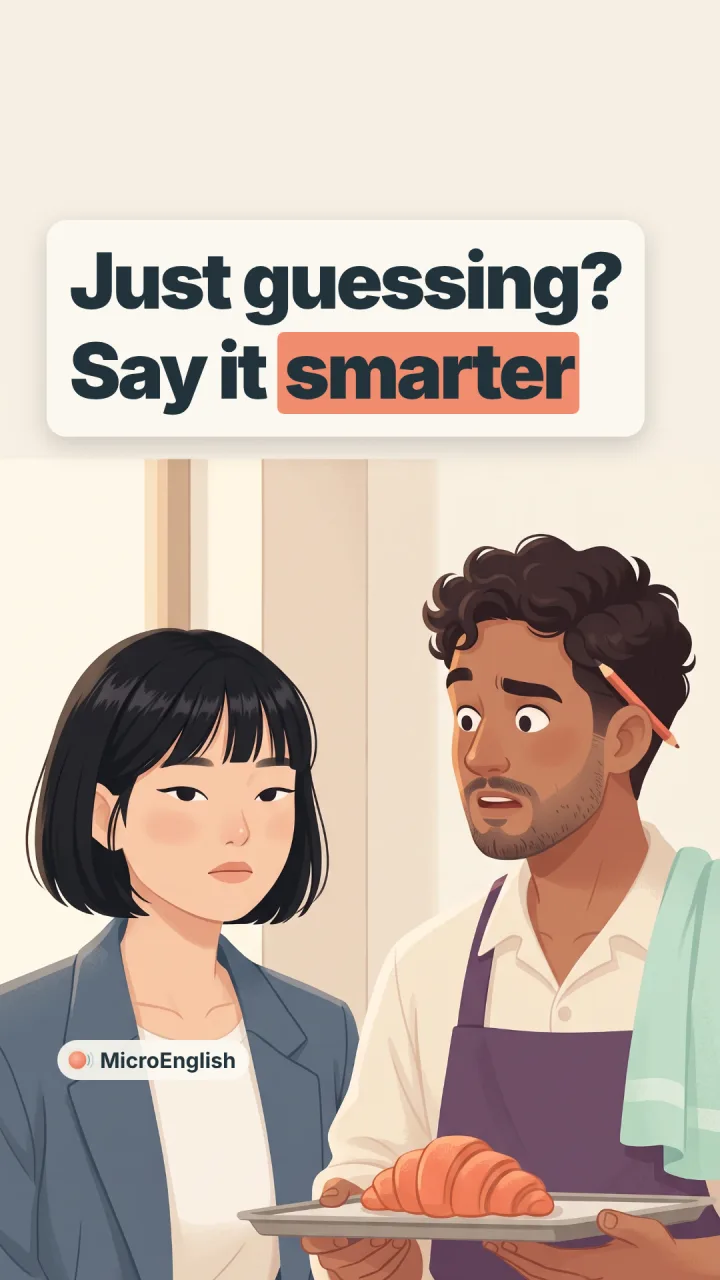
What happens in the video
Theo finds out the banners are the wrong size and jokes that he'll hide under his desk, but Hana reminds him the client visits tomorrow. Theo decides it's time to face the music and call the client. Then Hana tells him the client loved the giant banners and wants more.
1 Own up to it.
Tone Friendly, honest advice
Use it to tell someone to admit they did something wrong. To own up means to say you did it. It works between friends and coworkers, but it can sound pushy if you say it to your boss.
Oh, come on. Own up to it.
For example:
A: Someone broke the printer, and I don't want to say anything.
B: Was it you? Own up to it. People will respect that.
A: Fine. I'll tell the office manager.
2 We'll just face the music.
Tone Brave and ready
Use it before a hard conversation or a difficult moment that you can't avoid. It shows you're ready to accept the result. Don't use it for small, easy problems, or it sounds too dramatic.
We'll just face the music.
For example:
A: We missed the deadline. The manager wants to see us.
B: Then let's go in together. We'll just face the music.
3 It's time to pay the piper.
Tone Serious, no way out
Use it when the results of earlier choices finally arrive, such as a bill, a test, or a penalty. It sounds serious and a little old-fashioned. Avoid it when the problem was not the person's fault.
It's time to pay the piper.
For example:
A: I spent the whole semester at parties.
B: And the exams start Monday?
A: Yes. It's time to pay the piper.
4 That's on me.
Tone Casual, direct
Use it to say a mistake was your fault, quickly and without excuses. It's common at work and with friends. For a serious formal problem, a fuller apology is better.
For example:
A: The meeting room wasn't booked.
B: Sorry, that's on me. I'll book it now.
5 I take full responsibility.
Tone Formal, accountable
Use it in emails, meetings, or public statements when you accept blame clearly. It can sound stiff in a casual chat with friends.
For example:
A: The client got the wrong invoice.
B: I sent it, and I take full responsibility. I'll send the correct one today.
6 I'll take the heat.
Tone Protective, brave
Use it when you agree to receive the anger or criticism, sometimes to protect other people. Don't use it if you plan to hide afterward.
For example:
A: The boss will be angry about the delay.
B: It was my plan. I'll take the heat.
7 I had it coming.
Tone Rueful, self-aware
Use it after a bad result to say you deserved it because of your own actions. It's informal. Don't say it about someone else's bad luck, because it can sound cruel.
For example:
A: You got a parking ticket?
B: I parked there all week. I had it coming.
8 I'll deal with the consequences.
Tone Calm, practical
Use it when you know your choice may cause problems and you accept that. It's neutral, so it fits both work and daily life.
For example:
A: If you leave early, you might lose the bonus.
B: I know. I'll deal with the consequences.
Common mistakes
-
Not quite
I will face to the music.Better I will face the music.
Face is a verb that takes a direct object here. Don't add "to", and keep "the" before "music".
-
Not quite
Own up it.Better Own up to it.
The phrase is "own up to" something. You need "to" before the thing you admit, as in "own up to the mistake".
-
Not quite
It's time to pay the piper for this great lunch.Better It's time to pay for lunch.
"Pay the piper" is about accepting bad results of earlier choices, not paying a normal bill for something nice.
Quick quiz
Choose your answer for each question, then open the answer to check it.
-
Theo says, "Time to face the music." What does he mean?
- He wants to listen to a song
- He is ready to accept a difficult result
- He plans to hide from the client
Show the answer (Question 1)
Answer: He is ready to accept a difficult result To face the music means to stop avoiding a problem and accept what happens.
-
Your friend broke a glass and is hiding it. Which line gives friendly, honest advice?
- Own up to it.
- I had it coming.
- I take full responsibility.
Show the answer (Question 2)
Answer: Own up to it. "Own up to it" tells another person to admit they did it.
-
Which line sounds most serious, with no way out?
- That's on me.
- It's time to pay the piper.
- I'll deal with the consequences.
Show the answer (Question 3)
Answer: It's time to pay the piper. "Pay the piper" is used when the bad results of earlier choices finally arrive.
-
You write a formal email to a client about your mistake. Which line fits best?
- I had it coming.
- I take full responsibility.
- I'll take the heat.
Show the answer (Question 4)
Answer: I take full responsibility. It is clear and formal, so it suits a work email.
-
Which sentence is correct?
- We'll face to the music.
- We'll just face the music.
- We'll face the musics.
Show the answer (Question 5)
Answer: We'll just face the music. The fixed phrase is "face the music" with no "to" and a singular "music".
Questions learners ask
What does "face the music" mean?
It means to accept the unpleasant results of something you did, or to stop avoiding a hard situation. People often say it just before a difficult conversation. It has nothing to do with real music.
Is "face the music" formal or informal?
It's an informal idiom, but it's polite and common at work. You can say it in a meeting or to friends. In a formal written apology, "I take full responsibility" is clearer.
What is the difference between "own up to it" and "face the music"?
"Own up to it" is about admitting that you did something. "Face the music" is about accepting what happens next. Often you own up first, and then you face the music.
What does "pay the piper" mean?
It means the time has come to accept the costs or results of earlier choices. It sounds serious, as if there is no way out. Use it when the consequences have already arrived.
Film lines are short quotes used for language teaching. The dialogue belongs to its rightsholders. Theo and Hana are animated characters made with Google Flow.