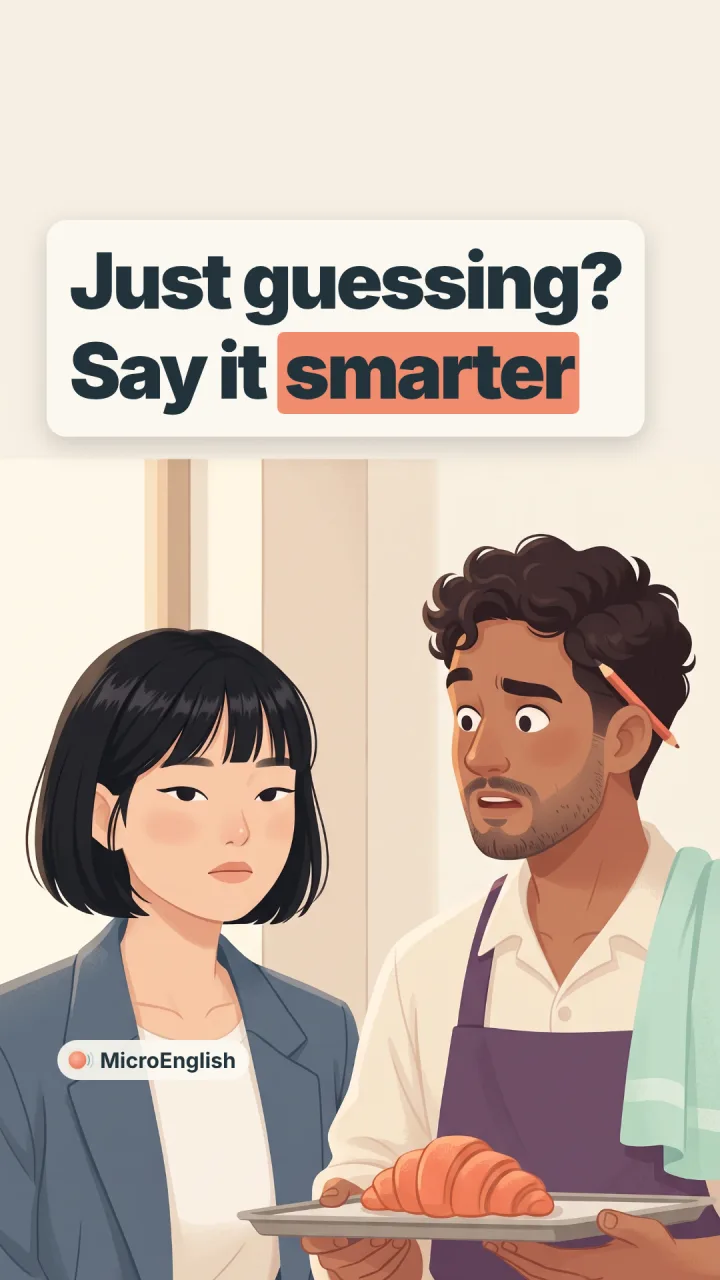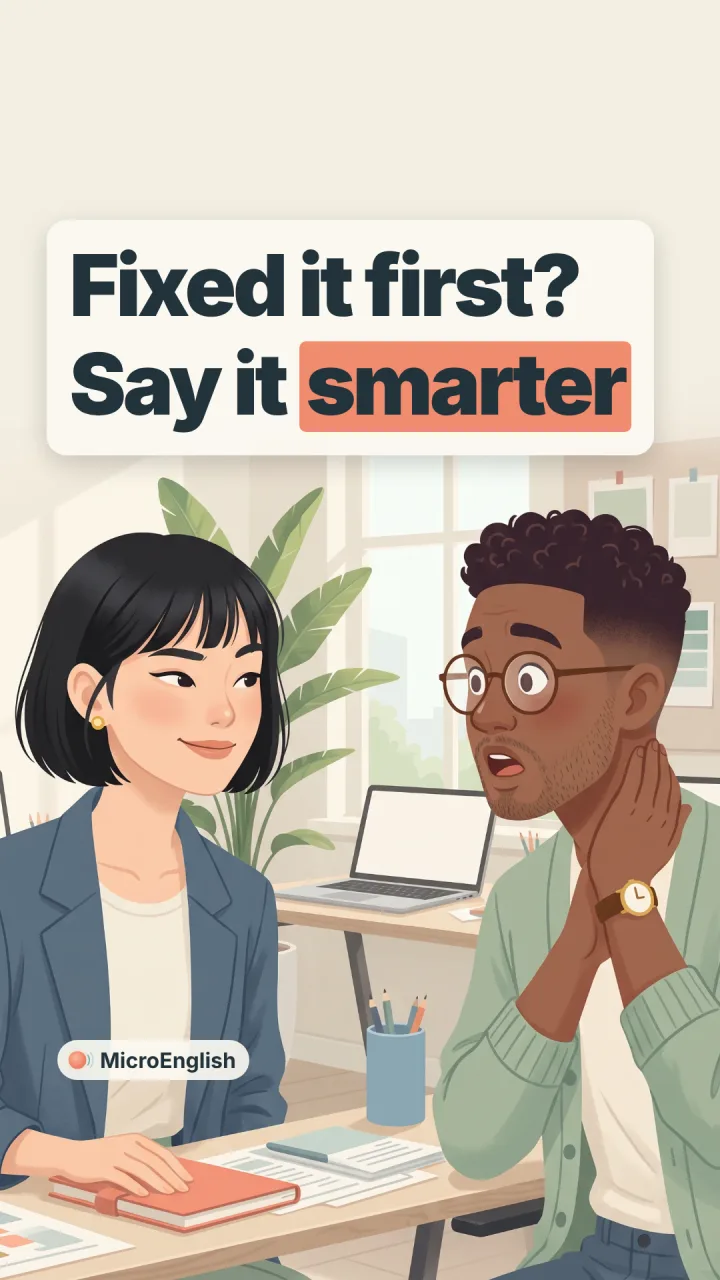
What happens in the video
Hana tells Theo that she already moved the client call and ordered his panic snacks, and Theo points out that he hasn't even panicked yet. Theo tells her, "You're always one step ahead of me, Hana." Hana corrects him: two steps, because she already ate his panic snacks.
1 Part of the plan.
Tone Calm and relaxed
Use it when something happens and it doesn't surprise you, because you expected it. It can sound a little smug, so don't use it when someone is upset about a real problem.
Part of the plan. Yes.
For example:
A: The meeting room is booked, so we can't use it.
B: Part of the plan. I already reserved the cafe downstairs.
2 I'll keep one step ahead of them.
Tone Confident and proud
Use it to promise that you will stay prepared before other people or problems catch up with you. Change "them" to fit the situation, for example "the competition" or "the deadline."
I'll keep one step ahead of them.
For example:
A: The other team keeps copying our ideas.
B: Don't worry. I'll keep one step ahead of them.
A: How?
B: I'm already working on the next version.
3 Right where I want you.
Tone Bold, playful challenge
Say it when you control the game and the other person has just made the move you wanted. It works in games and friendly competition, but it can sound threatening in a serious argument.
Right where I want you.
For example:
A: Ha! I just took your queen.
B: Right where I want you. Check.
A: Oh no.
4 Way ahead of you.
Tone Friendly, a little proud
Use it when someone suggests something you have already done. It is casual, so keep it for friends and coworkers you know well, not for your boss's first request.
For example:
A: We should send the photos to everyone.
B: Way ahead of you. I sent them this morning.
5 I'm already on it.
Tone Helpful and calm
Use it when someone asks for something and you have started working on it. It sounds polite and professional, so it is safe at work.
For example:
A: Can someone call the client about the delay?
B: I'm already on it. I'll update you in ten minutes.
6 I saw that coming.
Tone Relaxed, knowing
Use it when something happens that you expected, even if other people were surprised. Be careful with bad news, because it can sound like "I told you so."
For example:
A: The concert was moved to Sunday.
B: I saw that coming. The weather report looked terrible.
7 I've got it covered.
Tone Reassuring and steady
Use it to tell someone they don't need to worry because you have prepared everything. It is neutral and works with friends, family, and coworkers.
For example:
A: Who's bringing food to the party?
B: I've got it covered. I ordered pizza yesterday.
8 I thought you might say that.
Tone Calm, slightly teasing
Use it when you predicted someone's answer and you already have a reply ready. It is good in friendly discussions or negotiations, but avoid it when the other person is sharing something personal.
For example:
A: I can't come. I don't have a ride.
B: I thought you might say that. I'll pick you up at seven.
Common mistakes
-
Not quite
You're always one step in front of me.Better You're always one step ahead of me.
"In front of" describes physical position. To talk about being better prepared or thinking earlier, English uses "one step ahead of."
-
Not quite
I'll keep one step ahead them.Better I'll keep one step ahead of them.
"Ahead" needs "of" before the person or thing you are beating. Without "of," the sentence is not grammatical.
-
Not quite
Right where I want.Better Right where I want you.
The line needs an object. "You" shows who is in the position you planned, so don't drop it.
Quick quiz
Choose your answer for each question, then open the answer to check it.
-
Your friend says, "The bus is late!" You already booked a taxi. Which line fits best?
- Part of the plan.
- Right where I want you.
- I'll keep one step ahead of them.
Show the answer (Question 1)
Answer: Part of the plan. "Part of the plan" calmly shows that the problem doesn't surprise you because you prepared for it.
-
What is the tone of "Right where I want you"?
- Sad and worried
- Bold and playful
- Polite and formal
Show the answer (Question 2)
Answer: Bold and playful It is a playful challenge that says you control the game.
-
Your manager asks, "Can you fix the report?" You started ten minutes ago. What do you say?
- Right where I want you.
- I'm already on it.
- I saw that coming.
Show the answer (Question 3)
Answer: I'm already on it. "I'm already on it" is polite and tells the manager that the work has started.
-
Which sentence is correct?
- I'll keep one step ahead them.
- I'll keep one step ahead of them.
- I'll keep one step in ahead of them.
Show the answer (Question 4)
Answer: I'll keep one step ahead of them. The phrase is "one step ahead of" plus the person or thing.
-
A coworker shares bad news and seems upset. Which line should you avoid?
- I saw that coming.
- I'm sorry to hear that.
- Can I help?
Show the answer (Question 5)
Answer: I saw that coming. "I saw that coming" can sound like "I told you so" when someone is upset.
Questions learners ask
What does "one step ahead" mean?
It means you are better prepared, or you act or think earlier, than another person or a problem. You can say "one step ahead of" plus a person or thing. In the Short, Theo tells Hana she is always one step ahead of him because she fixed things before he asked.
Is "Way ahead of you" rude?
Usually not. It is a casual, friendly line that shows you already did something. Between friends it sounds light and fun. With a boss or a stranger, "I've already done that" sounds more polite.
How do I say "one step ahead" at work?
Choose neutral lines such as "I'm already on it" or "I've got it covered." Both show that you are prepared without sounding proud. Keep "Right where I want you" for games and friendly competition.
Can I say "two steps ahead"?
Yes. You can change the number to show you are even further ahead. In the Short, Hana jokes "Two steps" to show she did one more thing than Theo expected.
Film lines are short quotes used for language teaching. The dialogue belongs to its rightsholders. Hana and Theo are animated characters made with Google Flow.