Idiom
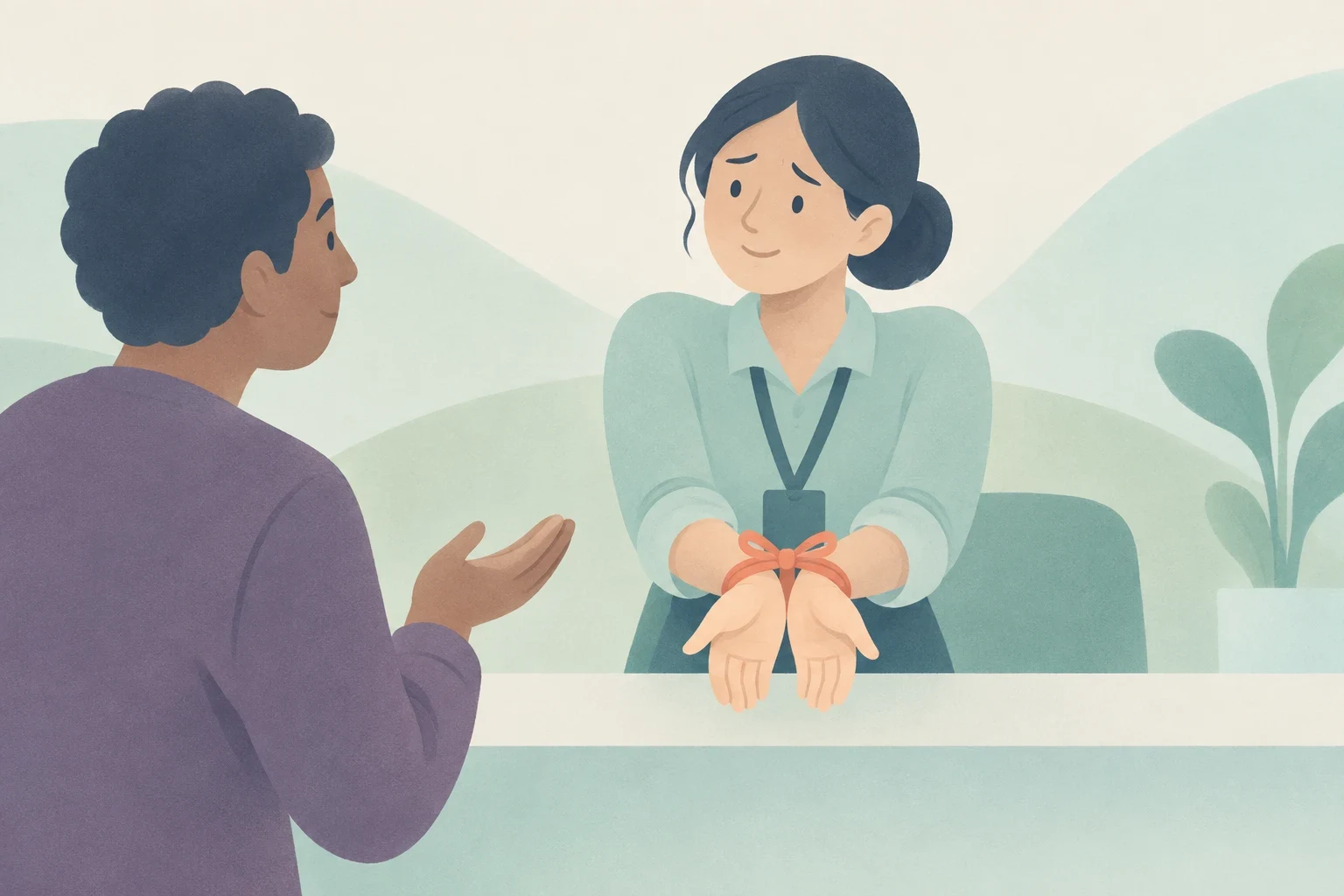
My hands are tied
What is the difference between having your hands full and having your hands tied?
If someone's hands are tied, something outside their control prevents them from acting. A rule, contract, or decision by someone in authority may stop them from helping.
Key points
- Use someone's hands are tied when something outside their control prevents them from acting.
- Keep hands plural, use are or were, and add by to explain what stops them.
- If you can offer another way to help, explain it.
This lesson has 5 stages. You can stop at any time and continue later.

Stage 1 of 5
Understand
What it means, when to use it, and mistakes to avoid.
Watch & learn
My hands are tied
Use someone's hands are tied when rules, policies, authorities, or external circumstances remove that person's freedom to take action.
Line 1 of 7 · Theo
Theo: No! I ... the ... I can't... my hands are... .
Say this line out loud, then continue.
The video could not continue. Try again or use the transcript below.
Your session
Learn with the video 15 min
Watch a short part, answer a question and practice what you heard. Then talk it through with the tutor.
The first part is free. Members continue to part 2 and can ask for more.
Key words in this video
Example
Memory tip
Goes with
Related forms
Not to be confused with
From this video
We couldn't load this word. Try again.
Examples
I want to approve your refund today, but my hands are tied by store regulations.
Why it works: The speaker demonstrates personal empathy while identifying store regulations as the governing constraint.
2 more examples
-
The supervisor explained that her hands were tied until executive leadership signed the budget.
Past tense were tied is paired with the possessive her to show that decision-making authority rested at a higher level.
-
We examined the distribution agreement, and our hands are tied regarding early delivery dates.
The plural phrase our hands are tied emphasizes that written contractual clauses eliminate operational flexibility.
Read the full guide
Deciding when external rules prevent your action
Use someone's hands are tied when something outside their control prevents them from taking the action being discussed. A rule, contract, or another person's decision may be the obstacle. The phrase often explains why someone cannot help even though they want to. If you are free to act and simply choose not to, it would give a misleading reason.
-
I would waive the late registration penalty, but my hands are tied by university guidelines.
Why it works: The speaker wants to help the student, but official university guidelines remove that freedom.
-
The branch staff wanted to replace the damaged router immediately, but their hands were tied until an inspector examined the hardware.
Why it works: The employees had goodwill, yet mandatory inspection procedures blocked immediate replacement.
Your turn
Which situation correctly calls for using 'my hands are tied'?
Answer: A customer service agent wants to offer a discount but company software blocks overrides.
Show the answer
Answer: A customer service agent wants to offer a discount but company software blocks overrides.
The idiom applies when outside systems or policies remove personal authority, not when someone makes a personal preference.
Matching possessive pronouns and plural verbs
Because the noun hands is plural, this idiom always requires a plural verb form such as are in the present tense or were in the past tense. Never pair the noun with singular verbs like is or was. Additionally, you must adjust the possessive adjective so that it accurately reflects the person or group facing the restriction, choosing forms like my, his, her, our, or their depending on who lacks authority.
-
Our hands are tied until the legal department finishes the contract review.
Why it works: The plural possessive our pairs with the plural verb are to describe a team limitation.
-
Marcus explained that his hands were tied during the budget negotiations yesterday.
Why it works: The singular possessive his pairs with the past plural verb were to describe an earlier restriction.
This also comes up in Off the top of my head and Set your heart on.
Your turn
Which sentence uses the correct grammatical agreement for this idiom?
Answer: Her hands were tied by the compliance checklist, so she waited for legal advice.
Show the answer
Answer: Her hands were tied by the compliance checklist, so she waited for legal advice.
The idiom requires the plural noun hands combined with the plural past verb were.
Naming the exact constraint using by
When you state that someone cannot act, listeners naturally want to know what creates the restriction. Adding the preposition by after the idiom allows you to name the specific regulation, contract, law, or authority that blocks the decision. This prepositional phrase shifts attention away from personal stubbornness and directs the listener toward the authentic governing document or institutional requirement.
-
Our hands are tied by federal safety regulations that govern chemical storage.
Why it works: The phrase by federal safety regulations specifies the precise legal constraint.
-
The procurement team stated that their hands were tied by the vendor agreement.
Why it works: Using by clarifies that contractual terms, rather than internal reluctance, prevent changes.
Your turn
How should a speaker connect the idiom to the specific rule creating the restriction?
Answer: Connect the rule using the preposition by, as in tied by company policy.
Show the answer
Answer: Connect the rule using the preposition by, as in tied by company policy.
The passive structure uses the preposition by to introduce the agent or regulation causing the limitation.
Separating true limits from personal refusals
Saying your hands are tied means an outside restriction prevents the action being discussed. It does not mean you have no choices in every part of the situation. If the choice is yours, explain your decision directly instead of blaming a restriction that does not exist.
-
I chose not to approve the travel expense because the conference lacked business relevance.
Why it works: This sentence describes a personal managerial evaluation rather than a binding administrative restriction.
-
I could not approve the travel expense because my hands were tied by the global spending ban.
Why it works: Here, an external executive ban removes all discretionary authority from the manager.
Your turn
Why is it inaccurate for an executive with full authority to say 'my hands are tied'?
Answer: The idiom only applies when someone genuinely lacks the authority or freedom to decide.
Show the answer
Answer: The idiom only applies when someone genuinely lacks the authority or freedom to decide.
Using the phrase when you hold full discretionary power misleads the listener about where real authority sits.
Delivering difficult customer refusals politely
In customer service, this phrase can explain that a rule prevents you from helping. It does not guarantee a calm response: a customer may still feel frustrated. Name the rule so they understand the limit, and offer another option or contact if one is available.
-
I wish I could issue a cash refund today, but my hands are tied by our thirty-day return policy; however, I can provide full store credit.
Why it works: The speaker combines empathy, the idiom, the specific rule, and a constructive alternative.
-
Our support agents explained that their hands were tied regarding account passwords, directing the user to the automated security portal.
Why it works: The agents protect security protocols while offering a legitimate alternate pathway.
Your turn
What makes the idiom effective during professional customer service conversations?
Answer: It shows personal empathy while clarifying that institutional rules govern the boundary.
Show the answer
Answer: It shows personal empathy while clarifying that institutional rules govern the boundary.
The expression separates personal willingness from organizational rules, softening the refusal without breaking policy.
Catching the idiom in natural speech
Tied often carries strong stress in this phrase. The verb are may be short and weak, so hands are can sound closely joined. Listen for all three words, and remember that speakers can change the stress to emphasize different parts of the message.
-
Listen to how the speaker accents tied: 'I would help, but my hands are TIED.'
Why it works: The stress falls heavily on tied, signaling the definitive boundary in the conversation.
-
In fast speech, 'hands are' contracts into a smooth sequence before the prominent verb 'tied'.
Why it works: Understanding the reduction of unstressed syllables prevents mishearing the noun phrase.
Your turn
Which word in the phrase 'our hands are tied' typically carries the strongest vocal stress?
Answer: The participle 'tied'.
Show the answer
Answer: The participle 'tied'.
As the semantic core expressing restriction, 'tied' receives the primary sentence stress and pitch peak.
Evaluating whether a claimed constraint is genuine
Because this idiom provides a convenient way to decline requests without accepting personal blame, speakers occasionally use it as a polite screen for simple unwillingness. Critical listeners look for concrete evidence of the claimed rule. When an outcome is significant, polite follow-up questions such as which guideline applies or who holds authorization can determine whether the boundary is authentic or merely an excuse.
-
The representative claimed his hands were tied, but a review of the service charter showed managers could approve exceptions.
Why it works: Investigating the actual guidelines revealed that the representative used the idiom as a conversational shield.
-
When the supplier said her hands were tied, our project manager asked to see the regulatory mandate.
Why it works: Asking for the specific regulation tests whether the limitation is real or negotiable.
Your turn
What should a professional do when an important decision is blocked by someone saying their hands are tied?
Answer: Politely ask which specific policy applies and whether an exception process exists.
Show the answer
Answer: Politely ask which specific policy applies and whether an exception process exists.
Inquiring about specific guidelines clarifies whether the restriction is rigid or subject to higher review.
Offering next steps after stating limits
After explaining the restriction, offer a useful next step if one is available. You might refer the person to a supervisor who can make the decision, show them where to find help, or suggest a later date. An alternative can make the refusal more helpful, but it is not part of the idiom's meaning.
-
My hands are tied regarding retroactive discounts, but I can apply a ten percent credit to your next quarterly invoice.
Why it works: The speaker offers a permitted forward-looking concession instead of an unhelpful dead end.
-
Our hands are tied until the system update completes, so let me take your phone number and call you the moment access opens.
Why it works: Proposing a concrete follow-up action shows dedication to customer support.
Your turn
What is the best communication practice after telling a client that your hands are tied?
Answer: Provide a constructive alternative or refer the client to an authorized channel.
Show the answer
Answer: Provide a constructive alternative or refer the client to an authorized channel.
Offering alternatives or clear next steps maintains professional goodwill and helps solve the underlying problem.
Use it naturally
How people really use “My hands are tied”
Neutral Fine almost anywhere, at work or with friends.
Words it often goes with
- hands are tied by policyOur hands are tied by policy, so we cannot extend the deadline ourselves.
- hands are tied untilMy hands are tied until the owner gives written permission.
- hands are tied regardingOur hands are tied regarding changes to the delivery date.
What people also say
- “My hands are tied by company policy.” instead of “Company policy removes my freedom to take action.” This sounds more conversational when explaining an external limit.
Questions about "My hands are tied"
What is the difference between having your hands full and having your hands tied?
Having your hands full means you are extremely busy with multiple tasks or heavy responsibilities. In contrast, having your hands tied means external rules, laws, or authorities prevent you from taking action, regardless of your schedule or workload.
I cannot attend the committee meeting because my hands are full with client audits.
I want to approve your budget request, but my hands are tied by company spending restrictions.
Can I say my hand is tied if only one obstacle exists?
No, the idiom is fixed in the plural form. You must always say hands are tied or hands were tied. Changing hands to the singular hand sounds unnatural and breaks the idiomatic meaning.
The clerk said her hands were tied by the registration deadline.
Can you use tie someone's hands as an active verb phrase?
Yes, an external policy, law, or authority can tie someone's hands. When used actively, the subject represents the rule or person that restricts another individual's ability to act freely.
The new municipal regulation ties our hands during emergency zoning disputes.
Is saying my hands are tied considered polite in formal business correspondence?
The idiom is standard in professional spoken English and semi-formal emails. However, in formal legal or executive letters, writers often prefer precise phrases such as company policy prevents us from or regulatory compliance restricts our ability to act.
Regulatory compliance prevents our office from approving retroactive adjustments.
Before you go
Remember this
Use someone's hands are tied when something outside their control prevents them from acting. Keep hands plural, use are or were, and add by to explain what stops them. If you can offer another way to help, explain it.
Stage 2 of 5
Listen
Hear it in real sentences, from short to long, and write what you hear.
Continue with the four activities from the video: listening, reading, speaking and writing. Back to the video
0 of 4 done
Listening 1 of 4
Listen, then type what you hear. Replay as often as you need.
0:00
- The supervisor explained that her hands were tied until executive leadership signed the budget.
- We examined the distribution agreement, and our hands are tied regarding early delivery dates.
Listening 2 of 4
Listen, then type what you hear. Replay as often as you need.
0:00
- The supervisor explained that her hands were tied until executive leadership signed the budget.
- We examined the distribution agreement, and our hands are tied regarding early delivery dates.
Try a longer clip. Listen once, then replay the part you missed.
Listening 3 of 4
Listen, then type what you hear. Replay as often as you need.
0:00
- The supervisor explained that her hands were tied until executive leadership signed the budget.
- We examined the distribution agreement, and our hands are tied regarding early delivery dates.
This clip is longer. Follow the instruction above the answer field.
Listening 4 of 4
Listen, then type the missing words. The rest of the text is already there.
0:00
- The supervisor explained that her hands were tied until executive leadership signed the budget.
- We examined the distribution agreement, and our hands are tied regarding early delivery dates.
Practice complete
You listened closely.
Your result is saved in this browser.
Keep your progress. Your practice is saved on this device only. Create a free account to keep it everywhere.
Create a free accountThat was today's free lesson. Tomorrow you get another one. Want more today? See membership.
Create a free SubLearn account to keep this progress across devices.
Save my progressStage 3 of 5
Speak
Say it with the speaker, then use it in your own answer.
Shadow
Say it along with the speaker
Play the line slowly, then speak at the same time as the speaker. Copy the rhythm, not just the words.
Your turn
Say it your way
You run a museum exhibition. A local teacher asks to let students handle an ancient object, but the owner's loan conditions forbid it. Speak for 30 to 60 seconds from memory. Explain the restriction and suggest a useful alternative.
Use: my hands are tied
Take ten seconds to think, then answer out loud without looking at the lesson. Speak for the time shown in the task above. Nothing is sent unless you ask for feedback.
0:00
Hear how someone else might say it
I understand why you want the students to handle the object. Seeing something behind glass doesn't offer the same experience. Unfortunately, my hands are tied by the owner's loan conditions, which explicitly prohibit anyone outside the conservation team from touching it. Even with gloves and close supervision, I can't authorize an exception. What I can offer is a session with a replica that students can examine closely. I'll also ask our conservator to explain how the original was made, so they can connect what they feel with what they see in the exhibition.
Try once more and answer this: Could the owner make an exception for a small group?
Stage 4 of 5
Write
Write your own response
AI feedback · it can make mistakes · Part of membership See membership
Check your own writing
Read one possible response
Draft saved on this device.
Use these checks to revise your message. Grammar and meaning are not automatically graded. Each task keeps its own draft in this browser tab.

You finished the free part of this lesson
- Understand
- Listen
- Speak
- Write
- CheckPart of membership
Worth another look
With a free account, the lessons you finish come back for review to help you remember them.Create a free account
Stage 5 of 5 · Part of membership
Check
New clips without hints.
Listening tests are included with membership. Try the free dictation first, then decide whether to continue.
Listening 1 of 2 Part of membership
Listening 2 of 2 Part of membership
Follow MicroEnglish
Find lesson updates, short videos and quick quizzes. Pick the app you already use.
Questions & comments
Ask about this lesson, share an example, or help another learner.
Example
Memory tip
Goes with
Related forms
Not to be confused with
In this lesson
This word isn't in our dictionary. Check the spelling, or try another form of the word.
We couldn't load this word. Try again.
