Idiom
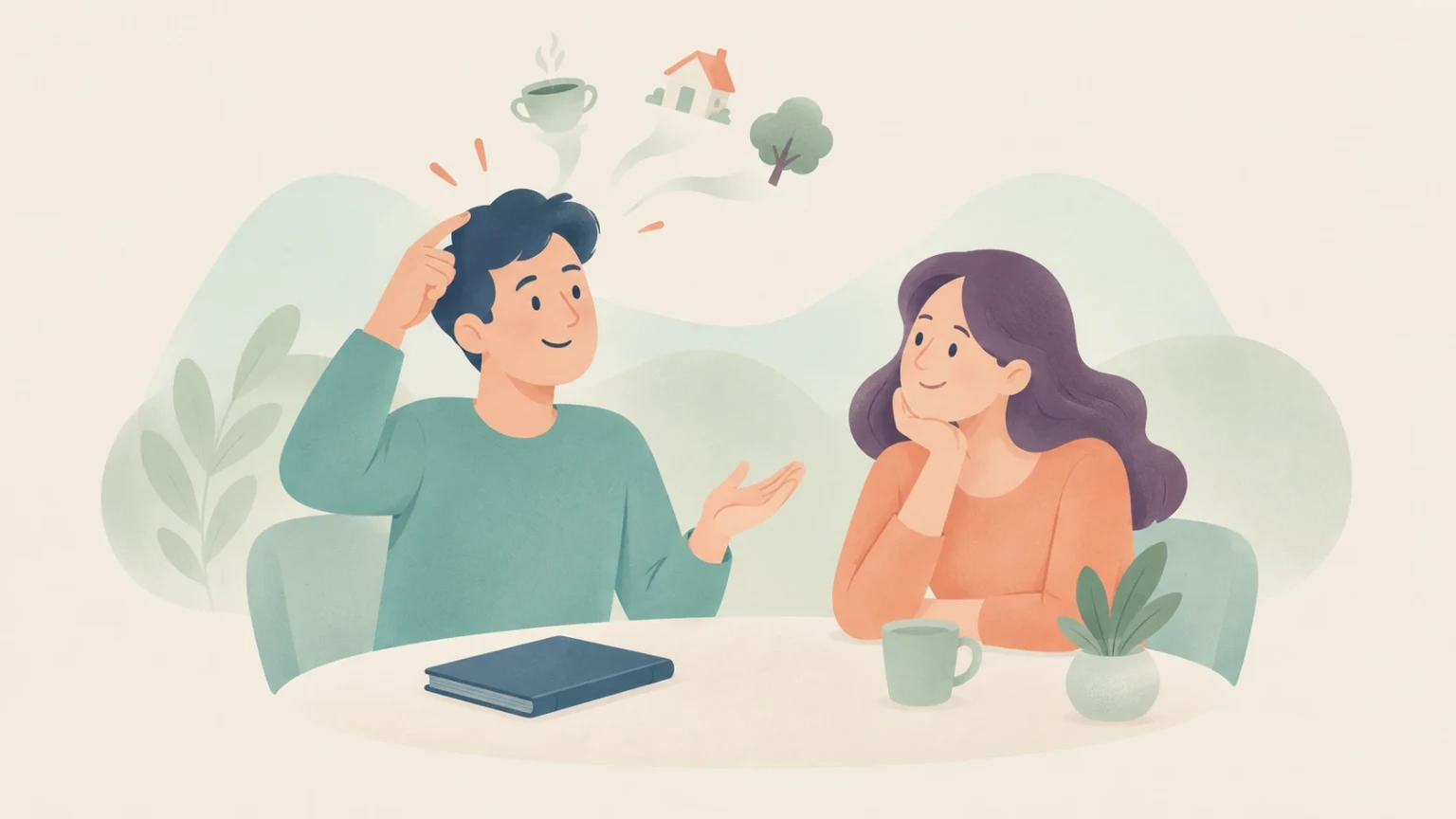
Off the top of my head
Does 'off the top of my head' mean I am guessing?
The phrase 'off the top of my head' describes an answer produced immediately from memory without looking at notes, checking a phone, or spending time to calculate.
Key points
- Use 'off the top of my head' for fast, unchecked answers from memory.
- Keep the word order fixed, change the possessive to fit the person remembering, and verify important facts later.
- Place the phrase naturally before an answer with an introductory comma, or after a verb phrase at the end of a sentence.
This lesson has 5 stages. You can stop at any time and continue later.

Stage 1 of 5
Understand
What it means, when to use it, and mistakes to avoid.
Examples
Off the top of my head, the café near the park has outdoor tables.
Why it works: The speaker remembers a café with outdoor tables but has not checked the information before answering.
2 more examples
-
Can you remember the door code off the top of your head?
The question asks whether the listener can recall the code right away without searching through notes.
-
I cannot tell you the exact train schedule off the top of my head.
The speaker explains that the train times are not immediately accessible in memory right now.
Read the full guide
Qualify an answer you have not checked
Use 'off the top of my head' when you answer with what you remember right away, without checking notes or looking anything up. The phrase explains how you reached the answer. Your information may be correct, approximate, or incomplete; you have simply not checked it before speaking.
-
Off the top of my head, our team has completed four projects this quarter.
Why it works: The speaker recalls the number immediately from memory without opening the project tracker.
-
I think the library closes at eight, but that is just off the top of my head.
Why it works: The speaker clarifies that the closing time comes from memory and needs confirmation.
Your turn
What does saying 'off the top of my head' tell your listener about your answer?
Answer: You are speaking immediately from memory without verifying the information.
Show the answer
Answer: You are speaking immediately from memory without verifying the information.
The idiom clarifies that the answer comes directly from immediate memory and has not been verified against records.
Suggest a place when a friend asks where to eat
A friend asks where you could eat outdoors. You remember a café, but you haven't checked its opening hours or whether tables are available. This phrase lets you suggest it while making clear that you're relying on memory. Your friend can then check the details before you go.
-
Friend A: 'Do you know anywhere with outdoor tables?' Friend B: 'Off the top of my head, the café near the park has some.' Friend A: 'Great. I'll check when it opens.'
Why it works: Friend B shares a remembered suggestion immediately, and Friend A agrees to verify the opening time.
-
Off the top of my head, that noodle bar around the corner has vegetarian soup.
Why it works: The recommendation comes from personal recollection rather than a current menu check.
This also comes up in My hands are tied and A mean streak.
Your turn
Why is this phrase useful when a friend asks for a restaurant recommendation on the street?
Answer: It offers a helpful suggestion from memory while indicating that details may need confirmation.
Show the answer
Answer: It offers a helpful suggestion from memory while indicating that details may need confirmation.
The expression provides an immediate idea while making it clear that you have not verified current hours or seating.
Keep the core pattern fixed and match the person
The core structure of this idiom is fixed: off + the + top + of + possessive + head. You cannot replace 'off' with 'from', and you cannot remove the words 'the' or 'of'. However, you must adjust the possessive word to match whoever holds the memory. When speaking about your own recollection, say 'my head'. When asking about the listener's memory, use 'your head'. For another person, choose 'his head', 'her head', or 'their head'.
-
Can you name three Italian restaurants off the top of your head?
Why it works: The question asks for retrieval from the listener's memory, so the possessive word is 'your'.
-
Off the top of her head, Clara estimated that the project would take six weeks to finish.
Why it works: The possessive word 'her' matches Clara because the project duration estimate came from her recollection.
Your turn
Which sentence matches the possessive word to the person whose memory provides the information?
Answer: Can you remember the door code off the top of your head?
Show the answer
Answer: Can you remember the door code off the top of your head?
The question addresses the listener's memory, requiring 'your head' alongside the fixed preposition 'off'.
Ask for quick recall or explain that you cannot remember
You will often hear this phrase in questions and negative statements. Asking 'Do you know ... off the top of your head?' tests whether someone can provide information without delay. If you do not recall the detail, replying 'I cannot remember off the top of my head' is polite and helpful. This negative phrasing does not mean the fact is permanently forgotten. It simply clarifies that the data is not accessible right at this second, though you might find it after checking your notes.
-
Do you know what time the courier arrives off the top of your head?
Why it works: This question politely asks whether the listener remembers the arrival time without searching for the tracking email.
-
I cannot tell you the invoice number off the top of my head.
Why it works: The speaker explains that the invoice number is not immediately accessible in memory.
Your turn
What does the statement 'I cannot remember off the top of my head' communicate?
Answer: The information is not immediately available in memory right now, but it could be looked up.
Show the answer
Answer: The information is not immediately available in memory right now, but it could be looked up.
The negative expression shows immediate recall is unavailable without ruling out checking notes later.
Choose casual spoken phrasing or direct professional writing
This expression belongs to conversational English. It is widely used in daily chats, team meetings, and informal workplace discussions among coworkers. However, you should avoid using it in formal business reports, academic papers, and official contracts. In formal writing, clear and direct phrases such as 'from memory' or 'subject to verification' are preferred. Using conversational idioms in serious documentation can make your work appear casual or imprecise.
-
Off the top of my head, the morning train usually leaves at quarter past seven.
Why it works: This conversational tone is natural and effective when helping a colleague during a casual chat.
-
According to initial estimates from memory, the repairs will take three days, subject to formal review.
Why it works: In a formal written report, direct phrasing replaces the conversational idiom.
Your turn
In which situation is 'off the top of my head' most appropriate?
Answer: A casual spoken conversation with a colleague during a coffee break.
Show the answer
Answer: A casual spoken conversation with a colleague during a coffee break.
The idiom is standard in spoken informal and semi-formal workplace dialogue, not formal documents.
Separate unchecked recall from rough estimation
Learners frequently make two errors with this expression: saying 'from the top of my head' or confusing it with an approximate guess. Standard English always uses 'off', never 'from'. Furthermore, do not confuse this phrase with a ballpark guess. A ballpark guess specifically provides an approximate numerical estimate, such as twenty to thirty participants. In contrast, 'off the top of my head' highlights unverified retrieval from memory and can introduce names, dates, places, suggestions, or factual statements.
-
A ballpark guess for the repair cost is five hundred dollars.
Why it works: A ballpark guess gives an approximate amount. Here, five hundred dollars is an estimate, not an exact confirmed cost.
-
Off the top of my head, Sarah and David are leading the workshop.
Why it works: The idiom introduces specific names recalled from memory, which cannot be called a ballpark guess.
Your turn
How does 'off the top of my head' differ from 'a ballpark guess'?
Answer: A ballpark guess focuses on approximate numbers, while the idiom highlights immediate recall without checking.
Show the answer
Answer: A ballpark guess focuses on approximate numbers, while the idiom highlights immediate recall without checking.
Ballpark guesses describe estimated quantities, whereas 'off the top of my head' explains that an answer comes immediately from memory.
Notice reduced connecting words in spoken sentences
When native speakers pronounce this phrase at normal speed, they emphasize the content nouns 'top' and 'head'. In contrast, the words 'the' and 'of' are spoken with very low energy and reduced vowels. The consonant in 'of' often becomes an extremely light sound or blends smoothly into the following possessive word. Do not expect every small word to sound distinct. Listening for the stressed beats on 'top' and 'head' will allow you to recognize the full expression easily.
-
Off the top of my head, I think we have two extra chairs.
Why it works: In fast speech, 'the' and 'of' weaken, leaving 'top' and 'head' as the prominent auditory landmarks.
-
She gave the answer off the top of her head without checking her notebook.
Why it works: The phrase links smoothly to the final words without pauses between 'of' and 'her'.
Your turn
Which words carry the primary stress and clearest pronunciation in 'off the top of my head'?
Answer: The content words 'top' and 'head'.
Show the answer
Answer: The content words 'top' and 'head'.
Content nouns carry sentence stress in natural speech, while grammatical words like 'the' and 'of' are reduced.
Reconstruct the phrase and respond from memory
To use this idiom naturally, practice assembling the sequence without hesitating over the small prepositions. Remember that you can place the phrase at the beginning of a statement followed by a comma, or at the end of a clause. After giving your immediate answer from memory, follow up by offering to verify the information. This combination lets you be helpful right away while demonstrating that you value accuracy in your daily communication.
-
Off the top of my head, the clinic is in suite 402, but I will check the confirmation email to be certain.
Why it works: The speaker supplies an immediate answer about the office location and immediately follows up with an offer to check.
-
I can name three good coffee shops off the top of my head if you want to grab an espresso.
Why it works: The idiom sits at the end of the main clause to indicate spontaneous recall.
Your turn
Which follow-up action best complements an immediate answer given off the top of your head?
Answer: Offering to verify the details in an official record or app to ensure accuracy.
Show the answer
Answer: Offering to verify the details in an official record or app to ensure accuracy.
Following up an unverified answer with a quick check ensures practical accuracy and builds credibility.
Use it naturally
How people really use “off the top of my head”
Informal Relaxed; better with friends and colleagues than in formal writing.
Words it often goes with
- remember off the top of my headThat's all I can remember off the top of my head.
- tell you off the top of my headI can't tell you off the top of my head how much the tickets cost.
- name off the top of your headHow many Canadian cities can you name off the top of your head?
What people also say
- “Off the top of my head, we have ten left.” instead of “According to my immediate recollection, we have ten left.” Use this when giving a quick answer from memory in conversation.
Questions about "Off the top of my head"
Does 'off the top of my head' mean I am guessing?
No, it does not mean pure guessing. It means you are retrieving information immediately from memory without looking at notes or records. Your memory may be accurate, approximate, or slightly incomplete, but you are not inventing an answer from nothing.
Off the top of my head, his flight arrives at four, but I will check the ticket.
Can I say 'from the top of my head'?
No, standard English requires the preposition 'off'. Saying 'from the top of my head' is a frequent learner mistake and sounds unnatural to native speakers. Always keep the starting word as 'off'.
Off the top of my head, we ordered twelve boxes yesterday.
When do I change 'my head' to 'your head'?
Change the possessive word to match the person whose memory provides the information. If you ask another person to answer from their memory, use 'your head'. If you speak about yourself, use 'my head'.
Can you name the new manager off the top of your head?
Can I say 'I don't know off the top of my head'?
Yes, this is very common. It politely explains that you do not have the information in your immediate memory right now, while leaving open the possibility that you can find it after checking.
I do not know the code off the top of my head, but I have it written at my desk.
Can the phrase go at the end of a sentence?
Yes, the phrase can appear naturally either at the beginning of a sentence followed by a comma, or at the end of a sentence directly after a verb phrase without a comma.
I cannot recall the street name off the top of my head.
Is it acceptable to use this phrase at work?
Yes. It fits ordinary workplace conversations, team meetings, and informal chats. In a formal report or legal document, 'from memory' or a direct statement that the information needs checking is usually clearer. A presentation may also include conversational language, depending on the audience and setting.
Off the top of my head, we have three clients scheduled for Monday.
Before you go
Remember this
Use 'off the top of my head' for fast, unchecked answers from memory. Keep the word order fixed, change the possessive to fit the person remembering, and verify important facts later.
Stage 2 of 5
Listen
Hear it in real sentences, from short to long, and write what you hear.
0 of 4 done
Listening 1 of 4
Listen, then type what you hear. Replay as often as you need.
0:00
- Can you remember the door code off the top of your head?
- I cannot tell you the exact train schedule off the top of my head.
Listening 2 of 4
Listen, then type what you hear. Replay as often as you need.
0:00
- Can you remember the door code off the top of your head?
- I cannot tell you the exact train schedule off the top of my head.
Try a longer clip. Listen once, then replay the part you missed.
Listening 3 of 4
Listen, then type what you hear. Replay as often as you need.
0:00
- Can you remember the door code off the top of your head?
- I cannot tell you the exact train schedule off the top of my head.
This clip is longer. Follow the instruction above the answer field.
Listening 4 of 4
Listen, then type the missing words. The rest of the text is already there.
0:00
- Can you remember the door code off the top of your head?
- I cannot tell you the exact train schedule off the top of my head.
Practice complete
You listened closely.
Your result is saved in this browser.
Keep your progress. Your practice is saved on this device only. Create a free account to keep it everywhere.
Create a free accountThat was today's free lesson. Tomorrow you get another one. Want more today? See membership.
Create a free SubLearn account to keep this progress across devices.
Save my progressStage 3 of 5
Speak
Say it with the speaker, then use it in your own answer.
Shadow
Say it along with the speaker
Play the line slowly, then speak at the same time as the speaker. Copy the rhythm, not just the words.
Your turn
Say it your way
Speak for 30 to 60 seconds from memory. Your sister is preparing for her first camping trip and asks what equipment she could borrow from you. Suggest a few items, explain what you remember about their condition, and mention one detail you need to check.
Use: off the top of my head
Take ten seconds to think, then answer out loud without looking at the lesson. Speak for the time shown in the task above. Nothing is sent unless you ask for feedback.
0:00
Hear how someone else might say it
Well, off the top of my head, I could lend you a tent, two sleeping bags, and a small camping stove. The tent held up well in heavy rain last summer, although one of the poles was starting to bend. I'd want to inspect that before handing it over. The sleeping bags should be fine for mild weather, but I wouldn't rely on them if the temperature drops sharply overnight. I also have a spare flashlight somewhere. The only thing I need to check is whether the stove still has any fuel.
Try once more and answer this: Which item would you recommend buying instead of borrowing?
Stage 4 of 5
Write
Write your own response
AI feedback · it can make mistakes · Part of membership See membership
Check your own writing
Read one possible response
Draft saved on this device.
Use these checks to revise your message. Grammar and meaning are not automatically graded. Each task keeps its own draft in this browser tab.

You finished the free part of this lesson
- Understand
- Listen
- Speak
- Write
- CheckPart of membership
Worth another look
With a free account, the lessons you finish come back for review to help you remember them.Create a free account
Stage 5 of 5 · Part of membership
Check
New clips without hints.
Listening tests are included with membership. Try the free dictation first, then decide whether to continue.
Listening 1 of 2 Part of membership
Listening 2 of 2 Part of membership
Follow MicroEnglish
Find lesson updates, short videos and quick quizzes. Pick the app you already use.
Questions & comments
Ask about this lesson, share an example, or help another learner.
Example
Memory tip
Goes with
Related forms
Not to be confused with
In this lesson
This word isn't in our dictionary. Check the spelling, or try another form of the word.
We couldn't load this word. Try again.
