找下一节课
搜索一个短语,或描述想表达什么,从当前可用课程中选择。
显示第163–180节,共592节课
-

Adjective Order: Build Clear Natural Descriptions
An adjective gives specific qualities to a noun, such as size, age, shape, color, origin, or material. When you say a comfortable wooden chair, the words comfortable and wooden clarify what kind of chair you mean. Adjectives also complete sentences after linking verbs, as in the chair feels comfortable, where the word links back to describe the subject.
-

Resume experience lines: write clear bullet points
A resume experience line is an incomplete sentence that acts as a concise work record. It leaves out the subject pronoun because your name already appears at the top of the page. The initial verb tells the reader what action you took, while the following words give the context.
-

Emphasizing adjectives: four common choices
Emphasizing adjectives direct attention to a specific feature of a noun phrase. Own highlights that something belongs to a person or that they are personally involved. Very identifies a specific, exact person, thing, place, or time. Only restricts the situation by showing that no other choices exist or by limiting an exact count. Mere frames an amount, object, or obstacle as minor or surprisingly small. Rather than making a description generally stronger, each word performs a distinct semantic job.
-
English pronunciation: clear daily practice
English pronunciation is the deliberate production of vowel and consonant sounds, rhythm, syllable stress, and phrase boundaries to convey clear meaning in speech. It guides how a listener separates individual words and identifies the central focus of your message.
-

Stative Verbs: Choosing the Correct Form
A stative use describes a condition, relationship, perception, or attitude rather than an activity presented as unfolding. Such uses usually take simple forms. Some verbs also have dynamic meanings, and some allow continuous forms to emphasize a temporary experience.
-
English grammar: choose your lesson
English grammar describes predictable patterns words follow to express time, relationships, questions, and descriptions. Choosing a topic begins by identifying what you want to communicate.
-
会员
全部课程免费学7天
- 592节课程,包含听写和听力测试
- 三种口音:英式、美式和澳式
- 每天有新课,并保存学习进度
无需绑卡。之后如想继续使用,每月$7.50起。
开始免费试用 -

Jerk Meaning: Movement and Slang
As a movement word, jerk refers to a short, sharp motion or the physical action of pulling, pushing, or twitching abruptly. It can describe mechanical actions, sudden vehicle starts, or involuntary muscle reflexes. In informal social contexts, jerk functions as a pejorative noun describing an unpleasant, self-centered, or discourteous person. While common in casual American speech, using the word as an insult reduces complex interpersonal problems to name-calling and tends to inflame disagreements.
-

Trauma meaning: physical injury and shock
In a medical context, trauma can mean injury to the body. Emotional trauma refers to harm connected with distressing experiences. A sentence may name the experience, its effects, or both. Check the context rather than assuming that every use describes the same injury or reaction.
-

Free TOEFL preparation: A daily study plan
Use each practice attempt to decide what to work on next. Try a specific task, check what caused difficulty, and choose a follow-up exercise. Your study log should show the problem you found and how you plan to practice it.
-

Practice English speaking: Five daily exercises
A speaking activity is an intentional spoken drill with an explicit goal and time limit. Instead of attempting an open-ended conversation with no clear direction, you assign yourself a narrow communicative job. That job might involve explaining why an order arrived late, requesting a meeting change, or contrasting two commuter routes. The defined boundary frees mental energy so you can concentrate on correct verbs, connectors, and audible pronunciation.
-

Has or have: choose the right verb
Have indicates possession, relationships, routines, and physical characteristics. Has is the third-person singular form of have, used with he, she, it, and singular nouns. In compound tenses, both words function as auxiliary verbs before a past participle.
-

Regular and irregular verbs: How past forms change
Regular past verbs use the suffix -ed or -d to express completed actions in past time. Irregular past verbs express past time through specific vowel or consonant changes, or by keeping an identical base form, rather than taking the regular suffix.
-

Non-Finite Verbs: Forms and Everyday Uses
A finite verb anchors a clause: it may show tense or be a modal such as can. Non-finite forms do not show tense on their own or change to agree with a subject. An infinitive uses the base form, with or without to. A gerund uses -ing to name an activity. Present participles end in -ing; past participles may end in -ed or have irregular forms such as broken and written. Participles can describe nouns or combine with helping verbs.
-

English Infinitives: When to Use To
An infinitive names an action without being tied to a specific time or person. The main verb in the sentence carries the tense, while the infinitive completes the thought. In 'She wants to travel,' the verb 'wants' shows the present tense, and 'to travel' identifies what she wants.
-

disposition meaning: character and tendency
Disposition refers primarily to a person's or animal's habitual nature, temperament, or customary state of mind. It also describes a recurring inclination or tendency to act in a particular manner. In specialized legal or administrative contexts, the word describes an orderly arrangement, the transfer of property, or the official settlement of a case.
-
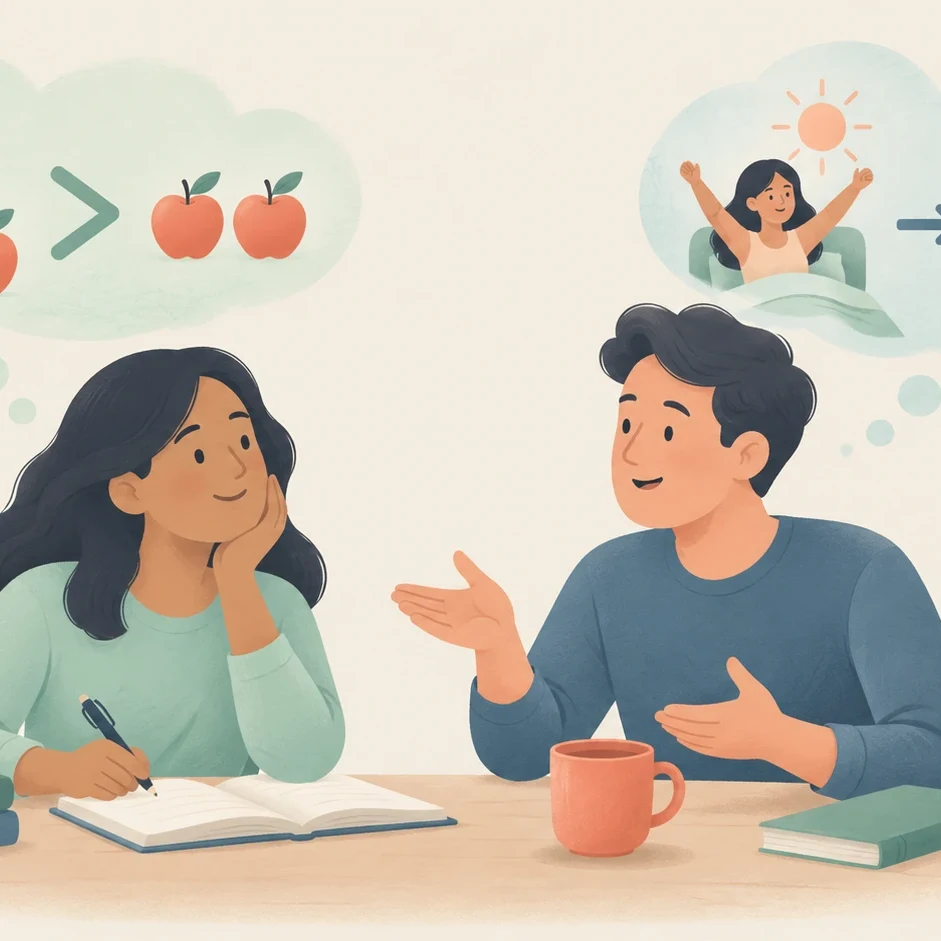
More than or more then: choose the right word
'More than' is a comparative phrase where 'than' introduces the second element, benchmark, or threshold of a comparison. It means an amount greater than a specified number or quality. 'Then' is an adverb of time, order, or condition, meaning 'after that', 'at that time', or 'in that case'. The form 'more then' has no grammatical standing as a comparative phrase.
-

How to use semicolons: guide for clear sentences
A semicolon marks a pause stronger than a comma but softer than a period. It indicates that the following statement directly explains, balances, or completes the statement before it without needing a coordinating conjunction.
-

Past perfect progressive: when to use it
The past perfect progressive highlights the duration or ongoing process of an activity that occurred before a later moment in the past. It shows that the earlier action was in progress up to or close to that second past event, often explaining a visible result or state at that time.
还没想好是否试用?每天收一节免费课
连续7天,每天发一段短听写到邮箱。在哪里都能练,不用注册账户。
找不到想学的表达或场景?
定制课程是会员功能。
查看会员方案