
Kurze Hörübung
Personal pronouns: rules and examples
How do I use personal pronouns correctly?
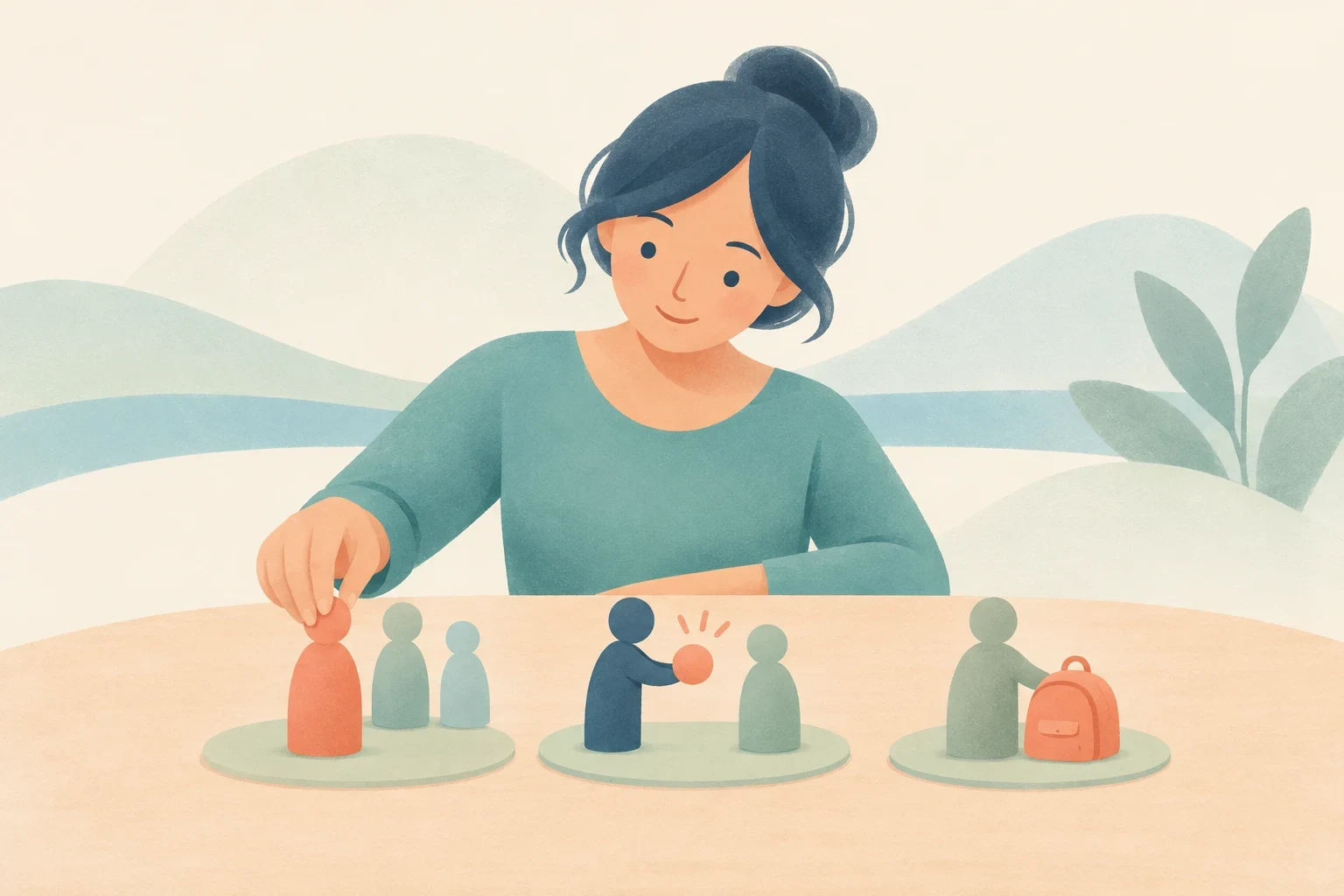
Personal pronouns change form according to their role: use subject pronouns for the person doing an action, object pronouns after verbs and prepositions, and possessive determiners before nouns. For example, 'They sent her their address.' Here, they acts, her receives the action, and their shows who owns the address.
Das solltest du dir merken
- Subject pronouns usually come before the main verb.
- Use object pronouns after verbs and prepositions.
- Put possessive determiners directly before the noun.
- Write possessive its without an apostrophe.
Diese Lektion hat 5 Etappen. Du kannst jederzeit aufhören und später weitermachen.

Auf einen Blick
| Form | Verwendung | Beispiel |
|---|---|---|
| Subject pronouns | Name who or what does the action. | We finished the puzzle. |
| Object pronouns | Name who or what receives an action or follows a preposition. | The guide spoke to us. |
| Possessive determiners | Show ownership before a noun. | He packed his lunch. |
| its / it's | Its shows ownership; it's means it is or it has. | The dog wagged its tail. It's happy. |
Etappe 1 von 5
Verstehen
Was bedeutet der Ausdruck, wann passt er und welche Fehler kannst du vermeiden?
Ausführliche Erklärung
A personal pronoun represents a specific person, group, animal, or object in conversation. First-person forms refer to the speaker or writer, second-person forms address the listener, and third-person forms refer to other individuals or things. The pronoun changes its shape to show grammatical role: subject, object, or possession.
Marcus called me yesterday to discuss the presentation.
Darum passt es: Me is an object pronoun that receives the action called from Marcus.
3 weitere Beispiele
-
We shared our project notes with the marketing team.
We is the subject doing the sharing, while our shows that the notes belong to us.
-
Sofia thanked them for their prompt assistance.
Them is an object pronoun following thanked, and their is a possessive determiner before assistance.
-
Jordan said they would send the revised contract before noon.
They is used as a singular pronoun referring to Jordan without specifying gender.
Ausführliche Erklärung lesen
Choose subject pronouns for the actor
Subject pronouns name the person or thing performing the action in a sentence. They usually sit before the main verb. The primary subject pronouns in English are I, you, he, she, it, we, and they. When you want to state who completes a task or initiates an event, select one of these forms rather than an object pronoun.
-
She manages the customer support department.
Darum passt es: She is the subject pronoun because she performs the action of managing.
-
They arrived early to prepare the training room.
Darum passt es: They is the subject pronoun naming the people doing the arriving.
Du bist dran
Which pronoun correctly completes this sentence: '___ reviewed the budget reports before the meeting'?
Antwort: They
Lösung anzeigen
Antwort: They
They is the subject pronoun needed before the main verb reviewed to name who did the action.
Use object pronouns after action verbs
Object pronouns receive the action of a verb. They typically follow the main verb in a clause. The standard English object pronouns are me, you, him, her, it, us, and them. When an action happens to someone or something, choose an object pronoun instead of a subject pronoun to ensure your sentence remains grammatically clear and natural.
-
The director praised us for delivering the project on time.
Darum passt es: Us is the object pronoun receiving the action of praise from the director.
-
Carlos called him to confirm the reservation time.
Darum passt es: Him is the object pronoun because Carlos performed the action of calling.
In Indefinite Pronouns: Rules and Examples und Reflexive Pronouns: Rules and Examples kannst du das weiterüben.
Du bist dran
Choose the correct pronoun: 'The instructor helped ___ with the software installation.'
Antwort: us
Lösung anzeigen
Antwort: us
Us is the object pronoun needed after the verb helped to show who received the assistance.
Place object pronouns after prepositions
Prepositions show relationships in time, space, and direction. Words like to, for, with, from, about, between, and after require object pronouns when a pronoun follows them. Learners sometimes mistakenly use subject pronouns after prepositions, especially in expressions such as between you and me. Always use me, him, her, us, or them following any preposition.
-
This project summary is strictly between you and me.
Darum passt es: Me follows the preposition between, so an object pronoun is required.
-
Priya ordered lunch for them before the client workshop.
Darum passt es: Them is the object pronoun following the preposition for.
Du bist dran
Which option correctly finishes the phrase: 'Our manager sent the updated schedule to ___'?
Antwort: her
Lösung anzeigen
Antwort: her
Her is the object pronoun required after the preposition to.
Test compound pronoun pairs alone
Combining a name with a pronoun often causes hesitation. To decide between expressions like Sarah and I versus Sarah and me, temporarily remove the other person from the sentence. You would say I wrote the email, so you should write Sarah and I wrote the email. Similarly, you say invited me, which means the client invited Sarah and me.
-
David and I inspected the newly renovated office space.
Darum passt es: I is correct because I inspected the space functions as a complete subject clause.
-
The architect gave David and me a detailed floor plan.
Darum passt es: Me is correct because the architect gave me the plan when tested alone.
Du bist dran
Which phrase correctly completes: 'The company awarded the bonus to ___'?
Antwort: Maya and me
Lösung anzeigen
Antwort: Maya and me
Removing Maya leaves 'awarded the bonus to me', showing that the object pronoun me is needed after to.
Show ownership with possessive determiners
Possessive determiners come directly before nouns to show who owns, uses, or relates to something. The English possessive determiners are my, your, his, her, its, our, and their. Unlike subject or object pronouns, which stand alone in place of a noun, these possessive words always accompany a following noun phrase to indicate clear possession in the sentence.
-
We parked our car behind the community library.
Darum passt es: Our sits before the noun car to show who owns the vehicle.
-
The consultant reviewed their presentation slides before noon.
Darum passt es: Their comes before presentation slides to show ownership by the group.
Du bist dran
Select the word that correctly shows possession: 'The team completed ___ assignment before Friday.'
Antwort: their
Lösung anzeigen
Antwort: their
Their is the possessive determiner needed before the noun assignment to show whose assignment it is.
Distinguish possessive its from it's
One frequent spelling mistake is adding an apostrophe to the possessive word its. The possessive determiner its never takes an apostrophe, just like his, hers, or theirs. When you write it's with an apostrophe, you are creating a contraction for it is or it has. Replace the word with it is in your head to verify whether an apostrophe belongs there.
-
The agency renewed its lease on the third floor.
Darum passt es: Its shows ownership of the lease by the agency and has no apostrophe.
-
It's obvious that the software update improved performance.
Darum passt es: It's is a contraction of it is, confirmed by expanding the words.
Du bist dran
Choose the correct spelling: 'The camera recorded ___ final video clip before the battery died.'
Antwort: its
Lösung anzeigen
Antwort: its
Its without an apostrophe indicates possession before the noun phrase final video clip.
Apply singular they for single individuals
Singular they has a long, established history in English. Use they, them, their, or theirs when referring to a single person whose gender is unknown, unstated, or nonbinary. Notice that while the pronoun refers to one individual, the accompanying verb retains its standard plural agreement. You write they are or they were, never they is or they was.
-
If a caller phones today, tell them I will return the message tomorrow.
Darum passt es: Them refers back to the single caller without assuming the person's gender.
-
Alex submitted their application form ahead of the deadline.
Darum passt es: Their serves as a possessive determiner for one individual.
Du bist dran
Which verb correctly completes: 'Somebody left an umbrella, and they ___ waiting at the reception desk'?
Antwort: are
Lösung anzeigen
Antwort: are
Even when referring to one person, they takes the plural verb form are.
Prevent confusion by repeating names when needed
Pronouns should always point to one unmistakable noun. When a sentence contains two people of the same gender or two separate objects, using a pronoun like he, she, or it can create ambiguity. In such cases, repeating the specific name or noun makes your meaning instantly clear. Do not sacrifice clarity merely to avoid writing a person's name twice.
-
Rachel emailed Clara because Clara had the final document password.
Darum passt es: Repeating Clara clarifies who held the password, whereas she would be ambiguous.
-
The technician placed the monitor on the desk and repaired the monitor.
Darum passt es: Naming the monitor again clarifies which item was repaired rather than the desk.
Du bist dran
Why is 'Mark spoke with Tom because Mark needed the key' clearer than using 'he' twice?
Antwort: Because 'he' could refer to either Mark or Tom.
Lösung anzeigen
Antwort: Because 'he' could refer to either Mark or Tom.
Repeating the name removes ambiguity so the reader knows exactly who needed the key.
Häufige Fehler
Vergleiche typische Fehler mit der passenden Form und lies die Begründung.
-
So nicht:
Her sent the parcel.Sag: She sent the parcel.
She is the subject pronoun needed for the person doing the action.
-
So nicht:
The coach spoke to we.Sag: The coach spoke to us.
Use the object pronoun us after the preposition to.
-
So nicht:
They forgot them tickets.Sag: They forgot their tickets.
Their is the possessive determiner needed before the noun tickets.
-
So nicht:
The bird cleaned it's feathers.Sag: The bird cleaned its feathers.
Its shows ownership; it's means it is or it has.
Fragen zu „Personal pronouns: rules and examples“
How do I know whether to use a subject pronoun or an object pronoun?
Look at the verb in the clause. If the pronoun does the action, use a subject pronoun such as I, she, or they before the verb. If the pronoun receives the action or follows a preposition like for, with, or to, use an object pronoun like me, her, or them.
She called the client before lunch.
The client called her after lunch.
Should I say 'my friend and I' or 'my friend and me'?
Test the sentence by removing the other person. If you would say 'I visited the gallery,' then write 'My friend and I visited the gallery.' If you would say 'The guide welcomed me,' then write 'The guide welcomed my friend and me.' The role does not change when another person joins you.
My friend and I completed the survey.
The manager thanked my friend and me.
Can 'they' refer to one person, and what verb form should follow it?
Yes. English uses singular they when you do not know a person's gender, when the gender is not relevant, or when someone prefers they as their personal pronoun. Even when referring to one person, always use plural verb forms like they are, they have, and they do.
Every customer should check their receipt.
A caller left a message, and they are waiting for a reply.
What is the difference between 'its' and 'it's'?
The word 'its' without an apostrophe is a possessive determiner that shows ownership for things or animals. The form 'it's' with an apostrophe is always a contraction of 'it is' or 'it has.' A helpful test is to expand the words. If 'it is' fits the sentence, use the apostrophe.
The company updated its privacy policy.
It's a great opportunity for our team.
Zum Abschluss
Das solltest du dir merken
Select subject pronouns for the actor before the verb, and object pronouns after verbs and prepositions. Place possessive determiners directly before nouns to show ownership, keeping its free of apostrophes. When you describe pairs or multiple people, test each pronoun alone and repeat a name whenever reference becomes unclear.
Etappe 2 von 5
Hören
Höre kurze und längere Sätze und schreibe auf, was du hörst.
0 von 4 abgeschlossen
Hörübung 1 von 4
Hör zu und schreibe die gehörten Wörter auf. Du kannst die Aufnahme beliebig oft anhören.
0:00
Hörübung 2 von 4
Hör zu und schreibe die gehörten Wörter auf. Du kannst die Aufnahme beliebig oft anhören.
0:00
Probiere eine längere Aufnahme. Hör sie einmal an und wiederhole dann die Stelle, die du nicht verstanden hast.
Hörübung 3 von 4
Hör zu und schreibe die gehörten Wörter auf. Du kannst die Aufnahme beliebig oft anhören.
0:00
Diese Aufnahme ist länger. Beachte die Anweisung über dem Antwortfeld.
Hörübung 4 von 4
Hör zu und ergänze die fehlenden Wörter. Der übrige Text steht schon da.
0:00
Übung abgeschlossen
Du hast genau hingehört.
Dein Ergebnis ist in diesem Browser gespeichert.
Deinen Fortschritt behalten. Dein Fortschritt ist nur auf diesem Gerät gespeichert. Mit einem kostenlosen Konto hast du ihn auch auf anderen Geräten dabei.
Kostenloses Konto erstellenDas war deine kostenlose Tageslektion. Morgen kannst du eine weitere wählen. Heute noch weiterüben? Mitgliedschaft ansehen.
Mit einem kostenlosen SubLearn-Konto bleibt dieser Fortschritt auch auf anderen Geräten erhalten.
Fortschritt speichernEtappe 3 von 5
Sprechen
Sprich gleichzeitig mit der Aufnahme mit. Verwende den Ausdruck danach in einer eigenen Antwort.
Mitsprechen
Sprich gleichzeitig mit
Spiele den Satz langsam ab und sprich gleichzeitig mit. Übernimm auch den Rhythmus, nicht nur die Wörter.
Jetzt bist du dran
Sag es mit deinen Worten
Describe a situation at work or school where you and a partner organized an event. Mention who helped you, what tasks they completed, and which items belonged to them.
So könntest du anfangen “Last month, my coworker and I organized…”
Überlege zehn Sekunden. Antworte dann laut, ohne auf die Lektion zu schauen. Halte dich an die Dauer in der Aufgabe oben. Deine Aufnahme wird erst gesendet, wenn du eine Rückmeldung anforderst.
0:00
Etappe 4 von 5
Schreiben
Eine eigene Antwort schreiben
KI-Rückmeldung · kann Fehler enthalten · Mit Mitgliedschaft verfügbar Mitgliedschaft ansehen
Deinen Text selbst prüfen
Eine mögliche Antwort lesen
Entwurf auf diesem Gerät gespeichert.
Nutze die Prüfpunkte, um deine Nachricht zu überarbeiten. Grammatik und Inhalt werden nicht automatisch bewertet. Jede Aufgabe behält ihren eigenen Entwurf in diesem Browser-Tab.

Du hast den kostenlosen Teil dieser Lektion abgeschlossen
- Verstehen
- Hören
- Sprechen
- Schreiben
- PrüfenTeil der Mitgliedschaft
Das kannst du noch üben
Mit einem kostenlosen Konto werden abgeschlossene Lektionen später zur Wiederholung vorgeschlagen. So kannst du das Gelernte festigen.Kostenloses Konto erstellen
Etappe 5 von 5 · Teil der Mitgliedschaft
Prüfen
Neue Aufnahmen ohne Hinweise.
Hörtests sind Teil der Mitgliedschaft. Probiere zuerst das kostenlose Diktat aus und entscheide danach, ob du weiterüben möchtest.
Hörübung 1 von 2 Mit Mitgliedschaft verfügbar
Hörübung 2 von 2 Mit Mitgliedschaft verfügbar
MicroEnglish folgen
Entdecke Lektionen, kurze Videos und kleine Quizfragen in der App, die du ohnehin nutzt.
Fragen und Kommentare
Stell eine Frage zur Lektion, teile ein Beispiel oder hilf anderen beim Lernen.
Beispiel
Merkhilfe
Häufige Verbindungen
Verwandte Formen
Nicht verwechseln mit
In dieser Lektion
Dieses Wort steht nicht in unserem Wörterbuch. Prüfe die Schreibweise oder probiere eine andere Form des Wortes.
Die Erklärung zu diesem Wort konnte nicht geladen werden. Versuch es noch einmal.