Micro-listening
This, that, these, those: how to choose
When should I use this, that, these or those?
Use this for one nearby item, that for one farther away, these for nearby items, and those for farther-away items. Match the word to whether the noun is singular or plural first. For example, you can say, “These pears are ripe” when they are near you. The same choices can refer to time or ideas.
Key points
- This and that go with singular or uncountable nouns.
- These and those go with plural nouns.
- This and these point to things that feel near.
- That and those can refer back to earlier ideas.
This lesson has 5 stages. You can stop at any time and continue later.
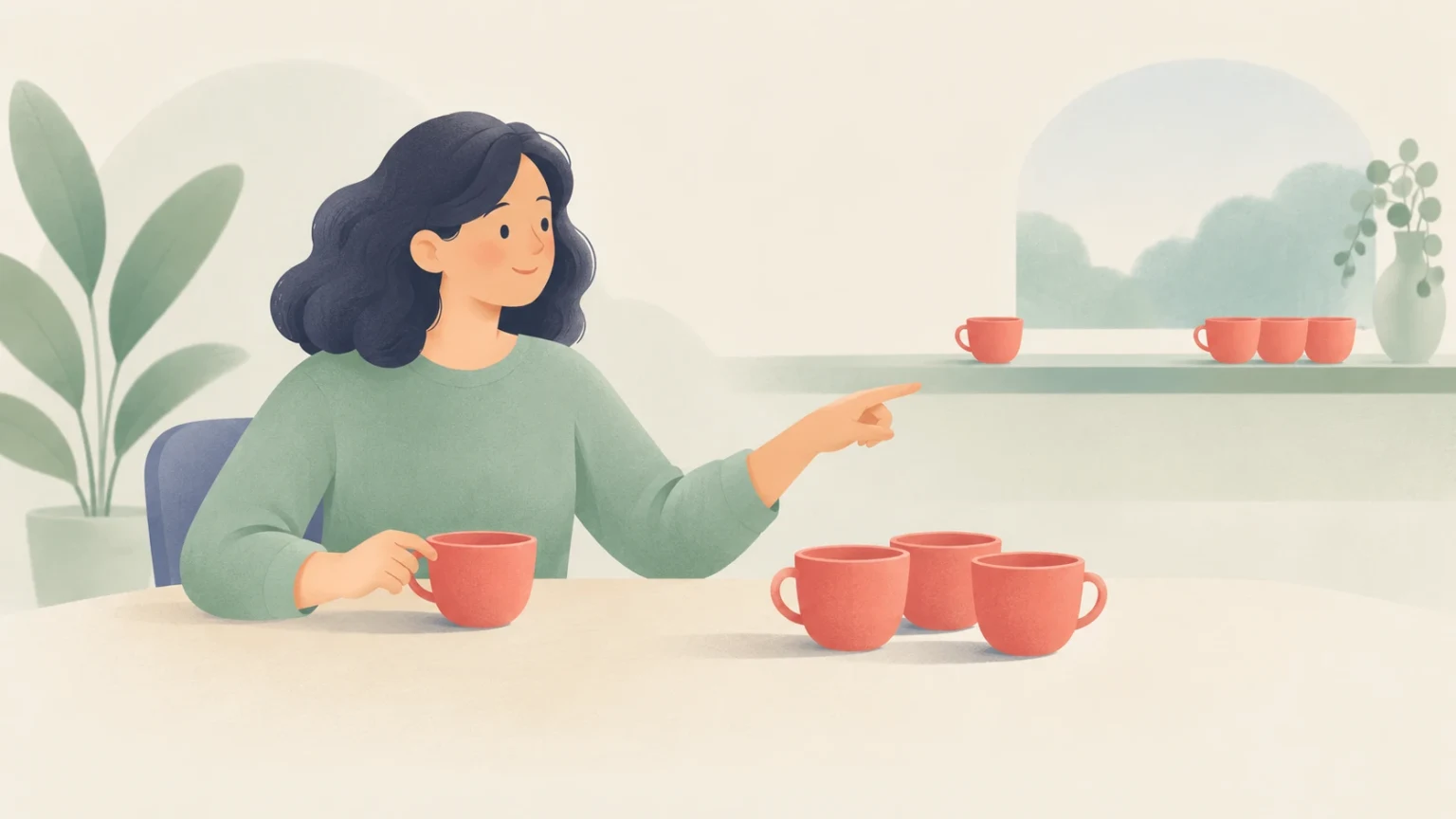

At a glance
| Form | Use it for | Example |
|---|---|---|
| this | One nearby person, thing or idea. | This mug is warm. |
| that | One farther-away person, thing or earlier idea. | That lamp is on the shelf. |
| these | More than one nearby person or thing. | These cups are clean. |
| those | More than one farther-away person or thing. | Those bicycles are outside. |
Stage 1 of 5
Understand
What it means, when to use it, and mistakes to avoid.
The full explanation
The words this, that, these, and those are demonstratives. They show your listener which specific item or idea you mean. Distance can be physical, like an item in your hands compared with an object across the street. Distance can also be conversational or psychological, such as an idea someone mentioned earlier or a plan for the coming weekend.
This apple on my desk looks fresh.
Why it works: Use this because apple is singular and sits right in front of the speaker.
3 more examples
-
These envelopes on the counter are ready for the morning mail.
Use these because envelopes is plural and rests near the speaker.
-
That apron hanging on the door belongs to Marco.
Use that because apron is singular and hangs away from the speaker across the room.
-
Those oranges across the aisle come from Spain.
Use those because oranges is plural and placed farther away in another aisle.
Read the full guide
Decide whether the noun is singular or plural
Count the people or items you mean before choosing any demonstrative. If you speak about one person, object, or place, you must choose between this and that. If you speak about more than one, you must choose between these and those. Beginners often make the mistake of pairing a plural noun with a singular word. Always check the number of the noun first.
-
This office stays open until six in the evening.
Why it works: Office is singular, so it takes the singular demonstrative this.
-
These offices stay open until six in the evening.
Why it works: Offices is plural, so it requires the plural demonstrative these.
Your turn
Which sentence shows correct agreement between the demonstrative and the noun?
Answer: This report needs your signature before noon.
Show the answer
Answer: This report needs your signature before noon.
Report is a singular countable noun, so it requires the singular demonstrative this rather than plural forms like these or those.
Identify near and far distance
Once you know the number of items, determine whether they are near you or farther away. English treats near items as things you can touch, hold, or easily reach. Far items are across the room, down the street, or simply outside your immediate personal reach. You can think of near items as here, and distant items as there.
-
I am holding this envelope in my hand right now.
Why it works: The envelope is physically touching the speaker's hand, representing immediate near distance.
-
Look at that envelope across the room on the cabinet.
Why it works: The envelope is across the room, representing far distance from the speaker.
You can practise this again in Choose and, but, because, or so and Countable and uncountable nouns: how to choose.
Your turn
You point to an umbrella standing across the hallway. How do you describe its distance?
Answer: It is far from you, so you use that or those.
Show the answer
Answer: It is far from you, so you use that or those.
An item across the hallway is separated from your immediate personal reach, so it requires a distant demonstrative like that or those.
Use this for one nearby item
Use this when you speak about one person, object, place, or concept that is near you. For example, you use this when you hold a cup of coffee, point to a chair beside you, or introduce a colleague standing right next to you. You can also use this with singular uncountable nouns like tea, water, or information when the substance is right in front of you.
-
This tea tastes slightly sweet.
Why it works: The speaker is holding or drinking from a single cup of tea right now.
-
This aisle has all the fresh produce you need.
Why it works: The speaker is currently standing inside the aisle.
Your turn
You are holding a single document in your hand. What do you say to your colleague?
Answer: Could you please review this document?
Show the answer
Answer: Could you please review this document?
Because you hold one document right in your hands, the correct choice is the singular, nearby demonstrative this.
Use these for multiple nearby items
Use these when you speak about two or more people or things close to you. Pronounce these with a long vowel sound and a voiced z sound at the end, which helps distinguish it from this. You might use these when presenting several samples on a table, holding a pair of keys, or discussing multiple documents on your desk. Make sure the following noun takes a plural ending.
-
These apples in the basket are ready to eat.
Why it works: Apples is plural and the basket is right in front of the speaker.
-
These keys open the side door and the storage room.
Why it works: The speaker holds multiple keys near their hand.
Your turn
Which sentence correctly refers to three folders sitting on your desk?
Answer: These folders contain the quarterly sales numbers.
Show the answer
Answer: These folders contain the quarterly sales numbers.
Folders is plural and sits right on your desk, so the plural near demonstrative these is correct.
Use that for one distant item
Use that when you point to a single item, person, or location that is farther away. For example, if you see a car parked down the road or a sign across the street, that is the natural choice. That is also useful when referring back to a single statement or event that finished recently in a conversation. It tells the listener to look or think away from the immediate point.
-
That exit at the end of the hall is locked after eight.
Why it works: Exit is singular and situated away from the speaker down the hall.
-
That answer you gave during the meeting made complete sense.
Why it works: Answer is singular and refers back to a completed statement from earlier.
Your turn
You want to show a friend a building across the street. Which phrase fits best?
Answer: Notice that building over there across the road.
Show the answer
Answer: Notice that building over there across the road.
Building is singular and located across the road, so that is the appropriate demonstrative.
Use those for multiple distant items
Use those when you identify two or more items or people separated from you by space or time. You often hear those in shops when asking a clerk to reach items on a high shelf. You also hear it when people talk about past memories, such as events from childhood or previous years. Check that the noun following those is clearly plural and that the verb matches.
-
Those boxes on the top shelf need to come down.
Why it works: Boxes is plural and rests far out of reach on the top shelf.
-
Do you remember those quiet evenings we spent in the village?
Why it works: Evenings is plural and refers to past times separated from the present.
Your turn
A customer wants to buy several shirts displayed in the front window. What does the customer say?
Answer: How much are those shirts in the window?
Show the answer
Answer: How much are those shirts in the window?
Shirts is plural and positioned away in the window display, requiring the plural distant demonstrative those.
Use demonstratives alone as pronouns
You do not always need to repeat the noun after this, that, these, or those. When the object you mean is completely obvious to both you and your listener, the demonstrative can stand alone as a pronoun. For example, if you hold two sweaters, you can say I prefer this instead of repeating the word sweater. Make sure the number still matches what you replace.
-
I like both designs, but this looks much cleaner.
Why it works: This replaces one design that the speaker holds or indicates directly.
-
Are these yours, or did someone leave them behind?
Why it works: These replaces a group of nearby items without naming them again.
Your turn
Your friend asks which pen you want to borrow while pointing to three pens on the table. How do you respond?
Answer: I will take this, please.
Show the answer
Answer: I will take this, please.
If you want one pen from the table, you use the singular pronoun this. Option B means you want all three, and option C has an agreement error.
Choose demonstratives for time and ideas
In spoken English, distance often describes time or conversation rather than physical space. Use this and these for events happening right now or in the near future, such as this morning or these upcoming weeks. Use that and those for events that happened in the past or ideas that someone else just mentioned. This conversational distinction makes your English sound natural in professional and social conversations.
-
This meeting is taking longer than expected.
Why it works: This refers to the meeting currently in progress.
-
That was a very helpful suggestion, Sarah.
Why it works: That refers back to a comment Sarah made a moment ago.
Your turn
A coworker finishes an explanation and you want to say you understood the point. What is the most natural reply?
Answer: That makes sense to me.
Show the answer
Answer: That makes sense to me.
That is the standard way to refer back to a single idea or explanation that someone just shared with you.
Common mistakes
What learners often say, what to say instead, and why.
-
Not this:
These chair is comfortable.Say: This chair is comfortable.
Chair is singular, so use a singular demonstrative.
-
Not this:
That apples look fresh.Say: Those apples look fresh.
Apples is plural, and the sentence describes items farther away.
-
Not this:
These is my favourite.Say: This is my favourite.
This replaces one item; these refers to more than one.
Questions about "This, that, these, those: how to choose"
How can I clearly hear and pronounce the difference between this and these?
The word this has a short vowel sound, like the vowel in sit or hit, and ends with a soft unvoiced s sound. The word these has a longer vowel sound, like the vowel in see or meet, and ends with a buzzing voiced z sound. When native speakers talk quickly, lengthening the vowel in these helps listeners recognize that you mean more than one item.
This seat is occupied.
These seats are reserved for our guests.
Which demonstratives should I use with uncountable nouns like water or information?
Uncountable nouns are grammatically singular in English, so they always take singular demonstratives. Use this when the substance or concept is near you or being discussed right now. Use that when the substance is farther away or refers to information shared earlier. You must never use these or those with uncountable nouns.
This water tastes fresh and cold.
That advice from our financial advisor helped us save money.
Why do English speakers say 'This is Mark' instead of 'I am Mark' on the phone?
In telephone introductions, English uses this to identify the speaker in the immediate conversation. When asking who is on the line, speakers traditionally say 'Who is that?' rather than 'Who are you?' because the other person is separated by distance. This convention is standard in both business and casual phone calls.
Hello, this is David calling from the dental clinic.
Is that Sarah speaking?
When someone explains something, should I say 'this makes sense' or 'that makes sense'?
Both can be heard, but that makes sense is far more common. English speakers use that to refer back to a thought, statement, or story that another person just completed. In contrast, you use this when you introduce an idea you are about to explain yourself, as in 'Listen to this idea.'
That sounds like a fair solution to the problem.
This is what I think we should do next.
Before you go
Remember this
To choose the right demonstrative, ask two simple questions. Is the noun singular or plural? Is it close to you or farther away? Use this for one nearby item, these for multiple nearby items, that for one distant item, and those for multiple distant items. Practice with physical items around you to build confidence.
Stage 2 of 5
Listen
Hear it in real sentences, from short to long, and write what you hear.
0 of 4 done
Listening 1 of 4
Listening 2 of 4
Try a longer clip. Listen once, then replay the part you missed.
Listening 3 of 4
This clip is longer. Follow the instruction above the answer field.
Listening 4 of 4
Listen, then type the missing words. The rest of the text is already there.
0:00
Practice complete
You listened closely.
Your result is saved in this browser.
Keep your progress. Your practice is saved on this device only. Create a free account to keep it everywhere.
Create a free accountThat was today's free lesson. Tomorrow you get another one. Want more today? See membership.
Create a free SubLearn account to keep this progress across devices.
Save my progressStage 3 of 5
Speak
Say it with the speaker, then use it in your own answer.
Shadow
Say it along with the speaker
Play the line slowly, then speak at the same time as the speaker. Copy the rhythm, not just the words.
Your turn
Say it your way
Describe three items on your desk and two objects across the room, explaining where each item sits and why you placed it there.
Use: this, that, these, those: how to choose
You could start with “On my desk, this notebook is where I write daily tasks, while that clock…”
Take ten seconds to think, then answer out loud without looking at the lesson. Speak for the time shown in the task above. Nothing is sent unless you ask for feedback.
0:00
Stage 4 of 5
Write
Use what you've learned to write about your day or week, then write a message.
Write
Put it in your own words
- I used “this, that, these, those: how to choose”.
- It is about my life, not the lesson’s example.
- I read it once aloud to check it sounds right.
Write your own response
Choose a situation and write 30–50 words of your own. In this activity, you decide what to say rather than copy the words in a recording.
Check your own writing
Read one possible response
Use these checks to revise your message. Grammar and meaning are not automatically graded. Each task keeps its own draft in this browser tab.

You finished the free part of this lesson
- Understand
- Listen
- Speak
- Write
- CheckPart of membership
Worth another look
With a free account, the lessons you finish come back for review to help you remember them.Create a free account
Stage 5 of 5 · Part of membership
Check
New clips without hints.
Listening tests are included with membership. Try the free dictation first, then decide whether to continue.
Listening 1 of 2 Part of membership
Listening 2 of 2 Part of membership
Follow MicroEnglish
Find lesson updates, short videos and quick quizzes. Pick the app you already use.
Questions & comments
Ask about this lesson, share an example, or help another learner.
Example
Memory tip
Goes with
Related forms
Not to be confused with
In this lesson
This word isn't in our dictionary. Check the spelling, or try another form of the word.
We couldn't load this word. Try again.
