What happens in the video
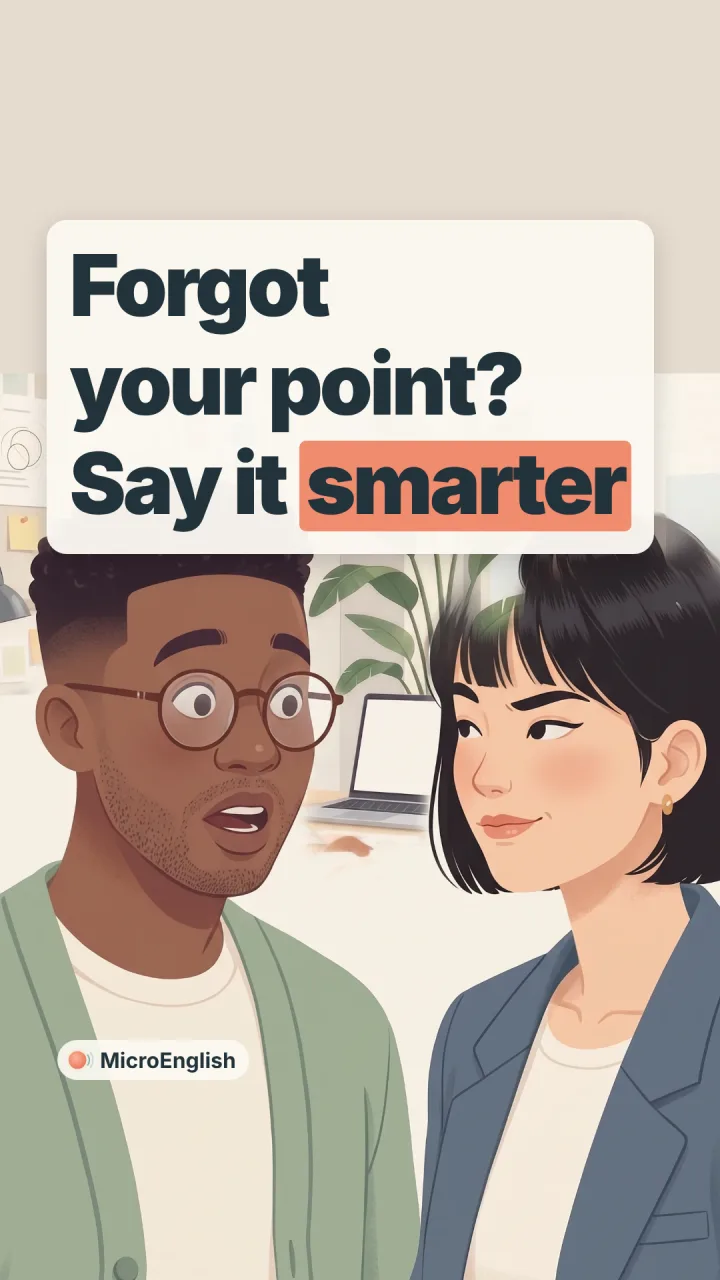
Theo starts explaining the poster, but soon he's talking about a broken printer, his cat, and a font, and he forgets what he wanted to say. Nadia reminds him: "The poster, Theo." Theo tries again with "Long story short, the poster's late. I need one more hour," and Nadia says, "Perfect. You've got it."
1 Long story short
Tone Casual, about your story
Use it to skip details and give the main result of a story. If you interrupt someone else with it, it can sound as though you want them to hurry.
Long story short.
For example:
A: How was your trip to the coast?
B: The train was late, the hotel lost our booking... Long story short, we stayed one night and came home.
A: Oh no. Next time will be better.
2 Get to the point
Tone Direct, a little impatient
Use it when someone is talking around a topic and you need the main idea. A softer start such as "please" or "sorry, could you" helps, because on its own the line can sound rude.
Please get to the point.
For example:
A: So, before I explain the budget, let me tell you about last year's numbers, and the year before...
B: Sorry, we only have five minutes. Could you get to the point?
A: Sure. We need more money for the website.
3 Let's cut to the chase
Tone Bold and businesslike
Use it to skip small talk and start the real conversation, often in work or negotiation. It's less polite at a friendly dinner, where small talk is part of the fun.
Let's cut to the chase.
For example:
A: Nice to see you again. How was the drive?
B: Fine, thanks. Let's cut to the chase. Can you deliver by Friday?
A: Yes, if we sign today.
4 To make a long story short
Tone Casual, slightly fuller
This is the full form of "long story short." It sounds a little more complete in writing or in a calmer conversation.
For example:
A: Did you find your keys?
B: I looked everywhere. To make a long story short, they were in my coat.
5 The bottom line is...
Tone Firm, practical
Use it to give the most important fact or decision after a discussion. It fits work talk well. It can sound cold in a personal or emotional conversation.
For example:
A: There are a lot of reasons the project is slow.
B: I know. The bottom line is we need two more people.
6 Can you give me the short version?
Tone Polite, friendly
Use it to ask for the main idea without sounding impatient. It's a soft alternative to "get to the point."
For example:
A: Well, it started on Monday when my manager called me...
B: I have to leave soon. Can you give me the short version?
A: I got the promotion!
7 In a nutshell
Tone Light, informal
Use it to sum up an idea in very few words. It works in speech and casual writing, but avoid it in a formal report.
For example:
A: What did the teacher say about the exam?
B: In a nutshell, study chapters three and four.
8 I'll keep it short.
Tone Polite, considerate
Say it before you speak to show you respect people's time. Only use it if you really will be brief.
For example:
A: Do you have a minute?
B: Sure.
A: I'll keep it short. The client moved the meeting to Thursday.
Common mistakes
-
Not quite
Long story short, you talk too much.Better Long story short, I missed the bus.
"Long story short" shortens your own story. If you use it about someone else's story, it sounds like a complaint, and that can be rude.
-
Not quite
Get to the point! (said sharply to a colleague)Better Sorry, could you get to the point? We're short on time.
On its own, "get to the point" can sound impatient. A softer start and a reason can make the request less abrupt, but your tone still matters.
-
Not quite
Let's cut the chase.Better Let's cut to the chase.
The idiom uses "to": "cut to the chase." Keep the phrase together when you mean to skip extra details and discuss the main point.
Quick quiz
Choose your answer for each question, then open the answer to check it.
-
You are telling a friend about a long, messy day and want to jump to the result. What do you say?
- Get to the point.
- Long story short, I got the job.
- Let's cut to the chase.
Show the answer (Question 1)
Answer: Long story short, I got the job. "Long story short" is for shortening your own story.
-
Which line sounds the most polite when you ask someone to be brief?
- Get to the point.
- Can you give me the short version?
- Cut to the chase.
Show the answer (Question 2)
Answer: Can you give me the short version? It's a friendly question, so it doesn't sound impatient.
-
At the start of a business meeting, you want to skip small talk. Which line fits best?
- In a nutshell.
- Let's cut to the chase.
- I'll keep it short.
Show the answer (Question 3)
Answer: Let's cut to the chase. "Let's cut to the chase" is bold and businesslike, and it means skipping small talk.
-
Choose the correct form.
- Let's cut the chase.
- Let's cut to the chase.
- Let's cut at the chase.
Show the answer (Question 4)
Answer: Let's cut to the chase. The fixed idiom is "cut to the chase," with "to."
-
What is the tone of "Get to the point" when it has no softer words around it?
- Warm and friendly
- Direct and a little impatient
- Formal and polite
Show the answer (Question 5)
Answer: Direct and a little impatient Said alone, the line pushes the speaker to hurry, so it can sound rude.
Questions learners ask
What does "cut to the chase" mean?
It means to skip the small talk or extra details and talk about the main thing. People often use it at work or in negotiations, usually as "Let's cut to the chase." It sounds confident and businesslike.
Is "get to the point" rude?
It can be. On its own, it sounds impatient. Add "please," "sorry," or a reason such as "we're short on time," or use a softer question like "Can you give me the short version?"
What's the difference between "long story short" and "to make a long story short"?
They mean the same thing. Both shorten your own story so you can give the result. "Long story short" is the quicker, more casual form, and "to make a long story short" sounds a little fuller.
How can I tell someone politely that I will be brief?
Say "I'll keep it short" before you start. It shows you respect the other person's time. Then keep your message short, or the line loses its meaning.
Film lines are short quotes used for language teaching. The dialogue belongs to its rightsholders. Theo and Nadia are animated characters made with Google Flow.