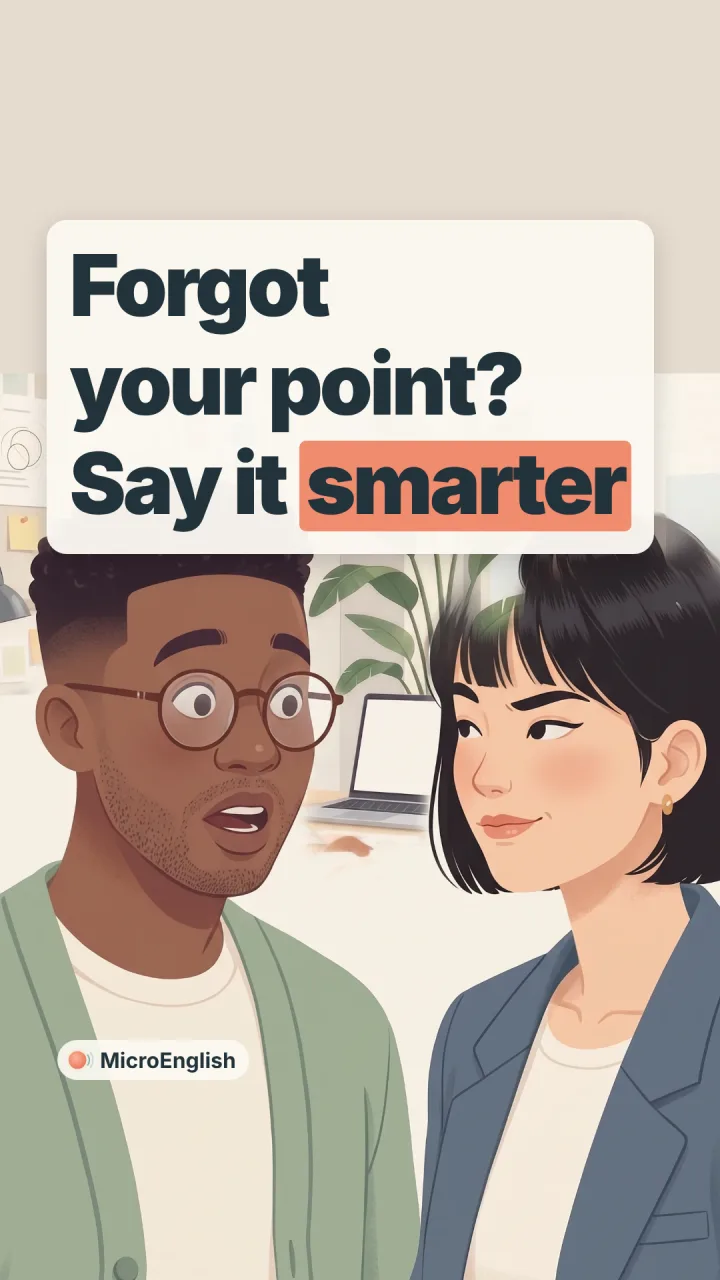
What happens in the video
Hana greets Theo by name, and Theo answers, "I totally forgot your name." Hana isn't impressed. In the better version, Theo says, "Sorry. I'm terrible with names. Remind me." Hana tells him her name and jokes that she remembers his cardigan.
1 I'm terrible with names
Tone Friendly and self-joking
Use it when you've met someone before and can't remember their name. You blame your memory, not the other person, so it sounds warm. Follow it with a short request such as "Remind me."
I'm terrible with names.
For example:
A: Hi! Good to see you again.
B: You too. Sorry, I'm terrible with names. Remind me?
A: It's Priya.
B: Priya, of course. Thanks.
2 What was your name again?
Tone Quick and casual
Use it when someone told you their name recently, maybe a few minutes ago. The word "again" shows that you heard it before and just lost it. With a manager or a client, add "Sorry" at the start.
What was your name again?
For example:
A: So that's how the new system works.
B: Thanks, that helps. Sorry, what was your name again?
A: Marco.
3 I've forgotten your name
Tone Honest and polite
Use it when you want to be direct and sincere, for example with an older colleague or at a formal event. Alone it can sound a little cold, so add "I'm so sorry" before it.
I've forgotten your name.
For example:
A: We met at the conference last spring.
B: Yes, I remember. I'm so sorry, I've forgotten your name.
A: No problem. It's Daniel.
4 Sorry, remind me of your name?
Tone Light and easy
Use it in everyday situations with neighbors, classmates, or coworkers. It sounds relaxed because you ask for help instead of apologizing a lot. Avoid it in a very formal meeting.
For example:
A: Hey, how was your weekend?
B: Great, thanks. Sorry, remind me of your name?
A: Lena.
5 Your name has slipped my mind
Tone Soft and a bit formal
Use it to explain gently that you have forgotten the name. "Slip my mind" means you forgot something. The phrase can fit a polite conversation at work, though it may sound more careful than you need with a close friend.
For example:
A: Nice to see you at the meeting again.
B: You too. I'm sorry, your name has slipped my mind.
A: It's Omar.
6 I know we've met, but I can't remember your name
Tone Warm and honest
Use it when you clearly remember the person but not the name. The first part tells them they matter to you. Don't use it if you aren't sure you've met before.
For example:
A: Hi there!
B: Hi! I know we've met, but I can't remember your name.
A: Sofia. We met at Ken's party.
B: Right, Sofia. Good to see you.
7 Sorry, I didn't catch your name
Tone Polite and neutral
Use it only right after an introduction, when you didn't hear the name clearly. Don't use it for someone you met weeks ago, because they know you heard it then.
For example:
A: Hi, I'm Siobhan, I'm on the design team.
B: Nice to meet you. Sorry, I didn't catch your name.
A: Siobhan. It's spelled S-I-O-B-H-A-N.
8 Could you tell me your name one more time?
Tone Careful and polite
Use it with people you don't know well, such as a client or a receptionist. "Could you" makes the request soft. With friends it can sound too formal.
For example:
A: I'll send you the form today.
B: Thank you. Could you tell me your name one more time?
A: Of course. It's Mrs. Tanaka.
9 Have you two met?
Tone Indirect and tactful
Use it when you're with a friend and meet someone whose name you forgot. The two people often introduce themselves, and you hear the name. It only works when a third person is with you.
For example:
A: Oh, hi! Good to see you.
B: Hi! This is my friend Alex. Have you two met?
A: No, I don't think so. I'm Jonas.
Common mistakes
-
Not quite
I'm terrible in names.Better I'm terrible with names.
English uses "with" here: good with names, bad with numbers, terrible with names. "In" sounds wrong to native speakers.
-
Not quite
Remember me your name, please.Better Remind me of your name, please.
"Remember" means you keep something in your memory. "Remind" means another person helps you remember. You ask someone to remind you.
-
Not quite
Sorry, I didn't catch your name. (to someone you met last month)Better Sorry, what was your name again?
"I didn't catch it" means you didn't hear it just now. For a name you heard before and forgot, use "again" or "I'm terrible with names."
Quick quiz
Choose your answer for each question, then open the answer to check it.
-
You met a coworker five minutes ago and already forgot her name. Which line fits best?
- What was your name again?
- I've never known your name.
- Who are you?
Show the answer (Question 1)
Answer: What was your name again? "Again" shows you heard the name recently and just need it one more time.
-
Which line blames your own memory in a friendly, joking way?
- You didn't tell me your name.
- I'm terrible with names.
- Your name is hard.
Show the answer (Question 2)
Answer: I'm terrible with names. It makes you the problem, not the other person, so it sounds warm and light.
-
How can you make "I've forgotten your name" sound kinder?
- Say it louder
- Add "I'm so sorry" before it
- Add "totally" before "forgotten"
Show the answer (Question 3)
Answer: Add "I'm so sorry" before it An apology softens the honest statement and shows you care.
-
Someone just said their name, but the room was noisy. What do you say?
- Your name has slipped my mind.
- I know we've met, but I can't remember your name.
- Sorry, I didn't catch your name.
Show the answer (Question 4)
Answer: Sorry, I didn't catch your name. "Didn't catch" means you didn't hear it clearly, which matches this situation.
-
Why did Theo's first line, "I totally forgot your name," sound rude?
- It had no apology and no request
- It was too formal
- It used the wrong tense
Show the answer (Question 5)
Answer: It had no apology and no request A brief apology or a request to remind you can make this sound less abrupt. Your tone matters too.
Questions learners ask
How do you politely say you forgot someone's name?
Apologize briefly, take the blame, and ask. For example, say "Sorry, I'm terrible with names. Remind me?" Keep it short. A long apology makes the moment more awkward.
Is it rude to ask someone's name again?
Asking again can be polite. A brief apology shows that you know the person has already told you. Keep your question friendly and direct rather than making a long apology.
What does "slipped my mind" mean?
It means you forgot something by accident. "Your name has slipped my mind" sounds softer than "I forgot your name." It's common at work and in polite conversation.
What's the difference between "I forgot" and "I've forgotten"?
Both are correct for a name. "I've forgotten your name" uses the present perfect and focuses on now: you don't know it at this moment. American speakers also often say "I forgot your name" in casual speech.
Film lines are short quotes used for language teaching. The dialogue belongs to its rightsholders. Hana and Theo are animated characters made with Google Flow.