Idiom
Crossed wires
What does crossed wires mean?
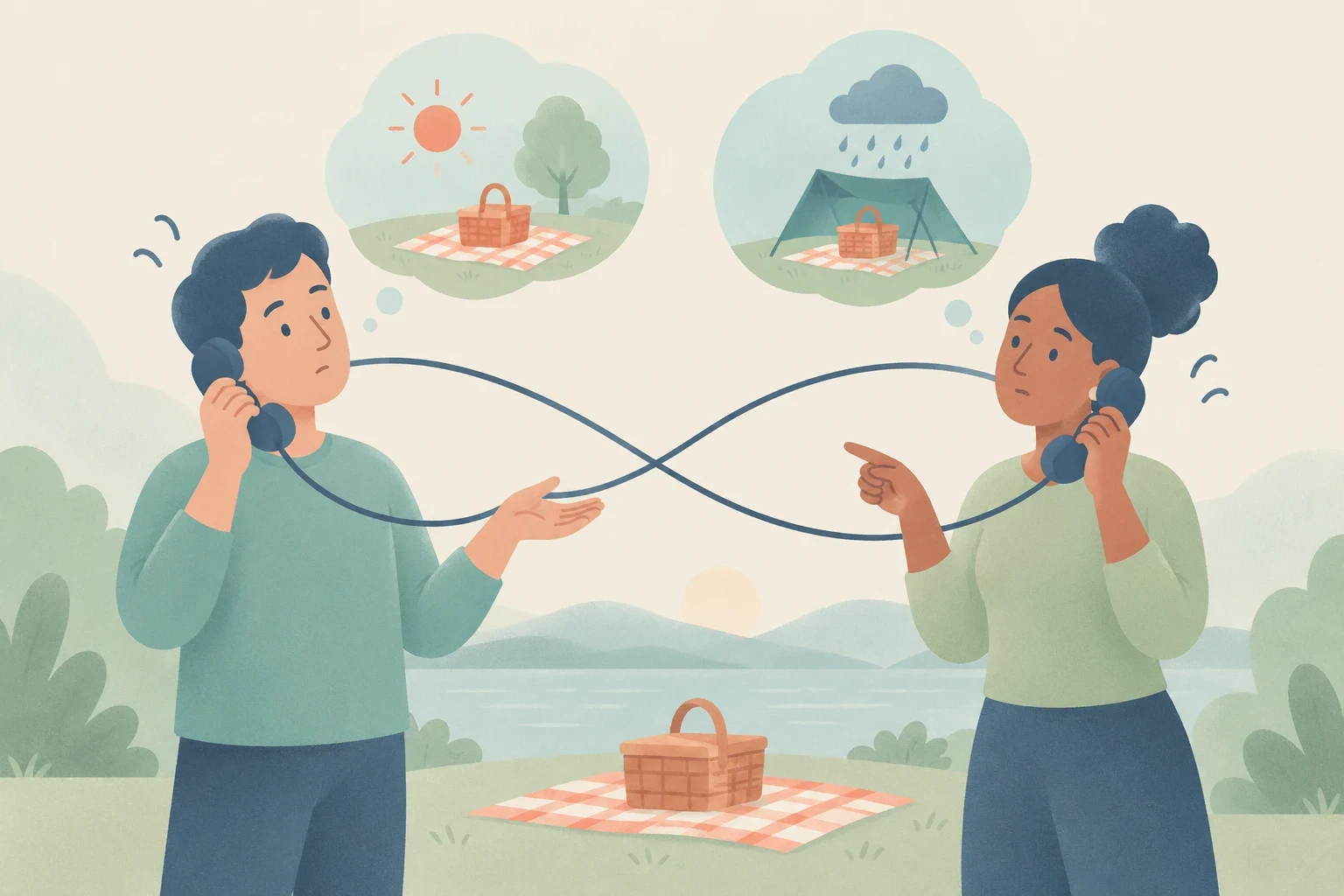
Get your wires crossed means to experience a misunderstanding because two or more people have different information, expectations, or interpretations of the same situation.
Key points
- Use get your wires crossed to describe misunderstandings without assigning harsh blame.
- Match the possessive word to the people involved, keep wires plural, and always follow up with a clear practical plan.
- Combine get with a possessive word matching the people involved: my, your, our, or their wires crossed.
This lesson has 5 stages. You can stop at any time and continue later.

Stage 1 of 5
Understand
What it means, when to use it, and mistakes to avoid.
Watch & learn
Crossed wires
Use get your wires crossed to explain a misunderstanding politely in conversation and agree on a clear next step.
Line 1 of 8 · Theo
Theo: We... our ? Our ? .
Say this line out loud, then continue.
The video could not continue. Try again or use the transcript below.
Your session
Learn with the video 15 min
Watch a short part, answer a question and practice what you heard. Then talk it through with the tutor.
The first part is free. Members continue to part 2 and can ask for more.
Key words in this video
Example
Memory tip
Goes with
Related forms
Not to be confused with
From this video
We couldn't load this word. Try again.
Examples
I think we got our wires crossed about the pickup location.
Why it works: The speaker gently points out differing expectations about where to meet.
2 more examples
-
I got my wires crossed and brought the wrong sample book to the presentation.
Using my shows that the speaker takes sole responsibility for the mistake.
-
The dispatchers got their wires crossed regarding the urgent supply order.
Their indicates that third parties experienced the confusion.
Read the full guide
Decide When a Misunderstanding Happened
Sometimes you understand a message differently from another person. You can call this a misunderstanding. To describe it in conversation, you can say, 'We got our wires crossed.' Your repaired bag is still at the shop because you expected delivery and the assistant expected collection. You need to explain the mix-up and agree how to get it home. The phrase describes confused communication, not damaged telephone equipment or physical cables. Nobody lied or tried to trick you. Each person acted reasonably on their own interpretation of the message.
-
We got our wires crossed about the drop-off time.
Why it works: The speaker and the listener had two different times in mind.
-
They got their wires crossed regarding the repair receipt.
Why it works: The two people misunderstood something about the repair receipt.
Your turn
Which situation describes crossed wires?
Answer: A customer and a repair shop assistant have different dates in mind for picking up a bag.
Show the answer
Answer: A customer and a repair shop assistant have different dates in mind for picking up a bag.
Crossed wires describes an honest misunderstanding about facts or dates, not an argument about prices or poor repair work.
Spot Misunderstandings in Daily Conversations
Read this conversation between a customer and a shop clerk. Notice how each person explains their view of the arrangement. Customer: Hello, I am calling about my leather travel bag. I waited home all morning, but the delivery driver never arrived. Clerk: Oh, I see the problem on our work order. We marked it ready for collection at our front desk. Customer: I think we got our wires crossed about that. I asked for home drop-off on Tuesday. Clerk: You are right. I will send a courier to your house this afternoon at no extra charge. The customer stays calm and names the confusion clearly without blaming the clerk.
-
I think we got our wires crossed about the home delivery.
Why it works: Adding 'I think' keeps the conversation polite when resolving an error.
-
We can arrange collection today if that works better for you.
Why it works: Clarifying the actual plan fixes the misunderstanding right away.
This also comes up in In the loop and To put someone on the spot.
Your turn
What caused the confusion between the customer and the shop clerk?
Answer: The customer expected home delivery while the clerk expected shop collection.
Show the answer
Answer: The customer expected home delivery while the clerk expected shop collection.
The customer stayed home for a courier, but the repair clerk had marked the bag for in-store pickup.
Match the Possessive Word to the People Involved
To build this expression, use get followed by a possessive word, such as my, your, our, or their, and end with wires crossed. Use our when both you and another person share the confusion. Choose my when you accept that you made the mistake alone. Use their when talking about other people who misunderstood each other. You can also hear his or her in specific stories. Always keep wires plural and keep crossed as an adjective ending in -ed. You can link to related phrases at /idioms/expressions-with-get/ to see how get combines with other everyday idioms.
-
I got my wires crossed and walked into the wrong conference room.
Why it works: The speaker takes personal responsibility for entering the incorrect room.
-
The cleaners and the office manager got their wires crossed about the recycling schedule.
Why it works: Both parties were confused about the pickup routine.
-
We got our wires crossed over the invoice total.
Why it works: Our indicates that the speaker and the other person shared the confusion.
Your turn
Which sentence uses the correct possessive form when you admit your own misunderstanding?
Answer: I got my wires crossed when reading the repair ticket.
Show the answer
Answer: I got my wires crossed when reading the repair ticket.
Match the subject I with the possessive word my when describing your own individual mistake.
Change the Verb for Past and Perfect Tenses
The word get changes to match your sentence tense, but wires crossed remains unchanged. In simple past stories, use got in both American and British English. Say 'we got our wires crossed yesterday.' When you use a helping verb such as have, British English speakers usually say 'we have got our wires crossed.' American English speakers often say 'we have gotten our wires crossed.' Both varieties understand each other without difficulty. To specify the reason for the mix-up, add the preposition about or over, as in getting your wires crossed about the delivery address.
-
Yesterday, the warehouse staff got their wires crossed about the shipping date.
Why it works: Simple past got fits a completed past event.
-
It looks like we have gotten our wires crossed about the return policy.
Why it works: American English often uses gotten after have for present perfect.
-
The two drivers got their wires crossed over the loading gate.
Why it works: The preposition over shows the topic of the confusion.
Your turn
Which sentence correctly shows American English present perfect for this idiom?
Answer: We have gotten our wires crossed about the tracking number.
Show the answer
Answer: We have gotten our wires crossed about the tracking number.
American English uses have gotten, while wires remains plural and crossed keeps its final -ed ending.
Protect Workplace Relationships with Polite Phrasing
The phrase crossed wires belongs to natural, conversational English. It works well in everyday workplace discussions, emails with teammates, and customer service chats. When you want to explain an error without pointing fingers, say 'we got our wires crossed.' Adding 'I think' or 'it seems' softens the statement even more. In contrast, telling a colleague 'you got your wires crossed' can sound harsh, because it blames them directly. For formal legal letters, contracts, or serious incident reports, avoid the idiom completely. Use a neutral phrase such as 'there was a misunderstanding regarding the schedule.'
-
I think we got our wires crossed regarding the final report deadline.
Why it works: Using 'I think we' shares responsibility and prevents defensiveness.
-
There was a misunderstanding regarding the terms of payment.
Why it works: A formal alternative suitable for written contracts and official claims.
Your turn
Why is 'I think we got our wires crossed' better than 'You got your wires crossed' at work?
Answer: It shares responsibility gently instead of directly blaming your colleague.
Show the answer
Answer: It shares responsibility gently instead of directly blaming your colleague.
Using we and adding I think softens the tone, protecting working relationships during a mix-up.
Distinguish Misunderstandings from Disagreements
Learners often make two mistakes with this idiom. The first is a grammar error: dropping the plural -s from wires or using the base verb cross instead of crossed. You must say 'wires crossed', never 'wire crossed' or 'wires cross'. Also remember the possessive word: do not say 'we got wires crossed'. The second mistake is confusing a misunderstanding with a disagreement. If you and your supervisor understand each other completely but disagree on a budget, you do not have crossed wires. For differing opinions, look at /idioms/eye-to-eye/ or /idioms/on-the-same-page/ instead.
-
We got our wires crossed about who would lock the storefront.
Why it works: Correct form with plural wires and past participle crossed.
-
The architect and the builder disagreed about the roof design, but they understood each other.
Why it works: Clear disagreement is not a case of crossed wires.
Your turn
Which sentence contains a grammar error?
Answer: We got our wire crossed about the morning appointment.
Show the answer
Answer: We got our wire crossed about the morning appointment.
The noun wire must always be plural in this idiom: wires crossed.
Listen for End Sounds in Natural Speech
When native speakers speak quickly, crossed wires presents two specific pronunciation points. The word crossed ends with a /st/ consonant cluster. The letters -ed sound like /t/, not a separate vowel syllable. Do not say 'cross-id'. Immediately after that /st/ cluster, wires begins with a /w/ sound and ends with a voiced /z/. In American English, you will hear a clear /r/ inside wires. In British and Australian English, the /r/ is silent, producing a diphthong ending in /z/. In all accents, the phrase carries normal sentence stress across crossed and wires rather than rushing through them.
-
They got their wires crossed during the morning shift handover.
Why it works: Notice how /st/ in crossed flows directly into the /w/ in wires.
-
I think we got our wires crossed about the garage access code.
Why it works: The stress falls on crossed and wires to highlight the misunderstanding.
Your turn
How is the ending of the word 'crossed' pronounced in this phrase?
Answer: It ends with the consonant sounds /st/, with -ed pronounced as /t/.
Show the answer
Answer: It ends with the consonant sounds /st/, with -ed pronounced as /t/.
The word crossed is a single syllable ending in /st/, where the spelling -ed represents the sound /t/.
Clarify the Arrangement in Two Clear Sentences
When you explain a mix-up, pair the idiom with a clear statement of what happens next. A complete explanation has two parts. First, name the misunderstanding politely using get + possessive + wires crossed. Second, state the exact plan so both sides agree. For instance, if you expected your repaired bag delivered to your home while the shop kept it on a shelf, say: 'We got our wires crossed about the collection. I will pick up the bag today at four o'clock.' This resolves the confusion immediately and leaves no doubt about the final outcome.
-
We got our wires crossed about the delivery date, so I will visit the shop at noon.
Why it works: The first part identifies the mix-up and the second confirms the action.
-
I got my wires crossed on the meeting room, but I am walking over right now.
Why it works: An admission of personal confusion followed by an immediate remedy.
Your turn
What is the most effective way to close an explanation of crossed wires?
Answer: State the exact practical action that both sides will follow next.
Show the answer
Answer: State the exact practical action that both sides will follow next.
Stating a clear next step confirms the true arrangement and solves the practical problem immediately.
Use it naturally
How people really use “get your wires crossed”
Neutral Fine almost anywhere, at work or with friends.
Words it often goes with
- got our wires crossed aboutWe got our wires crossed about who was making dinner.
- got their wires crossed regardingThe organizers got their wires crossed regarding the ticket prices.
- I think we got our wires crossedI think we got our wires crossed about which recipe to use.
What people also say
- “I think we got our wires crossed.” instead of “A misunderstanding occurred between us.” This sounds friendly and leaves room to explain both sides.
Questions about "Crossed wires"
What does crossed wires mean?
Crossed wires refers to a situation where two or more people misunderstand each other because they have different information, expectations, or interpretations. The idiom comes from old telephone lines touching and mixing calls, but today it only describes communication mix-ups.
We got our wires crossed about which train station to meet at.
Can I say I got my wires crossed?
Yes, you can use 'my wires crossed' when you want to take personal responsibility for a misunderstanding. It signals that you made the mistake alone rather than sharing blame with the listener.
I got my wires crossed and arrived thirty minutes before the office opened.
Is crossed wires the same as disagreeing?
No, crossed wires is strictly for misunderstandings. In a disagreement, both people understand each other clearly but hold different preferences or opinions. Use crossed wires only when someone misunderstood the facts, instructions, or arrangements.
They did not disagree on the price; they simply got their wires crossed about the delivery fee.
Do I say got or gotten our wires crossed?
In the simple past, both American and British English use 'got': 'we got our wires crossed yesterday.' When using the present perfect with 'have', British speakers typically say 'have got our wires crossed', whereas American speakers often say 'have gotten our wires crossed'.
In New York, you might hear that we have gotten our wires crossed about the start time.
In London, people usually say we have got our wires crossed.
Does saying you got your wires crossed sound rude?
It can sound blunt or accusatory because it points directly at the other person's mistake. In workplace settings, it is much safer and more polite to say 'I think we got our wires crossed' or 'there was a misunderstanding'.
Rather than saying you got your wires crossed, try saying that we got our wires crossed.
Before you go
Remember this
Use get your wires crossed to describe misunderstandings without assigning harsh blame. Match the possessive word to the people involved, keep wires plural, and always follow up with a clear practical plan.
Stage 2 of 5
Listen
Hear it in real sentences, from short to long, and write what you hear.
Continue with the four activities from the video: listening, reading, speaking and writing. Back to the video
0 of 4 done
Listening 1 of 4
Listen, then type what you hear. Replay as often as you need.
0:00
- I got my wires crossed and brought the wrong sample book to the presentation.
- The dispatchers got their wires crossed regarding the urgent supply order.
Listening 2 of 4
Listen, then type what you hear. Replay as often as you need.
0:00
- I got my wires crossed and brought the wrong sample book to the presentation.
- The dispatchers got their wires crossed regarding the urgent supply order.
Try a longer clip. Listen once, then replay the part you missed.
Listening 3 of 4
Listen, then type what you hear. Replay as often as you need.
0:00
- I got my wires crossed and brought the wrong sample book to the presentation.
- The dispatchers got their wires crossed regarding the urgent supply order.
This clip is longer. Follow the instruction above the answer field.
Listening 4 of 4
Listen, then type the missing words. The rest of the text is already there.
0:00
- I got my wires crossed and brought the wrong sample book to the presentation.
- The dispatchers got their wires crossed regarding the urgent supply order.
Practice complete
You listened closely.
Your result is saved in this browser.
Keep your progress. Your practice is saved on this device only. Create a free account to keep it everywhere.
Create a free accountThat was today's free lesson. Tomorrow you get another one. Want more today? See membership.
Create a free SubLearn account to keep this progress across devices.
Save my progressStage 3 of 5
Speak
Say it with the speaker, then use it in your own answer.
Shadow
Say it along with the speaker
Play the line slowly, then speak at the same time as the speaker. Copy the rhythm, not just the words.
Your turn
Say it your way
Speak for 30 to 60 seconds from memory. You and your sister are cooking dinner at home. You both made dessert, and neither made the main dish. Explain the misunderstanding politely and suggest how to get dinner ready.
Use: got our wires crossed
Take ten seconds to think, then answer out loud without looking at the lesson. Speak for the time shown in the task above. Nothing is sent unless you ask for feedback.
0:00
Hear how someone else might say it
My sister and I were making dinner for our parents, and we both ended up making dessert. I thought she was preparing the main dish, while she thought I was doing it. I said, "I think we got our wires crossed about who was cooking what." We laughed because we had two cakes but nothing for dinner. I suggested making pasta while she prepared a salad. That way, we could still eat soon. Next time, we'll write down what each person plans to make before we start.
Try once more and answer this: What did your sister think you were going to cook?
Stage 4 of 5
Write
Write your own response
AI feedback · it can make mistakes · Part of membership See membership
Check your own writing
Read one possible response
Draft saved on this device.
Use these checks to revise your message. Grammar and meaning are not automatically graded. Each task keeps its own draft in this browser tab.

You finished the free part of this lesson
- Understand
- Listen
- Speak
- Write
- CheckPart of membership
Worth another look
With a free account, the lessons you finish come back for review to help you remember them.Create a free account
Stage 5 of 5 · Part of membership
Check
New clips without hints.
Listening tests are included with membership. Try the free dictation first, then decide whether to continue.
Listening 1 of 2 Part of membership
Listening 2 of 2 Part of membership
Follow MicroEnglish
Find lesson updates, short videos and quick quizzes. Pick the app you already use.
Questions & comments
Ask about this lesson, share an example, or help another learner.
Example
Memory tip
Goes with
Related forms
Not to be confused with
In this lesson
This word isn't in our dictionary. Check the spelling, or try another form of the word.
We couldn't load this word. Try again.
