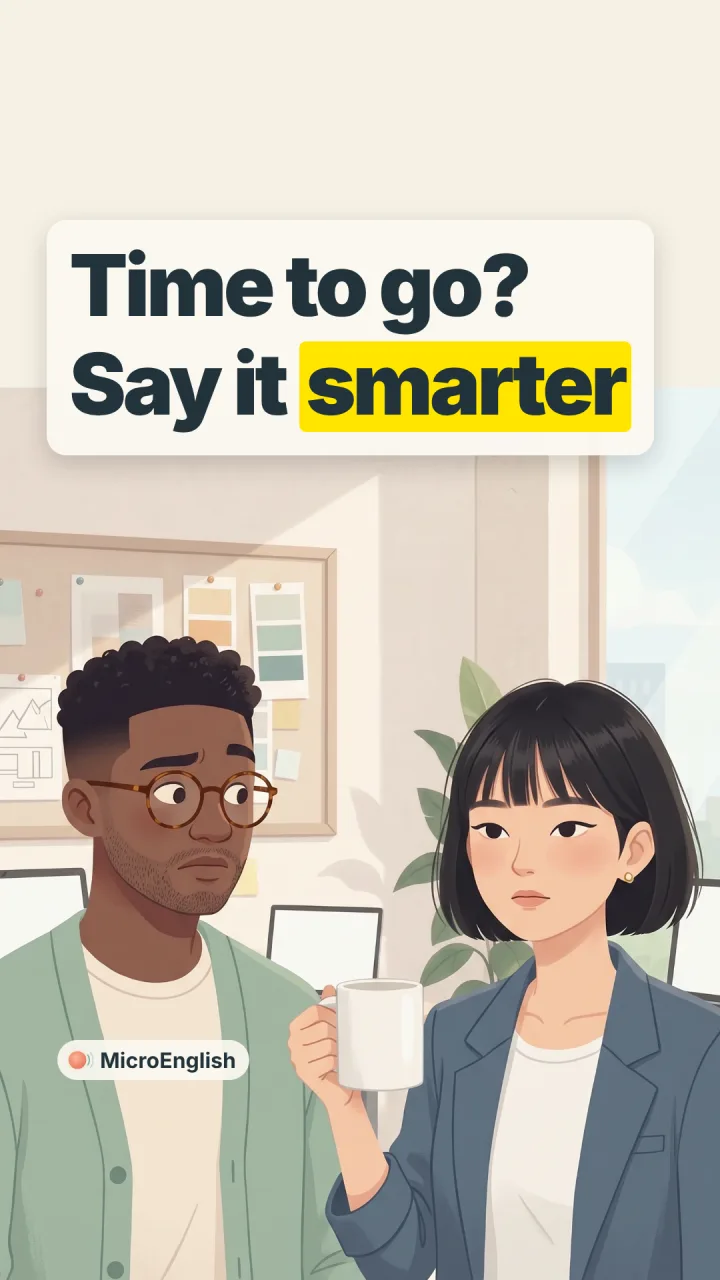
What happens in the video
Hana suggests cutting their meetings to one a week, starting with this one. Nadia answers with a flat "I agree" and asks if she can go now. In the payoff, Nadia says "I couldn't agree more. One short meeting is perfect," and Hana replies that she will book three meetings to plan it.
1 That's a fair point.
Tone Calm and fair
Use it when someone says something reasonable and you want to accept it calmly, often in a discussion or meeting. It can also come before a small disagreement, so don't use it to show strong excitement.
That's a fair point.
For example:
A: We should test the app on older phones too.
B: That's a fair point. Many of our users have older phones.
2 I'm with you on that.
Tone Friendly and supportive
Use it with friends and coworkers to show you are on the same side. In a very formal letter or report, choose "I agree" instead.
I'm with you on that.
For example:
A: I think we should leave early to miss the traffic.
B: I'm with you on that. Let's go at four.
3 I couldn't agree more.
Tone Strong, full agreement
Use it when you agree one hundred percent. It works at work and in daily life, but it sounds odd if you only partly agree.
I couldn't agree more.
For example:
A: Shorter meetings would save everyone time.
B: I couldn't agree more.
4 You're right about that.
Tone Simple and direct
Use it to agree with one specific thing the other person said. It is clear in almost any situation.
For example:
A: The second hotel is closer to the station.
B: You're right about that. Let's book it.
5 Exactly.
Tone Quick and certain
Use it when someone says the same thing you were thinking. Say it with a warm voice, because a flat "Exactly" can sound impatient.
For example:
A: So the problem is the deadline, not the budget?
B: Exactly.
6 That makes sense.
Tone Thoughtful, accepting
Use it after someone explains a reason and you now understand and accept it. It shows agreement with the logic, not strong personal support.
For example:
A: I moved the call to Friday because the client is traveling.
B: That makes sense. Thanks for telling me.
7 Fair enough.
Tone Relaxed, a little reluctant
Use it when you accept someone's reason, even if it was not your first choice. Don't use it for strong, happy agreement.
For example:
A: I can't come tonight. I have an early start tomorrow.
B: Fair enough. Maybe next week?
8 I see what you mean, but...
Tone Polite, partial agreement
Use it to accept part of an idea before you add a different view. Always finish the sentence with your own point.
For example:
A: We should cut all our meetings.
B: I see what you mean, but we still need one a week.
A: Okay, one a week.
Common mistakes
-
Not quite
I am agree with you.Better I agree with you.
Agree is a verb, so it doesn't need am. Say "I agree," or use one of the lines above, such as "I'm with you on that."
-
Not quite
I could agree more.Better I couldn't agree more.
The negative is the point. "I couldn't agree more" means your agreement is already at the maximum. Without the negative, it means you only partly agree.
-
Not quite
That's a fair point. (to show you are very excited about an idea)Better I couldn't agree more.
"That's a fair point" is calm and measured, and people often use it before adding a different view. For full, strong agreement, choose "I couldn't agree more."
Quick quiz
Choose your answer for each question, then open the answer to check it.
-
Your manager suggests a plan you support one hundred percent. Which line fits best?
- Fair enough.
- I couldn't agree more.
- I see what you mean, but...
Show the answer (Question 1)
Answer: I couldn't agree more. "I couldn't agree more" shows complete, strong agreement.
-
What does "I couldn't agree more" mean?
- I don't agree at all.
- I agree completely.
- I agree a little.
Show the answer (Question 2)
Answer: I agree completely. It means it is not possible to agree more than you already do.
-
A coworker says something reasonable in a meeting, and you want to accept it calmly. What can you say?
- That's a fair point.
- Exactly!!
- I could agree more.
Show the answer (Question 3)
Answer: That's a fair point. "That's a fair point" is calm and fair, and it suits meetings and discussions.
-
Which line sounds friendly and shows you are on the same side as a friend?
- I'm with you on that.
- Fair enough.
- That makes sense.
Show the answer (Question 4)
Answer: I'm with you on that. "I'm with you on that" is friendly and supportive, and it works well with friends and coworkers.
-
You only partly agree and want to add your own view. Which line fits?
- I couldn't agree more.
- Exactly.
- I see what you mean, but...
Show the answer (Question 5)
Answer: I see what you mean, but... This line accepts part of the idea and then lets you add a different point.
Questions learners ask
What is a more natural way to say "I agree"?
It depends on how strongly you agree. "That's a fair point" is calm, "I'm with you on that" is friendly, and "I couldn't agree more" shows full agreement. For a quick reply, "Exactly" also works well.
Is "I couldn't agree more" positive or negative?
It is positive. The sentence uses a negative form, but it means you agree completely. You can't agree any more than you already do.
Can I say "I'm with you on that" at work?
Yes. It is friendly and works well with coworkers in conversation and in informal messages. In a formal report or letter, "I agree" is a safer choice.
Does "That's a fair point" always mean full agreement?
No. It means the other person's idea is reasonable. People often use it calmly, and sometimes they add a different view after it, such as "That's a fair point, but we also need to think about cost."
Film lines are short quotes used for language teaching. The dialogue belongs to its rightsholders. Hana and Nadia are animated characters made with Google Flow.