
Micro-listening
Glass, cup, or mug: choose the right word
What is the difference between a glass and a cup?
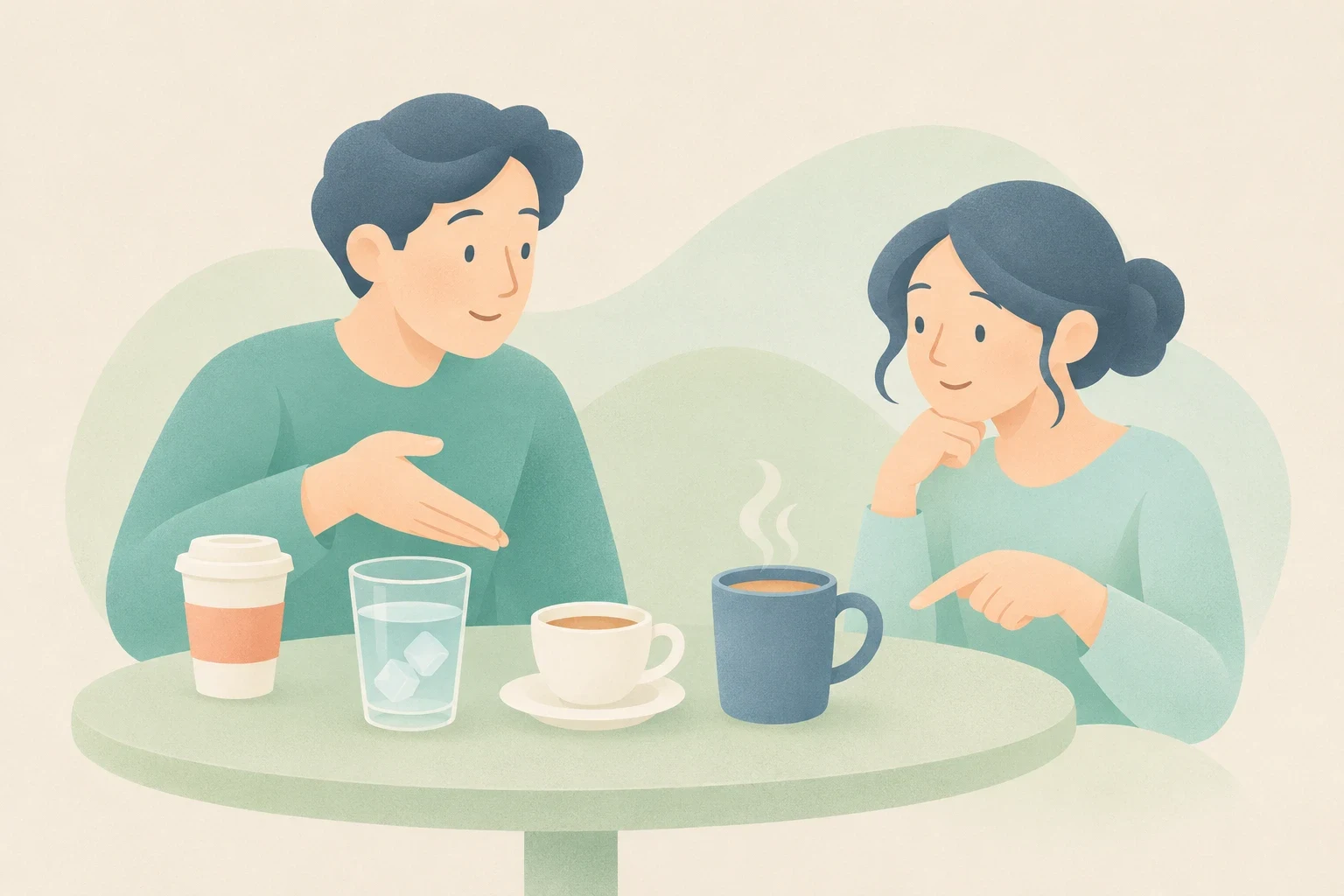
Use a glass for cold drinks like water or juice when the container is made of glass and has no handle. Use a cup for hot drinks like tea or coffee, or for light plastic and paper drink containers.
Key points
- Use a mug for a larger, heavier cup with a handle that you hold in your hand without a small plate underneath.
- Always distinguish countable drinking glasses from uncountable glass material.
- Add of after the container word when you ask for a drink serving, such as a glass of water, a cup of tea, or a mug of coffee.
This lesson has 5 stages. You can stop at any time and continue later.

At a glance
| Word | Typical material | Handle and saucer | Common drinks |
|---|---|---|---|
| a glass | clear glass | no handle, no saucer | cold water, milk, juice, wine |
| a cup | ceramic, paper, or plastic | small handle with a saucer, or disposable without a handle | hot tea, coffee, or water in a disposable cup |
| a mug | thick ceramic or metal | large handle, no saucer | hot coffee, tea, hot chocolate |
Stage 1 of 5
Understand
What it means, when to use it, and mistakes to avoid.
Examples
Could I have a glass of cold water with my lunch, please?
Why it works: Uses a glass of because the drink is cold water served in a transparent glass container without a handle.
3 more examples
-
She poured hot black tea into a small white cup and placed it on a saucer.
Uses a cup for a smaller handled container served with a saucer for a hot drink.
-
He keeps a large blue mug on his office desk for morning coffee.
Uses a mug for a larger, heavier handled container used without a saucer at work or home.
-
Please take a plastic cup from the stack beside the water cooler.
Uses plastic cup because disposable containers made of plastic or paper are called cups even when they hold cold water.
Read the full guide
Choose glass for cold drinks and cup for hot drinks
Use a glass when you drink a cold liquid from a container made of clear glass without a handle. People normally ask for a glass of water, milk, juice, or wine at meals. Use a cup for a smaller container with a handle that holds hot drinks like tea or coffee, often resting on a small plate called a saucer.
-
The waiter brought a glass of orange juice and a glass of ice water to our table.
Why it works: Both drinks are cold and served in clear glass containers without handles.
-
Would you like a cup of hot tea after dinner?
Why it works: Tea is a hot drink served in a handled container, so a cup fits naturally.
Your turn
You are at a restaurant table and want cold tap water in a clear container without a handle. Which request is natural?
Answer: Could I have a glass of water, please?
Show the answer
Answer: Could I have a glass of water, please?
Cold water at a dining table comes in a transparent container made of glass without a handle, so a glass of water is the natural choice.
When to say mug instead of cup
A mug is a larger, heavier type of cup with thick sides and a handle big enough for your fingers. Unlike a traditional teacup, a mug does not use a saucer underneath. People commonly use a mug at home or at an office desk for everyday hot drinks such as morning coffee, herbal tea, or hot chocolate.
-
I warmed my hands around a big mug of hot chocolate after walking in the rain.
Why it works: A mug describes a large, thick container with a handle and no saucer.
-
At formal afternoon tea, the hotel serves Earl Grey in a thin cup with a matching saucer.
Why it works: A smaller, lighter container that sits on a saucer is called a cup rather than a mug.
You can practise this again in Eat, ate, or eaten: choose the right form and Too long or to long: Choose the right word.
Your turn
Which container is large, has thick ceramic sides and a handle, and sits directly on an office desk without a saucer?
Answer: a mug
Show the answer
Answer: a mug
A mug is heavier and larger than a regular teacup, has a handle for hot drinks, and is used without a saucer.
Compare glass, cup, and mug by drink and shape
When you choose between these three words, look at three clues: the material, the handle, and the drink temperature. A glass is made of transparent glass with no handle and holds cold drinks. Both a cup and a mug have handles for hot drinks, while a mug is taller, thicker, and used without a saucer.
-
On the breakfast tray, there was a glass of cold milk and a mug of black coffee.
Why it works: Contrasts a glass for the cold drink with a mug for the larger hot drink.
-
The cafe serves espresso in a small cup on a saucer.
Why it works: Uses a cup when the hot coffee comes in a small container with a saucer.
Your turn
Which feature separates a standard drinking glass from a ceramic mug?
Answer: A glass is made of clear glass without a handle for cold drinks, while a mug has a handle for hot drinks.
Show the answer
Answer: A glass is made of clear glass without a handle for cold drinks, while a mug has a handle for hot drinks.
A drinking glass has no handle and holds cold drinks, whereas a mug has a handle and thick walls for hot drinks.
Say a glass of or a cup of when you ask for a drink
Use a glass of, a cup of, or a mug of before the liquid when you ask for or offer a drink filled with something. For example, ask for a glass of water or a cup of tea. When you talk about the empty container itself, put the drink word first to make a compound noun like a water glass, a teacup, or a coffee mug.
-
Could you bring me a glass of apple juice, please?
Why it works: Uses a glass of + drink noun to ask for a filled serving to drink.
-
She put four clean water glasses and two teacups in the cupboard.
Why it works: Uses water glasses and teacups because the containers are empty tableware.
Your turn
You are unpacking a kitchen box and find an empty ceramic container meant for tea. How do you describe it?
Answer: This box has a clean teacup.
Show the answer
Answer: This box has a clean teacup.
A teacup is the container itself, even when it is empty, while a cup of tea means a cup filled with tea to drink.
Why plastic and paper containers are called cups
Cold drinks do not always go in a glass. Light disposable containers made of paper, thin plastic, or foam are called a paper cup or a plastic cup, even when they have no handle and hold cold water or juice. In addition, recipes use a cup as a standard kitchen measurement, such as a cup of flour or a cup of milk, no matter which container you hold.
-
At the park picnic, we poured cold lemonade into clear plastic cups.
Why it works: Uses plastic cups because the containers are made of plastic, not glass.
-
Add one cup of cold milk and two cups of flour to the mixing bowl.
Why it works: Uses cup and cups for a standard cooking measurement in a recipe.
Your turn
At an office water cooler, there is a stack of light disposable plastic containers for cold water. What do English speakers call one of them?
Answer: a plastic cup
Show the answer
Answer: a plastic cup
Because the container is made of thin disposable plastic rather than actual glass, English speakers call it a plastic cup even when it holds cold water.
Countable a glass versus uncountable glass
The noun glass changes its grammar with its meaning. When you mean a drinking container, it is countable, so you say a glass or two glasses. When you mean the clear hard material used in windows and bottles, glass is uncountable and never takes a or an. Notice that the plural word glasses can also mean the lenses people wear on their faces to see clearly.
-
Please put three clean glasses on the dinner table for our guests.
Why it works: Countable plural glasses means three drinking containers.
-
That green bottle is made of thick glass, so it is heavy to carry.
Why it works: Uncountable glass refers to the transparent material without an article.
-
Maya needs her reading glasses to check the small print on the menu.
Why it works: Plural glasses here refers to eyewear worn on the face.
Your turn
Which sentence uses the word glass correctly for the transparent material?
Answer: Be careful on the kitchen floor because there is broken glass near the sink.
Show the answer
Answer: Be careful on the kitchen floor because there is broken glass near the sink.
When glass means the transparent material rather than a whole drinking container, it is uncountable and does not take a or an.
Hear a glass of and a cup of in fast speech
In natural spoken English, the main nouns glass, cup, and mug carry clear stress, while the small grammar words a and of become very short and quiet. In phrases like a glass of water or a cup of tea, both a and of use a weak vowel sound, and the final consonant of glass or cup links smoothly into of. Listen for the stressed container word and the drink noun after it.
-
Could I get a cup of coffee and a glass of water?
Why it works: In fast speech, cup of sounds like 'cup-uhv' and glass of sounds like 'glass-uhv' before the drink nouns.
-
She left a mug of hot tea on the kitchen counter.
Why it works: The final /g/ sound of mug links directly into the weak vowel of of.
Your turn
When a waiter speaks at normal speed in 'Would you like a glass of water?', why does the word of sound so quiet?
Answer: Because of is reduced to a weak vowel sound between the stressed words glass and water.
Show the answer
Answer: Because of is reduced to a weak vowel sound between the stressed words glass and water.
In connected speech, function words like a and of are unstressed and link directly to the stressed noun glass.
Common mistakes with glass, cup, and mug
Learners often make three small errors when ordering or describing drinks. First, do not call a disposable container at a water cooler a plastic glass; say a plastic cup or a paper cup instead. Second, keep the word of when asking for a serving, such as a glass of juice rather than a juice glass. Third, remember that a recipe asking for a cup of milk refers to a fixed measurement.
-
Could I have a glass of cold milk, please?
Why it works: Includes of because the speaker wants milk to drink, not an empty milk glass.
-
The children drank apple juice from paper cups at the birthday party.
Why it works: Uses paper cups for disposable containers even though the apple juice is cold.
Your turn
You are thirsty at a friend's apartment and want cold orange juice to drink right now. Which sentence avoids a common mistake?
Answer: May I have a glass of orange juice, please?
Show the answer
Answer: May I have a glass of orange juice, please?
When you ask for a filled drink, you need the pattern a glass of + drink noun; an orange juice glass means an empty glass.
Practice choosing glass, cup, or mug in everyday requests
Before you order at a cafe or ask a host for a drink, pause to check the drink temperature and the container type. Ask for a glass of cold water or juice at a dinner table, a cup of tea or coffee when a small cup with a saucer is served, and a mug of coffee or hot chocolate for a bigger casual drink. Use a paper cup or plastic cup for disposable containers.
-
We ordered a mug of hot chocolate, a cup of green tea, and two glasses of tap water.
Why it works: Matches each container word to the drink temperature and serving style.
-
If you take your iced coffee on the bus, the server will put it in a plastic cup with a lid.
Why it works: Uses plastic cup for a takeaway cold drink container.
Your turn
Which order correctly matches all three containers to their drinks at a neighborhood cafe?
Answer: We would like a mug of hot chocolate, a cup of black tea with a saucer, and a glass of cold tap water.
Show the answer
Answer: We would like a mug of hot chocolate, a cup of black tea with a saucer, and a glass of cold tap water.
A mug suits a large hot chocolate, a cup with a saucer suits hot tea, and a glass suits cold tap water.
Questions about "Glass, cup, or mug: choose the right word"
What is the difference between a glass and a cup?
A glass is a drinking container made of transparent glass without a handle, and people normally use it for cold drinks such as water, milk, juice, or wine. A cup is typically made of ceramic, paper, or plastic, often has a handle for hot drinks like tea or coffee, and may sit on a small saucer.
He poured cold milk into a tall glass.
She drank hot coffee from a white ceramic cup.
When should I use mug instead of cup?
Use mug when the container is larger and heavier than a teacup, has thick sides and a handle, and is used without a saucer. People often use a mug at home or at a work desk for a large serving of coffee, tea, or hot chocolate, whereas a cup is smaller or paired with a saucer.
I keep a heavy ceramic mug on my desk for morning coffee.
The waiter served afternoon tea in a small cup on a saucer.
Why do people say a plastic cup of water instead of a plastic glass?
In everyday English, a glass usually means a container made from the material glass. When a light disposable container is made of plastic, paper, or foam, speakers call it a plastic cup or a paper cup, even if it has no handle and holds cold water or juice.
She took a paper cup of cold water from the office cooler.
We packed twenty plastic cups for the cold juice at the picnic.
What is the difference between a cup of tea and a teacup?
A cup of tea is a serving of liquid tea inside a cup ready for you to drink. A teacup is the container itself, whether it is full or empty. The same rule works for a glass of water (the drink serving) versus a water glass (the empty or clean container).
Would you like a warm cup of tea before you leave?
Please place the clean teacups and water glasses in the cabinet.
When is the word glass countable and when is it uncountable?
Glass is countable when you mean a drinking container, so you can ask for a glass of water or wash three glasses. Glass is uncountable when you mean the hard transparent material used to make windows, jars, and bottles. The plural form glasses also refers to eyeglasses worn on the face.
Two water glasses are sitting on the kitchen counter.
Those sauce jars are made of thick recycled glass.
Before you go
Remember this
Match a glass to cold drinks in transparent glass containers without handles, a cup to hot drinks with a saucer or disposable paper and plastic containers, and a mug to larger everyday hot drinks without a saucer. Always distinguish countable drinking glasses from uncountable glass material.
Stage 2 of 5
Listen
Hear it in real sentences, from short to long, and write what you hear.
0 of 4 done
Listening 1 of 4
Listening 2 of 4
Try a longer clip. Listen once, then replay the part you missed.
Listening 3 of 4
This clip is longer. Follow the instruction above the answer field.
Listening 4 of 4
Listen, then type the missing words. The rest of the text is already there.
0:00
Practice complete
You listened closely.
Your result is saved in this browser.
Keep your progress. Your practice is saved on this device only. Create a free account to keep it everywhere.
Create a free accountDaily practice reminder
One short email on days you have not practised yet. Create a free account and confirm your email address to get it.
Create a free accountThat was today's free lesson. Tomorrow you get another one. Want more today? See membership.
Create a free SubLearn account to keep this progress across devices.
Save my progressStage 3 of 5
Speak
Say it with the speaker, then use it in your own answer.
Shadow
Say it along with the speaker
Play the line slowly, then speak at the same time as the speaker. Copy the rhythm, not just the words.
Your turn
Say it your way
Imagine a friend is visiting your kitchen on a warm afternoon. In 20 to 30 seconds, offer them a cold drink in a glass or a plastic cup and a hot drink in a cup or a mug, and explain where the containers are kept.
You could start with “Make yourself comfortable in the kitchen. If you want a cold drink, you can…”
Take ten seconds to think, then answer out loud without looking at the lesson. Speak for the time shown in the task above. Nothing is sent unless you ask for feedback.
0:00
Stage 4 of 5
Write
Write your own response
AI feedback · it can make mistakes · Part of membership See membership
Check your own writing
Read one possible response
Draft saved on this device.
Use these checks to revise your message. Grammar and meaning are not automatically graded. Each task keeps its own draft in this browser tab.

You finished the free part of this lesson
- Understand
- Listen
- Speak
- Write
- CheckPart of membership
Worth another look
With a free account, the lessons you finish come back for review to help you remember them.Create a free account
Stage 5 of 5 · Part of membership
Check
New clips without hints.
Listening tests are included with membership. Try the free dictation first, then decide whether to continue.
Listening 1 of 2 Part of membership
Listening 2 of 2 Part of membership
Follow MicroEnglish
Find lesson updates, short videos and quick quizzes. Pick the app you already use.
Questions & comments
Ask about this lesson, share an example, or help another learner.
Example
Memory tip
Goes with
Related forms
Not to be confused with
In this lesson
This word isn't in our dictionary. Check the spelling, or try another form of the word.
We couldn't load this word. Try again.
