What happens in the video
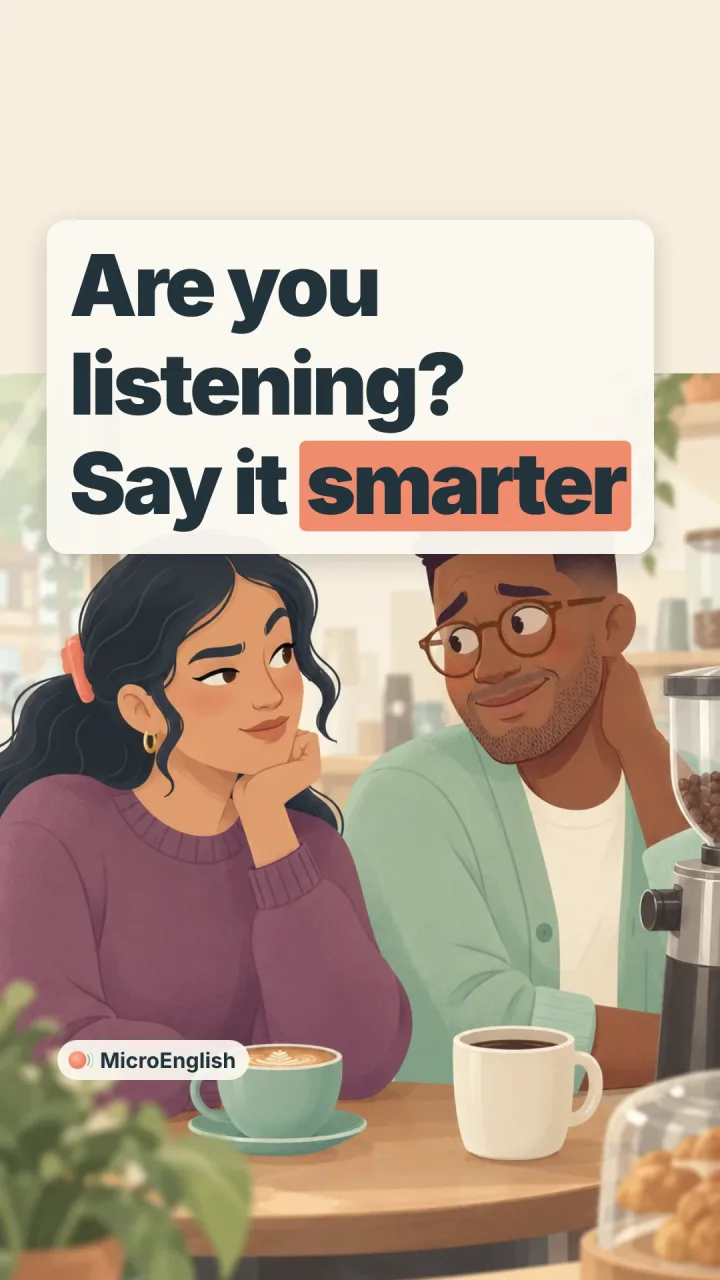
Nadia is explaining an idea to Theo, but she has to ask whether he is listening to her or to the coffee grinder. Theo says sorry and admits the grinder's pitch was more exciting. When Nadia says coffee cups become tiny billboards and asks, "Are you with me?", Theo answers, "I'm with you," and asks if the grinder can star in it.
1 Does that make sense?
Tone Soft and polite
Use it after you explain something, like a plan or an instruction. It checks your words, not their attention, so it doesn't sound like you're blaming the other person.
Does that make sense?
For example:
A: So we meet at nine, then drive to the client together. Does that make sense?
B: Yes, that works. Who's driving?
2 Did you catch that?
Tone Casual quick check
Use it when the other person might not have heard you, for example in a noisy place or on a bad phone line. Here, catch means hear or understand. It is too casual for a formal presentation.
Did you catch that?
For example:
A: The train leaves from platform six, not four. Did you catch that?
B: Six. Got it, thanks.
3 Are you with me?
Tone Direct but friendly
Use it when someone drifts away while you are talking. It's friendly with friends and coworkers. With a boss or a client, a softer line like "Does that make sense?" is safer.
Are you with me?
For example:
A: First we fix the menu, then we change the prices. Are you with me?
B: Sorry, I was thinking about lunch. Can you say that again?
4 Are you following me?
Tone Neutral, a little formal
Use it in the middle of a long or complex explanation. It asks if the person can follow your steps. Don't use it too often in one conversation, or it can sound like you think the listener is slow.
For example:
A: The cost goes up when the order is late. Are you following me?
B: I think so. Late orders cost more.
5 Am I making sense?
Tone Humble and warm
Use it when you are not sure your explanation is clear. It puts the responsibility on you, so it's very polite. It works well in meetings and with people you don't know well.
For example:
A: I want the report shorter but with more numbers. Am I making sense?
B: Yes. Fewer words, more data.
6 Are we on the same page?
Tone Friendly, work-style
Use it to check that you both agree on a plan, not only that the person heard you. It's common at work. Avoid it when you only want to know if someone heard a simple fact.
For example:
A: So the deadline is Friday, and you send the draft by Wednesday. Are we on the same page?
B: Yes, Wednesday for the draft.
7 Any questions so far?
Tone Open and calm
Use it in a class, a training session, or a presentation, after a group of points. It invites the listener to speak. It is less useful in a quick, casual chat.
For example:
A: That's the first part of the process. Any questions so far?
B: Just one. Where do we save the files?
8 Should I go over that again?
Tone Helpful and patient
Use it when the other person looks confused or distracted. It offers help instead of asking them to admit they weren't listening. Don't use it in a sharp voice, or it can sound sarcastic.
For example:
A: Should I go over that again?
B: Yes, please. Just the part about the prices.
Common mistakes
-
Not quite
Are you listening me?Better Are you listening to me?
The verb listen needs the preposition to before the person or thing you hear. You can say "Are you listening?" with no object, but not "listening me."
-
Not quite
A: Are you with me? B: Yes, I'm with me.Better A: Are you with me? B: Yes, I'm with you.
The answer changes the pronoun. Theo says "I'm with you" in the Short because he means he is following Nadia's idea.
-
Not quite
Does it make sense for you?Better Does that make sense? / Does that make sense to you?
With make sense, English uses to for the person, not for. Most speakers just say "Does that make sense?" with that pointing back to what they said.
Quick quiz
Choose your answer for each question, then open the answer to check it.
-
You just explained a new schedule to a coworker. Which line checks your explanation without suggesting they weren't paying attention?
- Are you listening to me?
- Does that make sense?
- Did you catch that?
Show the answer (Question 1)
Answer: Does that make sense? "Does that make sense?" checks your words, not the listener's attention.
-
In "Did you catch that?", what does catch mean?
- Take with your hands
- Hear or understand
- Run after someone
Show the answer (Question 2)
Answer: Hear or understand In this question, catch means hear or understand what was said.
-
Your friend is looking at their phone while you talk. Which line is direct but still friendly?
- Are you with me?
- Any questions so far?
- Am I making sense?
Show the answer (Question 3)
Answer: Are you with me? "Are you with me?" is useful when someone's attention drifts away.
-
Someone asks you, "Are you with me?" Which answer is correct?
- I'm with me.
- I'm with you.
- I'm listening you.
Show the answer (Question 4)
Answer: I'm with you. You answer about the speaker, so the pronoun changes to you.
-
You are teaching a group and want to invite people to speak. Which line fits best?
- Did you catch that?
- Any questions so far?
- Are you with me?
Show the answer (Question 5)
Answer: Any questions so far? "Any questions so far?" opens the floor in a class or presentation.
Questions learners ask
Is "Are you listening to me?" rude?
It's not always rude, but it often sounds annoyed, like a complaint. Many people hear it as "You are not listening." If you want to stay friendly, use "Are you with me?" or "Does that make sense?" instead.
What is the most polite way to check if someone understands?
"Am I making sense?" and "Does that make sense?" are both very polite. They focus on your explanation, so the listener doesn't feel tested. They work in meetings, emails, and calls.
What does "Did you catch that?" mean?
It means "Did you hear or understand what I just said?" It's a casual, quick check. It's useful in noisy places or on the phone, but it can feel too informal in a presentation.
How do I answer "Are you with me?"
If you're following, say "I'm with you" or "Yes, go on." If you lost the thread, be honest: "Sorry, can you say that again?" Both answers are normal and polite.
Film lines are short quotes used for language teaching. The dialogue belongs to its rightsholders. Nadia and Theo are animated characters made with Google Flow.