
Micro-listening
See a doctor or go to the doctor: choose the right phrase
The short answer
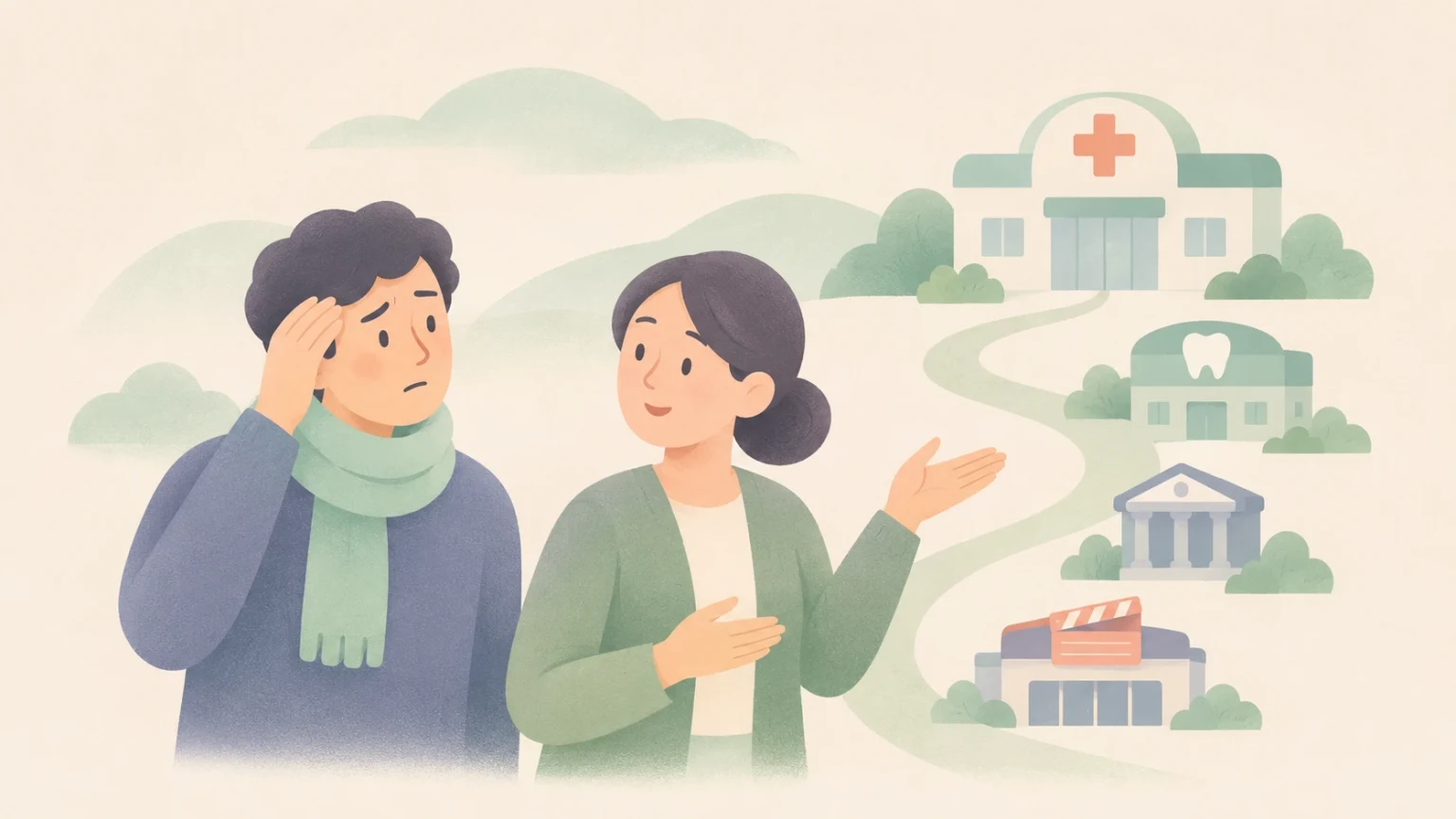
The phrase 'see a doctor' focuses on consulting one qualified medical professional for advice or treatment. You use 'a' because any doctor can examine the symptom and help. The phrase 'go to the doctor' treats a clinic visit as a standard community service, just like 'go to the dentist' or 'go to the bank'.
Key points
- You use 'the' for the type of service even when the listener does not know which clinic you visit.
- Match the phrase to your purpose.
- Say 'see a doctor' when you mean consulting any medical expert about a symptom.
This lesson has 5 stages. You can stop at any time and continue later.

At a glance
| Phrase | Article choice | Main focus | Everyday situation |
|---|---|---|---|
| see a doctor | a (any qualified doctor) | Consulting a professional for medical advice | Advising a friend or coworker with a fever or cough |
| go to the doctor | the (standard community service) | Making a routine clinic visit or errand | Explaining an appointment or a change in your schedule |
Stage 1 of 5
Understand
What it means, when to use it, and mistakes to avoid.
Examples
You have had that cough for a week, so you should see a doctor.
Why it works: Uses 'see a doctor' with 'a' to advise consulting any qualified medical professional about a symptom.
3 more examples
-
I am going to the doctor tomorrow morning, so I will arrive at the office at ten.
Uses 'go to the doctor' with 'the' to explain a routine medical errand on a schedule.
-
After I go to the dentist, I need to go to the bank in town.
Uses 'the' for both standard community services without referring to one unique building known to the listener.
-
Did you see the doctor about your headache this morning?
Uses 'see the doctor' with 'the' because both speakers already know about that specific morning appointment.
Read the full guide
Choose between see a doctor and go to the doctor
Learners often learn to use 'a' for any person and 'the' for one specific person. That general rule makes 'see a doctor' and 'go to the doctor' look confusing when you do not have a particular doctor in mind. In everyday English, use 'see a doctor' when you mean getting medical advice from any doctor, and use 'go to the doctor' when you talk about visiting a clinic as a normal errand or service.
-
If your fever does not come down today, you should see a doctor.
Why it works: Focuses on getting expert medical advice from any doctor who can examine the fever.
-
I have to go to the doctor this afternoon for a quick checkup.
Why it works: Describes visiting a medical clinic as a normal personal errand.
-
She told her manager that she needed to go to the doctor before lunch.
Why it works: Explains a practical schedule errand without naming a specific physician.
Your turn
Your colleague has had a bad cough all week. Which sentence gives the most natural advice?
Answer: You should see a doctor about that cough.
Show the answer
Answer: You should see a doctor about that cough.
Use 'see a doctor' with 'a' when you advise someone to get medical help from any qualified doctor.
Use see a doctor when any qualified doctor can help
Speakers choose 'see a doctor' when the main idea is speaking with a trained professional. In this phrase, 'see' means to consult an expert rather than just look at someone. You use the article 'a' because any qualified doctor can examine the problem and give advice. You do not need to name a specific clinic or physician. This pattern often follows 'should', 'need to', or 'have to' when discussing symptoms.
-
He has a terrible headache and needs to see a doctor soon.
Why it works: Uses 'see a doctor' after 'needs to' because any qualified physician can check his headache.
-
When a cough lasts more than two weeks, you should see a doctor.
Why it works: Gives general health advice about consulting a member of the medical profession.
-
Did you see a doctor while you were ill on holiday?
Why it works: Asks whether the listener consulted any medical professional during the trip.
You can practise this again in See, look, or watch: choose the right verb and See or watch: Choose the right verb.
Your turn
Why does English use 'a' in the advice 'You should see a doctor'?
Answer: Because the speaker means consulting any qualified member of the medical profession.
Show the answer
Answer: Because the speaker means consulting any qualified member of the medical profession.
In 'see a doctor', 'a' shows that any qualified doctor can give the needed medical advice.
Use go to the doctor for a routine visit or clinic
English uses 'the' for familiar public and personal services that people use in daily life. When you say 'go to the doctor', you treat the medical visit as a standard community service. The listener does not need to know which doctor or clinic you use. This phrase is not limited to an old family doctor you already know. You can say 'go to the doctor' even when visiting a brand-new clinic. Compare schedule expressions in /grammar/future-plans/ and /micro-listenings/2-2/.
-
I am going to the doctor tomorrow, so I cannot join the early meeting.
Why it works: Uses present continuous with 'going to the doctor' to explain a planned clinic visit.
-
Even in a new city, you can go to the doctor at a walk-in clinic.
Why it works: Shows that 'go to the doctor' works for any clinic service, not only a longtime family physician.
-
How often do you go to the doctor for a routine health check?
Why it works: Treats medical checkups as a regular everyday service.
Your turn
You are visiting a new clinic in town tomorrow morning. How do you explain your morning errand to a coworker?
Answer: I have to go to the doctor tomorrow morning.
Show the answer
Answer: I have to go to the doctor tomorrow morning.
Use 'go to the doctor' for a clinic visit as an everyday errand, even when the clinic is new or unknown to the listener.
When people say the doctor's or the dentist's
In everyday conversation, speakers often add an apostrophe and 's' to say 'go to the doctor's'. This possessive form points to the workplace of the medical professional. In American English, it is short for 'the doctor's office'. In British English, it is short for 'the doctor's surgery'. Both 'go to the doctor' and 'go to the doctor's' sound completely natural in daily speech. Speakers use the exact same choice with 'go to the dentist' and 'go to the dentist's'.
Both 'go to the doctor' and 'go to the doctor's' fit everyday spoken English and casual messages. After the verb 'see', always keep the person form 'see a doctor' or 'see the doctor' without an apostrophe and 's'.
American speakers expand 'the doctor's' to 'the doctor's office'. British speakers often call the same place 'the doctor's surgery'. Despite the different place nouns, the short form 'go to the doctor's' works in both regions.
-
I am going to the doctor's after work to pick up a prescription.
Why it works: Uses the conversational possessive form 'the doctor's' to mean the clinic or office.
-
She went to the dentist's on Tuesday for a routine cleaning.
Why it works: Applies the same possessive workplace pattern to a dental visit.
-
Wait for me outside the doctor's office next to the pharmacy.
Why it works: Uses the full American English noun phrase 'the doctor's office'.
Your turn
What does 'the doctor's' stand for in the sentence 'I am going to the doctor's this afternoon'?
Answer: The doctor's office in American English or the doctor's surgery in British English.
Show the answer
Answer: The doctor's office in American English or the doctor's surgery in British English.
The possessive form 'the doctor's' refers to the place where the doctor works: the office or surgery.
Use the same pattern with the dentist, the bank, and the cinema
The pattern in 'go to the doctor' belongs to a wider group of everyday errands and leisure places. English speakers say 'go to the dentist', 'go to the bank', 'go to the cinema', and 'go to the post office'. In all of these expressions, 'the' names the familiar type of place or service. You do not need to have one unique building in mind that both speakers could point to on a map.
| Service expression | What 'the' identifies | Natural example |
|---|---|---|
| go to the dentist | Dental care as a familiar personal service | I go to the dentist every six months. |
| go to the bank | Banking service at any branch counter | He needs to go to the bank during his lunch break. |
| go to the cinema | Going out to watch a film at a theater | We like to go to the cinema on Friday nights. |
| go to the post office | Postal service for sending packages or letters | Can you go to the post office to mail this parcel? |
-
I have to go to the bank before it closes at four.
Why it works: Uses 'the bank' for a routine financial errand without naming a specific branch.
-
Let's go to the cinema this evening if you finish work on time.
Why it works: Uses 'the cinema' for the activity of going out to see a film.
-
She stopped at the post office on her way home from the dentist.
Why it works: Pairs two familiar community services that both take 'the'.
Your turn
Which sentence uses articles naturally for everyday errands in town?
Answer: I need to go to the bank and then go to the dentist.
Show the answer
Answer: I need to go to the bank and then go to the dentist.
Regular community services such as 'the bank' and 'the dentist' take 'the' after 'go to'.
When to say see the doctor or go to a doctor
You can also swap the articles when the situation calls for a different meaning. Use 'see the doctor' when both speakers already know which appointment or physician you mean. For example, a partner at home can ask about your morning appointment by saying, 'Did you see the doctor?' Use 'go to a doctor' when you emphasize going to any doctor at all instead of ignoring a health problem. Review basic article rules in /micro-listenings/a-an-and-the-choose-an-article-listening-practice/.
-
Did you see the doctor this morning, and what did she say about your cough?
Why it works: Uses 'see the doctor' because both speakers know about that specific morning appointment.
-
Please wait in the reception area until you can see the doctor.
Why it works: Refers to the specific physician on duty at the clinic where the patient is waiting.
-
Do not ignore that fever any longer; please go to a doctor today.
Why it works: Uses 'go to a doctor' to urge someone to visit any medical clinic rather than stay home.
Your turn
Your brother had a medical appointment at nine o'clock this morning. What can you ask him at lunch?
Answer: Did you see the doctor this morning?
Show the answer
Answer: Did you see the doctor this morning?
Use 'see the doctor' when referring to a specific appointment or doctor that both speakers already know about.
Hear weak a and the in fast spoken English
In connected speech, 'a' and 'the' are both short, unstressed words. Speakers pronounce 'a' as a quiet schwa vowel /ə/ linked right onto the verb 'see'. They pronounce 'the' as a quick /ðə/ right after 'go to'. Because both articles are quiet, you can miss them if you only listen for a loud vowel. Listen for the complete verb frame, either 'see a' or 'go to the', along with the situation.
Keep the rhythm smooth by putting stress on the content words and reducing the articles to weak forms.
-
You should see a doctor as soon as possible.
Why it works: In fast speech, 'see a' links together as /siːjə/ before the stressed noun 'doctor'.
-
I always go to the doctor in my local clinic.
Why it works: The two weak syllables 'to the' (/tə ðə/) create a two-beat bridge after 'go'.
-
I have to go to the dentist early tomorrow morning.
Why it works: Listen for the verb 'go' plus two rapid weak words before the stressed word 'dentist'.
Your turn
Why can 'a' and 'the' be difficult to catch in fast spoken sentences like 'You should see a doctor'?
Answer: Because both articles are pronounced as short, unstressed weak forms between stressed content words.
Show the answer
Answer: Because both articles are pronounced as short, unstressed weak forms between stressed content words.
In connected speech, 'a' (/ə/) and 'the' (/ðə/) are weak and unstressed, so listening for the full verb frame helps you recover them.
Fix common article mistakes with medical visits
A common mistake is dropping the article and saying 'go to doctor' or 'see doctor'. Learners often do this because English uses no article in 'go to school', 'go to work', and 'go to bed'. Those zero-article phrases describe daily life institutions where you spend hours as a student, worker, or sleeper. Service visits like 'the doctor', 'the dentist', and 'the bank' always keep their article. Compare health habits in /micro-listenings/8-hours-of-sleep/ and medicine guidance in /micro-listenings/3-2/.
Compare zero-article institutions with countable service visits so you never leave out 'a' or 'the'.
-
I need to go to the doctor before I go to work today.
Why it works: Contrasts 'go to the doctor' (with 'the') and 'go to work' (with no article) in the same sentence.
-
After the children go to school, I will go to the bank.
Why it works: Shows zero article with 'school' and 'the' with the community service 'the bank'.
-
Take your medicine, drink some water, and go to bed early.
Why it works: Uses no article in the fixed daily expression 'go to bed'.
Your turn
Which sentence correctly contrasts an errand service with a zero-article institution?
Answer: I will go to the doctor before I go to work.
Show the answer
Answer: I will go to the doctor before I go to work.
Use 'the' for community services like 'go to the doctor', and use no article for daily institutions like 'go to work'.
Recall the right phrase in everyday health situations
When you speak or write in a real health situation, decide first whether you are giving medical advice or describing an errand. Use 'see a doctor' when you tell someone with a cough, fever, or headache to consult a medical professional. Use 'go to the doctor' or 'go to the doctor's' when you explain an appointment on your schedule. Apply the same 'go to the' pattern to the dentist, the bank, and the cinema.
-
If your headache keeps coming back, you really should see a doctor.
Why it works: Chooses 'see a doctor' to recommend consulting a medical expert about a recurring symptom.
-
I am going to the doctor's at eleven, and then I will pick up my medicine.
Why it works: Chooses 'going to the doctor's' to describe a scheduled clinic errand.
-
On my day off, I plan to go to the dentist and go to the cinema.
Why it works: Uses 'go to the' consistently across a personal care service and a leisure place.
Your turn
Choose the sentence where both medical clauses use articles accurately.
Answer: My friend told me to see a doctor, so I am going to the doctor tomorrow.
Show the answer
Answer: My friend told me to see a doctor, so I am going to the doctor tomorrow.
Use 'see a doctor' for the advice to consult a professional, and 'going to the doctor' for the planned clinic visit.
Questions about "See a doctor or go to the doctor: choose the right phrase"
Why do we say 'go to the doctor' even when the listener does not know which doctor we mean?
In this phrase, 'the' does not point to one famous person that everyone knows. Instead, English uses 'the' to name a standard community service that people use in daily life. When you say 'go to the doctor', you mean using medical clinic services as a familiar errand. You can use it even when visiting a clinic for the first time.
I need to go to the doctor this week because my ear hurts.
She moved here last month and had to go to the doctor at a local clinic.
Is it 'go to the doctor' or 'go to the doctor's'?
Both forms are natural and common in everyday English. 'Go to the doctor' names the professional service, while 'go to the doctor's' refers to the workplace. In American English, 'the doctor's' is short for 'the doctor's office'. In British English, it is short for 'the doctor's surgery'. Never add the apostrophe and 's' after 'see' in 'see a doctor'.
I have to go to the doctor tomorrow afternoon.
He is going to the doctor's after lunch to get his test results.
Can I say 'see the doctor' or 'go to a doctor'?
Yes, you can use both phrases when the situation fits. Say 'see the doctor' when you mean a specific appointment or a physician that both you and the listener already know about. Say 'go to a doctor' when you want to stress visiting any medical clinic at all instead of ignoring a cough, fever, or pain.
Did you see the doctor at your ten o'clock appointment?
You cannot ignore that high fever; please go to a doctor today.
Why do 'go to the dentist', 'go to the bank', and 'go to the cinema' also use 'the'?
These expressions follow the same everyday service pattern as 'go to the doctor'. When you say 'go to the dentist', 'go to the bank', 'go to the cinema', or 'go to the post office', 'the' identifies the type of public service or leisure activity. You do not need to mean one unique building in the city.
I need to go to the bank before we go to the cinema tonight.
She goes to the dentist twice a year for a checkup.
Can I say 'go to doctor' without 'a' or 'the', like 'go to work' or 'go to school'?
No, 'go to doctor' without an article is incorrect in standard English. Phrases like 'go to work', 'go to school', and 'go to bed' use no article because they describe daily institutions where you spend time in a regular role. Countable service places like 'the doctor', 'the dentist', and 'the bank' always require an article.
I have to go to the doctor before I go to work this morning.
After the children go to school, their father will go to the dentist.
Before you go
Remember this
Match the phrase to your purpose. Say 'see a doctor' when you mean consulting any medical expert about a symptom. Say 'go to the doctor' or 'go to the doctor's' when you describe a clinic visit as an everyday errand. Keep 'the' with other regular community services such as 'the dentist', 'the bank', 'the cinema', and 'the post office', and never drop the article to say 'go to doctor'.
Stage 2 of 5
Listen
Hear it in real sentences, from short to long, and write what you hear.
0 of 4 done
Listening 1 of 4
Listening 2 of 4
Try a longer clip. Listen once, then replay the part you missed.
Listening 3 of 4
This clip is longer. Follow the instruction above the answer field.
Listening 4 of 4
Listen, then type the missing words. The rest of the text is already there.
0:00
Practice complete
You listened closely.
Your result is saved in this browser.
Keep your progress. Your practice is saved on this device only. Create a free account to keep it everywhere.
Create a free accountDaily practice reminder
One short email on days you have not practised yet. Create a free account and confirm your email address to get it.
Create a free accountThat was today's free lesson. Tomorrow you get another one. Want more today? See membership.
Create a free SubLearn account to keep this progress across devices.
Save my progressStage 3 of 5
Speak
Say it with the speaker, then use it in your own answer.
Shadow
Say it along with the speaker
Play the line slowly, then speak at the same time as the speaker. Copy the rhythm, not just the words.
Your turn
Say it your way
Speak for 20 to 30 seconds as if leaving a voice message for a friend who has had a bad headache and cough for days. Advise your friend to see a doctor, and mention when you next plan to go to the doctor or the dentist yourself.
You could start with “I heard that you still have a bad cough, so I think you should…”
Take ten seconds to think, then answer out loud without looking at the lesson. Speak for the time shown in the task above. Nothing is sent unless you ask for feedback.
0:00
Stage 4 of 5
Write
Write your own response
AI feedback · it can make mistakes · Part of membership See membership
Check your own writing
Read one possible response
Draft saved on this device.
Use these checks to revise your message. Grammar and meaning are not automatically graded. Each task keeps its own draft in this browser tab.

You finished the free part of this lesson
- Understand
- Listen
- Speak
- Write
- CheckPart of membership
Worth another look
With a free account, the lessons you finish come back for review to help you remember them.Create a free account
Stage 5 of 5 · Part of membership
Check
New clips without hints.
Listening tests are included with membership. Try the free dictation first, then decide whether to continue.
Listening 1 of 2 Part of membership
Listening 2 of 2 Part of membership
Follow MicroEnglish
Find lesson updates, short videos and quick quizzes. Pick the app you already use.
Questions & comments
Ask about this lesson, share an example, or help another learner.
Example
Memory tip
Goes with
Related forms
Not to be confused with
In this lesson
This word isn't in our dictionary. Check the spelling, or try another form of the word.
We couldn't load this word. Try again.
