Everyday listening · B1
Changing a plan
Follow a changed plan: hear the reason, the agreed time and whether the meeting place stays the same.
Try the first dictation free. Full practice and tests follow your existing membership access.
Examples
I can still meet you today, but I am running fifteen minutes late.
Why it works: The word but introduces an unexpected delay without cancelling the planned get-together.
2 more examples
-
Could we start our practice session at two o'clock instead?
The phrase could we combined with instead makes a polite proposal for a replacement time.
-
That works for me, so I will see you in the library lobby then.
The phrase that works for me clearly confirms agreement with the proposed time.
Read the full guide
Try the listening exercise
A changed plan means checking what is different
When a plan changes, identify what is different and what stays the same. A new time may leave the place and activity unchanged. The written sports-center example below shows that pattern; it is separate from the bike-ride recording. Check each detail rather than assuming the whole plan has been canceled.
-
We are still meeting at the sports center, but we need to start thirty minutes later.
Why it works: The activity and location remain the same while only the start time moves.
-
I have to call off our bike ride today because it is raining heavily.
Why it works: This sentence describes a full cancellation where no activity takes place.
Your turn
In the sports-center example, which part of the plan changes?
Answer: The start time.
Show the answer
Answer: The start time.
The friends still meet at the sports center, but they start thirty minutes later.
Listen for whether the ride is canceled or delayed
On the first listen, check whether the ride is canceled, delayed or still undecided. A flat tire does not automatically cancel it, and a new time is not an agreement on its own. Listen for a solution and acceptance. Some lines below are adapted from the dialogue. Use the Practice recording to hear what the friends decide.
-
Hi, are you ready for our bike ride at ten?
Why it works: This opening question confirms the original plan before any problem is announced.
-
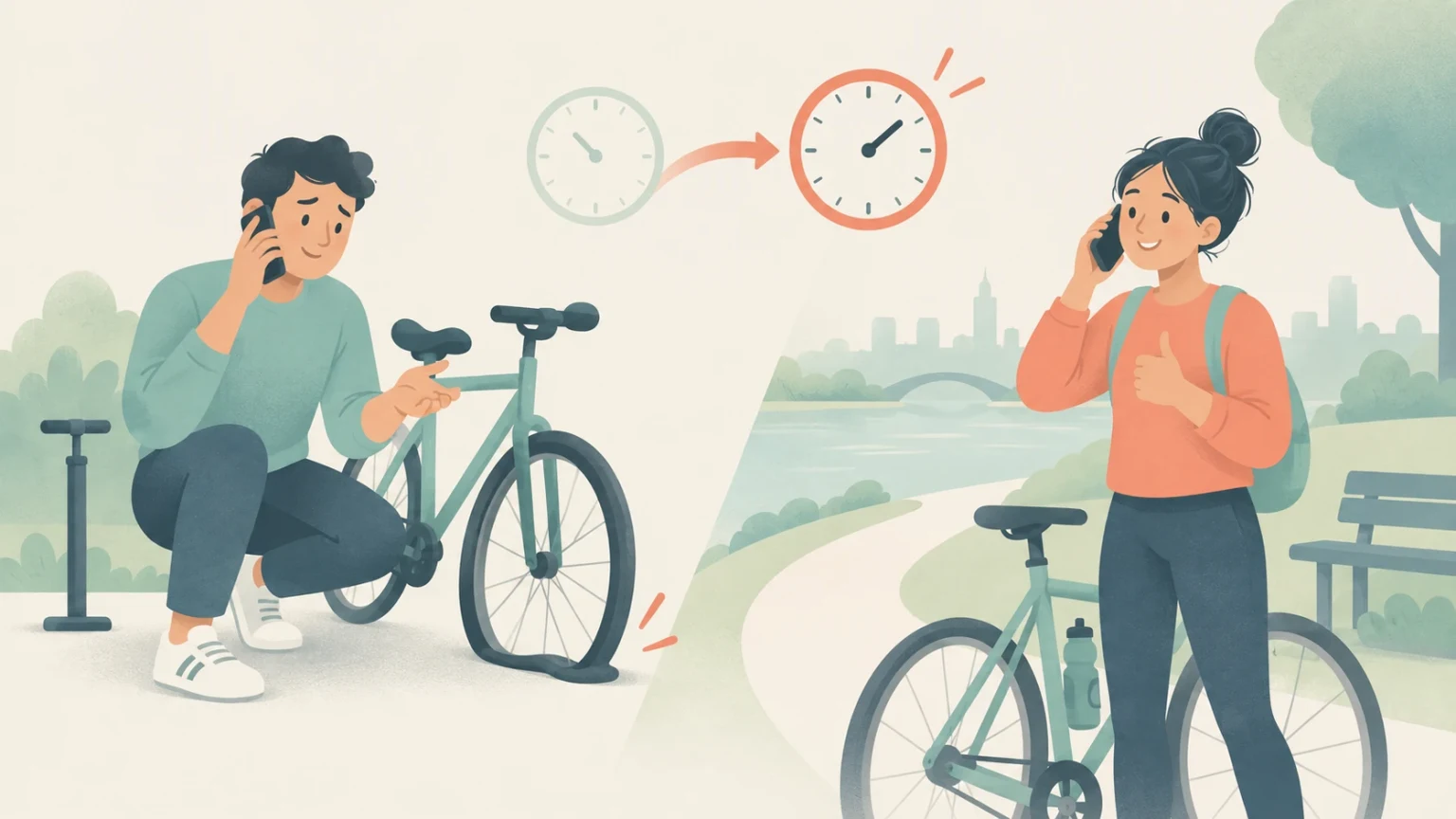
Not yet, I have a flat tire on my front wheel.
Why it works: The speaker states the obstacle clearly without immediately cancelling the meeting.
-
No, I can fix it quickly, so let us still go.
Why it works: The speaker clarifies that the ride is not canceled despite the mechanical problem.
You can practise this again in Future plans and Changing a restaurant booking.
Your turn
On your first listen to the dialogue, what happens to the bike ride?
Answer: The ride is delayed to a later time rather than canceled.
Show the answer
Answer: The ride is delayed to a later time rather than canceled.
The speaker says the tire can be repaired quickly, and the friends accept a later time for the ride.
Separate a proposed time from an agreed time
Separate five details: the reason, original time, proposed time, agreed time and place. A proposed time becomes agreed only when the other person accepts it. The written exchange below lets you compare those stages. Then listen in Practice and note each detail yourself; this guide's worked example is not an unseen listening test.
-
Are you ready for our bike ride at ten?
Why it works: This reflects the original schedule before any delay was introduced.
-
Could we meet at half past ten instead?
Why it works: This is the proposed replacement time offered to accommodate fixing the flat tire.
-
That works for me. Are we still meeting at the park entrance?
Why it works: This acceptance confirms half past ten as the agreed time and verifies that the location stays the same.
Your turn
In the written exchange above, which reply accepts the proposed time?
Answer: That works for me. Are we still meeting at the park entrance?
Show the answer
Answer: That works for me. Are we still meeting at the park entrance?
'That works for me' accepts the suggestion. The question about the park entrance then checks whether the place stays the same.
Use staged hints before revealing the conversation
Replay, then open the first Practice hint. Open the next only if you still need help. Dictation hints give a word count, opening words and then a blank outline. For the conversation's gap-fill, hints give the gap count, first gap's position and then word beginnings. 'But' marks contrast, 'instead' marks a replacement and 'still' shows that something continues.
-
I want to go, but I have a flat tire.
Why it works: The word but signals contrast between the speaker's desire and the physical obstacle, not merely a reason.
-
Could we meet at half past ten instead?
Why it works: The word instead explicitly marks half past ten as a replacement for the earlier hour.
-
We can still meet near the main park gate.
Why it works: The word still signals continuity, indicating that the meeting spot remains unchanged despite the schedule shift.
Your turn
How is 'still' different from 'but' and 'instead'?
Answer: 'Still' shows something continues; 'but' marks contrast and 'instead' marks a replacement.
Show the answer
Answer: 'Still' shows something continues; 'but' marks contrast and 'instead' marks a replacement.
In 'We can still meet there', the place remains possible. 'But' contrasts two ideas, while 'instead' replaces one choice with another.
Use could we to suggest a change and confirm agreement
Use 'could we' with a base verb to suggest a change politely. 'Make it' plus a time means 'set the meeting for that time'. The written question below proposes a time; it is not about past ability. 'Instead' marks the replacement, and 'that works for me' accepts it. Repeat the new time and place to check the arrangement.
-
Could we make it half past ten instead?
Why it works: Could we with the base verb make refers to future scheduling, proposing a replacement time politely.
-
That works for me.
Why it works: An idiomatic acceptance confirming that the proposed arrangement is suitable.
-
That works for me; I will see you at the park entrance at ten thirty.
Why it works: An explicit confirmation repeating the agreed time and unchanged location to avoid confusion.
Your turn
What does the phrase could we make it ten thirty instead express in an everyday conversation?
Answer: A polite proposal for a replacement meeting time in the present or future.
Show the answer
Answer: A polite proposal for a replacement meeting time in the present or future.
Could we followed by the base verb make it and instead functions as a polite proposal to replace an earlier time with a new one.
Recognize short linked words and half past
Short words such as 'we' and 'at' may be quick or unstressed. In the Practice dialogue, replay 'could we meet at' and 'fix it' rather than expecting a pause between every word. The written examples below show other patterns; they are not additional audio clips. Stress may highlight a new time, but listen for the other person's acceptance too.
Half past ten means 10:30. In informal British English, half ten can have the same meaning. Ten thirty or half past ten makes the intended time clearer across different varieties of English.
-
Could we make it at ten thirty?
Why it works: In speech, 'we' and 'at' are often weak, and 'make' can link into 'it'. This is a written example, not a separate audio clip.
-
I can't leave yet, so could we meet at half past TEN instead?
Why it works: 'Can't' signals a limitation. The capitals mark possible emphasis on the proposed time in this written example; listen to an actual recording to hear its stress.
-
She asked to meet at half ten, which means ten thirty.
Why it works: In colloquial British English, half ten refers to 10:30, not 9:30 or 5:00.
Your turn
Read: 'Could we meet at half past ten?' — 'That works for me.' Which time has been accepted?
Answer: 10:30.
Show the answer
Answer: 10:30.
'Half past ten' means 10:30, and 'that works for me' accepts it. In audio, stress can be a clue, but listen for the words and the reply too.
Avoid confusing a suggestion with a confirmed arrangement
A question can suggest a new time without settling the plan. The other person may accept it or offer another time. Listen for a reply such as 'that works for me', 'sounds good' or 'see you then' before treating the time as agreed. If the reply rejects it or stays uncertain, the plan is not yet settled.
-
Could we meet at eleven instead? Actually, that is too late for me.
Why it works: Eleven was proposed but rejected immediately, demonstrating why suggestions are not agreements.
-
How about ten thirty? That works for me.
Why it works: The suggestion is followed by clear acceptance, making ten thirty the settled time.
Your turn
Why wait for the other person's reply before treating a proposed time as settled?
Answer: They may accept it, reject it or suggest another time.
Show the answer
Answer: They may accept it, reject it or suggest another time.
A suggestion is not an agreement until the other person accepts it. If it is rejected, the plan is not settled yet.
Practice the recordings and check the final plan
Use the Practice recordings for dictation and gap-fill. Then cover the worked examples and answer the check below from memory. Replay the Practice dialogue to check the reason, agreed time and place, including the reply that accepts the suggestion. Use the separate Test recordings last; they contain a different update.
-
I can't meet at ten, so let us meet at half past ten at the park entrance.
Why it works: Failing to hear the contraction can't would cause you to misrecord the original time as the agreed time.
-
The friends had to delay their ride because of a flat tire, but the meeting spot stayed the same.
Why it works: This summary recalls the three essential facts: the obstacle, the delay, and the unchanged location.
Your turn
Which summary matches the final arrangement in the bike-ride conversation?
Answer: The friends agree to meet at the park entrance at half past ten, allowing time to repair the flat tire.
Show the answer
Answer: The friends agree to meet at the park entrance at half past ten, allowing time to repair the flat tire.
They say the tire can be repaired quickly and accept half past ten at the same park entrance. The conversation agrees the plan; it does not show the repair being completed.
Use it naturally
How people really use “That works for me”
Neutral Fine almost anywhere, at work or with friends.
Words it often goes with
- works well for meAn early start works well for me.
- works for me tooMeeting at eight works for me too.
- works for me tomorrowThat time works for me tomorrow.
What people also say
- “That works for me.” instead of “That arrangement is acceptable to me.” Use this simple reply when you agree to a suggested plan.
Before you go
Remember this
A delayed plan is not a canceled plan. When a speaker suggests a new time using could we and instead, wait for clear acceptance before writing the time down. The original ten o'clock ride moves to half past ten, while the park entrance stays unchanged.
Follow MicroEnglish
Find lesson updates, short videos and quick quizzes. Pick the app you already use.
Questions about "Changing a plan"
How do I know if the plan is canceled or just changed?
Check whether the original activity still happens. 'I can't make it' means 'I can't come'; 'at all' rules out coming for that occasion. 'Call off' means cancel. A new time with 'later' or 'instead' suggests a change, but listen for acceptance. Someone may cancel one plan and suggest another day, so use the whole reply rather than one word alone.
I cannot make it today at all.
Could we meet thirty minutes later instead?
Which time should I remember when I hear two times?
Focus on the time that both speakers accept. The first time is often the original plan or a rejected suggestion. The second time is usually the replacement idea, but it only becomes the actual meeting time once the other person confirms it with words like that works for me or see you then.
Ten o'clock was our first plan, but ten thirty is when we will actually meet.
How can I politely ask to meet later?
Use 'could we' with a base verb and a proposed time. Add 'instead' to mark a replacement. To ask whether the time suits the other person, use 'does' with the base form 'work', not 'works'. The examples below show both the suggestion and the question.
Could we meet at half past ten instead?
Does ten thirty work for you?
Does half ten mean 10:30?
In informal British English, half ten can mean 10:30. The expression alone does not say morning or evening. Ten thirty or half past ten makes the time clearer across different varieties of English; add morning or evening when the context is unclear.
Do you mean half ten in the morning or in the evening?
I will meet you at ten thirty near the gate.
What does that works for me mean?
The expression that works for me means that a proposal is convenient and acceptable. It does not mean someone is doing physical labor. It simply confirms that the suggested time, location, or arrangement fits your schedule without creating a problem.
Ten thirty works for me, so let us meet then.
That location works well for both of us.
What should I listen for if I miss some words?
On a first listen for meaning, focus on the problem, time and agreement. Then replay to check smaller words, especially negatives and prepositions. Dictation asks for the recorded words; in a gap-fill, enter only the missing words. 'But' and 'instead' can flag a change; 'still' can show something continues.
Listen for but to notice the problem.
Catch the replacement time after could we.
Listen first
Listen and write
Replay the recording and type the exact words. Use a hint if you need one.
0 of 4 done
Listening 1 of 4
Listening 2 of 4
Try a longer clip. Listen once, then replay the part you missed.
Listening 3 of 4
This clip is longer. Follow the instruction above the answer field.
Listening 4 of 4
Listen, then type the missing words. The rest of the text is already there.
0:00
Practice complete
You listened closely.
Your result is saved in this browser.
Keep your progress. Your practice is saved on this device only. Create a free account to keep it everywhere.
Create a free accountThat was today's free lesson. Tomorrow you get another one. Want more today? See membership.
Create a free SubLearn account to keep this progress across devices.
Save my progressWrite your own response
AI feedback · it can make mistakes · Part of membership See membership
Check your own writing
Read one possible response
Draft saved on this device.
Use these checks to revise your message. Grammar and meaning are not automatically graded. Each task keeps its own draft in this browser tab.
More ways to practise
Speaking, further practice and member writing feedback are optional. Your own message and exact dictation are separate activities.
Your turn
Say it your way
Leave a voicemail for your friend explaining that your bus is delayed, proposing to meet thirty minutes later, and confirming that the café entrance remains the same.
You could start with “Hi, I am running a little late because…”
Take ten seconds to think, then answer out loud without looking at the lesson. Speak for the time shown in the task above. Nothing is sent unless you ask for feedback.
0:00
Shadow
Say it along with the speaker
Play the line slowly, then speak at the same time as the speaker. Copy the rhythm, not just the words.
Test yourself
Listening tests are included with membership. Try the free dictation first, then decide whether to continue.
Listening 1 of 2 Part of membership
Listening 2 of 2 Part of membership
Questions & comments
Ask about this lesson, share an example, or help another learner.
