Idiom
To get a word in edgeways
Is there any difference in meaning between 'edgeways' and 'edgewise'?
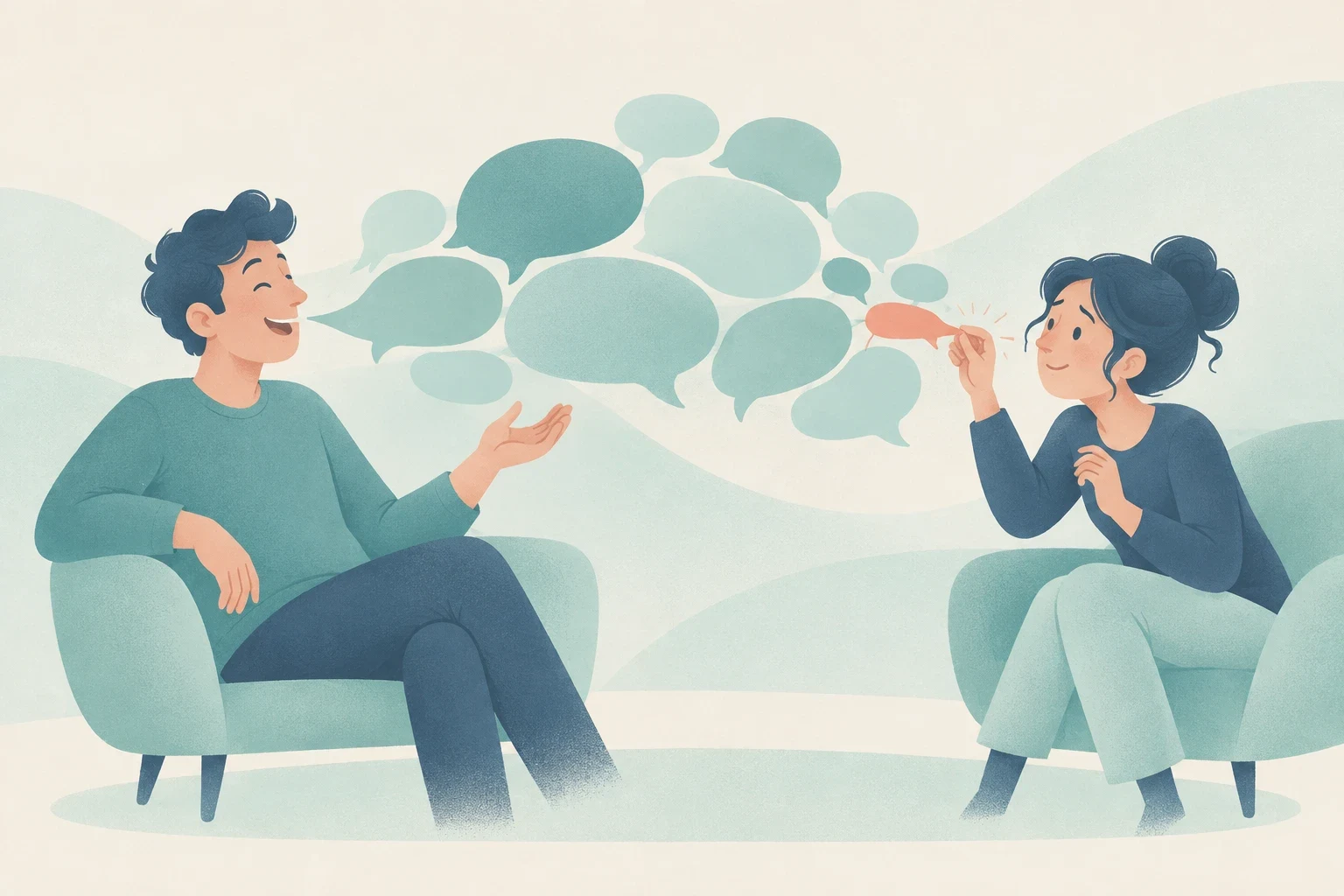
To get a word in edgeways means to find a brief opening to speak while another person or group talks almost continuously.
Key points
- Use 'get a word in edgeways' when continuous talking makes it hard to speak.
- Negative forms such as 'couldn't' and 'hardly' are useful, but positive sentences also work when someone finds a chance to speak.
- 'Edgeways' is the usual British form; 'edgewise' is the usual American form.
Can you use "To get a word in edgeways" yourself?
This lesson has 5 stages. You can stop at any time and continue later.

Stage 1 of 5
Understand
What it means, when to use it, and mistakes to avoid.
Examples
Marcus spoke so rapidly about the schedule that nobody could get a word in edgeways.
Why it works: Shows the typical negative pattern with 'could not' to describe an impossible speaking situation.
2 more examples
-
I waited for Nina to take a breath and finally got a word in edgeways.
Uses the past simple 'got' in a positive sentence to show successful timing after continuous speech.
-
My supervisor talks without pausing, so I can hardly get a word in edgewise during our weekly check-ins.
Demonstrates the standard American variant 'edgewise' combined with the negative adverb 'hardly'.
Read the full guide
Recognizing When One Speaker Monopolizes the Room
When you join a conversation, speakers usually trade turns through subtle pauses, eye contact, and falling intonation at the end of sentences. However, some speakers talk continuously without yielding the floor, leaving no natural gaps for responses. English speakers use the idiom 'get a word in edgeways' specifically for this situation. It paints a picture of trying to slide something very thin, like the edge of a coin or blade, into a narrow crack that is almost shut. If the gap does not exist, speaking remains impossible.
-
David spoke about his car repairs for twenty minutes, and nobody else could get a word in edgeways.
Why it works: Highlights complete conversational domination where listeners cannot enter.
Your turn
What physical picture does the phrase 'get a word in edgeways' suggest?
Answer: Sliding a thin edge into a tiny opening between continuous speech
Show the answer
Answer: Sliding a thin edge into a tiny opening between continuous speech
The idiom visualizes inserting something sideways into an extremely narrow gap created by continuous talkers.
Combining the Idiom with Negative Words
You will hear this expression in negative sentences far more often than in positive statements. Speakers routinely combine it with modal verbs of inability, such as 'could not' or 'cannot', and with limiting adverbs like 'hardly', 'barely', or 'scarcely'. This grammatical habit reinforces the central meaning of frustration, showing that the opportunity to talk was either nonexistent or extremely difficult to secure. When constructing sentences, always place your negative modal or restrictive adverb before 'get'.
-
The interviewers asked questions so quickly that the candidate could hardly get a word in edgeways.
Why it works: Uses 'hardly' before 'get' to describe an almost impossible chance to speak.
This also comes up in Hand in your notice and Easier said than done.
Your turn
Which sentence demonstrates the standard grammatical pattern for this idiom?
Answer: I could not get a word in edgeways because the presenter never paused.
Show the answer
Answer: I could not get a word in edgeways because the presenter never paused.
The idiom naturally combines with negative modals such as 'could not' to show an inability to speak.
Choosing Between Edgeways and Edgewise
Depending on where your listeners live, you must decide whether to say 'edgeways' or 'edgewise'. Both terms are grammatically correct and carry identical meanings, but they follow clear geographic preferences. British, Australian, and New Zealand English speakers overwhelmingly favor 'edgeways'. In contrast, North American English in the United States and Canada almost exclusively uses 'edgewise'. While native speakers understand both variants without difficulty, choosing the form that matches your audience helps your spoken English sound completely natural.
-
During the Chicago seminar, our guest lecturer talked non-stop, so I could barely get a word in edgewise.
Why it works: Illustrates the North American preference for 'edgewise' in an American setting.
Your turn
If you are writing for a North American audience, which regional form is standard?
Answer: Get a word in edgewise
Show the answer
Answer: Get a word in edgewise
American and Canadian English consistently use 'edgewise', while British English uses 'edgeways'.
Locking in the Preposition In
Many language learners make mistakes with the small linking word inside this fixed expression. It is tempting to substitute prepositions such as 'on', 'at', or 'into', producing errors like 'get a word on edgeways' or 'put a word into edgeways'. Native speakers treat this phrase as a rigid unit where only 'in' is acceptable. Changing the preposition breaks the idiom immediately and sounds unnatural. Memorize the entire four-word cluster 'get a word in' as a single unbreakable grammatical chunk.
-
We tried to clarify the delivery date, but we could not get a word in edgeways.
Why it works: Maintains the required preposition 'in' directly before 'edgeways'.
Your turn
Which preposition is required immediately before 'edgeways' or 'edgewise'?
Answer: in
Show the answer
Answer: in
The idiom is fixed with 'in'; prepositions like 'on' or 'through' are incorrect.
Decoding Connected Speech in Natural Audio
In conversational English, native speakers rarely articulate each word of this idiom separately. Instead, they link the consonant sound at the end of 'word' directly to the vowel beginning 'in', producing what sounds like 'wer-din'. Furthermore, the vowel in 'a' reduces to a weak schwa sound, and 'could not' frequently contracts to 'couldn't' with an unreleased final consonant. Recognizing these phonetic linkages prevents you from searching for isolated dictionary words and helps you understand spontaneous spoken complaints instantly.
-
He spoke so fast that nobody could get a word in edgeways.
Why it works: In rapid speech, 'word in' links smoothly as /wɜːdɪn/ without any internal pause.
Your turn
How do native speakers typically pronounce 'word in' during fast conversation?
Answer: They link the final /d/ to the following vowel, sounding like 'wer-din'.
Show the answer
Answer: They link the final /d/ to the following vowel, sounding like 'wer-din'.
Connected speech links the final consonant of 'word' with the initial vowel of 'in'.
Evaluating Social Tone and Directness
While 'get a word in edgeways' is extremely popular, you must evaluate your social setting before using it. The phrase expresses a direct evaluation that someone else talked excessively and dominated shared time unfairly. In casual conversations among friends or coworkers sharing mutual frustration, it sounds humorous and relatable. However, saying 'I could not get a word in edgeways' directly to a client, an interviewer, or a senior manager during a meeting sounds confrontational. Use professional alternatives when speaking to senior stakeholders.
-
After the panel finished, Simon joked that he could not get a word in edgeways.
Why it works: Demonstrates lighthearted use among colleagues after an unbalanced discussion.
Your turn
Why should you avoid saying this phrase directly to an executive during an ongoing presentation?
Answer: It carries an accusatory tone suggesting the executive is talking too much.
Show the answer
Answer: It carries an accusatory tone suggesting the executive is talking too much.
The expression explicitly criticizes conversational balance, which can sound disrespectful to senior leaders.
Distinguishing Interruption from Monologue
Use this idiom when other people's continuous talking leaves you little chance to speak. A brief overlap doesn't necessarily mean that: friends may talk at the same time and still give everyone a turn. Focus on whether you could contribute, rather than assuming the other person deliberately tried to stop you.
-
Our brainstorm was noisy and energetic, but everyone shared ideas freely without anyone feeling silenced.
Why it works: Shows active conversation where the idiom would NOT be appropriate.
Your turn
Which situation justifies using 'get a word in edgeways'?
Answer: One colleague gives a twenty-minute monologue and ignores raised hands.
Show the answer
Answer: One colleague gives a twenty-minute monologue and ignores raised hands.
The idiom specifically applies when one person dominates the time and leaves no room for others.
Reporting Dominant Talkers in Written Updates
When writing emails or project debriefs, you may need to explain why specific feedback was not delivered during a meeting. While using the idiom in casual messages to teammates is common, formal project logs require a measured explanation. You can use the idiom to capture the team's lived experience, but immediately pair it with a concrete professional remedy, such as submitting written notes or requesting a follow-up call. Grounding the idiom in actionable next steps keeps your professional communication constructive and focused.
-
We could not get a word in edgeways during the briefing, so we submitted our technical questions in writing.
Why it works: Pairs the idiomatic description of the meeting with a constructive written solution.
Your turn
When mentioning this idiom in a team debrief, what should follow to keep communication constructive?
Answer: A concrete next step such as sharing questions or notes in writing
Show the answer
Answer: A concrete next step such as sharing questions or notes in writing
Pairing the idiom with a practical solution ensures your debrief remains productive rather than merely negative.
Use it naturally
How people really use “get a word in edgeways”
Informal Relaxed; better with friends and colleagues than in formal writing.
Words it often goes with
- could hardly get a word in edgewaysWith both cousins talking at once, I could hardly get a word in edgeways.
- couldn't get a word in edgewaysThe caller talked so much that I couldn't get a word in edgeways.
- finally got a word in edgewaysWhen the guide paused for water, we finally got a word in edgeways.
What people also say
- “I couldn't get a word in edgeways.” instead of “I could not obtain an opportunity to speak.” Use this when someone keeps talking and leaves you no opening.
Questions about "To get a word in edgeways"
Is there any difference in meaning between 'edgeways' and 'edgewise'?
Both words mean exactly the same thing. The difference is purely geographical. British speakers overwhelmingly say 'get a word in edgeways', whereas American and Canadian speakers normally use 'get a word in edgewise'. Both regional forms follow identical grammar and negative patterns.
In London, reporters noted that nobody could get a word in edgeways.
In New York, journalists wrote that nobody could get a word in edgewise.
Can I use 'get a word in edgeways' in positive sentences without negative words?
Yes. A positive sentence means someone found a chance to speak despite the continuous talking. Words such as 'finally' or 'eventually', or the phrase 'managed to', can emphasize the effort or wait.
After waiting fifteen minutes, Clara finally got a word in edgeways.
Can I replace 'in' with 'on' or 'into' in this expression?
No. The preposition 'in' is fixed. Saying 'get a word into edgeways' or 'get a word on edgeways' is ungrammatical. The idiom relies on the fixed spatial concept of inserting a thin edge into an existing gap.
Tom talked so fast that I could not get a word in edgeways.
Is it polite to use this phrase directly to someone who is speaking too much?
Saying 'I cannot get a word in edgeways' directly to someone during a formal business meeting sounds sharp and accusatory. It is usually better to use it when debriefing with a trusted colleague afterwards, or to soften it with humour in casual settings.
Could I add one quick comment before we move to the next item?
Before you go
Remember this
Use 'get a word in edgeways' when continuous talking makes it hard to speak. Negative forms such as 'couldn't' and 'hardly' are useful, but positive sentences also work when someone finds a chance to speak. 'Edgeways' is the usual British form; 'edgewise' is the usual American form.
Stage 2 of 5
Listen
Hear it in real sentences, from short to long, and write what you hear.
0 of 4 done
Listening 1 of 4
Listen, then type what you hear. Replay as often as you need.
0:00
- I waited for Nina to take a breath and finally got a word in edgeways.
- My supervisor talks without pausing, so I can hardly get a word in edgewise during our weekly check-ins.
Listening 2 of 4
Listen, then type what you hear. Replay as often as you need.
0:00
- I waited for Nina to take a breath and finally got a word in edgeways.
- My supervisor talks without pausing, so I can hardly get a word in edgewise during our weekly check-ins.
Try a longer clip. Listen once, then replay the part you missed.
Listening 3 of 4
Listen, then type what you hear. Replay as often as you need.
0:00
- I waited for Nina to take a breath and finally got a word in edgeways.
- My supervisor talks without pausing, so I can hardly get a word in edgewise during our weekly check-ins.
This clip is longer. Follow the instruction above the answer field.
Listening 4 of 4
Listen, then type the missing words. The rest of the text is already there.
0:00
- I waited for Nina to take a breath and finally got a word in edgeways.
- My supervisor talks without pausing, so I can hardly get a word in edgewise during our weekly check-ins.
Practice complete
You listened closely.
Your result is saved in this browser.
Keep your progress. Your practice is saved on this device only. Create a free account to keep it everywhere.
Create a free accountThat was today's free lesson. Tomorrow you get another one. Want more today? See membership.
Create a free SubLearn account to keep this progress across devices.
Save my progressStage 3 of 5
Speak
Say it with the speaker, then use it in your own answer.
Shadow
Say it along with the speaker
Play the line slowly, then speak at the same time as the speaker. Copy the rhythm, not just the words.
Your turn
Say it your way
You will host a radio discussion with three local musicians. Speak for 30 to 60 seconds from memory about your plan to give everyone speaking time. Explain how you will step in if one guest talks too much.
Use: get a word in edgeways
Take ten seconds to think, then answer out loud without looking at the lesson. Speak for the time shown in the task above. Nothing is sent unless you ask for feedback.
0:00
Hear how someone else might say it
Before the show, I'll tell the musicians that everyone should have time to share a story. I'll start by asking each guest a short question. If someone talks for too long, I'll wait for a pause and thank them before inviting another guest to respond. I don't want anyone to struggle to get a word in edgeways. I'll also watch for guests who seem ready to speak. If a quieter musician needs more time, I'll ask about their latest song so they have an easy way into the conversation.
Try once more and answer this: What would you say to a guest who kept interrupting?
Stage 4 of 5
Write
Use what you've learned to write about your day or week, then write a message.
Write
Put it in your own words
- I used “get a word in edgeways”.
- It is about my life, not the lesson’s example.
- I read it once aloud to check it sounds right.
Write your own response
Choose a situation and write 30–50 words of your own. In this activity, you decide what to say rather than copy the words in a recording.
Check your own writing
Read one possible response
Use these checks to revise your message. Grammar and meaning are not automatically graded. Each task keeps its own draft in this browser tab.

You finished the free part of this lesson
- Understand
- Listen
- Speak
- Write
- CheckPart of membership
Worth another look
With a free account, the lessons you finish come back for review to help you remember them.Create a free account
Stage 5 of 5 · Part of membership
Check
New clips without hints.
Listening tests are included with membership. Try the free dictation first, then decide whether to continue.
Listening 1 of 2 Part of membership
Listening 2 of 2 Part of membership
Follow MicroEnglish
Find lesson updates, short videos and quick quizzes. Pick the app you already use.
Questions & comments
Ask about this lesson, share an example, or help another learner.
Example
Memory tip
Goes with
Related forms
Not to be confused with
In this lesson
This word isn't in our dictionary. Check the spelling, or try another form of the word.
We couldn't load this word. Try again.
