Idiom
Easier said than done
Can I say more easier said than done to sound more emphatic?
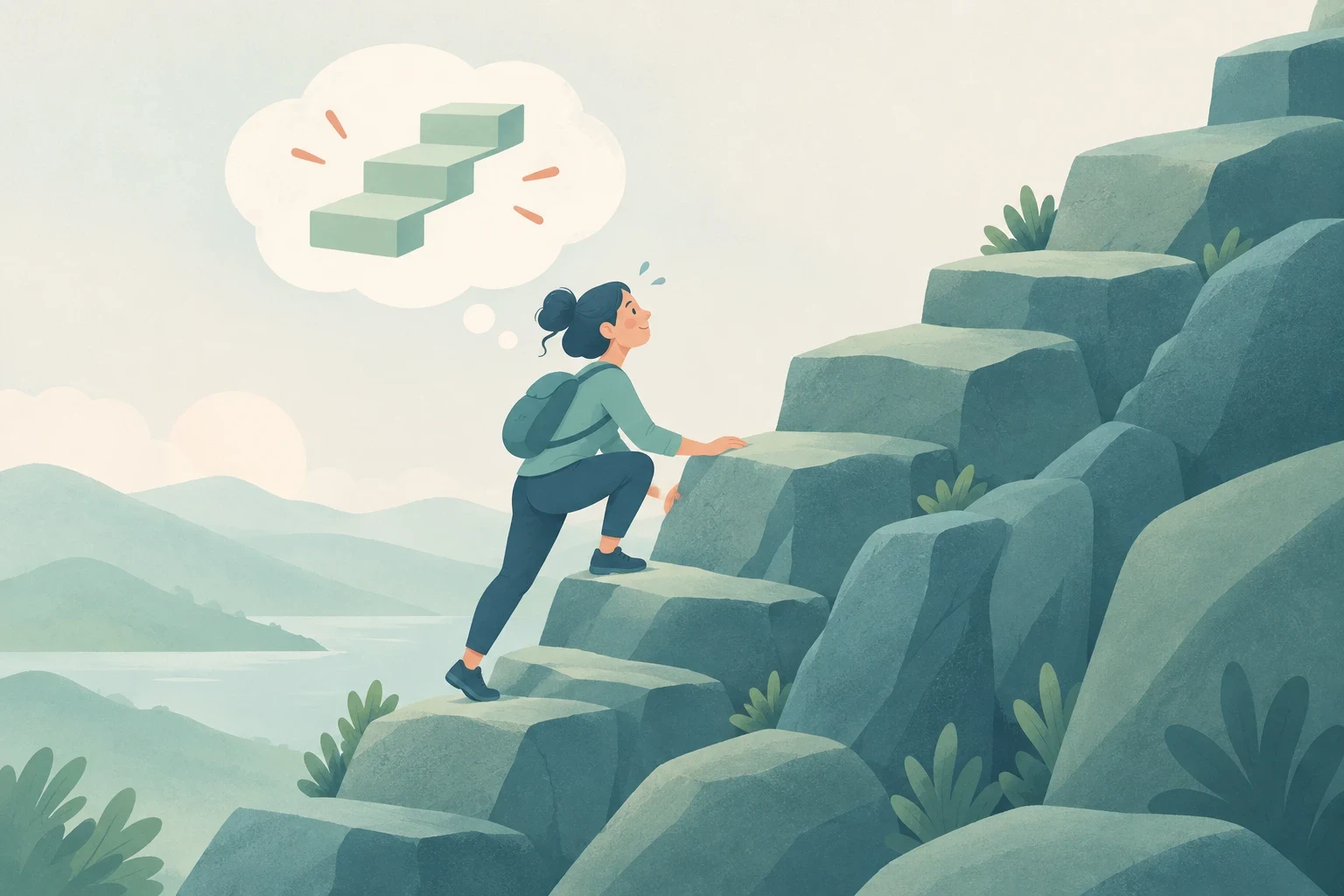
Easier said than done describes an action, suggestion, or plan that appears straightforward when spoken aloud, but presents significant practical obstacles when attempted.
Key points
- Remember to maintain the past participle forms said and done, join them with than, and avoid adding more before easier.
- Place the phrase directly after a linking verb such as is or feels, or speak it as a complete reaction with That is.
- To intensify the contrast, use much or far before easier, but never combine more with easier.
This lesson has 5 stages. You can stop at any time and continue later.

Stage 1 of 5
Understand
What it means, when to use it, and mistakes to avoid.
Watch & learn
Easier said than done: meaning and listening practice
Learn Easier said than done with Bella, then practise with British and American conversations, speaking time and common questions. B2 English.
Line 1 of 8 · Bella (tutor)
to MicroEnglish! Has you,
Say this line out loud, then continue.
The video could not continue. Try again or use the transcript below.
Your session
Learn with the video 15 min
Watch a short part, answer a question and practice what you heard. Then talk it through with the tutor.
The first part is free. Members continue to part 2 and can ask for more.
Key words in this video
Example
Memory tip
Goes with
Related forms
Not to be confused with
From this video
We couldn't load this word. Try again.
Examples
Migrating our user records without downtime is easier said than done.
Why it works: The speaker indicates that moving data sounds simple as a target, but the technical execution involves major challenges.
2 more examples
-
You might tell me to avoid caffeine, but that is much easier said than done.
Much strengthens the difficulty of cutting out caffeine compared to giving the advice.
-
Waking up early during winter mornings is often easier said than done.
The action appears straightforward as a daily habit, yet cold mornings make it hard to achieve.
Read the full guide
Deciding When Advice Sounds Too Simple
When someone offers well-meaning advice, the solution often sounds effortless because speaking a few words requires no physical exertion. Real tasks involve unexpected friction, such as conflicting schedules, missing materials, or emotional stress. You choose this idiom when you want to validate that the suggestion makes sense as a concept, while reminding the listener that execution requires substantial effort and time.
-
Going to bed by ten every evening is easier said than done when you work late shifts.
Why it works: The speaker acknowledges that sleeping early is a sensible goal, but irregular work schedules create genuine obstacles.
-
Staying calm during a tense client meeting is easier said than done.
Why it works: Remaining composed sounds elementary, yet emotional pressure makes actual self-control difficult.
Your turn
Why would a speaker use easier said than done after receiving a practical recommendation?
Answer: To acknowledge that the advice sounds reasonable in theory while pointing out practical hurdles
Show the answer
Answer: To acknowledge that the advice sounds reasonable in theory while pointing out practical hurdles
The expression does not reject the premise of the advice; it highlights the realistic difficulties involved in carrying it out.
Keeping the Said and Done Pair Intact
English learners frequently attempt to use the base verb forms by saying easier say than do. This expression is a fixed comparative structure built around two past participles: said and done. In passive grammar patterns, participles often function like adjectives that describe the state of an action. Treating either verb as an infinitive or base form destroys the idiomatic balance that native listeners anticipate.
-
Rebuilding our department workflow is easier said than done.
Why it works: Notice the exact pairing of the irregular participles said and done.
-
Cutting our household expenses in half is easier said than done.
Why it works: The participles describe the status of the advice rather than an active command.
This also comes up in Cut to the chase and Go with the flow.
Your turn
Which sentence preserves the correct fixed grammatical form of the expression?
Answer: Organizing the storeroom by Friday is easier said than done.
Show the answer
Answer: Organizing the storeroom by Friday is easier said than done.
The idiom relies strictly on the paired past participles said and done.
Selecting Than for the Comparison
Because the comparative word easier introduces a comparison between words and physical execution, it must be followed by the conjunction than. In fast conversation, than is unstressed and sounds like thun, which causes some learners to write that by mistake. Writing that breaks the comparative structure and produces an ungrammatical clause. Always verify your spelling to ensure the comparative conjunction appears.
-
Cooking healthy dinners every night is easier said than done.
Why it works: Than connects the comparative adjective easier to the second element of the contrast.
-
Switching software providers without downtime is easier said than done.
Why it works: The conjunction than correctly introduces the participle done.
Your turn
Which connective word correctly completes the comparative construction?
Answer: than
Show the answer
Answer: than
Because easier is a comparative adjective, it requires the comparative conjunction than.
Using the Phrase as an Immediate Reaction
You can use that to refer back to advice instead of repeating it. A reply such as That is easier said than done means that following the advice is harder than suggesting it. Here, that is the subject and refers to the earlier suggestion.
-
You tell me to relax before the presentation, but that is easier said than done.
Why it works: That refers to the specific advice of relaxing before speaking publicly.
-
My roommate suggested buying a cheaper laptop, but that is easier said than done.
Why it works: The standalone response comments directly on the prior suggestion.
Your turn
What does that refer to in the conversational reply: 'That is easier said than done'?
Answer: The suggestion or advice the other speaker just mentioned
Show the answer
Answer: The suggestion or advice the other speaker just mentioned
In this rejoinder, the demonstrative pronoun that points back to the prior speaker's recommendation.
Strengthening the Contrast Without Adding More
When you want to emphasize that a proposal is extraordinarily difficult, modify easier with adverbs such as much, far, or a lot. Never add more in front of easier, because easier already carries the comparative inflection. Saying more easier is a redundant grammatical error that distracts your listener. Sticking to much easier keeps your English natural, accurate, and forceful.
-
Quitting sugar entirely is much easier said than done when snacks surround you.
Why it works: Much intensifies the contrast appropriately without introducing a double comparative.
-
Securing a bank loan without existing collateral is far easier said than done.
Why it works: Far provides strong emphasis on the extreme gap between advice and reality.
Your turn
Which sentence correctly intensifies the degree of difficulty?
Answer: Relocating to a new city alone is much easier said than done.
Show the answer
Answer: Relocating to a new city alone is much easier said than done.
Use much to intensify the comparative adjective; never combine more with easier.
Catching the Weak Vowel in Fast Speech
In conversational English, native speakers rarely enunciate the word than with a full open vowel. Instead, the vowel reduces to a weak schwa sound, and the initial voiced dental consonant links directly to the preceding /d/ in said. Because the entire phrase flows together as a rhythmic unit, the prominent stress falls on the syllable eas- and the participle done. Recognizing this stress rhythm prevents you from getting lost during rapid exchanges.
-
Finding affordable rent near campus is easier said than done.
Why it works: Notice how said than done sounds like a single rhythmic burst with stress on done.
-
Sorting these old tax papers is easier said than done.
Why it works: The vowel in than reduces to an unstressed weak syllable.
Your turn
Where does the strongest rhythm and stress fall within the idiom during natural speech?
Answer: On the first syllable of easier and on the final word done
Show the answer
Answer: On the first syllable of easier and on the final word done
Content words carry the primary stress, while function words like than reduce to weak forms.
Pushing Back Without Sounding Dismissive
Bluntly telling a teammate that their idea is impossible can sound aggressive and damage professional relationships. Using easier said than done acts as a diplomatic buffer. It validates their intention by showing you heard their suggestion, while shifting attention to realistic constraints. To keep your tone cooperative, follow the idiom immediately with a concrete reason, such as limited staffing, tight deadlines, or technical constraints.
-
Updating the database by noon is easier said than done because our team must first run validation tests.
Why it works: Following the idiom with a technical reason keeps the tone professional and constructive.
-
Freezing hiring this quarter is easier said than done when two key engineers have just resigned.
Why it works: The speaker points out concrete staffing facts rather than rejecting the budget goal outright.
Your turn
How can you use easier said than done constructively during a team meeting?
Answer: Pair the phrase with a specific operational obstacle to explain your reasoning
Show the answer
Answer: Pair the phrase with a specific operational obstacle to explain your reasoning
Adding a concrete constraint ensures the response sounds like practical problem-solving rather than mere complaint.
Explaining Delays in Professional Updates
In written progress reports and email correspondence, this idiom helps explain why an apparently straightforward milestone required additional time. Rather than making excuses, a professional writer uses the phrase to contrast initial expectations with practical discoveries. Framing the delay this way demonstrates thoroughness and realism, showing stakeholders that you understand both the strategic objective and the detailed craftsmanship needed to achieve it.
-
Eliminating duplicate accounts across legacy systems was easier said than done.
Why it works: The sentence introduces an explanation of technical complexity in a project summary.
-
Standardizing formatting across twenty separate supplier contracts proved easier said than done.
Why it works: The phrasing shows that what looked like simple clerical work involved detailed negotiation.
Your turn
When is easier said than done most effective in a written project update?
Answer: When explaining why an apparently simple deliverable encountered genuine practical complexities
Show the answer
Answer: When explaining why an apparently simple deliverable encountered genuine practical complexities
The idiom effectively bridges the gap between initial plans and the unexpected practical work discovered during execution.
Use it naturally
How people really use “easier said than done”
Neutral Fine almost anywhere, at work or with friends.
Words it often goes with
- much easier said than doneFinding a date when the whole family is free is much easier said than done.
- often easier said than doneKeeping a surprise secret is often easier said than done.
- will be easier said than doneGetting everyone to the park before noon will be easier said than done.
What people also say
- “That's easier said than done.” instead of “That is simple to suggest but difficult to perform.” A natural response to advice that overlooks practical problems.
Questions about "Easier said than done"
Can I say more easier said than done to sound more emphatic?
No. The word easier is already the comparative form of easy. Adding more produces a double comparative error. If you want to make the contrast stronger, use much, far, or a lot before easier.
Finding a quiet apartment downtown is much easier said than done.
How does this idiom differ from simply saying that something is hard?
Saying an action is hard only describes the difficulty of the task itself. Using easier said than done specifically highlights a contrast between verbal advice that sounds simple and the demanding effort required to carry it out.
Running twenty miles is hard, but eating healthy meals while traveling is easier said than done.
Can I use easier said than done with my manager without sounding rude?
Yes, provided you pair the expression with an explanation. If you only say 'That is easier said than done,' it can sound dismissive. When you immediately follow it with specific practical reasons, it comes across as realistic planning.
Cutting server costs is easier said than done because our team must first archive older user databases safely.
Why do some learners mistakenly say easier said that done?
In rapid speech, the unstressed word than reduces to a weak vowel and blends with surrounding consonants. Because than and that sound similar when spoken quickly, listeners sometimes mishear the final consonant.
Organizing the annual conference on schedule was easier said than done.
Before you go
Remember this
Remember to maintain the past participle forms said and done, join them with than, and avoid adding more before easier.
Stage 2 of 5
Listen
Hear it in real sentences, from short to long, and write what you hear.
Continue with the four activities from the video: listening, reading, speaking and writing. Back to the video
0 of 4 done
Listening 1 of 4
Listen, then type what you hear. Replay as often as you need.
0:00
- You might tell me to avoid caffeine, but that is much easier said than done.
- Waking up early during winter mornings is often easier said than done.
Listening 2 of 4
Listen, then type what you hear. Replay as often as you need.
0:00
- You might tell me to avoid caffeine, but that is much easier said than done.
- Waking up early during winter mornings is often easier said than done.
Try a longer clip. Listen once, then replay the part you missed.
Listening 3 of 4
Listen, then type what you hear. Replay as often as you need.
0:00
- You might tell me to avoid caffeine, but that is much easier said than done.
- Waking up early during winter mornings is often easier said than done.
This clip is longer. Follow the instruction above the answer field.
Listening 4 of 4
Listen, then type the missing words. The rest of the text is already there.
0:00
- You might tell me to avoid caffeine, but that is much easier said than done.
- Waking up early during winter mornings is often easier said than done.
Practice complete
You listened closely.
Your result is saved in this browser.
Keep your progress. Your practice is saved on this device only. Create a free account to keep it everywhere.
Create a free accountThat was today's free lesson. Tomorrow you get another one. Want more today? See membership.
Create a free SubLearn account to keep this progress across devices.
Save my progressStage 3 of 5
Speak
Say it with the speaker, then use it in your own answer.
Shadow
Say it along with the speaker
Play the line slowly, then speak at the same time as the speaker. Copy the rhythm, not just the words.
Your turn
Say it your way
Speak for 30 to 60 seconds from memory. You are planning a surprise picnic for your grandmother with relatives who live in different cities. Explain why keeping it secret sounds simple, what could go wrong, and how you would handle it.
Use: easier said than done
Take ten seconds to think, then answer out loud without looking at the lesson. Speak for the time shown in the task above. Nothing is sent unless you ask for feedback.
0:00
Hear how someone else might say it
I want to organize a surprise picnic for my grandmother, but keeping it secret is easier said than done. My cousins live in three different cities, and she always asks about their travel plans. Someone could easily mention the picnic during a phone call. I'd create a separate family chat and ask everyone to keep their plans private for a few days. My sister could invite Grandma for a walk and bring her to the park. If Grandma guessed our plan, we'd still have a lovely afternoon together.
Try once more and answer this: Who would you trust to bring your grandmother to the picnic?
Stage 4 of 5
Write
Write your own response
AI feedback · it can make mistakes · Part of membership See membership
Check your own writing
Read one possible response
Draft saved on this device.
Use these checks to revise your message. Grammar and meaning are not automatically graded. Each task keeps its own draft in this browser tab.

You finished the free part of this lesson
- Understand
- Listen
- Speak
- Write
- CheckPart of membership
Worth another look
With a free account, the lessons you finish come back for review to help you remember them.Create a free account
Stage 5 of 5 · Part of membership
Check
New clips without hints.
Listening tests are included with membership. Try the free dictation first, then decide whether to continue.
Listening 1 of 2 Part of membership
Listening 2 of 2 Part of membership
Follow MicroEnglish
Find lesson updates, short videos and quick quizzes. Pick the app you already use.
Questions & comments
Ask about this lesson, share an example, or help another learner.
Example
Memory tip
Goes with
Related forms
Not to be confused with
In this lesson
This word isn't in our dictionary. Check the spelling, or try another form of the word.
We couldn't load this word. Try again.
