What happens in the video
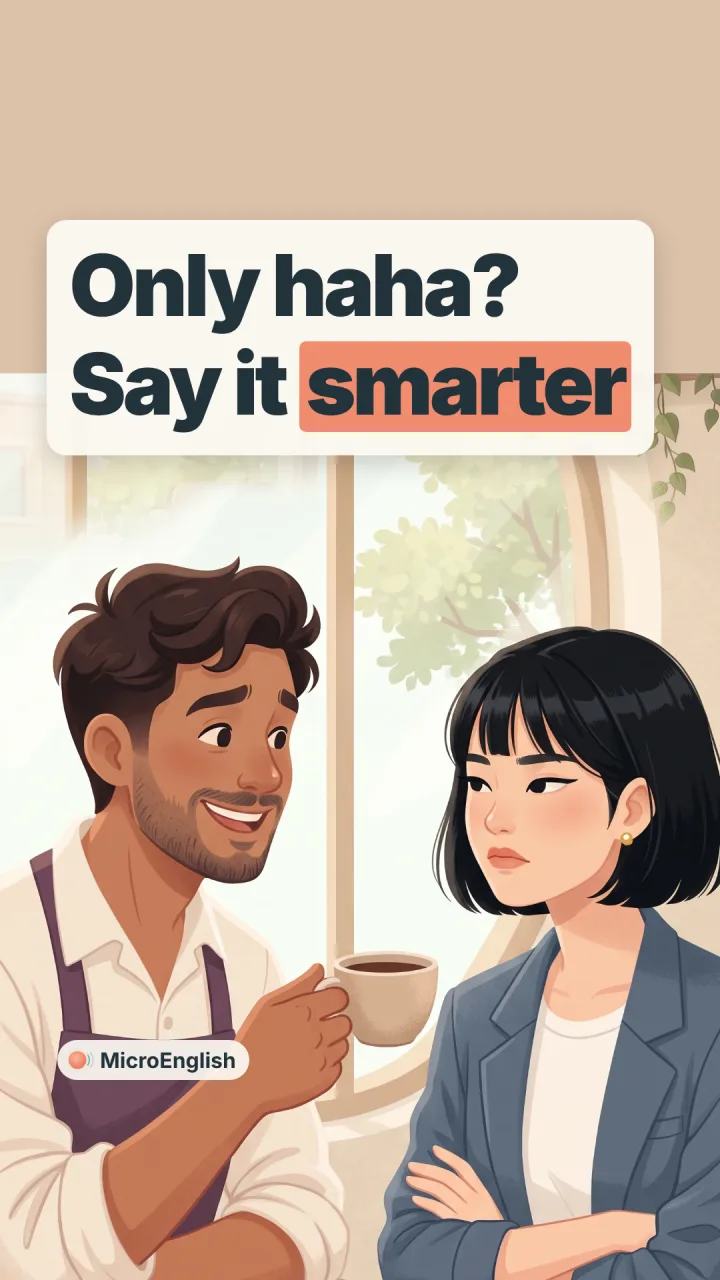
Marco tells Hana a joke: "My coffee called the police. It got mugged." Hana answers, "Hilarious. I'll laugh when my coffee arrives," so Marco learns there is no laugh without coffee. In the end Hana says, "Fine, Marco. You crack me up," and Marco hands her the coffee, half gone because he drank it while laughing.
1 That's funny.
Tone Light and casual
Use it for small, friendly jokes with friends or coworkers. Don't use it for a joke that made you laugh very hard, because it can sound too small.
That's funny.
For example:
A: I told my boss I was late because my alarm was on vacation.
B: That's funny. Did he laugh?
2 You crack me up.
Tone Warm and friendly
Crack up means laugh a lot. Say this about a person, not a single joke, when they often make you laugh. It's informal, so keep it for friends, family and relaxed coworkers.
You crack me up. You know that?
For example:
A: I named my plant Steve. Steve is doing great this week.
B: You crack me up. Say hi to Steve for me.
3 I can't stop laughing.
Tone Big, honest laughter
Use it for a really big laugh, when you laugh again every time you think about the joke. It works in speech and in text messages. It sounds strange for a small joke.
Oh my god. I can't stop laughing.
For example:
A: Did you watch the video of the dog opening the fridge?
B: Yes! I can't stop laughing.
A: Me too. I watched it five times.
4 That's hilarious.
Tone Strong and enthusiastic
Hilarious means very funny, so this is stronger than "That's funny." Say it with energy. If you say it slowly and flatly, people may hear sarcasm.
For example:
A: My little brother tried to pay for candy with a photo of money.
B: That's hilarious! What did the shop owner say?
5 You're so funny.
Tone Friendly compliment
Use it to tell someone they have a good sense of humor. A warm voice makes it a compliment. With a flat voice or a raised eyebrow, it can mean the opposite.
For example:
A: I brought snacks for the meeting. I'm calling them brain fuel.
B: You're so funny. Thanks for the snacks.
6 Stop, you're killing me.
Tone Playful, very informal
Use it with friends when a joke makes you laugh so hard it almost hurts. Nobody is in danger; it only means "this is too funny." Avoid it in formal settings.
For example:
A: And then the cat sat on the keyboard and sent my email to everyone.
B: Stop, you're killing me.
7 That made my day.
Tone Warm and grateful
Use it when something funny made you happy for the whole day. It's good in messages and at work. It sounds less loud than "I can't stop laughing."
For example:
A: I sent you a photo of my dog wearing my glasses.
B: I saw it. That made my day.
8 Very funny.
Tone Dry, often sarcastic
People often say this when they don't find a joke funny, or when the joke was about them. Use it only if you want to show mild annoyance. Don't use it as a real compliment.
For example:
A: I hid your keys in the fridge. Surprise!
B: Very funny. Now give them back, please.
Common mistakes
-
Not quite
You crack up me.Better You crack me up.
When the object is a pronoun like me, him or her, it goes between crack and up. You can also say "I cracked up" with no object.
-
Not quite
Very funny! I love this joke!Better That's funny! I love this joke!
"Very funny." alone usually sounds sarcastic in English. If you really enjoyed the joke, use "That's funny" or "That's hilarious."
-
Not quite
It's very hilarious.Better It's hilarious. / It's really funny.
Hilarious already means very funny, so "very hilarious" sounds wrong. Use "really" or "absolutely" if you want more strength, or put "very" before "funny."
Quick quiz
Choose your answer for each question, then open the answer to check it.
-
Your coworker makes a small, friendly joke about the printer. Which reaction fits best?
- That's funny.
- I can't stop laughing.
- Very funny.
- Stop, you're killing me.
Show the answer (Question 1)
Answer: That's funny. "That's funny." is light and casual, which matches a small joke.
-
What does "You crack me up" mean?
- You annoy me.
- You make me laugh a lot.
- You confuse me.
- You hurt my feelings.
Show the answer (Question 2)
Answer: You make me laugh a lot. Crack up means laugh a lot, so the speaker is saying the person often makes them laugh.
-
Your friend hides your phone as a joke and you are a little annoyed. Which line shows that?
- That made my day.
- You crack me up.
- Very funny.
Show the answer (Question 3)
Answer: Very funny. "Very funny." is often said in a dry, sarcastic way to show mild annoyance.
-
Which line is best for a laugh so big that you laugh again every time you remember the joke?
- That's funny.
- I can't stop laughing.
- You're so funny.
Show the answer (Question 4)
Answer: I can't stop laughing. "I can't stop laughing." describes big, honest laughter that you can't control.
-
In the Short, Hana says "Hilarious. I'll laugh when my coffee arrives." What does she mean?
- She is laughing very hard.
- She is not laughing yet and wants her coffee first.
- She thinks Marco is a great comedian.
Show the answer (Question 5)
Answer: She is not laughing yet and wants her coffee first. Her second sentence shows the laugh will come later, so "Hilarious" is not a real laugh here.
Questions learners ask
What can I say instead of "That's funny"?
For a stronger reaction, say "That's hilarious" or "I can't stop laughing." To compliment the person, say "You crack me up" or "You're so funny." For a warm reply in a message, "That made my day" works well.
Is "You crack me up" rude?
No. It's a friendly, informal compliment that means the person makes you laugh a lot. It's fine with friends and relaxed coworkers. In a very formal meeting, "That's funny" is safer.
Why does "Very funny" sometimes sound unfriendly?
Native speakers often say "Very funny." in a flat voice when a joke is not funny to them, or when the joke is at their expense. The words are positive, but the tone shows annoyance. If you want to praise a joke, choose "That's hilarious" instead.
How do I say I'm laughing in a text message?
You can write "I can't stop laughing" or "That made my day." Many people also write "lol" (laughing out loud) for a small laugh. Full sentences sound warmer and are clearer for people who don't use internet abbreviations.
Film lines are short quotes used for language teaching. The dialogue belongs to its rightsholders. Marco and Hana are animated characters made with Google Flow.