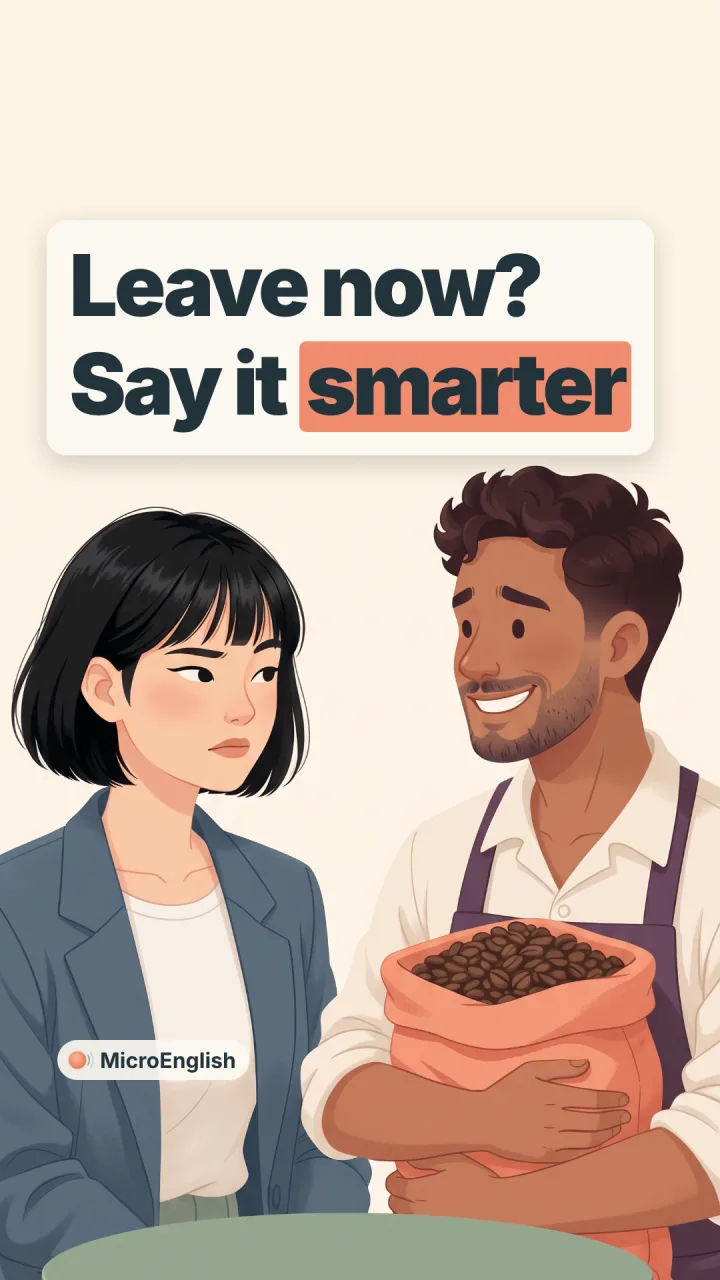
What happens in the video
Hana asks Marco to remove himself from the chair slowly, with the beans, and Marco wonders if that means he should leave the chair but take the beans. Later, Hana tells him, "We'd better hit the road now." Marco is ready: he packed sandwiches for the drive, even though it's only six minutes.
1 We should get going.
Tone Polite and gentle
Use it at the end of a visit, a dinner, or a meeting when you want to leave without sounding rude. It works with hosts, coworkers, and people you don't know well.
Well, we should get going.
For example:
A: Would you like another coffee?
B: Thanks, but we should get going. It's getting late.
A: Of course. Thanks for coming.
2 Let's hit the road.
Tone Casual and friendly
Use it before a trip, a drive, or any time you leave to travel somewhere. It sounds relaxed, so it fits friends and family better than a formal meeting.
Let's hit the road.
For example:
A: The car is packed and I have the map.
B: Great. Let's hit the road.
3 Let's get a move on.
Tone Bold and in a hurry
It means "hurry up." Use it with friends when you are late or close to late. Don't use it with a host or your boss, because it can sound like an order.
Let's get a move on.
For example:
A: The movie starts in ten minutes.
B: Then let's get a move on. I'll grab my keys.
4 We'd better hit the road.
Tone Friendly with a reason
"We'd better" means "we had better." It adds a small warning: if you don't leave now, there may be a problem, such as traffic or being late. Use it with friends and family.
For example:
A: It's already five o'clock.
B: We'd better hit the road, or we'll miss the train.
5 I should head out.
Tone Relaxed and polite
Use it when you, not the whole group, need to leave. It works at work, at a party, or after a call. It is softer than "I'm leaving."
For example:
A: Are you staying for the next round of games?
B: I should head out. I have an early start tomorrow.
6 I'd better be off.
Tone Light and friendly
Use it when you are leaving and want to sound warm. It is common in British English but understood everywhere. It sounds a little old-fashioned in very casual American speech.
For example:
A: It was good to see you.
B: You too. I'd better be off, though. My bus is coming.
7 Time to go.
Tone Short and direct
Use it when the plan is already clear and you just give the signal, for example to family or children. With people you don't know well, a longer line sounds kinder.
For example:
A: Shoes on? Bag ready?
B: Yes, all done.
A: Okay, time to go.
8 Shall we?
Tone Polite invitation
Use it when everyone knows the next step is leaving and you invite the other person to start moving. Say it with a small smile or a look at the door. It is too vague if the plan isn't clear yet.
For example:
A: I've paid the bill.
B: Thanks. Shall we?
A: Yes, let's go.
9 I'm going to take off.
Tone Casual and easy
In casual American English, "take off" can mean "leave." Use it with friends and coworkers. In formal settings, "I need to leave now" is clearer.
For example:
A: Are you done for today?
B: Yes, I'm going to take off. See you tomorrow.
Common mistakes
-
Not quite
Let's hit road.Better Let's hit the road.
The expression is fixed. Keep "the" before "road," or the line sounds unnatural.
-
Not quite
We better to go now.Better We'd better go now.
The full form is "we had better," and it is followed by the base verb without "to." In speech, "had" becomes "'d."
-
Not quite
Saying "Let's get a move on" to a host at the end of dinner.Better We should get going. Thank you for dinner.
"Let's get a move on" means "hurry up," so it can sound rude to a host. "We should get going" is the polite way to end a visit.
Quick quiz
Choose your answer for each question, then open the answer to check it.
-
You are at a friend's parents' house after dinner. Which line is the most polite way to say you want to leave?
- Let's get a move on.
- We should get going.
- Time to go.
Show the answer (Question 1)
Answer: We should get going. "We should get going" is gentle and fits the end of a visit.
-
What does "Let's get a move on" mean?
- Let's move to a new house.
- Let's hurry up.
- Let's take a short break.
Show the answer (Question 2)
Answer: Let's hurry up. The line means "hurry up" and is used when time is short.
-
Your friends have packed the car for a weekend trip. What is a natural, friendly thing to say?
- Let's hit the road.
- I'd better be off.
- I should head out.
Show the answer (Question 3)
Answer: Let's hit the road. "Let's hit the road" is casual and fits the start of a trip or drive.
-
Which sentence is correct?
- We'd better to leave.
- We'd better leave.
- We better leaving.
Show the answer (Question 4)
Answer: We'd better leave. "Had better" is followed by the base verb without "to."
-
You are leaving a party alone, and your friends are staying. Which line fits best?
- Let's hit the road.
- Shall we?
- I should head out.
Show the answer (Question 5)
Answer: I should head out. "I should head out" talks about you alone, while the other lines invite the whole group.
Questions learners ask
What does "hit the road" mean?
"Hit the road" means to leave, usually to start a trip or a drive. It is casual and friendly. People often say "Let's hit the road" or "We'd better hit the road" when they are ready to go.
Is "Let's get a move on" rude?
It can be. The line means "hurry up," so it sounds direct. With friends it is fine, but with a host, a client, or your boss, say "We should get going" instead.
How do I leave a visit politely in English?
Use a soft line such as "We should get going" or "I should head out," then add a reason or a thank-you. For example, you can say "We should get going. Thanks so much for dinner." The thank-you makes the goodbye feel warm.
What is the difference between "we should" and "we'd better"?
Both suggest leaving. "We should get going" is a gentle suggestion. "We'd better hit the road" adds a small warning that something bad may happen if you wait, like being late or getting stuck in traffic.
Film lines are short quotes used for language teaching. The dialogue belongs to its rightsholders. Hana and Marco are animated characters made with Google Flow.