What happens in the video
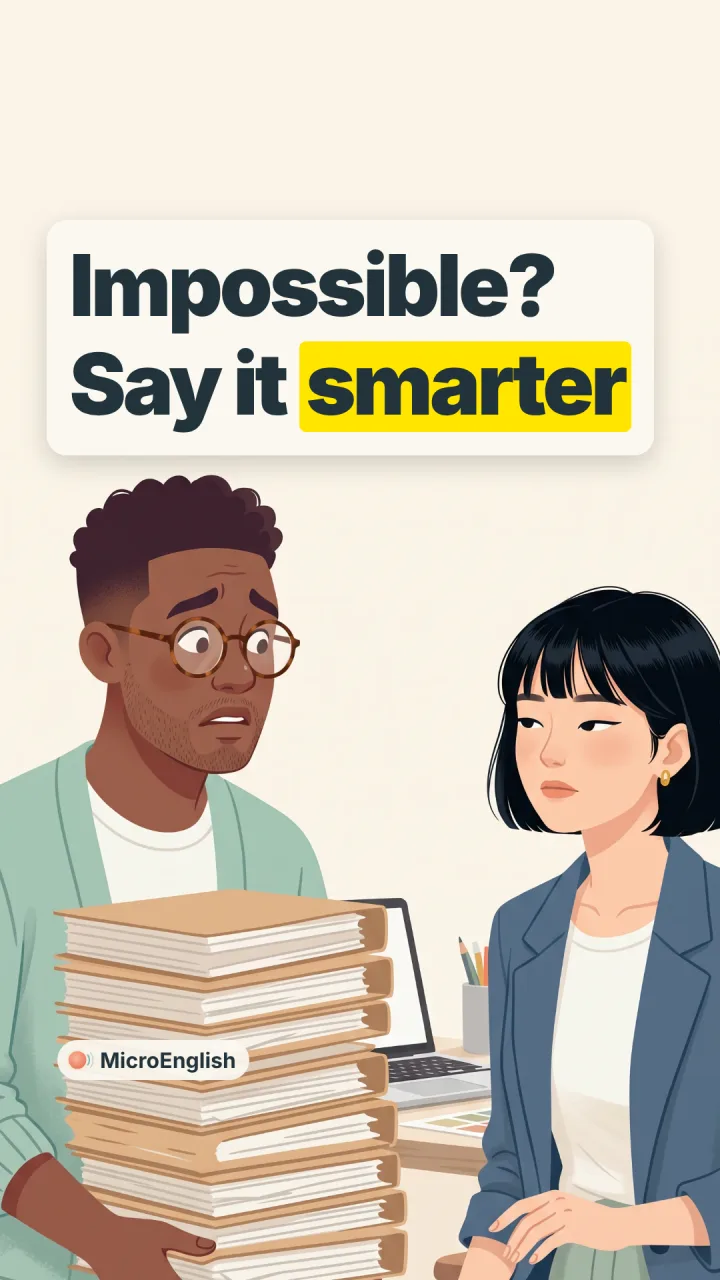
Theo asks Hana if they can redo the whole website before lunch. Hana says "That's impossible," because lunch started ten minutes ago, so Theo tries "after lunch" instead. This time Hana says "I'm afraid that won't work" and suggests starting with one page, which suits Theo fine, since he has only finished one button.
1 That could be difficult.
Tone Soft and polite
Say this first, then explain the problem. It works well at work or with people you don't know well. Don't use it when the answer is a clear no, because the other person may think there's still a chance.
Well, that could be difficult.
For example:
A: Can you send me the full report tonight?
B: That could be difficult. I'm still waiting for the sales numbers.
A: OK, how about tomorrow morning?
2 I'm not sure that's possible.
Tone Honest but kind
Use it when you have real doubts but don't want to say no yet. It leaves room to try. Avoid it if you already know the answer is no.
I'm not sure that's possible, but I'm promising you that we will try.
For example:
A: Could we get a table for ten at eight o'clock?
B: I'm not sure that's possible, but I'll ask the manager.
3 I'm afraid that won't work.
Tone Firm and polite
Use it to say a clear no in a polite way. "I'm afraid" makes the no softer, but the decision is final. It isn't the right choice when you are still unsure.
I'm afraid that won't work, Jim.
For example:
A: Can we move the meeting to Sunday?
B: I'm afraid that won't work. The office is closed on Sundays.
A: Monday, then?
4 That might be a bit tricky.
Tone Light and friendly
Use it with friends or coworkers when the request is hard but not serious. It sounds relaxed. In a formal email, "That could be difficult" is a safer choice.
For example:
A: Can you pick me up at the airport at 6 a.m.?
B: That might be a bit tricky. I start work at 7.
5 I don't think we can do that by Friday.
Tone Clear and specific
Use it when the problem is time and you can name the deadline. Change "Friday" to the real date or time. It's direct, so add a reason or a new date.
For example:
A: The client wants the new design this week.
B: I don't think we can do that by Friday. We could show them a first draft.
6 That's not realistic with the time we have.
Tone Professional and direct
Use it in meetings when a plan needs more time or people than you have. It points to the situation, not the person. It can sound too strong with a manager unless you add a suggestion.
For example:
A: Let's translate the whole website this month.
B: That's not realistic with the time we have. Can we start with the home page?
7 I don't see how we can make that work.
Tone Doubtful and honest
Use it when you've thought about the idea and can't find a way to do it. It invites the other person to explain their plan. Don't use it as a quick reply, because it can sound negative.
For example:
A: We can share one laptop for all five of us.
B: I don't see how we can make that work. We all need to work at the same time.
8 What if we tried a smaller version first?
Tone Helpful and positive
Use it after you've explained the problem, to offer an option. It turns a no into a plan. It doesn't work alone if the other person doesn't know there's a problem yet.
For example:
A: Can we launch the app in five countries next month?
B: I'm not sure that's possible. What if we tried a smaller version first?
A: Good idea. Let's start with one country.
Common mistakes
-
Not quite
I'm afraid of that won't work.Better I'm afraid that won't work.
"Afraid of" means you feel fear about something. In this polite phrase, "I'm afraid" just means "I'm sorry to say," so don't add "of."
-
Not quite
I'm not sure that's impossible.Better I'm not sure that's possible.
Putting "not sure" together with "impossible" flips the meaning. Now it sounds like you think the plan might work. To show doubt, say "not sure" plus "possible."
-
Not quite
That could difficult.Better That could be difficult.
After "could," you need a verb. With an adjective like "difficult," use "be": could be difficult, might be tricky.
Quick quiz
Choose your answer for each question, then open the answer to check it.
-
Your manager asks for something you know you can't do. Which line gives a clear but polite no?
- I'm not sure that's possible.
- I'm afraid that won't work.
- That might be a bit tricky.
Show the answer (Question 1)
Answer: I'm afraid that won't work. This line is firm and final, and "I'm afraid" keeps it polite.
-
Which line shows doubt but leaves room to try?
- I'm not sure that's possible.
- I'm afraid that won't work.
- That's impossible.
Show the answer (Question 2)
Answer: I'm not sure that's possible. "Not sure" means you have doubts but haven't said no.
-
What does "I'm afraid" mean in "I'm afraid that won't work"?
- I feel scared.
- I'm sorry to tell you.
- I'm not sure.
Show the answer (Question 3)
Answer: I'm sorry to tell you. Here "I'm afraid" softens bad news and has nothing to do with fear.
-
A friend asks you for a ride at 6 a.m. Which line sounds the most relaxed?
- That's not realistic with the time we have.
- I'm afraid that won't work.
- That might be a bit tricky.
Show the answer (Question 4)
Answer: That might be a bit tricky. "A bit tricky" is light and friendly, which fits a chat between friends.
-
You said "That could be difficult." What should usually come next?
- Nothing more.
- The reason or a smaller option.
- "That's impossible."
Show the answer (Question 5)
Answer: The reason or a smaller option. This line works best as an opener before you explain the problem.
Questions learners ask
Is it rude to say "That's impossible" in English?
It isn't always rude, but it can sound blunt, especially at work. It closes the conversation and doesn't give a reason. A softer line such as "That could be difficult" keeps the conversation open.
What does "I'm afraid" mean when someone says no?
It means "I'm sorry to tell you this." Speakers use it to make bad news sound polite. For example, "I'm afraid that won't work" is still a no, just a kind one.
How do I say no politely in a work email?
Start with a soft line, give the reason, and then offer an option. For example, write "That could be difficult this week because the team is busy," then suggest a new date or a smaller task. This shows you want to help even if you can't do everything.
What's the difference between "That could be difficult" and "I'm afraid that won't work"?
"That could be difficult" warns that there's a problem but doesn't say no. "I'm afraid that won't work" says no clearly. Choose the first when you might still find a way, and the second when the answer is final.
Film lines are short quotes used for language teaching. The dialogue belongs to its rightsholders. Theo and Hana are animated characters made with Google Flow.