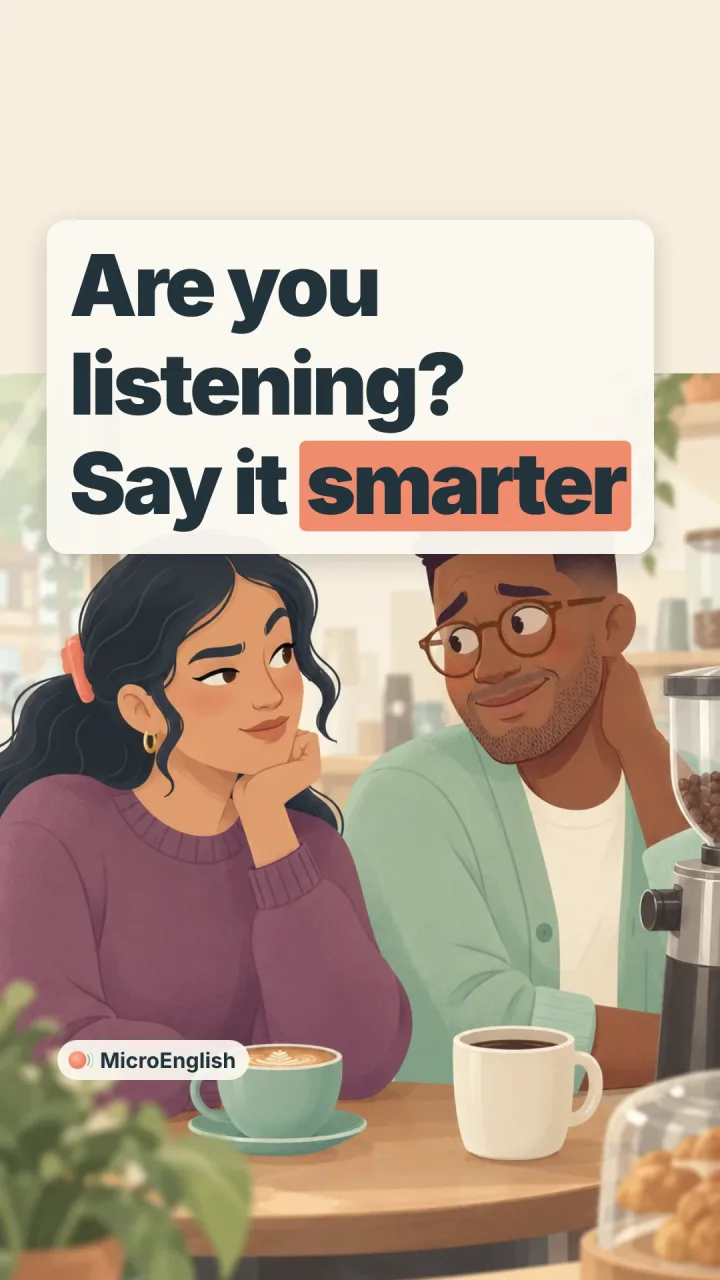
What happens in the video
Theo is working on something for a client and wants to know who decides. He mixes up the idiom and asks, "Who shoots the calls here?" Hana corrects him. Later Theo gets it right: "You call the shots. Pick one." Hana is happy with that and picks the blue one.
1 Elizabeth will be in charge.
Tone Neutral and clear
Use "be in charge" to say who leads or who is responsible for a person, group, or task. It works at work, at home, or anywhere, and it fits both formal and casual talk.
Elizabeth will be in charge.
For example:
A: I'm away next week. Who should the team ask if there's a problem?
B: Elizabeth will be in charge. Send your questions to her.
2 I call the shots.
Tone Casual and confident
Use it to say that you make the decisions. It sounds strong, so say it with a smile among friends. With a manager or client, it can sound bossy or rude.
I call the shots.
For example:
A: Can we change the plan for Saturday?
B: It's my party, so I call the shots. We're keeping the plan.
A: Fair enough.
3 Doris will take charge.
Tone Bold, act now
Use "take charge" when someone starts to lead or takes control of a situation. It describes taking action. "Be in charge" describes who already has responsibility.
Doris will take charge.
For example:
A: The manager is sick, and nobody knows what to do.
B: Don't worry. Doris will take charge until the manager gets back.
4 It's your call.
Tone Friendly; lets someone else decide
Use it to give a decision to another person. It sounds polite and relaxed. Do not use it if you still want to choose yourself, because the other person will expect to decide.
For example:
A: Should we take the train or drive?
B: I'm happy with either. It's your call.
A: Then let's take the train.
5 It's up to you.
Tone Neutral and open
Use it when the other person can decide and you have no strong opinion. It works in almost any situation. Said in a flat voice, it can sound like you don't care, so add a reason or a smile.
For example:
A: Pizza or noodles tonight?
B: It's up to you. I like both.
6 Who's in charge here?
Tone Direct question
Use it to find the person who can make a decision or fix a problem. Say it calmly. In an angry voice, it sounds like a complaint.
For example:
A: Excuse me, who's in charge here?
B: That's the shift manager, Sam. I'll get him for you.
7 She runs the show.
Tone Informal, observing
Use it to say that one person really controls a group, event, or business, even if another person has the title. It is casual, so avoid it in a formal report.
For example:
A: Is Mark the owner of this café?
B: On paper, yes. But his sister runs the show.
8 Let me handle this.
Tone Calm, stepping up
Use it to offer to deal with a problem yourself. It is a softer way to take charge. In a meeting, it can sound like you don't trust others, so use it when you really can help.
For example:
A: The client is upset about the delay.
B: Let me handle this. I'll call them now.
Common mistakes
-
Not quite
Who shoots the calls here?Better Who calls the shots here?
The words stay in a fixed order. You call (decide) the shots. Swapping them makes the phrase sound like nonsense, and Hana reacts to exactly this mistake in the Short.
-
Not quite
I call the shot.Better I call the shots.
The idiom always uses the plural "shots." The singular form sounds wrong to native speakers, even though the meaning is clear.
-
Not quite
Doris will take the charge.Better Doris will take charge.
"Take charge" and "be in charge" have no article. Adding "the" changes the meaning. "The charge" can mean a price or a legal accusation.
Quick quiz
Choose your answer for each question, then open the answer to check it.
-
Your friend asks where to eat. You don't mind and want them to choose. What do you say?
- I call the shots.
- It's your call.
- Who's in charge here?
- Let me handle this.
Show the answer (Question 1)
Answer: It's your call. "It's your call" gives the decision to the other person.
-
Which line simply states who leads, in a neutral tone?
- Elizabeth will be in charge.
- I call the shots.
- She runs the show.
Show the answer (Question 2)
Answer: Elizabeth will be in charge. "Be in charge" states a role without sounding bossy or casual.
-
The team leader leaves suddenly and nobody is leading. Which line fits best?
- Doris will take charge.
- It's up to you.
- Doris runs the show.
Show the answer (Question 3)
Answer: Doris will take charge. "Take charge" means to start leading or take control. Here, Doris will lead after the team leader leaves.
-
What does "I call the shots" mean?
- I take photos.
- I make the decisions.
- I phone people often.
- I follow orders.
Show the answer (Question 4)
Answer: I make the decisions. "Call the shots" is an idiom for making the decisions.
-
Which line could sound rude if you say it to your manager?
- Who's in charge here?
- It's up to you.
- I call the shots.
Show the answer (Question 5)
Answer: I call the shots. It is strong and confident, so it can sound bossy to someone above you.
Questions learners ask
What does "call the shots" mean?
It means to make the decisions or control what happens. You can say it about yourself, as in "I call the shots," or about someone else, as in "She calls the shots at home." It is informal but very common.
Is "call the shots" rude?
Not by itself. "You call the shots" is friendly because you give someone the choice. "I call the shots" can sound bossy, especially at work or to someone senior, so think about who is listening.
What is the difference between "in charge" and "take charge"?
"Be in charge" describes a role: who leads or is responsible. "Take charge" describes an action: someone starts leading, often in a difficult moment. Compare "Elizabeth will be in charge" with "Doris will take charge."
How do I say that someone else can decide?
Use "It's your call," "It's up to you," or "You call the shots." The first two are polite and work almost anywhere. "You call the shots" is more playful, like Theo's line to Hana in the Short.
Film lines are short quotes used for language teaching. The dialogue belongs to its rightsholders. Theo and Hana are animated characters made with Google Flow.