What happens in the video
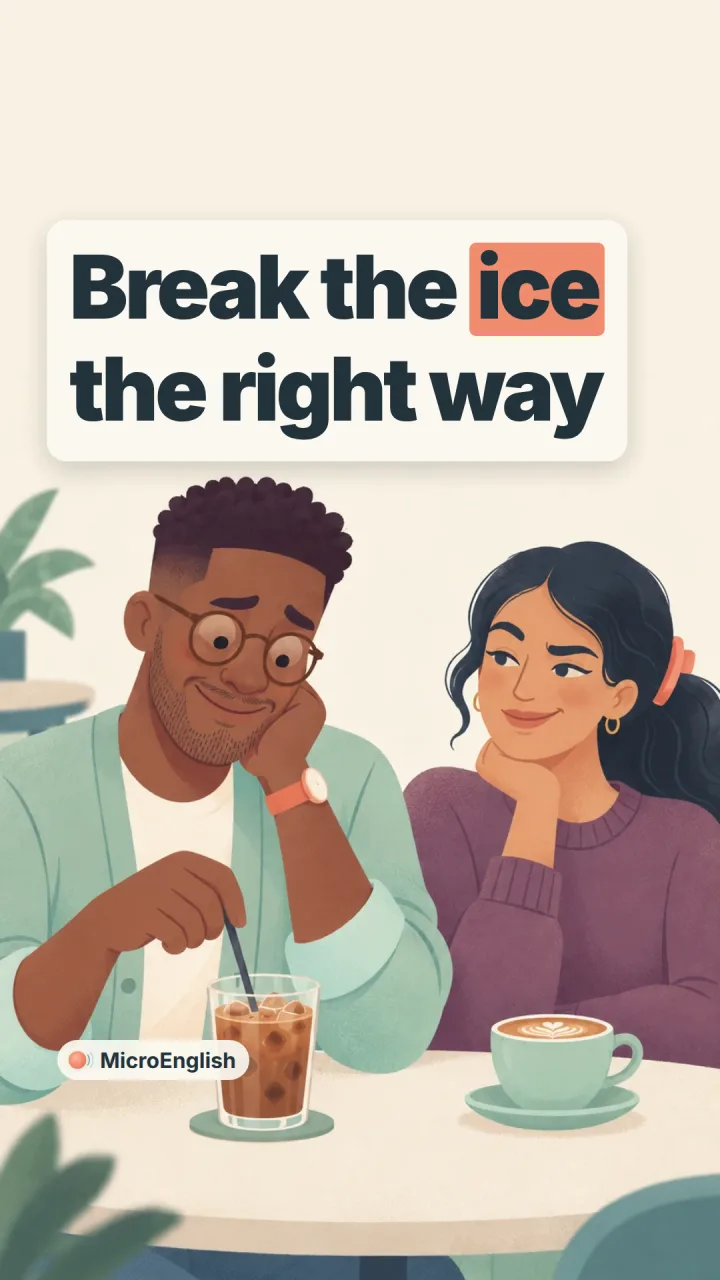
Theo wants to talk to Nadia, so he says "Hi. So ice. Cold. Right? I'm trying to break it." Nadia looks confused, because the only ice nearby is in her iced coffee. Theo tries again with a simple question, "How was your weekend?", and this time Nadia answers right away and asks about his weekend too.
1 Maybe break the ice.
Tone Friendly and casual
Use it when a group feels quiet or awkward and someone needs to start talking. It's a suggestion, so it works well with friends or coworkers. It isn't something you say to a stranger as your first words.
Maybe break the ice.
For example:
A: Nobody's talking. This is a bit uncomfortable.
B: Maybe break the ice. Ask them about their trip.
A: Good idea. I'll start.
2 Get the ball rolling.
Tone Confident, takes the lead
Use it to start a meeting, a project, or a group activity, usually when you are the one leading. It sounds less natural in a quiet one-to-one chat with someone you just met.
You know, get the ball rolling.
For example:
A: Everyone's here. Should we wait a few more minutes?
B: No, let's get the ball rolling. Maria, can you start with your update?
3 I'm trying to make small talk.
Tone Honest and a bit shy
Use it when your easy, light question gets a strange or serious reaction and you want to explain that you were only being friendly. Small talk means easy chat about things like the weekend or the weather.
I'm trying to make small talk.
For example:
A: Why do you want to know about my weekend?
B: Sorry, I'm trying to make small talk. You don't have to answer.
A: Oh, no, it's fine. It was quiet.
4 How was your weekend?
Tone Warm and easy
Use it early in the week with coworkers, classmates, or neighbors. It invites the other person to say how their weekend went. Later in the week, try "How's your week going?"
For example:
A: Morning! How was your weekend?
B: Really nice, thanks. I went hiking. How about yours?
A: Pretty relaxed. I mostly stayed home.
5 Have you been here before?
Tone Curious and polite
Use it at a cafe, a class, an event, or a new place where you and the other person are both visitors. It doesn't fit somewhere the person obviously goes every day, like their own office.
For example:
A: Have you been here before?
B: Once, last year. The soup is great.
A: Thanks, I'll try it.
6 Is this seat taken?
Tone Polite and neutral
Use it before you sit next to someone on a train, in a class, or at an event. It also opens a short chat in a natural way. Don't use it when the seats are clearly empty and nobody is nearby.
For example:
A: Excuse me, is this seat taken?
B: No, go ahead.
A: Thanks. Busy morning, isn't it?
7 I don't think we've met. I'm Sam.
Tone Open and friendly
Use it at a party, a meeting, or a new job to introduce yourself, with your own name. It works best when you're in the same group or event. It can feel strange to a stranger on the street.
For example:
A: Hi, I don't think we've met. I'm Sam.
B: Nice to meet you, Sam. I'm Lee. I work with Anna.
A: Oh, great. How do you know her?
8 So, how do you know everyone here?
Tone Relaxed and social
Use it at a party or a dinner where people come from different groups. It gives the other person an easy story to tell. Avoid it at a work meeting where everyone is a coworker.
For example:
A: So, how do you know everyone here?
B: I went to school with the host. What about you?
A: We play tennis together.
9 Let's get started.
Tone Clear and neutral
Use it to begin a meeting or class in a simple, direct way. It's a plain alternative to "get the ball rolling" and fits formal and informal settings.
For example:
A: Okay, it's ten o'clock. Let's get started.
B: Sure. Should I share my screen first?
Common mistakes
-
Not quite
Let me break the ices.Better Let me break the ice.
In this idiom, "ice" is uncountable and always singular. Keep "the ice" every time.
-
Not quite
I'm trying to do a small talk.Better I'm trying to make small talk.
English uses "make small talk," and "small talk" is uncountable, so it doesn't take "a." You can also say "chat" or "have a chat."
-
Not quite
Let's get the ball roll.Better Let's get the ball rolling.
The fixed phrase uses the -ing form: "get the ball rolling." Keep "rolling" when you mean to start an activity.
Quick quiz
Choose your answer for each question, then open the answer to check it.
-
A new team is meeting for the first time and nobody is speaking. Which line suggests that someone should start talking?
- Maybe break the ice.
- Is this seat taken?
- I don't think we've met.
Show the answer (Question 1)
Answer: Maybe break the ice. "Break the ice" means to start talking when a situation feels awkward or quiet.
-
You are leading a meeting and want to begin in a confident way. What do you say?
- I'm trying to make small talk.
- Let's get the ball rolling.
- Have you been here before?
Show the answer (Question 2)
Answer: Let's get the ball rolling. "Get the ball rolling" means to start an activity, and it sounds like you're taking the lead.
-
Which topic is a typical example of small talk?
- Your salary
- Your weekend
- Your health problems
Show the answer (Question 3)
Answer: Your weekend Small talk is easy, light chat, and the weekend is a safe, friendly topic.
-
Your coworker looks surprised by your friendly question. Which line explains that you were only being polite?
- Let's get started.
- I'm trying to make small talk.
- Get the ball rolling.
Show the answer (Question 4)
Answer: I'm trying to make small talk. This line honestly says that your question was just light, friendly chat.
-
Which sentence is correct?
- She's good at making a small talk.
- She's good at making small talk.
- She's good at doing small talks.
Show the answer (Question 5)
Answer: She's good at making small talk. We say "make small talk" with no "a" and no plural.
Questions learners ask
What does "break the ice" mean?
It means to say or do something that helps people start talking and feel more relaxed. People use it when a group is quiet, when strangers meet, or when a moment feels awkward. You can say "Let me break the ice" or suggest "Maybe break the ice."
What is the difference between "break the ice" and "get the ball rolling"?
"Break the ice" is about social comfort: getting people to talk when things feel awkward. "Get the ball rolling" is about starting an activity, such as a meeting or project. You might break the ice with a joke, then get the ball rolling with the first item on the agenda.
What are good small talk questions in English?
Choose easy questions about things you share with the other person. "How was your weekend?", "Have you been here before?" and "How do you know everyone here?" all work well. Ask a follow-up question after the answer, and share a little about yourself too.
Is it rude to start a conversation with a stranger in English?
Usually not, if you keep it short and light and the setting is right, like a cafe, class, or event. A polite opener such as "Is this seat taken?" gives the person an easy way to reply or to end the chat. If they give short answers, it's fine to stop there.
Film lines are short quotes used for language teaching. The dialogue belongs to its rightsholders. Theo and Nadia are animated characters made with Google Flow.