
Find your next lesson
Search a phrase, or describe what you need to say. Choose from the lessons currently available.
Showing 19–36 of 814 lessons
-

Reflexive pronouns: choose the right form
A reflexive pronoun shows that the person performing the action is also the person receiving the action. In other sentences, a reflexive pronoun follows a noun or pronoun to add emphasis, showing that the person acted without help.
-

Shall or will: choose the right word
Will expresses certainty, intention, or a decision made while speaking. It works naturally with all subjects in modern English. Shall asks for someone else's opinion or preference when you propose an action. In questions, shall I means do you want me to do this, while shall we means would you like us to do this together.
-
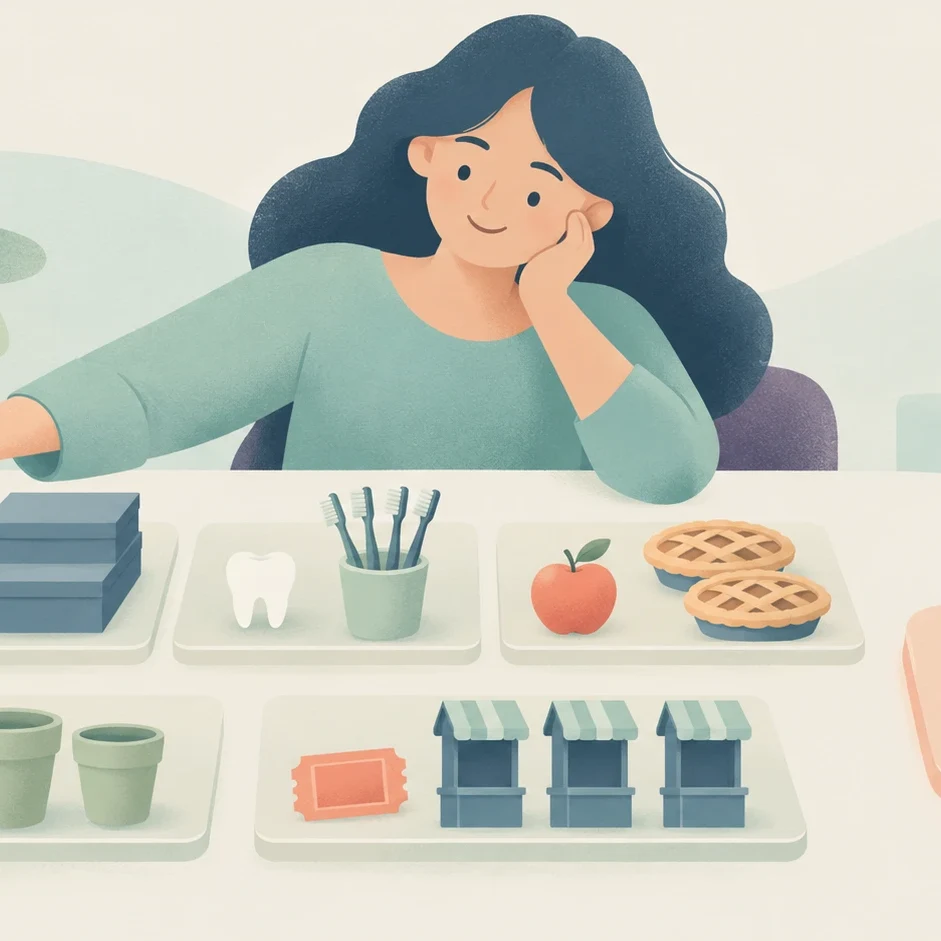
Nouns as adjectives: choose singular or plural
In English, a noun placed directly before another noun describes what kind of thing it is. In the phrase bus station, station is the place, and bus explains what kind of station it is. The first word gives extra information without needing a longer prepositional phrase like station for buses.
-

Keep your eyes peeled: meaning and everyday use
Keep your eyes peeled is an informal idiom that means watching with steady attention. It does not describe physical peeling. Instead, it creates an image of wide, open eyes ready to spot something important. You use it when you expect a target to appear, especially when finding that target requires active visual effort.
-

Whose or who's: choose the right word
Whose is a possessive word that identifies which person owns or is connected to something. Who's is a contraction representing either who is or who has. The apostrophe in who's marks the omitted letters from the auxiliary verbs is or has, rather than indicating ownership.
-

Pathetic meaning: pity and harsh criticism
In older usage and formal writing, pathetic describes suffering or sadness that invites sympathy. In modern daily conversation, people often use pathetic to criticize an effort, excuse, or result as very poor or inadequate. Both meanings express emotion, but one shows compassion while the other shows irritation.
-
Membership
Open every lesson free for 7 days
- 814 lessons with dictation and listening tests
- Three accents: British, American and Australian
- Your progress is saved
No card needed. Then from $7.50 a month if you want to keep going.
Start free trial -

Subordinate clauses: clear rules and examples
A subordinate clause, also known as a dependent clause, adds necessary context to an independent main clause. Subordinate clauses can explain reasons with words like because, indicate time relationships with words like when, before, or while, set conditions with if or unless, introduce surprising contrasts with although, describe nouns with relative pronouns like who or which, or complete mental actions with content words like that and whether.
-

Do or does: questions and negatives guide
In the present simple tense, do and does act as helper words for questions and negatives with ordinary main verbs. They do not add extra meaning; instead, they signal the question or negative structure and show the subject group.
-

Pensive meaning: quiet serious thought
Pensive describes someone who is thinking quietly and seriously, often about significant choices, changes, or memories.
-
Common abbreviations: practical everyday usage
An abbreviation is a shortened representation of a word or phrase used to save space in writing and time in communication. While some abbreviations represent single words, others represent multiword expressions. Recognizing the letters alone does not indicate how to speak the form or what action the message requires.
-

A or an before an acronym: Spoken sound rules
An abbreviation represents a longer phrase or title. Some forms, called initialisms, are pronounced letter by letter, while others, called acronyms, are pronounced as ordinary words. In both cases, the indefinite article reflects the very first sound spoken in the phrase.
-

Nostalgic meaning: Talk about the past
Feeling warm affection and gentle longing for past experiences, people, or places, often with awareness that those times are gone.
-

Swan song: Describing a final project
The phrase describes a memorable final contribution made before a person steps down, changes careers, or finishes a defining period of work. Although song suggests music, speakers use the term for books, speeches, community projects, and research papers.
-

Him or His: Choose the Right Word
Him is the object pronoun for a male person. English uses it when an action affects that person directly or when the person follows a preposition. His is the possessive form. It shows that an object, schedule, relationship, or responsibility connects to that person.
-

Words Ending in Holic: Meanings and Respectful Use
The ending -holic forms an informal noun describing an individual who exhibits a powerful interest, persistent habit, or compulsion. While it often emphasizes enjoyment in casual settings, it can also highlight an inability to moderate behavior.
-

Top-drawer: Praise High Quality
Top-drawer describes a person, service, or object of the highest standard. It expresses a strong, enthusiastic opinion about quality. When you describe someone as top-drawer, you place them among the best. It is not a neutral technical measurement, but a personal judgment of excellence.
-

Articles with Illness Names: Choose the Right Form
Articles show whether English treats an illness as an uncountable condition, a single countable event, or a set phrase. You place no article before many common conditions, such as diabetes or malaria, because they function as uncountable nouns. You add a or an before countable illness words when you describe one instance of sickness. In some everyday phrases like the flu, the article is part of an established habit.
-

Fidelity vs Transparency: Choosing the Right Word
Fidelity describes how accurately a reproduction follows its source, such as sound, color, or text. It can also describe loyalty to a person or principle. Transparency describes openness that allows people to inspect facts, prices, and decisions. In physical objects, transparency describes clear materials like glass that you can see through.
Not ready for a trial? Get a free lesson every day
Get one short dictation by email each day for 7 days. You can practice wherever you are, without an account.
Can't find a lesson on what you need?
Lesson requests come with membership.
See membership