Phrasal verb
Put out
What does 'put out' mean in everyday English?
In everyday English, 'put out' primarily conveys three actions: stopping a fire or flame from burning, releasing an official announcement or statement to the public, or causing a person inconvenience and extra labor.
Key points
- Determine the meaning of 'put out' by checking whether the object is a fire, a public document, or a person.
- Keep pronouns in the middle position, use 'turn off' for ordinary electrical appliances, and remember that 'put' remains identical in the past simple.
- When using 'put out' with a noun object like 'the fire' or 'the warning statement', the noun can sit immediately after 'out' or between 'put' and 'out'.
This lesson has 5 stages. You can stop at any time and continue later.
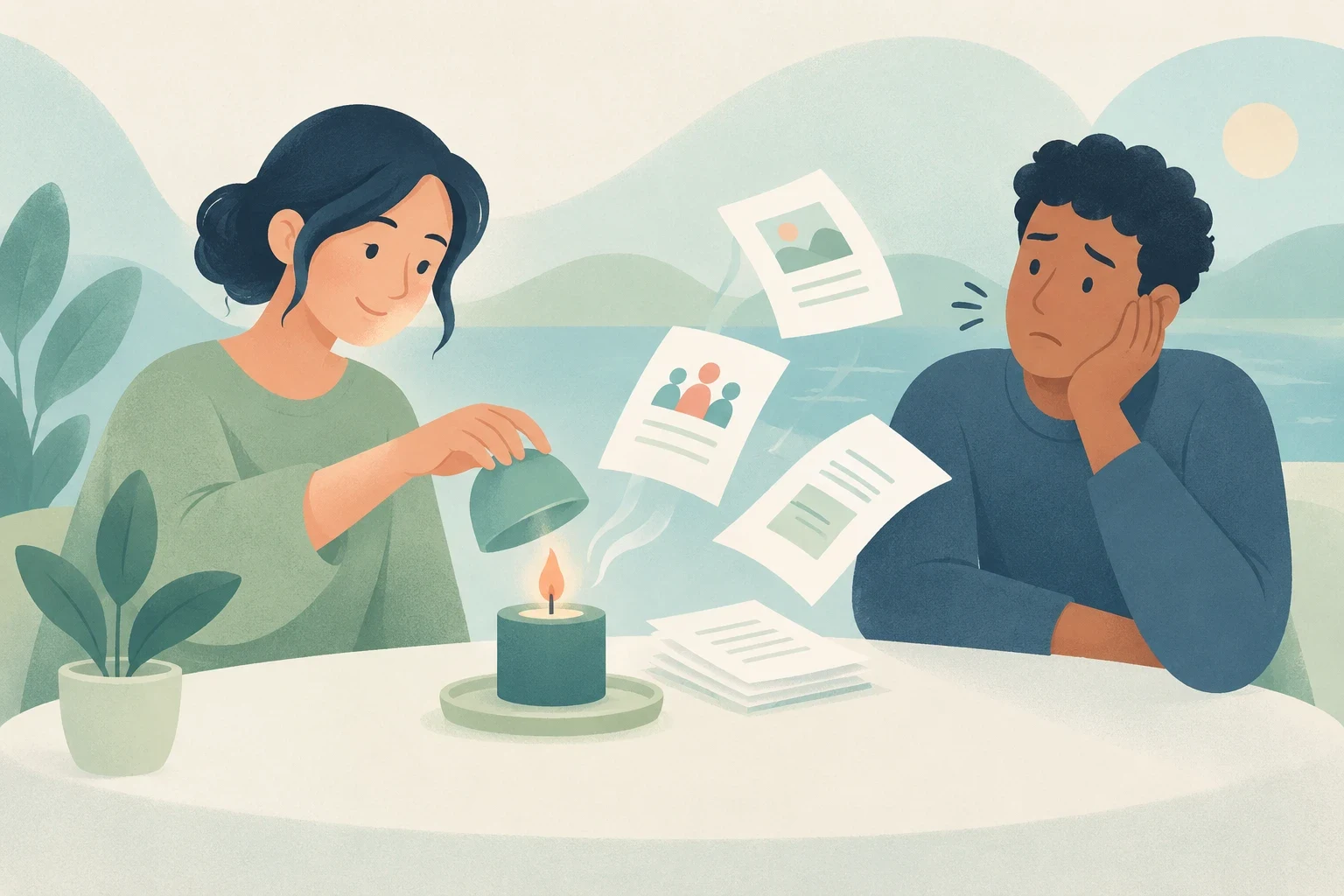

Stage 1 of 5
Understand
What it means, when to use it, and mistakes to avoid.
Examples
Please put the patio torch out before going inside.
Why it works: Here 'put out' means extinguishing a flame, and the noun object sits between 'put' and 'out'.
2 more examples
-
The transit office put out a schedule update after the storm.
'Put out' means publishing or issuing public information to travelers.
-
I can take the commuter bus so I do not put you out during rush hour.
'Put you out' means causing inconvenience or extra work for the driver, with the pronoun correctly placed in the middle.
Read the full guide
Check the object to choose the right meaning
The phrase 'put out' combines a verb with a short preposition-like particle. In grammar, the person or thing receiving the action of a verb is called the object. Because 'put out' carries several distinct definitions, looking at the object immediately reveals the intended message. When the object is a burning match, candle, or bonfire, the phrase describes stopping the fire. When the object is a notice, report, or warning, the phrase describes publishing information for others. When the object is a person, the phrase describes causing inconvenience or extra work.
-
The park ranger put out the campfire before noon.
Why it works: The object 'the campfire' points to stopping a flame.
-
The school board put out an alert regarding delayed buses.
Why it works: The object 'an alert' indicates publishing public news.
-
We can stay at a hotel so we do not put your family out.
Why it works: The object 'your family' refers to causing inconvenience.
Your turn
In the sentence 'The city council put out a water advisory yesterday', what does the phrase mean?
Answer: The council issued public guidance to residents.
Show the answer
Answer: The council issued public guidance to residents.
The object is 'a water advisory', which is an informational notice, so 'put out' means to release or publish information.
Stop a flame or turn off a device
The most concrete meaning of 'put out' is making a burning material stop burning. Native speakers use this daily for candles, matches, campfire wood, and cigarettes. The formal dictionary equivalent is 'extinguish', but plain English speakers rarely use 'extinguish' in conversation. Notice the difference between describing a cause and describing a result: someone or something puts a flame out, whereas a flame goes out when it stops burning. Goes out does not tell you what caused it to stop. For modern electrical devices such as lamps, televisions, or computer screens, prefer the phrase 'turn off' or 'switch off'. While older speakers sometimes say 'put out the light', applying 'put out' to modern electronics sounds unnatural.
-
She used a metal snuffer to put out the dining room candles.
Why it works: 'Put out' describes physically stopping an open flame.
-
The gust of autumn wind blew hard, and the lantern flame went out.
Why it works: Went out says the flame stopped burning. This sentence names a gust of wind as the cause.
-
Remember to turn off the desk lamp before leaving the office.
Why it works: 'Turn off' is the natural, modern choice for an electrical appliance.
This also comes up in Pull out and Back up.
Your turn
Which sentence describes an intentional action to stop an open flame?
Answer: He put out the match before tossing it into the bin.
Show the answer
Answer: He put out the match before tossing it into the bin.
He put out the match names the person who extinguished it. Went out describes the flame stopping; the wording alone does not tell us whether someone caused that result.
Make an announcement or notice public
When institutions, companies, or officials 'put out' something, the object is usually a message intended for public reading. Typical objects include a press release, an official statement, a bulletin, a storm warning, or a weekly community newsletter. In this context, 'put out' means to produce, publish, or distribute information so that people can review it. You may also hear creative professionals say a band 'put out a new album' or an author 'put out a book', meaning they produced and released creative work. Focus first on official notices and announcements, which are the most frequent in work and civic settings.
-
The railway company put out an apology for the canceled trains.
Why it works: The transit operator issued a public statement to travelers.
-
Local police put out a warning about icy bridges across town.
Why it works: The authority released safety information for drivers.
-
Our community garden puts out a monthly schedule of volunteer days.
Why it works: The group distributes a regular informational calendar.
Your turn
Which noun fits best as an object of 'put out' when communicating news?
Answer: an urgent safety bulletin
Show the answer
Answer: an urgent safety bulletin
A safety bulletin is a public communication document that organizations publish or release to share information.
Ask before causing someone extra trouble
When the object of 'put out' is a person, the phrase means causing that person inconvenience, schedule changes, or unwanted physical effort. It does not necessarily mean making them angry; it simply refers to disrupting their normal comfort or routine. Consider an original community event dialogue where a volunteer packs up supplies: Tom says, 'We have twenty folding chairs left over from the meeting. Could I stack them in your hallway until tomorrow morning? Would that put you out?' Maya responds, 'Not at all, Tom; my hallway is clear.' For practice with indirect social interactions and polite checking, see /micro-listenings/13-2/.
-
Would it put you out if I dropped off the tools after dinner?
Why it works: The speaker asks whether arriving later will disrupt the host's evening.
-
I do not want to put my coworker out by asking for a ride across town.
Why it works: The speaker avoids creating extra travel hassle for a colleague.
Your turn
What does a neighbor mean by asking, 'Would that put you out?'
Answer: Would that request cause you inconvenience or extra work?
Show the answer
Answer: Would that request cause you inconvenience or extra work?
'Put someone out' refers specifically to imposing extra labor or scheduling hassle, rather than physical ejection or rage.
Distinguish personal annoyance from special effort
Two fixed patterns with 'put out' look similar but describe opposite attitudes. The passive pattern 'to be put out' or 'to feel put out' means to feel offended, irritated, or sulky because someone ignored your feelings or broke etiquette. In contrast, the reflexive pattern 'to put yourself out' means to go to great personal trouble to help someone else, comparable to the idiom /idioms/to-bend-over-backwards/. When a neighbor offers to drive you to the airport at dawn, saying 'Please do not put yourself out' shows polite gratitude and tells them not to suffer excessive trouble. Tone of voice carries the warmth in that reassurance.
-
Karen was put out when her colleagues finalized the agenda without asking her.
Why it works: Karen felt mild irritation and offense at being excluded.
-
You do not need to put yourself out cooking a huge meal for us.
Why it works: The guest reassures the host not to make stressful, excessive efforts.
Your turn
Choose the sentence where a speaker reassures a helper not to take on excessive hassle:
Answer: Do not put yourself out preparing the guest room for just one night.
Show the answer
Answer: Do not put yourself out preparing the guest room for just one night.
'Put yourself out' means making a strenuous, inconvenient effort for someone else. Telling someone not to do so reassures them.
Position pronouns between the two words
Phrasal verbs like 'put out' are separable when used with direct objects. A separable phrasal verb allows noun objects to sit in two different locations: directly after the particle or between the verb and the particle. You can say 'put out the bonfire' or 'put the bonfire out'. Both are completely grammatical. However, an essential grammatical rule governs pronouns: whenever the object is a pronoun such as 'it', 'them', 'me', or 'you', it must go in the middle. Saying 'put out it' or 'would that put out you' is a grammatical error. Always use 'put it out', 'put them out', and 'put you out'.
-
The spark caught the curtain, but he quickly put it out.
Why it works: The pronoun 'it' sits strictly between 'put' and 'out'.
-
We have six wet lanterns, so please put them out carefully.
Why it works: The pronoun 'them' sits in the middle position.
-
I hope my late arrival does not put you out.
Why it works: The person pronoun 'you' sits between 'put' and 'out'.
Your turn
Which sentence shows the correct word order for a pronoun object?
Answer: The candle smoked until she put it out with water.
Show the answer
Answer: The candle smoked until she put it out with water.
Pronoun objects must sit between the verb and the particle, making 'put it out' the only correct arrangement.
Keep the verb unchanged in past sentences
The verb 'put' is irregular and retains the identical spelling and pronunciation across present, past simple, and past participle forms. The third-person present adds an 's' to form 'puts', and the continuous aspect uses 'putting' with a double 't'. However, the past form remains simply 'put'. A frequent mistake among intermediate English learners is adding an '-ed' ending to write 'putted out'. The word 'putted' belongs exclusively to golf. When constructing questions and negatives in the past simple, use the auxiliary 'did' or 'did not' alongside base form 'put', such as 'Did they put out the fire?' or 'We didn't put out a notice'.
-
Yesterday the safety officer put out a revised handbook.
Why it works: 'Put' serves as a past simple verb without any suffix.
-
Did the maintenance crew put out the warning cones before noon?
Why it works: Past questions use auxiliary 'did' followed by base verb 'put'.
-
They did not put out the barbecue until the rain started falling.
Why it works: Past negatives pair 'did not' with the base form 'put'.
Your turn
Identify the sentence that contains a verb form error:
Answer: The volunteers putted out the fire before it touched the fence.
Show the answer
Answer: The volunteers putted out the fire before it touched the fence.
'Putted' is incorrect for extinguishing or phrasal verb uses; the correct past simple form is 'put'.
Compare the core meanings side by side
To select the correct pattern rapidly, review how the meaning shifts according to the object and syntactic frame. In professional and formal prose, you can substitute higher-register words: 'extinguish' for fires, 'publish' or 'issue' for statements, and 'inconvenience' for persons. In everyday conversation, however, native speakers choose 'put out'. The following reference summary contrasts the core meanings and patterns: extinguishing a fire pairs with things that burn ('put out the fire' or 'put it out'); publishing pairs with documents ('put out a statement' or 'put it out'); inconveniencing pairs with persons ('put someone out' or 'put you out'). Notice that 'be put out' expresses feeling annoyed, while 'put yourself out' denotes undertaking personal hardship.
-
Formal: The ministry issued a circular; Everyday: The ministry put out a circular.
Why it works: 'Put out' serves as the natural everyday alternative to 'issued'.
-
Formal: I apologize for inconveniencing you; Everyday: I hope I did not put you out.
Why it works: 'Put you out' expresses the everyday counterpart to 'inconvenience'.
Your turn
Which formal verb corresponds directly to 'put out' in 'The hospital put out a bulletin'?
Answer: issued
Show the answer
Answer: issued
When applied to a document or bulletin, 'put out' corresponds in formal English to 'issued' or 'published'.
Hear connected sounds and weak pronouns
In natural spoken English, words do not stop cleanly before the next word starts. When 'put' precedes 'out', the final consonant /t/ links directly to the vowel sound /aʊ/. In American and Canadian speech, this /t/ between vowels sounds like a quick flap, similar to the middle sound in 'water'. When a short pronoun like 'it' appears in 'put it out', learners must process two links: 'put-it-out' often sounds like a single three-syllable word. The vowel in 'it' is very brief, so listeners who expect a crisp pause frequently miss the pronoun altogether and believe they heard 'put out'. Paying attention to rhythm helps identify the hidden pronoun.
-
Spoken rapidly: 'Pu-di-dout' represents 'put it out'.
Why it works: The flapped consonants link the verb, pronoun, and particle into one continuous sound flow.
-
Spoken smoothly: 'Pu-dout the blaze' represents 'put out the blaze'.
Why it works: The final consonant of 'put' carries smoothly into the opening vowel of 'out'.
Your turn
Why might an English learner miss the pronoun 'it' in the spoken phrase 'put it out'?
Answer: The short pronoun links quickly between vowels and becomes unstressed.
Show the answer
Answer: The short pronoun links quickly between vowels and becomes unstressed.
Because 'it' is unstressed and links between two consonants or vowels, its acoustic footprint is short and easily overlooked.
Select the meaning and rebuild the sentence
Strengthening your command of 'put out' requires active recall rather than passive reading. Practice by taking a clear situation cue, identifying the target meaning, and constructing a complete original sentence. When handling pronouns, check that the pronoun sits directly between 'put' and 'out'. When describing the past, confirm that you preserved the base spelling 'put'. If you are deciding whether to pair verbs with infinitives or gerunds in surrounding clauses, consult /grammar/gerunds-and-infinitives-1-stop-try-remember-need/. Testing yourself on realistic conversational scenarios will give you confidence to produce accurate phrasing without pausing to translate.
-
Cue: Camping fire safety -> Recall -> 'We used three buckets of river water to put the fire out.'
Why it works: Active sentence construction confirms meaning and correct particle placement.
-
Cue: Late car pickup -> Recall -> 'I hope coming to the train station did not put you out.'
Why it works: Practicing polite checks ensures natural placement of personal pronouns.
Your turn
Rewrite 'The campers put out the lanterns' using a pronoun for 'the lanterns':
Answer: The campers put them out.
Show the answer
Answer: The campers put them out.
'The lanterns' is plural, replaced by 'them', which must sit between 'put' and 'out' without altering the verb form.
Use it naturally
How people really use “put out”
Neutral Fine almost anywhere, at work or with friends.
Words it often goes with
- put out a fireThe firefighters worked together to put out a fire.
- put out a statementThe company will put out a statement tomorrow.
- put out a noticeThe school plans to put out a notice about the new bus route.
- put you outWould an early visit put you out?
What people also say
- “I don't want to put you out.” instead of “I don't want to cause you inconvenience.” This sounds natural when asking someone for a favor.
Questions about "Put out"
What does 'put out' mean in everyday English?
In everyday situations, 'put out' has three primary meanings depending on the object. First, it means to stop a fire, candle, or cigarette from burning. Second, it means to issue or publish public information such as an announcement or report. Third, when applied to people, it means to cause someone trouble, extra effort, or inconvenience.
The fire department put out the grass fire within twenty minutes.
The school put out a newsletter about next term's timetable.
I can take the bus if driving me would put you out.
Should I say 'put it out' or 'put out it'?
Always say 'put it out'. When the object is a pronoun such as 'it', 'them', 'him', or 'you', it must sit between 'put' and 'out'. English grammar does not allow the pronoun to follow 'out'. You can put full nouns either after the phrase or in the middle, but pronouns always belong in the middle.
The campfire was smoking, so we put it out with water.
If the candles are still burning, please put them out.
What does 'I don't want to put you out' mean?
This polite sentence means you do not want to cause extra effort, trouble, or inconvenience for the other person. People frequently use it when accepting or asking for help, rides, or shelter. It shows respect for the listener's schedule and personal comfort.
I can call a taxi because I do not want to put you out late at night.
Thank you for the bed, and please let me know if I put you out.
Does 'she was put out' mean she was angry?
It generally describes someone who feels mildly annoyed, offended, or irritated rather than furious. It implies that a remark, delay, or lack of courtesy hurt their feelings or ruffled their expectations. It describes an emotional state rather than an active request.
He was visibly put out when the meeting started without him.
Elena felt put out because nobody thanked her for organizing the lunch.
Is the past tense 'put out' or 'putted out'?
The past tense and past participle are both 'put out'. The word 'put' is an irregular verb that does not change its spelling or pronunciation in the past. The form 'putted' exists only in the sport of golf when striking a ball gently into a hole.
Yesterday the tenant put out the grease fire with baking soda.
Has the committee put out the new guidelines yet?
Can I say 'put out the light'?
Yes, you can say 'put out the light', but it sounds somewhat traditional or literary today. In modern everyday English, native speakers usually say 'turn off the light' or 'switch off the light' for electrical lamps. However, for candles, lanterns, and open flames, 'put out' remains the standard choice.
Remember to turn off the kitchen light before bed.
The guard put out the oil lamp before closing the gate.
Before you go
Remember this
Determine the meaning of 'put out' by checking whether the object is a fire, a public document, or a person. Keep pronouns in the middle position, use 'turn off' for ordinary electrical appliances, and remember that 'put' remains identical in the past simple.
Stage 2 of 5
Listen
Hear it in real sentences, from short to long, and write what you hear.
0 of 4 done
Listening 1 of 4
Listen, then type what you hear. Replay as often as you need.
0:00
- The transit office put out a schedule update after the storm.
- I can take the commuter bus so I do not put you out during rush hour.
Listening 2 of 4
Listen, then type what you hear. Replay as often as you need.
0:00
- The transit office put out a schedule update after the storm.
- I can take the commuter bus so I do not put you out during rush hour.
Try a longer clip. Listen once, then replay the part you missed.
Listening 3 of 4
Listen, then type what you hear. Replay as often as you need.
0:00
- The transit office put out a schedule update after the storm.
- I can take the commuter bus so I do not put you out during rush hour.
This clip is longer. Follow the instruction above the answer field.
Listening 4 of 4
Listen, then type the missing words. The rest of the text is already there.
0:00
- The transit office put out a schedule update after the storm.
- I can take the commuter bus so I do not put you out during rush hour.
Practice complete
You listened closely.
Your result is saved in this browser.
Keep your progress. Your practice is saved on this device only. Create a free account to keep it everywhere.
Create a free accountThat was today's free lesson. Tomorrow you get another one. Want more today? See membership.
Create a free SubLearn account to keep this progress across devices.
Save my progressStage 3 of 5
Speak
Say it with the speaker, then use it in your own answer.
Shadow
Say it along with the speaker
Play the line slowly, then speak at the same time as the speaker. Copy the rhythm, not just the words.
Your turn
Say it your way
Speak for 30 to 60 seconds from memory. Imagine you are staying at your cousin's apartment during a vacation. Describe a candle you used at dinner and how you asked to borrow a suitcase without causing extra trouble.
Use: put it out put you out
Take ten seconds to think, then answer out loud without looking at the lesson. Speak for the time shown in the task above. Nothing is sent unless you ask for feedback.
0:00
Hear how someone else might say it
Last week, I stayed at my cousin's apartment during my vacation. One evening, we had dinner with a candle on the table. Before we went out for a walk, I checked the candle and put it out. Then I asked about borrowing a suitcase because the handle on mine was broken. I said, "Could I borrow your small suitcase? I don't want to put you out." She said it was no trouble because she wasn't traveling that week. I thanked her and cooked breakfast the next morning.
Try once more and answer this: Why did you need to borrow a suitcase?
Stage 4 of 5
Write
Write your own response
AI feedback · it can make mistakes · Part of membership See membership
Check your own writing
Read one possible response
Draft saved on this device.
Use these checks to revise your message. Grammar and meaning are not automatically graded. Each task keeps its own draft in this browser tab.

You finished the free part of this lesson
- Understand
- Listen
- Speak
- Write
- CheckPart of membership
Worth another look
With a free account, the lessons you finish come back for review to help you remember them.Create a free account
Stage 5 of 5 · Part of membership
Check
New clips without hints.
Listening tests are included with membership. Try the free dictation first, then decide whether to continue.
Listening 1 of 2 Part of membership
Listening 2 of 2 Part of membership
Follow MicroEnglish
Find lesson updates, short videos and quick quizzes. Pick the app you already use.
Questions & comments
Ask about this lesson, share an example, or help another learner.
Example
Memory tip
Goes with
Related forms
Not to be confused with
In this lesson
This word isn't in our dictionary. Check the spelling, or try another form of the word.
We couldn't load this word. Try again.